Tag Archives: Pastoral Care

While You Have the Light

Jesus answered, “This voice has come for your sake, not for mine. Now is the judgment of this world; now the ruler of this world will be driven out. And I, when I am lifted up from the earth, will draw all people to myself.” He said this to indicate the kind of death he was to die. The crowd answered him, “We have heard from the law that the Messiah remains forever. How can you say that the Son of Man must be lifted up? Who is this Son of Man?” Jesus said to them, “The light is with you for a little longer. Walk while you have the light, so that the darkness may not overtake you. If you walk in the darkness, you do not know where you are going. While you have the light, believe in the light, so that you may become children of light.” After Jesus said this, he departed and hid from them.   John 12:30-36.

As a child, I always dreaded that moment in the evening when my mother turned off the light.  I was firmly convinced of monsters and the idea that they had particular sway during the night-time hours.  (Up until the age of around eight, my chosen career path was “vampire killer.”)  Years later, I decided that while there are certainly monsters in the world, we make our own evil.  Now, I’ve come full circle and have accepted that there really is something out there called evil, and that evil is a spiritual reality.

In this passage from John’s Gospel, Jesus encourages us to walk in the light “so that the darkness may not overtake you.”  Once overtaken by darkness, we struggle to see where we’re going.  We take the wrong path; we get lost.  Jesus tells us that “the light is with you for a little longer.”  Deep into this journey through Holy Week, we get the feeling that we are walking at dusk, as the light is fading.

This passage resonates with the opening of John’s Gospel, which described the life of Jesus as the light of all people.  “The true light, which enlightens everyone, was coming into the world.”  John 1:9.  If we believe in this light, we become children of God, or “children of light.”  John seems to suggest that living into our Christian life will work a fundamental change in our spiritual DNA.  As we travel through these scriptural pilgrimages during Holy Week, we should remember that Jesus calls us to become children of the light, reflecting the light of Christ into all the dark places of the world.

Jesus does not suggest that His followers will not experience the darkness.  Good Friday teaches us that’s just not the case.  Christianity does not operate as some sort of good luck charm or talisman against the darkness.  Jesus’ assures us of something quite different.  He tells us that the darkness will not “overcome” those who walk with Him.  Once again, that’s got to be good news.

God watch over thee and me,

James R. Dennis, O.P.

© 2012 James R. Dennis

Six Days Before the Passover

Six days before the Passover Jesus came to Bethany, the home of Lazarus, whom he had raised from the dead. There they gave a dinner for him. Martha served, and Lazarus was one of those at the table with him. Mary took a pound of costly perfume made of pure nard, anointed Jesus’ feet, and wiped them with her hair. The house was filled with the fragrance of the perfume. But Judas Iscariot, one of his disciples (the one who was about to betray him), said, “Why was this perfume not sold for three hundred denarii and the money given to the poor?” (He said this not because he cared about the poor, but because he was a thief; he kept the common purse and used to steal what was put into it.) Jesus said, “Leave her alone. She bought it so that she might keep it for the day of my burial. You always have the poor with you, but you do not always have me.” When the great crowd of the Jews learned that he was there, they came not only because of Jesus but also to see Lazarus, whom he had raised from the dead. So the chief priests planned to put Lazarus to death as well, since it was on account of him that many of the Jews were deserting and were believing in Jesus.  John 12:1-11.

Perhaps Mary of Bethany shows us the only authentic response to Holy Week: she responds with an extravagant love.  At a dinner for the Lord, she acted out of  lavish charity and kindness toward Jesus.  She anointed him for his death, filling the house with this remarkable and extravagant fragrance.  (Scholars report that this perfume would have cost the yearly wages of a laborer.)  I think St. John meant to remind us that following Jesus might sometimes require that we forego counting the cost of loving God.

Mary’s extravagance carries with it the sort of sensuality that would have made the other guests, and almost any good Jew, more than a little uncomfortable.  She anointed Jesus’ feet and wiped them dry with her hair.  No respectable Jewish woman would have behaved this way. Social custom would have limited this sort of affectionate behavior to a woman’s husband or perhaps her family, and even then, only in private.  Mary’s conduct  reflects a profoundly intimate relationship.

In anointing Jesus, Mary prefigures the preparation of His body for burial.  But although  Jesus awaited His death with his friends, the presence of Mary’s brother (Lazarus) reveals that death holds no finality here. Mary anoints Jesus for his burial while he is still living.  Lazarus, who was dead, has joined them for dinner.  We encounter here the intersection of death and life, woven together in a story of reckless mercy, in the context of having a meal together.  St. John teaches us that death will have its say, but not the last word.

John juxtaposes Mary’s remarkable fidelity with Judas’ treason.  Similarly, he contrasts the beauty of the perfume’s scent and this deeply affectionate moment with the ugly brutality of the impending crucifixion in which hatred seems to win the day.  St. John tells us these events took place six days before the Passover.  The timetable echoes with the days of creation, and through his Passion Jesus makes “all things new again”.  Jesus renews all creation through the his death on the Cross, a death by which love conquers fear, hatred and death itself.

Pax Christi,

James R. Dennis, O.P.

 © 2012 James R. Dennis

Rabbi, Teach Us How to Pray

The Master of peace and unity would not have each of us pray singly and severally, since when we pray we are not to pray only for ourselves.  For we neither say: “My Father, who art in heaven” nor “Give me this day my bread”; nor does each of one of individually pray for our own debt to be forgiven, nor do we ask that we alone should not be led into temptation, nor that we only should be delivered from evil.

Our prayer is general and for all; and when we pray, we pray not for one person but for us all, because we are all one.  God, the Master of peace and concord, so willed that one should pray for all, even as he himself bore us all.  St. Cyprian, Treatise on the Lord’s Prayer.

I found this commentary on the Lord’s Prayer in a wonderful book, Readings for the Daily Office from the Early Church.  St. Cyprian lived in the third century in and around Carthage, in northern Africa.  He lived during a time of great trials for the Church, a time of plague, famine, schism and persecution.  He died for the faith in 258 A.D.

I recently wrote about the nature of evil, which always works to separate us: from God, from our brothers and sisters and from our true selves.  Unlike sin, which separates, prayer works to unify.  Cyprian rightly reminds us that God has woven our lives together.  Jesus called upon us to recognize that bond in the Lord’s Prayer.  If we take a look at the very first two words of the prayer (“Our Father”) we recognize our common origin.  We aren’t like a family; we are a family.

When I was a boy at Burnet Elementary School, one of my classmates accosted me on the playground and asked me if I had accepted Jesus Christ as my personal savior.  This question took place in a fairly big crowd of kids, and that event may be my first memory of genuine peer pressure.  I answered, “Well, yes, and no….I think He came to save the whole world.”

I’m not sure how well I understood the theology behind what I said.  (I’m pretty sure it was not a popular answer.)  On the other hand, I think this statement recognized an important concept:  I cannot really separate God’s love for me from my love for His children.  The Lord’s Prayer, and St. Cyprian, call us into that recognition.  I cannot pray for my daily bread alone; my brother’s bread must be just as important.

This notion underlies a good deal of Christian theology.  All were made in the image of God.  The forgiveness of us all must be my concern and my prayer.  One of my favorite writers on prayer, Rabbi Heschel, noted:  “The purpose of prayer is not the same as the purpose of speech.  The purpose of speech is to inform; the purpose of prayer is to partake.”

When we pray the Lord’s Prayer, we partake in the hopes and the troubles and the gratitude of our brothers and sisters.  We also share in God’s hopes and concerns for all His children.  We thus knit our lives together with God’s dreams for the kingdom: the kingdom which has not yet come and the kingdom which is already here and present.  During this holy season, let’s pray for each other and for God’s presence to fall down upon all our lives like a steady rain.

God watch over thee and me,

James R. Dennis, O.P.

© 2012 James R. Dennis

Be Merciful to Me, a Sinner

He also told this parable to some who trusted in themselves that they were righteous and regarded others with contempt: ‘Two men went up to the temple to pray, one a Pharisee and the other a tax-collector. The Pharisee, standing by himself, was praying thus, “God, I thank you that I am not like other people: thieves, rogues, adulterers, or even like this tax-collector. I fast twice a week; I give a tenth of all my income.” But the tax-collector, standing far off, would not even look up to heaven, but was beating his breast and saying, “God, be merciful to me, a sinner!” I tell you, this man went down to his home justified rather than the other; for all who exalt themselves will be humbled, but all who humble themselves will be exalted.’ Luke 18:  9-14.

Sometime today, a priest will mark my forehead with ashes and remind me that I came from the dust, and that I’ll return there.  Those ashes mark the beginning of the Holy Season of Lent.  I hope to use this time to reflect on the complex nature of sin, the Lenten practices which might heal us, and the holy custom of reconciliation  with God.

If we view Lent as simply an occaision on which we give up something we enjoy (sweets, red wine, or our double mocha macchiato), I think we have barely scratched the surface.  Lent serves as a time for putting down our arms and making peace with the God who calls us back to Him.  During this season, we drink the bitter medicine that will hopefully heal our wounds and lead us closer to the Lord of Heaven.

In today’s Gospel reading, we find two men praying in the temple: a Pharisee and a tax collector (who you’ll sometimes see called a publican).  In first century Palestine, good Jews despised the tax collectors or at least saw them as deeply flawed and unclean.  In the first place, tax collectors collaborated with the pagan Roman empire occupying their holy homeland.  Further, most of them could not survive on their income as collectors, and had to cheat people in order to make their living.

On the other hand, the Pharisees were devout, prayerful men who tried to live according to the law of Moses.  The Pharisee in this parable has even gone beyond the Mosaic law, fasting twice a week rather than once. His prayer, however, reveals that he has become mired in the spiritual quicksand of self-admiration.  He believes he can rely on his own righteous behavior to justify himself before God.

Jesus contrasts this sense of spiritual self-sufficiency with the humility of the tax collector, who knows that he is a sinner and asks for God’s mercy.  He can rely on nothing other than God’s grace.  In one of Jesus’ classic inversions, the tax collector is sanctified.  The Pharisee has fastidiously done all the right things (fasting and tithing), but has somehow missed the point.  Like many of us, the Pharisee believes he has actually done God a favor by being so moral.  The tax collector approaches God with a contrite heart, knowing that he’s let God down once again.

This parable offers us the first step in that process:  rigorous self-examination and coming to terms with our failures.  We need to resist our instinctive compulsion to see and present ourselves as righteous (or perhaps guilty of only minor infractions) while we view others as the real sinners, or perhaps see others as the real source of our sin.  As we take a hard look at our lives, some of what we see may make us wince; some of it may make us want to turn away.  That’s the very stuff we need to work on, because those are the weak spots where our separation from the Holy begins.

Often, when we look at what we’ve done and what we’ve failed to do, we may consider our situation rather hopeless.  Our sins constantly separate us from God, and despite our good efforts, we cannot avoid them.  Like the Pharisee, we’re lost in self-deception, self-aggrandisement and our myopic respect for our virtues.  I don’t think the Pharisee was a particularly evil man; rather, his pride blinded him to his own situation.  His self-absorption prevented any real self-understanding.

We pray a fairly desperate prayer in my church: “We have no power within ourselves to help ourselves.”  Our only refuge looks like the most dangerous place for us, standing naked before God who sees all, and who somehow finds a way in impossible situations.  This all begins with a good, hard look at our lives, the things we’ve done, and the ways we’ve distanced ourselves from God.  Jesus thought so, anyway.

I wish you a good and holy Lent,

James R. Dennis

© 2012 James R. Dennis

The Good Shepherd

“I am the good shepherd. The good shepherd lays down his life for the sheep.   The hired hand, who is not the shepherd and does not own the sheep, sees the wolf coming and leaves the sheep and runs away-and the wolf snatches them and scatters them.  The hired hand runs away because a hired hand does not care for the sheep.  I am the good shepherd. I know my own and my own know me,  just as the Father knows me and I know the Father.  And I lay down my life for the sheep.  I have other sheep that do not belong to this fold. I must bring them also, and they will listen to my voice. So there will be one flock, one shepherd.  For this reason the Father loves me, because I lay down my life in order to take it up again.  No one takes  it from me, but I lay it down of my own accord. I have power to lay it down, and I have power to take it up again. I have received this command from my Father.”  John 10:11-18.

This reading from John’s Gospel offers a rich passage, and those who know it well may have lost some appreciation for its texture.  First, when Jesus says “I am the good shepherd”, He presents us with one of the seven “I Am” statements.  These include “I am”: the bread of life;  the light of the world; the gate or door; the good shepherd; the resurrection and the life; the way, the truth and the life; and the vine.  Each of these statements resonates with God’s self description found in Exodus 3:14 (“I Am Who Am”).  In other words, John offers us a clear claim of the divinity of Jesus through these statements.

Jesus’ description of himself as a good shepherd also resonates with God’s announcement in the Old Testament:  “For thus says the Lord God: I myself will search for my sheep, and will seek them out.  As shepherds seek out their flocks when they are among their scattered sheep, so I will seek out my sheep.”  Ezek.  34: 11-12.    From his deathbed, Jacob declared that God had been the shepherd “all of my life to this day.”  Gen 48:24.  Jesus’ description of himself further calls to mind the 23rd Psalm.  Thus, Jesus locates himself firmly within the Davidic line:  a shepherd king.

We also need to grasp just how startling Jesus’ understanding of himself as a “good shepherd” would have been to a first century audience.  At that time, shepherds would have been considered am ha’aretz (people of the land or people of the dirt).  Shepherds were considered dirty, coarse, boorish, and uncivilized.  Rabbinic Judaism looked down on shepherds, who did not regularly keep the commandments.  Because of their work, they may not have even kept the Sabbath.

The shepherds of first century Palestine were also a rough lot, solitary men of tremendous courage.  They had to protect the flock from lions, bears, wolves and other predators.  Rather than the gentle, pastoral image we may have inherited from the Romantic poets, shepherds were fierce fighters who were prepared for dangerous combat when necessary to protect their sheep.  For example, David learned about battle by protecting his father’s sheep from predators.  1 Sam. 17:33-37.

So, there’s something in Jesus’ description of himself as “the good shepherd” that subverts our understanding and upends our expectations.  Jesus also contrasts himself with “the hired hands” who run away in the face of a wolf.  He thus begins to teach about his commitment to us, a commitment that disregards his own safety, that disregards his own life.  This commitment, this covenant, finds its root in love, and in the Father’s love for Jesus and in Jesus’ love for the Father.  Jesus teaches not only about the nature of His love for the disciples, but also about his love for every one of us.   In essence, Jesus tells us:  “I will not abandon you.”

Jesus then tells us that his sheep will listen to his voice.  I wonder how well we do that today.  Setting aside the question of listening, do we even recognize Jesus’ voice when he calls?  Christ then offers a remarkable insight that speaks to our fractured Church today.  He speaks of unity:  “So there will be one flock, one shepherd.”  When we encounter discord, schism, and fracture in the world, we can rest assured that at least one party (and perhaps all) are not listening to Jesus.

I believe this remarkable passage ultimately centers upon the overarching Christian commandment:  love God and love each other.  As Desmond Tutu once observed, “Nothing is too much trouble for love.”  Love binds the sheep to the shepherd, and binds the shepherd to his flock.  We understand the risks inherent in the practice of love, risks that will ultimately lead to Golgotha.  Despite these risks, in the final analysis, the Gospel teaches us that nothing else really matters.

God watch over thee and me,

James R. Dennis, O.P.

© 2012 James R. Dennis

If You Choose, You Can Make Me Clean

A leper came to Jesus begging him, and kneeling he said to him, “If you choose, you can make me clean.” Moved with pity, Jesus stretched out his hand and touched him, and said to him, “I do choose. Be made clean!” Immediately the leprosy left him, and he was made clean. After sternly warning him he sent him away at once, saying to him, “See that you say nothing to anyone; but go, show yourself to the priest, and offer for your cleansing what Moses commanded, as a testimony to them.” But he went out and began to proclaim it freely, and to spread the word, so that Jesus could no longer go into a town openly, but stayed out in the country; and people came to him from every quarter.  Mark 1:40-45.

At some point in our lives, most of us have experienced the pain, shame and loneliness of being an outsider.  In today’s Gospel reading, we find a man who knew that isolation intimately.  At that time, leprosy and most skin diseases were treated as a kind of plague.  Because of his illness, the community shunned him, and the Mosaic law justified and condoned their fears.  He had no right to approach Jesus, and Jesus had no business having anything to do with him, let alone touching him.

This man lived the life of walking ghost, or perhaps more accurately, a walking corpse. As a leper, this “unclean” man could not enter the Temple; he could not even enter any community other a community of other lepers.  Jesus enters into this ostracism by touching him and sharing in his uncleanness.

This man’s statement (“If you choose, you can make me clean”) carries a number of messages within it.  First, we can hear the pain in the voice of a man who simply doesn’t have the power to help himself.  We also hear a remarkable affirmation of faith in Jesus’ healing power.  And perhaps we also hear just a hint of a challenge to Jesus’ willingness to reach out to this man.

Jesus then tells the man something that God’s been trying to convey throughout the Old Testament:  I choose to heal you.  The text thus illustrates an important idea of divine freedom, reaching out to restore God’s creation.  As He did with Sarah and Abraham, as He did in the Exodus, and as he did on the Cross, God instinctively exercises His freedom to redeem our broken lives.  I think Jesus is telling us:  “This is what the kingdom looks like.”

Mark describes Jesus as “moved with pity”.  The phrase suggests a very deep emotional response, the sort of reaction that you feel deep within your gut.  It has also sometimes been translated as “moved with anger”.  I suspect that Jesus felt a certain anger at all those things which separate men from God, and perhaps at the lack of depth or vision in the priestly interpretation of the holiness code.  Perhaps Jesus was angry  with the very notion, embedded into this man by a life as a lonely outcast, that God would choose anything other than to heal him.

Regardless of whether Jesus was moved with pity or anger, we shouldn’t miss the important point:  His immediate response to this emotion was to reach out, to redeem and to restore.

Jesus then gives this man a strict warning not to tell anyone, but to simply present himself at the temple.  This instruction falls into what theologians call the “Messianic secret.”  In this passage and many others, Jesus often instructs those He heals (and even the demons he casts out) to keep quiet about what they’ve seen.  We get the impression that until the Resurrection (which would clearly reveal the meaning of Christ’s life) Jesus tried to avoid an incomplete understanding of his ministry.

Despite Jesus’ warning, the man begins to proclaim the news about Jesus.  This leads to a curious and ironic reversal.  While the man was originally kept from society, Jesus now finds himself an outsider because of his fame and the press of the crowds.  Cleansed of his disease, the man can now rejoin his town and family.  Having restored this man to his health and freedom,  Jesus could no longer travel freely and had to remain “out in the country” .  Jesus therefore becomes an outsider himself, no longer able to go to the towns and villages.  Even Jesus finds himself marginalized, and thus those who follow him should not be surprised when it happens to us, too.

In one sense, this passage is about risk.  Jesus took a tremendous risk in healing this man, risking contamination.  Jesus also took a risk in asking for this man’s assurance of secrecy, risking his own isolation.  By subjecting Himself to human history and sin, Jesus risked our judgment and condemnation.  In fact, the Gospels point to the final risk of the Incarnation, the Cross.

I think today’s Gospel reading teaches us another important lesson.  Mark illustrates one of the core tenets of the Christian faith:  ours is religion for the last kids picked for dodge ball, the kids no one wants to dance with, and those who always get their hearts broken.  We shouldn’t read this as a story about something that happened once, a long time ago; Jesus still choses to make us clean, to restore us and heal us.  Following Jesus is all about second chances.  It was for this man in today’s Gospel.  And it is for you and me, too.

Shabbat shalom,

James R. Dennis

© 2012 James R. Dennis

What Jesus Came to Do

Jesus left the synagogue at Capernaum, and entered the house of Simon and Andrew, with James and John. Now Simon’s mother-in-law was in bed with a fever, and they told him about her at once. He came and took her by the hand and lifted her up. Then the fever left her, and she began to serve them.

That evening, at sundown, they brought to him all who were sick or possessed with demons. And the whole city was gathered around the door. And he cured many who were sick with various diseases, and cast out many demons; and he would not permit the demons to speak, because they knew him.

In the morning, while it was still very dark, he got up and went out to a deserted place, and there he prayed.  And Simon and his companions hunted for him. When they found him, they said to him, “Everyone is searching for you.” He answered, “Let us go on to the neighboring towns, so that I may proclaim the message there also; for that is what I came out to do.” And he went throughout Galilee, proclaiming the message in their synagogues and casting out demons.  Mark 1:29-39.

In the Lectionary reading today, Jesus leaves the synagogue at Capernaum and travels to the home of Peter’s mother-in-law.  She has taken to her bed with a fever, which often presented a life-threatening condition in those days.  Jesus takes her by the hand and lifts her up.  That phrase, “lifted her up” resonates with meaning, calling to mind Jesus being lifted up on the cross and lifted up from the grave.  Jesus restores her to health, and restores her to her community.

We see a pattern begin to emerge in Jesus’ ministry.  The holiness and purity laws of the day would have required that one separate oneself from those who were ill, especially those who were spiritually diseased or who suffered from a moral infection.  Rather than shunning them, Jesus rushed to them.  At the time, this offered a new teaching, something really extraordinary.

That evening, word of Jesus’ healing ministry begins to spread and the house is surrounded by those who need Jesus’ healing touch.  Having had some involvement in the work of pastoral care, this passage from the Gospel rings remarkably true.  Pastoral care is the church’s growth industry in a world that groans in pain and cries out for God’s presence.

Jesus then engages in a practice we’ve seen before, and we’ll see again and again.  Having preached, having healed, he retreats “to a deserted place” and prayed.  Jesus knew what we so often ignore:  even the work of ministry can become empty and debilitating unless we allow the Father to refresh and renew us in prayer. Or perhaps Jesus knew what many of us so often forget: when we’ve come into direct contact with the overwhelming power of God to touch people’s lives, sometimes a bit of silent reflection offers the best and perhaps the only authentic response.

Peter and the disciples then encourage Jesus to return to Capernaum, where everyone is looking for him.  The disciples make the same mistake many of us do when we’ve encountered God doing something wonderful.  They suggest, “Do it again!”    As C.S. Lewis noted,  we are swimming upstream spiritually when we tell God “Encore!”  In Letters to Malcolm, Lewis observed : “It is no good angling for the rich moments. God sometimes seems to speak to us most intimately when he catches us, as it were, off our guard.”  Our fixation with that last event, that former experience, or that past feeling may well divert our attention from the new wonders God is already working.

Jesus tells the disciples that they need to go into “the neighboring towns”, which would have meant leaving the city of Capernaum and going into the countryside.  Here, we again see Jesus engage in a practice that will form a routine for Him:  (1) engage in ministry (proclaiming the Good News and healing the brokenhearted); (2) retreat and refresh in prayer; (3) expand the ministry to another place and people; and (4) repeat.  Those who follow Christ should seriously consider the wisdom of this regime.  It’s what we came here to do, too.

I wish you a good and holy Sabbath,

James R. Dennis, O.P.

© 2012 James R. Dennis

The Pool of Siloam

As he walked along, he saw a man blind from birth. His disciples asked him, “Rabbi, who sinned, this man or his parents, that he was born blind?” Jesus answered, “Neither this man nor his parents sinned; he was born blind so that God’s works might be revealed in him. We must work the works of him who sent me while it is day; night is coming when no one can work. As long as I am in the world, I am the light of the world.” When he had said this, he spat on the ground and made mud with the saliva and spread the mud on the man’s eyes, saying to him, “Go, wash in the pool of Siloam” (which means Sent). Then he went and washed and came back able to see.

Jesus heard that they [the Pharisees] had driven him out, and when he found him, he said, “Do you believe in the Son of Man?” He answered, “And who is he, sir? Tell me, so that I may believe in him.” Jesus said to him, “You have seen him, and the one speaking with you is he.” He said, “Lord, I believe.”  John 9:1-7; 35-38.

I regularly travel with some friends to a camp in the Sangre de Christo mountains of New Mexico.  There, away from the lights of the city, when the sun sets in the forest, I’m always struck by just how dark it can get.  That kind of darkness impresses us with fear, with vulnerability and with isolation.  I suspect that’s exactly the sort of life the man born blind led until his encounter with Jesus.

In the Daily Office today, we find the story of Jesus and that man, set out in the ninth chapter of John’s Gospel.  It’s a powerful story, powerful enough to have inspired the former slave-trader John Newton to pen one of our favorite hymns, Amazing Grace.  (“I was blind, but now I see.”)  This story also illustrates two of the attributes of Jesus’ name described by Bernard of Clairvaux in my last post:  Jesus is light and Jesus is healing.

Back then, the Jewish people associated blindness and most any sort of physical infirmity with sin.  The disciples echo this assumption, asking whether this blindness resulted from this man’s sin or the sins of his parents.  That assumption, expressly rejected by Jesus, lingers on with us today.  From illness to  natural disaster, people and their “religious” leaders try to assign the fault for these events to some past moral failure.  Jesus refuses to take part in that speculation. 

Blindness and many other physical infirmities would exclude one from the Temple, from the place where good devout Jews could encounter God.  In almost every icon depicting the story, therefore, we see the Temple in the background.  The man born blind, therefore, becomes a sort of icon for those who the religious structure of that time excluded.  And into the darkness that enveloped this man, Jesus enters and describes himself as the “light of the world.”

Jesus spits on the ground and makes mud which he spreads on the man’s eyes.  It’s an interesting and curious approach to this man’s predicament, but I think part of the key to understanding this story lies just a couple of sentences earlier.  Rather than explaining to the disciples the real cause of this man’s blindness, Jesus tells them:  “We must work the works of him who sent me….” Having been sent by God, Jesus must engage in God’s work.  Jesus didn’t need a poultice to cure this man’s blindness, but I think he intentionally invoked the image of God’s creation of Adam.  Just as God created Adam from the clay (mud) of the earth, Jesus will re-create this blind man’s life.

Jesus then instructs the man to wash himself in the pool of Siloam.  (Notice that this is the work for which God “sent” Jesus into the world, and the very name of the pool means “sent”.)  The Jewish people used that pool as a place for ritual purification, necessary for entry into the Temple.  The man born blind is thus “baptized” back into the community of those eligible to encounter God in that Holy Place and his sight returns.   The pool, intended as a place for purification, has become a place for healing and reconciliation.

Now, all this transpires on the Sabbath, and provides the Pharisees with one more instance of Jesus’ disregard for the religious traditions (and authorities) of the day.  The Pharisees convince themselves that Jesus is a great sinner, just like the man born blind, whom they expel. John thus makes clear that they remain in the darkness, spiritually blind.

When Jesus encounters the man born blind later, the man confesses his faith in Jesus as the Messiah, the Son of Man.  There are few moments in Scripture more poignant than his final acknowledgement:  “Lord, I believe.” 

I’m wondering, who is unwelcome today and who have we excluded because their “sin” disqualifies them?  Like the Pharisees, have we fallen in love with doing “churchy things” rather than falling in love with God and his children? Are we instruments of reconciliation in the world, or do we place obstacles in the path of those who want and need God’s help?  And perhaps more importantly, I wonder where are the dark places in the world and in our lives not yet illuminated by the light of Christ?

Pax Christi,

James R. Dennis, O.P.

 © 2012 James R. Dennis


Looking For the Kingdom

Then the king will say to those at his right hand, ‘Come, you that are blessed by my Father, inherit the kingdom prepared for you from the foundation of the world; for I was hungry and you gave me food, I was thirsty and you gave me something to drink, I was a stranger and you welcomed me, I was naked and you gave me clothing, I was sick and you took care of me, I was in prison and you visited me.’  Then the righteous will answer him, ‘Lord, when was it that we saw you hungry and gave you food, or thirsty and gave you something to drink?  And when was it that we saw you a stranger and welcomed you, or naked and gave you clothing?  And when was it that we saw you sick or in prison and visited you?’  And the king will answer them, ‘Truly I tell you, just as you did it to one of the least of these who are members of my family, you did it to me.’  Then he will say to those at his left hand, ‘You that are accursed, depart from me into the eternal fire prepared for the devil and his angels;for I was hungry and you gave me no food, I was thirsty and you gave me nothing to drink, I was a stranger and you did not welcome me, naked and you did not give me clothing, sick and in prison and you did not visit me.’ Then they also will answer, ‘Lord, when was it that we saw you hungry or thirsty or a stranger or naked or sick or in prison, and did not take care of you?’  Then he will answer them, ‘Truly I tell you, just as you did not do it to one of the least of these, you did not do it to me.’  Matt. 25: 34-46.

By now, we Christians should be accustomed to the notion of an invisible reality.  We believe in an unseen God at work in the world, that simple bread and wine are transformed every week into the body and blood of Jesus, and that the Church operates as the mystical body of Christ today.  So, the reading from today’s Lectionary shouldn’t surprise us:  Christ tells us that somehow our works of charity reveal and reflect His presence in the world.

Charity doesn’t mean simply rich people writing checks to poor people, and it’s quite different from what we think of as philanthropy.  It’s Latin root is caritas, meaning loving-kindness.  In Greek the word is agape, and in Hebrew, the word is chesed.  The ancient Christian virtue of charity both glorifies and reflect’s God’s love.  In no small measure, charity is less about what we do and more about who we are.

Let’s return to the notion of this invisible reality about which Jesus is teaching us.  He tells us that our charity (our ability to love our ability to see his love and be his love) to those on the margins of society actually reveals our love for Him.  This is the tricky part:  “Just as you did it to one of the least of these who are members of my family, you did it to me.”  Jesus tells us that through the mystery of the  incarnation, every one of us can still encounter the Living Christ.  Our compassion for the hungry, the stranger,  the sick and the prisoners will allow us to find Jesus.  If we take Scripture seriously, we are all compelled to accept this mystical reality.

This entire discussion takes place within the context of Jesus telling us that our ability to love without flinching provides the standard by which the sheep and the goats will be separated.  Our salvation depends on our charity.  Jesus offers all this as an explanation of what the Kingdom is like. 

I don’t think Jesus is simply talking about heaven, or about some distant time when we’ll find out what it’s like to see the face of God.  Remember, Jesus also told us, “the kingdom of God is among you now.”  Luke 17:21. 

I know:  the world today doesn’t look much like the Kingdom.  That sick lady in the hospital, that homeless smelly old man, and that tattooed gang member in the County Jail:  they just don’t seem to have much in common with the Son of God.  But I believe in the invisible reality that Jesus told us we couldn’t yet see.  And I believe that our charity will  form our souls and will reveal the kingdom among us.

Shabbat Shalom,

James R. Dennis, O.P.

© 2011 James R. Dennis

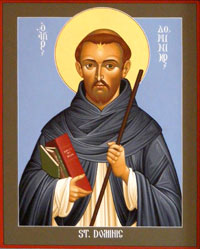
Why I Am a Dominican

Blessed Lord, who caused all holy Scriptures to be written for our learning: Grant us so to hear them, read, mark, learn, and inwardly digest them, that we may embrace and ever hold fast the blessed hope of everlasting life, which you have given us in our Savior Jesus Christ; who lives and reigns with you and the Holy Spirit, one God, for ever and ever. Amen.

As novices in the Dominican Order, we regularly engage in study and reflection together.  On a weekly basis, we will take a passage or a concept and each write an essay.  Each of us will then comment on each other’s work, so that our study becomes part of the bond of our community.  This past week, our topic required us to reflect on our experience of worship.  Mary, one of my Dominican sisters,  wrote the following piece:

Well the week of worship started a little differently.

Last week I was driving my son to the doctor and we passed the sign leading to one of our prominent suburban parishes currently in a rector search. My son said, “Mom – don’t you really wish you could be preaching THERE on Sundays instead of at Saint Otherwise?” Translated from his tone of voice and prior verbalizations – instead of at your hopelessly small, hopelessly underfinanced, hopelessly eccentric and, generally hopeless little congregation. To my surprise I said “yes. I really would.” And then rattled on a bit about frustration and other human emotions. I hate to confess having said this or felt this. I have a very faithful (to the Lord) and loyal (to the church and if truth be known, to its not always so humble rector) congregation. Which is or at least so far has been, persistently small, persistently underfinanced, as eccentric a collection as one would find in any given Episcopal parish, albeit without a lot of average types to absorb the eccentricity. After almost eight years of what sometimes feels like slogging [as our neuralgic deacon likes to point out] (in the most neuralgic ways possible, without ever demonstrating the desire to do anything other than get dressed up on Sundays and chant things) no visually apparent results, I hate to confess that it is harder than I would like it to be to stay with it. And of late I have more often than I would like to confess to you all had a harder time than I should in putting in the prayer, the time, the study, the listening, and all the things that go into the relationship of priest and parish, and preacher and assembly. And I wonder if there will ever be an answer to what seems to be the most lingering congregational question, asked every Sunday possibly since the parish was founded 126.3 years ago: does anyone remember which can has the decaf in it?
Yet when I come on Sunday morning, wondering as I always do whether there will actually be a minyan’s worth of people in the pews, and feeling alone and somehow unblessed in my priestly ministry, getting over the weekly “what do you mean you’re not coming to church and can I ever get out of here on Sunday morning without an argument” conversation at home, we begin the celebration of the Eucharist, with whoever is there, there and whoever is not somehow brought present perceptibly by those who are (I don’t know how they do it but they do – could it be, well love?), and somehow a change begins. Not in them but in me. I look at them and listen to them, and I get up to preach the word with the gospel open behind me. I walk into their midst and they change me. And I don’t remember anything about the suburban church or the congregation replete with potential foursomes for golf and loads of well-groomed acolytes and articulate lectors. And the sermon I didn’t think I had, has me instead, and the words start to remold themselves from what I imagined and hacked away at into living connections to lives and I am somehow between the gospels and those lives as the connections are knit. And I wash my hands among the innocent and begin the Eucharistic prayer. And I look up and down the center aisle through the glass windows of the doors someone came and put in because they knew the old ones needed replacing. And I see a world from which they have gathered. And I look down and the way the sun plays with the reflections of things around the foot of my chalice I see myself, and I see them and I see the high altar cross, all reflecting from the cup from which our Lord asked us to drink together. and I am where I should be, with them, in their dyings and risings and dying again. And I am graced. And I am humbled. And I am home. And another week will turn. Ethel has died at 92 and her son didn’t want a service. and Sophia will have her tenth birthday prayer. Nicholas will insist he is not a saint, and his mother will agree with him. Carolyn will tell us about the family for which we prayed for a year while their six-year-old son died of cancer giving birth to twins. The senior warden will ask if we can have a secret location for the vestry meeting so that the deacon doesn’t come. I will try to think of a canonical way this could happen. Joyce will go back to her husband and son for another six months of abuse in a remote part of Florida and she will weep as I pray a blessing for her and tell her to come back safe in April. George will have laughed at the jokes in my sermon. Mary Kay and Mike will be at home because Mike is sick from the fourth to the last radiation treatment on his spine. When I say “take them in remembrance that Christ died for you” Trish and I will catch each other’s eyes and she will know we are with her when she goes to painful divorce proceedings on Tuesday. The Organ will have ciphered, even though the repair guy said there was nothing wrong. Christ is among us, and hopeless is not a word that can be thought or spoken. That is my Sunday last. And if God is gracious, my Sunday next as well I think.
And I have tried to keep you all, as I do each Sunday, in the midst of its consecratory power.
Peace to all

I am both humbled and proud to call Mary my sister. When I read her piece, I found myself simply struck speechless.  And then I realized that I am too rarely speechless.    And that is why I am a Dominican.
Shabbat Shalom,
James R. Dennis, O.P.

© 2011 James R. Dennis