Tag Archives: Dominican

Advent (Learning to Wait)

O that you would tear open the heavens and come down,
        so that the mountains would quake at your presence–
as when fire kindles brushwood
        and the fire causes water to boil–
to make your name known to your adversaries,
        so that the nations might tremble at your presence!
When you did awesome deeds that we did not expect,
you came down, the mountains quaked at your presence.
Is. 64: 1-3.

In our world today, most of us have concluded that the problem with instant gratification is….it takes too long.  We aren’t accustomed to waiting:  for the economy to recover, for our children to figure out how to behave, for a new car, or for God to fix things.  The Psalm for today reflects exactly that kind of impatience.  The reading perfectly explores our Advent expectations, as we ask God, “Where, exactly, have you been?  Have you even noticed what’s going on down here?”

Many of the Advent readings address exactly this deep longing within the Jewish people, as they waited for someone to lead them out of slavery in Egypt, as they bore the shame of the Exile, and as they waited for God to redeem this world that just wasn’t working.  They had waited for thousands and thousands of years and they knew that something had to change.

The season of Advent centers on precisely this deep, overwhelming conviction that something must change, and only God can make a difference in this situation. This notion leads us to the second Advent impulse:  our need to prepare ourselves for this coming change.  Thus, we sometimes refer to Advent as “the little Lent.”

We listen to John the Baptist calling us to “make straight the path of the Lord.”  John warns us that we aren’t ready for God’s arrival into our lives, that we cannot begin to understand the radical difference Jesus will make in the world.  The Baptist cautioned the first century Palestinians that only repentance would prepare them for the cataclysmic difference that Jesus would make.  Only that repentance would prepare them for the truth of Christ.  He is still warning us of that today.

Rowan Williams once said, “During Advent, we try to get ourselves a bit more  used to the truth – the truth about ourselves, which is not always very  encouraging, but the truth about God above all which is always  encouraging. The One who comes will come with a great challenge. It will  be like fire on the earth as the Bible says. And yet the One who comes  is coming in love. He’s coming to set us free. And that’s something well  worth waiting for.”

I wish you a very holy season of Advent.  Shabbat shalom,

James R. Dennis, O.P.

© 2011 James R. Dennis

Giving Thanks

Then Jesus took the loaves, and when he had given thanks, he distributed them to those who were seated; so also the fish, as much as they wanted.  John 6: 11.

I love the Thanks-giving holiday for a lot of reasons.  First, I think few things are more important for our spiritual lives than learning to approach God and His world with gratitude.  I have known several people in my life who just had that aura of holiness about them, and without exception they all had the gift of gratitude.  Secondly, I think we find ourselves very near to the Sacred when we join with friends and family and collectively recall our gifts.  Finally, as we stand on the cusp of the season of Advent and prepare to celebrate the gift of the Incarnation, giving thanks just feels like the right thing to do.

I ran across this Orthodox prayer the other day, and it struck me as ideal for giving thanks for all our gifts:

“Glory to You who have called me forth into life;
Glory to You who have revealed the beauty of the universe to me;
Glory to You who have opened  both heaven and earth to me as an eternal book of wisdom;
Glory to Your eternity in the midst of this temporal world;
Glory to You for Your mercies known and unknown;
Glory to You for every sigh of my sorrow;
Glory to You for every step in my life, and for every moment of joy;
Glory to You, O God, unto the ages!”

God give us all grateful hearts,

James R. Dennis, O.P.

© 2011 James R. Dennis

Looking For the Kingdom

Then the king will say to those at his right hand, ‘Come, you that are blessed by my Father, inherit the kingdom prepared for you from the foundation of the world; for I was hungry and you gave me food, I was thirsty and you gave me something to drink, I was a stranger and you welcomed me, I was naked and you gave me clothing, I was sick and you took care of me, I was in prison and you visited me.’  Then the righteous will answer him, ‘Lord, when was it that we saw you hungry and gave you food, or thirsty and gave you something to drink?  And when was it that we saw you a stranger and welcomed you, or naked and gave you clothing?  And when was it that we saw you sick or in prison and visited you?’  And the king will answer them, ‘Truly I tell you, just as you did it to one of the least of these who are members of my family, you did it to me.’  Then he will say to those at his left hand, ‘You that are accursed, depart from me into the eternal fire prepared for the devil and his angels;for I was hungry and you gave me no food, I was thirsty and you gave me nothing to drink, I was a stranger and you did not welcome me, naked and you did not give me clothing, sick and in prison and you did not visit me.’ Then they also will answer, ‘Lord, when was it that we saw you hungry or thirsty or a stranger or naked or sick or in prison, and did not take care of you?’  Then he will answer them, ‘Truly I tell you, just as you did not do it to one of the least of these, you did not do it to me.’  Matt. 25: 34-46.

By now, we Christians should be accustomed to the notion of an invisible reality.  We believe in an unseen God at work in the world, that simple bread and wine are transformed every week into the body and blood of Jesus, and that the Church operates as the mystical body of Christ today.  So, the reading from today’s Lectionary shouldn’t surprise us:  Christ tells us that somehow our works of charity reveal and reflect His presence in the world.

Charity doesn’t mean simply rich people writing checks to poor people, and it’s quite different from what we think of as philanthropy.  It’s Latin root is caritas, meaning loving-kindness.  In Greek the word is agape, and in Hebrew, the word is chesed.  The ancient Christian virtue of charity both glorifies and reflect’s God’s love.  In no small measure, charity is less about what we do and more about who we are.

Let’s return to the notion of this invisible reality about which Jesus is teaching us.  He tells us that our charity (our ability to love our ability to see his love and be his love) to those on the margins of society actually reveals our love for Him.  This is the tricky part:  “Just as you did it to one of the least of these who are members of my family, you did it to me.”  Jesus tells us that through the mystery of the  incarnation, every one of us can still encounter the Living Christ.  Our compassion for the hungry, the stranger,  the sick and the prisoners will allow us to find Jesus.  If we take Scripture seriously, we are all compelled to accept this mystical reality.

This entire discussion takes place within the context of Jesus telling us that our ability to love without flinching provides the standard by which the sheep and the goats will be separated.  Our salvation depends on our charity.  Jesus offers all this as an explanation of what the Kingdom is like. 

I don’t think Jesus is simply talking about heaven, or about some distant time when we’ll find out what it’s like to see the face of God.  Remember, Jesus also told us, “the kingdom of God is among you now.”  Luke 17:21. 

I know:  the world today doesn’t look much like the Kingdom.  That sick lady in the hospital, that homeless smelly old man, and that tattooed gang member in the County Jail:  they just don’t seem to have much in common with the Son of God.  But I believe in the invisible reality that Jesus told us we couldn’t yet see.  And I believe that our charity will  form our souls and will reveal the kingdom among us.

Shabbat Shalom,

James R. Dennis, O.P.

© 2011 James R. Dennis
Becoming a Prayer

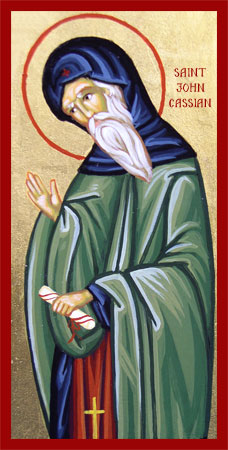
 In fact, everything that we have in our minds before the time of prayer is inevitably brought back by memory when we are praying.  So whatever kind of people we want to be in our prayer time, we want to be before we begin to pray.  St. John Cassian, Conferences.

I found  this quotation from Cassian in today’s reading in a wonderful little book, Drinking from the Hidden Fountain: A Patristic Breviary.  In The Conferences (written between 426 and 429 A.D.), Cassian surveyed much of the work of the Desert Fathers.  The Desert Fathers, along with Cassian, provided the foundation of the monastic movement.

St. Cassian reminds us that we cannot separate our prayer life from the balance of our lives.  We cannot separate the way we pray from the way we live.  If our lives are rushed, jumbled and frantic, our prayers will reflect that.  If our lives are self-centered or consumed by pettiness, our prayer lives will not be much different.  If our relationships with our brothers and sisters are shallow and insincere, our relationship with the One God will reflect that as well.

We work so hard to compartmentalize our lives.  We tell ourselves: “This is the face I show at work; this is the way I act with my friends; and this is the kind of person I want to project at prayer.”  Ultimately, I think we’ll find that God sees through these persona, sees beyond the walls we try to build.  We can trust that His love exceeds even our capacity to fool ourselves.  Rabbi Heschel wrote that “To pray is to dream in league with God, to envision His holy visions.”

Cassian rightly notes that as we approach the Almighty in prayer, we bring our lives before Him, whether we intend to or not.  Thus, the Christian life calls us into that process of continual conversion, until our daily lives perfectly reflect the kind of person we want to bring to God in prayer, a person who can rightly share in God’s “holy visions”.  We are all already in a conversation with God, whether we know it or not.  Cassian asks how authentic, how honest and how loving we want that conversation to be.

God watch over thee and me,

James R. Dennis, O.P.

© 2011 James R. Dennis

Marked as Christ’s Own Forever

Heavenly Father, we thank you that by water and the Holy Spirit you have bestowed upon these your servants the forgiveness of sin, and have raised them to the new life of grace. Sustain them, O Lord, in your Holy Spirit. Give them an inquiring and discerning heart, the courage to will and to persevere, a spirit to know and to love you, and the gift of joy and wonder in all your works. Amen. You are sealed by the Holy Spirit in Baptism and marked as Christ’s own for ever. Amen. The Book of Common Prayer.

This past Sunday at my parish we baptized two children into the family of God.  Not twenty minutes earlier, I had taught a Sunday school class in which the discussion centered on the story of a judge in Rockport, Texas who had been captured on video in the process of “disciplining” his 16 year-old daughter.  The stark contradiction between that story and the sacrament of Holy Baptism left me astonished and wondering:  “How did we get from here to there?”

The video of the Texas judge and his daughter has now gone “viral.”  (I think one could make a pretty good argument that there was something viral in this family dynamic long before the release of the video.)  In case you haven’t seen it,   the video reveals a brutal, sadistic, beating of a teenage girl. The judge’s wife appears to encourage and facilitate the beating. It lasts for almost seven minutes, and I must confess that I was able to watch only about two minutes of it. Two observations emerge from watching this video.  First, this was not the first time this had happened.  This savage beating clearly occurred as part of a pattern of violence in the life of this family.  Secondly, this family did not honor or practice the rubric that one should never strike one’s children in anger.

I don’t think we get very far by simply observing that this was a bad man, or a dysfunctional family, or an instance of genuine evil.  (As I’ve said before, I try to make it a practice not to judge the content of a another man’s soul. Jesus taught us to pray for these people, and I have and will continue to do so.)  Rather, I want to pose a different question.

Knowing the Texas judiciary as I do, I’m fairly certain that this man, that this family, sat in some church in the area pretty regularly.  Whether they did or not, we should all ask ourselves how people can sit in our pews, nod their heads, and then go home to their families and beat, abuse and neglect our children.  Aren’t these the same children that we, at some point, presented for their baptism?  That strikes me as the real question.

I’m familiar with the biblical text in proverbs which seems to condone, and perhaps even recommend, the corporal punishment of children.  I’m also familiar with a good deal of literature and the testimony of several friends that corporal punishment does not work.  (Actually, it actually might work to change behavior in the very short-term, but we should rightly wonder whether it also fosters a culture of violence in our families and our children.)  But more importantly, Jesus said: “Truly I tell you, just as you did it to one of the least of these who are members of my family, you did it to me.”  Matt.  25:40.  I don’t think the Savior was foolin’ around.

In my legal practice, I have volunteered as an attorney representing children in cases where the State has intervened in cases of abuse and neglect.  I have seen the cycle of family violence repeat itself too often and seen the tragic results.  Our churches should, no, our churches must, take their teaching responsibilities in this area more seriously.  We could begin by starting a serious conversation about this issue, or by teaching new parents about other disciplinary practices they could add to their parenting toolboxes beyond corporal punishment.

As part of our promises during the sacrament of baptism, every member of our congregation agrees we will:  (1) “seek and serve Christ in all persons,” loving our neighbors as ourselves; and (2) “strive for justice and peace among all people, and respect the dignity of every human being.”  In those promises, we recognize the sacramental nature of our duty to keep our children safe.  I’m at a loss to reconcile those promises with what I saw in that video, and it’s well past the time that our churches did something about it.

Lord , make us instruments of your peace.

Pax,

James R. Dennis, O.P.

© 2011 James R. Dennis
Our Dangerous Habits

Jesus said, “Then the kingdom of heaven will be like this. Ten bridesmaids took their lamps and went to meet the bridegroom. Five of them were foolish, and five were wise. When the foolish took their lamps, they took no oil with them; but the wise took flasks of oil with their lamps. As the bridegroom was delayed, all of them became drowsy and slept. But at midnight there was a shout, `Look! Here is the bridegroom! Come out to meet him.’ Then all those bridesmaids got up and trimmed their lamps. The foolish said to the wise, `Give us some of your oil, for our lamps are going out.’ But the wise replied, `No! there will not be enough for you and for us; you had better go to the dealers and buy some for yourselves.’ And while they went to buy it, the bridegroom came, and those who were ready went with him into the wedding banquet; and the door was shut. Later the other bridesmaids came also, saying, `Lord, lord, open to us.’ But he replied, `Truly I tell you, I do not know you.’ Keep awake therefore, for you know neither the day nor the hour.”  Matt. 25:1-13.

In the Lectionary today, we encounter the Parable of the Bridegroom. The parable sounds a well-known warning to us:  “Keep awake therefore, for you know neither the day nor the hour.”  While Jesus is teaching us about the need for preparation, I think he’s also pointing out just how difficult the Christian life will be.

In the field of law, we have a doctrine called stare decisis.  It means that once a case has been decided a certain way, future cases that present similar facts should generally be decided the same way.  The doctrine allows for consistency (the hobgoblin of small minds), predictability and promotes a certain sense of fairness.

We apply a similar practice in our own lives.  Each of us have developed a habit, a rubric, for dealing with telemarketers, panhandlers on the street, or older people who corner us to talk about their aches and pains.  We have a formula for how we deal with the coworker who stops by our desk to talk about their family problems.  These rubrics, these habits, offer us a certain level of efficiency.  But they may also pose a danger to our spiritual lives because they prevent us from having to think about individual situations or feel compassion when confronted with a unique situation.

The great German philosopher Martin Heidegger called this “unreflective everydayness.”  I think, in part, that’s what Jesus was warning us about in the Parable of the Bridegroom.  By relying on our preprogrammed responses, we miss the opportunity to see the face of Christ in those around us, and perhaps, to be the face of Christ for them.  I do not know how often God intervenes in the world around us, but I suspect it’s a lot more than most of us realize.  Christ’s advice “Keep awake” may well offer the best cure for the spiritual doldrums that obfuscate  God’s presence in the world.

 To paraphrase one of  the great prophets of our age, Ferris Bueller, “The Christian life moves pretty fast. If you don’t stop and look around once in a while, you could miss it.”

Shabbat Shalom,

 James R. Dennis, O.P.

© 2011 James R. Dennis

Go And Do Likewise

“A man was going down from Jerusalem to Jericho, and fell into the hands of robbers, who stripped him, beat him, and went away, leaving him half dead. Now by chance a priest was going down that road; and when he saw him, he passed by on the other side.  So likewise a Levite, when he came to the place and saw him, passed by on the other side.  But a Samaritan while traveling came near him; and when he saw him, he was moved with pity.  He went to him and bandaged his wounds, having poured oil and wine on them. Then he put him on his own animal, brought him to an inn, and took care of him.  The next day he took out two denarii,  gave them to the innkeeper, and said, ‘Take care of him; and when I come back, I will repay you whatever more you spend.’  Which of these three, do you think, was a neighbor to the man who fell into the hands of the robbers?”  He said, “The one who showed him mercy.” Jesus said to him, “Go and do likewise.”  Luke 10: 30-37.

In this morning’s readings in the Daily Office, we encounter the Parable of the Good Samaritan.  It’s an extraordinarily familiar story, although it appears only in the Gospel of St. Luke.  Perhaps we know the story so well that it’s lost some of its impact.  Familiarity, after all, breeds indifference long before it breeds contempt.  So, we may have forgotten just how shocking this story was to the audience in first century Palestine.

Part of what’s been lost to us is the geography.  The story takes place on the long, downhill road between Jerusalem and Jericho, a road also known at the time as the “Bloody Pass” or “The Way of Blood.”  The road meanders and the topography provides the perfect environment for an ambush:  a paradise for bandits and robbers.

There’s nothing surprising then about the man being beaten, robbed and left for dead on that road.  Nor would Jesus’ audience have been particularly surprised to hear Jesus tell that the priest and the Levite both passed the man by, in fact they walked by “on the other side” of the road.  (The laws of ritual purification at the time might actually have recommended this practice to devout Jews.)  We aren’t surprised by Jesus’ casting the priests and Levites in the role of the villains:  both Jesus and John the Baptist had been doing that for a while.

But the notion that the Samaritan showed the quality of mercy, the notion of the Samaritan as the hero of the story, that would have astonished and befuddled Jesus’ first century audience.  The Samaritans and the Jews had hated each other for hundreds of years at the time Jesus told this story.  The Samaritans had desecrated the Temple with human bones.  The Jews reciprocated.  According to the Mishna (the first major work of Rabbinic Judaism), “He that eats the bread of the Samaritans is like to one that eats the flesh of swine” (Mishna Shebiith 8:10). So, hearing about a “good Samaritan” would have bewildered Jesus’ audience.  It would be the equivalent of a modern parable about the “good Klansman” or a “good Zeta” (one of the Mexican drug cartels) or the “Good Al-Qaeda fighter.”

Thus, part of Jesus’ message continues the message of the sixth chapter of Luke’s Gospel.  “But I say to you that listen, Love your enemies, do good to those who hate you,bless those who curse you, pray for those who abuse you.”  Luke 6:27-28.  This commandment teaches that there is nothing soft or squishy or indulgent about the Christian life.  It is, as C.S. Lewis observed, “as hard as nails.”  And this teaches one of the many ways that Christianity must remain counter-cultural:  loving our enemies, caring for those who’ve wounded us, will never be a popular position.

I think, however, this parable suggests at least one more critical lesson.  Jesus teaches us about our most common sin, if not our greatest sin: indifference.  Jesus contrasts the compassion which overtook the Samaritan with the indifference of the priest and the Levite.  It’s a sharp criticism directed at the religious leaders of his day, and I’m not so certain it doesn’t apply with equal force today.  Indifference, perhaps even more than hatred, may have the greatest power to separate us from God.

So, I’m wondering, who did I not notice?  Who did I walk to the other side of the road to avoid?  As Bruce Cockburn wrote, “Lord, spit on our eyes so that we can see.”

Shabbat shalom,

James R. Dennis, O.P.

© 2011 James R. Dennis

The Spiritual Wisdom of Steve Jobs

It has been a week since Steve Jobs passed away, but I wanted to take a while before writing about it. It seemed like these events required a bit of time for reflection. In part, the whole thing seemed sort of “secular.” Even the wry corporate logo seems to grin at the notion of eating from the tree of knowledge: not humanity’s finest moment.

Jobs and his work at Apple seem like the classic, remarkable success story, but maybe that’s not the case. If you’ve taken the time to listen to Job’s 2005 commencement address at Stanford, I’m sure you found it moving. If you haven’t yet heard it, you can find it here: http://www.youtube.com/watch?v=UF8uR6Z6KLc. In the address, Jobs tells three stories that reveal the secret of his success: failure and catastrophe.

Although our world values success perhaps above all else, Jobs talked about: (1) dropping out of college; (2) getting fired from Apple; and (3) being diagnosed with pancreatic cancer. Each of these experiences, which would have looked like failure or disasters to all the world, contributed (and perhaps even brought about) that remarkable life. Jobs noted his inability, at the time of these events, to see the connections between them and their impact on his life. He described this as difficulty in connecting “the dots.”

Our world places remarkable value on success and accomplishment. It motivates so much of what we do, so much of who we are. Sometimes, what looks like sucess is nothing more than tenacity. As Winston Churchill once said, “Success consists of going from failure to failure without loss of enthusiasm.” Nothing in Churchill’s statement, or Jobs’ commencement address, should come as a surprise to those of us who believe in the living God.

The story is as old as our removal from Eden, as old as being trapped between the Red Sea and the Egyptian army. We’ve been telling this story since the destruction of the Temple and the Babylonian Exile. Each of these events seemed like catastrophes at the time. We hear the same story as Cleopas and another disciple traveled to Emmaus, despondent and convinced that Jesus’ ministry was a great “failure.” Later, they learned that this through this catastrophe, God was at work, displaying His capacity to reveal Himself even in the horror of Golgotha.

So, while we may rightfully celebrate our successes, I hope we don’t miss the opportunity to see God at work in those events where we seem to have stumbled. When that Sunday school class doesn’t quite come off like we hoped or when confronted with a pastoral situation that we feel powerless to help with, we might remember the power of an unseen God to connect the dots. In the Church, we call that “faith.”

Requiescat en pace, Mr. Jobs.

James R. Dennis, O.P.

© 2011 James R. Dennis

Sh’ma Yisrael

During this interstice between the High Holy Days of Rosh Hashanah and Yom Kippur, I thought we’d examine the Sh’ma Yisrael, or Shema. For many observant Jews, the Shema offers the central prayer service of Judaism. The recitation of this prayer twice daily is a commandment. As a good Jew, Jesus would certainly have followed this practice. Deuteronomy instructs us that we shall say this prayer upon lying down and rising up. Deut. 6-7. Some have suggested that the Shema functions less as a prayer than as a creed, a statement of the binding principles of the Jewish faith.

The first section of the prayer begins: “Hear, oh Israel, the Lord our God is One. You shall love the Lord your God with all your heart, and with all your soul and with all your might.” We might examine those two sentences more closely.

The opening line of the Shema reminds God’s people of God’s oneness. This sometimes seems counterintuitive to us. God created the universe in all its complexity, hears the prayers of billions and billions of people and knows their needs. God authored gravity and the immense power of the stars. Surely, that God is incredibly complex. Sometimes, God seems like such a decent fellow, when all is going well and our bellies are full. At other times, when life isn’t going so well, we perceive God as uncaring, or perhaps even vengeful. Yet the Shema reminds us that of the simplicity of God, despite the complexity we might perceive.

St. Thomas wrote often of the simplicity of God. Summa Theologiae 1.3.7; Summa contra Gentiles 1.22.9-10. In fact, Aquinas described God as “infinitely simple.” The Oneness, or simplicity of God, provides the unifying power, the unifying event and idea for our disparate perceptions. No other ideology or vision or philosophy can replace God as the single, ultimate ground of meaning. The Shema expresses God’s sovereignty, God’s kingship, over all creation and creatures.

St. John comments on God’s oneness when he observes quite simply that “God is love.” 1 John 4:8. This leads us directly to the second passage of the Shema which continues: “And you shall love the Lord your God with all your heart, and with all your soul and with all your might.” This passage suggests that our love of the Lord must be single-minded: there is no room here for duplicity. If we truly loved unambiguously, there would be little space in our hearts for the separation of sin. Learning to love God this way requires a great deal of us. Great love always does. The Shema provides the central focus of our spirituality: loving God. But it also teaches that where we encounter love, we encounter the divine center of things.

Jesus clearly understood the central nature of the Shema. A scribe asked Christ, “Which is the greatest commandment?” Jesus answered directly from the Shema:

Jesus answered, ‘The first is, ‘Hear, O Israel: the Lord our God, the Lord is one; you shall love the Lord your God with all your heart, and with all your soul, and with all your mind, and with all your strength.’”

Mark 12: 29-30. Jesus then added a gloss to the Shema, taking his reference from Leviticus:

“The second is this, ‘You shall love your neighbour as yourself.’ There is no other commandment greater than these.”

Mark 12:32. Jesus teaches that these two commandments provide the framework, the scaffolding, for the balance of the Scriptures. Matt. 22:40. Because “our neighbors” are made in the image of God, our love of them reveals the depth of our love of the Almighty. Our capacity to love God is bounded by our capacity to love “our neighbors.”

Understanding the Shema, then, isn’t something clever or broad-minded Christians can discuss at cocktail parties. It provides us with a deep and profound understanding of who Jesus was and what he thought was important. Praying the Shema at morning and in the evening, then, helps us to understand Christ. We have a great deal to learn from our Jewish brothers and sisters. Jesus thought so, anyway.

Shabbat Shalom,

James R. Dennis, O.P.

© 2011 James R. Dennis

Life and Death Decisions

On August 19, 1989, Mark MacPhail, a former Army Ranger, worked for the Savannah Police Deparment. That night, with his wife and baby daughter at home, MacPhail was working as an off-duty as a security guard in a Burger King restaurant. When MacPhail learned of a man being assaulted in the parking lot, he intervened to defend the victim. Seven witnesses testified that they had seen Troy Anthony Davis shoot MacPhail, and two others testified that Davis had confessed to the murder. Davis, a black man, stood accused of killing MacPhail, a white police officer.

Some of the witnesses who testified at trial later recanted their sworn statements. Two of the jurors indicated that had they known 20 years ago of the facts that have surfaced since then, they would have voted differently. Nonetheless, some 20 years after he was originally sentenced to receive the death penalty, the State of Georgia ended Troy Davis’ life on September 21, 2011.

Sometimes, history entangles strange stories together. You see, back on June 7, 1998 James Byrd accepted a ride home from Shawn Berry, Lawrence Brewer and John King. Mr. Byrd knew the driver, Shawn Berry, from around town. But instead of taking him home, the three men took Mr. Byrd out into the country. They beat him viciously, urinated on him, chained his ankles to their pickup truck and dragged him for three miles. They then went to a barbeque. As you probably know, the incident took place in Jasper, Texas.

In one of those historical ironies, the State of Texas executed Lawrence Brewer on the same day Georgia executed Troy Davis. Brewer, a white supremacist, had previously served time for drug possession and burglary. He had apparently joined a white supremacist gang during this earlier prison term, and it was there that he met John King. When interviewed by the media the day before his execution and asked if he had any remorse, he said “As far as any regrets, no, I have no regrets. No, I’d do it all over again, to tell you the truth.”

As a lawyer, I think I understand the legal issues in most of these cases, and it’s hard for me to avoid the notion that the death penalty is constitutional. There are also a number of practical issues involved, like the question of deterrence and the relative cost of life imprisonment versus the total costs of carrying out the death penalty. One of those practical issues is the remarkable disparity in the racial application of the death penalty. There’s also the question, in fact the probability, that we have executed several people who were innocent of the crimes of which they were convicted. But I don’t think that answers the question, the bedrock question I’d like us to consider this morning: what kind of people do we want to be?

The scriptural witness in this regard is somewhat ambiguous, forcing us, as Scripture so often does, to struggle with the text and its meaning. Proponents of the death penalty find solace in the commandment of Leviticus: “Whoever takes the life of any human being shall be put to death” (Leviticus 24:17). (It’s worth noting, however, that the Old Testament similarly provides for the execution of those who works on the Sabbath (Exodus 31:15) or for one who curses one’s parent (Exodus 21:17) and even for a rebellious teenager (Deuteronomy 21:18-21).)

Those who oppose the death penalty can look to the notion that God has reserved vengeance for himself (Rom. 12:19). We find in the Biblical story of the first murder that God spared Cain’s life, although Abel certainly seems like an innocent victim. Chapter 8 of John’s Gospel records the only time our Savior’s encounter with capital punishment in the case of the woman caught in adultery; and Jesus put a stop to it.

It’s worth observing that there are good people, and there are people of faith, on both sides of this issue. As so often happens, we find that we must struggle with the biblical text on this issue. I think that’s a good thing, because the Bible isn’t a book of recipes that will teach us how to prepare a good life, nor is it an encyclopedia where we can go to look up the “right” answer. In Holy Scripture, God speaks to us in a collection of stories, a narrative about how people struggle to find their sanctification and how we struggle to find ours.

Three overarching themes, however, strongly suggest to me that capital punishment is the wrong answer. The first of these is an understanding of what it means to be human. We are told that we were made imago Dei, “in the image of God.” That probably doesn’t mean that our elbow looks like God’s elbow. But I think it means that all of us have some spark of the divine within, no matter how well we try to hide it. In other words, we are all instances (no matter how blurred) of something sacred and holy.

Secondly, we have the Biblical meta-narrative of God’s reaching again and again to redeem people, not because of their merit but because of His love. This happens over and over in the Bible, often enough that I believe God is trying to tell us something. We see it in the story of Cain, in the Exodus (which remains the overarching narrative for the Jewish people), in the story of David, and in the story of Christ’s calling St. Paul. Jesus preached “Do not judge, so that you may not be judged.” (Matt. 7:1.) While I’m not smart enough to have considered all of the implications of that commandment, I think at a minimum that we are not to judge the content and character of another man’s soul. God knows who can be redeemed, and I do not.

Finally, I oppose the death penalty because I honor the Christian virtue of hope. I am hopeful that God can redeem the even the shame of the murder of James Byrd, and the horror Lawrence Brewer’s unrepentant racism. I am hopeful that God’s love can reach into Brewer’s life, and into mine. I believe in “the means of grace and the hope of glory.” I think capital punishment reflects a despair at the possibility of Christ’s redemptive love reaching into the very darkest places of the human heart, and I am compelled to reject that.

In the final analysis, I think the real question is one posed by Sister Helen Prejean: “The profound moral question is not, ‘Do they deserve to die?’ but ‘Do we deserve to kill them?'” I pray the answer is no, just as I pray for Mark MacPhail, for James Byrd, for Troy Davis and Lawrence Brewer.

Shabbat Shalom,

James R. Dennis, O.P.

© 2011 James R. Dennis