Tag Archives: Jesus

How Can These Things Be?

From Mount Hor the Israelites set out by the way to the Red Sea, to go around the land of Edom; but the people became impatient on the way. The people spoke against God and against Moses, “Why have you brought us up out of Egypt to die in the wilderness? For there is no food and no water, and we detest this miserable food.” Then the LORD sent poisonous serpents among the people, and they bit the people, so that many Israelites died. The people came to Moses and said, “We have sinned by speaking against the LORD and against you; pray to the LORD to take away the serpents from us.” So Moses prayed for the people. And the LORD said to Moses, “Make a poisonous serpent, and set it on a pole; and everyone who is bitten shall look at it and live.” So Moses made a serpent of bronze, and put it upon a pole; and whenever a serpent bit someone, that person would look at the serpent of bronze and live.  Numbers 21: 4-9.

Jesus said to Nicodemus, “Just as Moses lifted up the serpent in the wilderness, so must the Son of Man be lifted up, that whoever believes in him may have eternal life.
“For God so loved the world that he gave his only Son, so that everyone who believes in him may not perish but may have eternal life.”  John 3: 14-16.

The first passage, from the Book of Numbers, deeply challenges our understanding of Yahweh, and confronts our  imaginations.  It takes place against the backdrop of  the consistent theme within the Exodus narrative:  forty years of wandering in the wilderness, marked by the people’s resistance, God’s punishment, the people’s repentance, and God’s restoration.   As the people near the end of their journey, a campaign of rebellion  arose against both Moses and God.  The text reports that God addressed this issue through an infestation of seraphs (poisonous snakes).

One might reasonably conclude that there were already poisonous snakes among the Hebrew people, spreading this contagion of destructive grumbling.  While we may struggle with the notion that God sent the snakes down upon the Hebrews, I want to suggest that those vipers were merely visible tokens of the toxic rebellion that already enveloped them.  The serpents which would lead to their deaths were already there.  God merely revealed a physical sign of the spiritual reality they already confronted.  It’s as though the Lord were telling them, “This is what your way looks like.”

In this fitting Lenten passage, when the people acknowledge their complicity for their situation, God intervenes to save them.  God instructs Moses, who creates a bronze serpent placed upon a pole.  When those bitten by snakes look upon this image, this icon, God heals them.  Out of this destructive pattern of sin and death, God will raise up a way of healing.  This leads us to the Gospel reading for today.

In the Gospel passage, we encounter the terribly interesting figure of Nicodemus, a Pharisee who secretly followed Jesus.  Immediately prior to this passage, Jesus challenges Nicodemus’ imagination, teaching about the need for a man to be “born again”.  Jesus then reveals his messianic role, drawing on the iconic image of Moses lifting up a serpent in the wilderness.  This statement carries with it the double-meaning of the Christ being raised up as the Messiah and of Jesus raised up on the cross.  As with the earlier passage from Numbers, Jesus describes a spiritual reality that the world cannot yet comprehend.

The cross will become the source of healing this broken world.  Just as with the bronze serpent, that which we perceived as an image of fear and death becomes the source of our new life.  Again, it’s as though God said to the world, “All right.  This horror on Golgotha is the result of the way you want to do business.  But I can still create life where you see nothing but death and shame.”

 Jesus teaches Nicodemus that believing  in the Son “lifted up” provides the way to eternal life.  It’s important to note that the Greek phrase John uses isn’t actually “believes in him” but rather “believes into him”.  In other words, Jesus isn’t describing an intellectual assent to a set of propositions, but rather a radical submission and new way of life.  Jesus offers eternal life, therefore, to those who join in His way of life.  Thus, St. Paul could accurately say “I no longer live, but Christ lives in me.”  Gal. 2:20.

John’s Gospel offers us a deeply rooted theology of the cross.  In fact, for St. John, the cross operates as the fulcrum point upon which all of human history turns.  This passage seems to answer, perhaps a little obliquely, Nicodemus’ question, “How can these things be?”  John 3:9.

Jesus points to a spiritual reality we cannot yet see, that we cannot yet understand.  Our new life, our eternal life, in Christ originates in one mysterious, glorious, incomprehensible notion:  “God so loved the world that he gave his only Son, so that everyone who believes into him may not perish but may have eternal life.”  Salvation arises through God’s love, revealed on the cross.  In the depth of this Lenten season, that’s good news.

Shabbat shalom,

© 2012 James R. Dennis

Moses and the Bronze Serpent © Fr. Lawrence Lew, O.P.

Cleaning (God’s) House

The Passover of the Jews was near, and Jesus went up to Jerusalem. In the temple he found people selling cattle, sheep, and doves, and the money changers seated at their tables. Making a whip of cords, he drove all of them out of the temple, both the sheep and the cattle. He also poured out the coins of the money changers and overturned their tables. He told those who were selling the doves, “Take these things out of here! Stop making my Father’s house a marketplace!” His disciples remembered that it was written, “Zeal for your house will consume me.” The Jews then said to him, “What sign can you show us for doing this?” Jesus answered them, “Destroy this temple, and in three days I will raise it up.” The Jews then said, “This temple has been under construction for forty-six years, and will you raise it up in three days?” But he was speaking of the temple of his body. After he was raised from the dead, his disciples remembered that he had said this; and they believed the scripture and the word that Jesus had spoken.  John 2: 13-22.

Few paths offer a quicker road to trouble than criticizing someone’s religion or their politics.  Almost certainly, Jesus knew that about us, and travelling down that road got Him killed.  In today’s reading from the Lectionary, Jesus criticized both the religion and the politics of the Judean authorities of that time.

The Temple stood as a monument to something sacred and holy:  it represented the intersection of heaven and earth, the dwelling place of the Living God, and a visible symbol of both national identity and God’s covenant with the Jewish people.  Most people would perceive an attack on the Temple  as an attack on the faith (and the nation) itself.  These events took place as the city of Jerusalem swelled with the Passover crowds.

All four Gospels record this event, one of the few occasions on which Jesus became deeply angry.  In the other three Gospels, Jesus calls the Temple a “den of thieves.”  John places this event near the beginning of Jesus’ public ministry, as opposed to the synoptic Gospels which place it much later.

Jesus apparently became enraged upon observing the barriers thrown up by the priestly authorities, barriers which stood between God and His people.  For example, because Roman coins were forbidden in the Temple, they had to be exchanged (at a substantial discount) for the currency of the Temple.

The Temple authorities also collaborated with the Roman occupation, and Jesus overturned that table as well.  In John’s Gospel, Jesus  insults the Temple culture, calling it a “marketplace.”  Trading on access to the Holy was then, and still remains, a special kind of blasphemy.  Jesus became enraged when He saw the Sacred being traded like a commodity.  I think we underestimate the Gospel if we see this as a historical criticism of “the Jews” back then.

Our churches still seek to collaborate with political power.  We still fall under the thrall of a purity system that separates the righteous from the sinners, the holy from the impure and the whole from those who are broken.  We might well examine the ways in which we still place obstacles in the paths of those who come looking for God.  We might wonder whether our churches, like the Temple in Jesus’ time, have become comfortable monuments to the status quo.  We might ask whether our houses of worship have become mutual admiration societies rather than instruments of change.  Perhaps we should share the Savior’s sense of outrage when we encounter it.

The Judean authorities asked Jesus to provide them with a sign (seimeion), in other words, to show them the authority by which Jesus issues this prophetic condemnation.  Asked for an explanation, Jesus replies with an enigma.  Jesus responds that upon the destruction of “this temple”, he will raise it up in three days.  As is so often the case in John’s Gospel, Jesus is misunderstood.  (We find the classic example of this in Jesus’ trial as Pilate questions Him.  John 18, 19.)  Jesus speaks of the sanctuary of His body; the Judeans think He’s talking about the architecture.

Ultimately, Jesus will displace the Temple as the intersection of heaven and earth.  As He told the Samaritan woman only two chapters later, “the hour is coming when you will worship the Father neither on this mountain nor in Jerusalem.”  John 4:21. Further, Jesus’ death would signal the final sacrifice, rendering the Temple culture obsolete. Jesus thus appropriates the functions of the Temple for Himself.  The life of Christ would come to operate as the new meeting place for those seeking El Shaddai (God Almighty).

Like the Temple culture of Jesus’ time, many of us would still prefer a God we could do business with (see here).  Jesus offers us something radically different:  He offers Himself.  He becomes the locus point (the alpha and the omega) where human history intersects with the Father. He has been raised as the new edifice where we can encounter the holy.

As we come to this new Temple, Jesus doesn’t expect us to bring a dove or to engage in some special ritual.  He asks us to take the whip into our own hands, and chase away everything that separates us from God. He asks us to come and offer ourselves, our whole lives, without reservation. He asks us to take up our cross and follow Him.

Shabbat shalom,

James R. Dennis, O.P.

© 2012 James R. Dennis

The Greater Danger

We see also that the greater danger does not come from outside us.  It comes from within.  It comes from our very selves.  The enemy is within us.  Within us is the very progenitor of our error; within us, I say, dwells our adversary.  Hence, we must examine our aims, explore the habits of our minds, be watchful over our thoughts and over the desires of our heart.
Let us therefore not seek for causes outside ourselves nor blame others for them.  Let us acknowledge our guilt.  For we must willingly attribute to ourselves, not to others, whatever evil we can avoid doing when we so choose.  St. Ambrose (Bishop of Milan), The Six Days of Creation 1, 31-32.

Again, I found this bit of wisdom in the Readings for the Daily Office from the Early Church.  St. Ambrose was the Bishop of Milan, and lived in the fourth century.  He fought against the Arian heresy (which held that Jesus had not existed eternally and was subordinate to God the Father).  He often stood against imperial authority and was one of the four original Doctors of the Church.

Ambrose rightly points to one of our great shortcomings:  our willingness to justify ourselves by blaming others.  It’s a very old problem, dating back to the first sin recorded in Scripture.  When God asks Adam whether he has eaten of the tree of the knowledge of good and evil, Adam replies:  “The woman whom you gave to be with me, she gave me fruit from the tree and I ate.”  Gen. 3:12.  Adam thus inaugurates our primary strategy for dealing with sin:  justifying ourselves by spreading the blame.  In essence, Adam said that Eve bore the real responsibility for this offense, along with God who gave her to him.

Scripture offers a very clear witness on this point.  Jesus asked, “Why do you see the speck in your neighbour’seye, but do not notice the log in your own eye?”  Luke 6:41.  Perhaps more to the point, St. John reminds us:  “If we say that we have no sin, we deceive ourselves, and the truth is not in us.If we confess our sins, he who is faithful and just will forgive us our sins and cleanse us from all unrighteousness.”  1 John 1: 8-9.

Our desperate efforts to justify what we’ve done, to justify ourselves before the Almighty, place our souls in grave peril.  Christ invites us to drink from the cup of forgiveness, and yet we turn away and deny that we are thirsty.  As C.S. Lewis observed:  “We poison the wine as He decants it into us; murder a melody He would play with us as the instrument…Hence all sin, whatever else it is, is sacrilege.” We want so fiercely to be “good” people, and perhaps even more frantically to appear to be “good” people.  I think in part we feel this way because we do not really trust in God’s infinite capacity to love and forgive. 

I wonder, at our core, how many of us really trust God?  The psalmist wrote that our Father would not refuse a broken and contrite heart.  The real risk to our spiritual lives lies, as St. Ambrose observed, lies in our stubborn insistence on externalizing evil, rather than recognizing the ways in which we’ve separated ourselves from God.

God watch over thee and me,

James R. Dennis, O.P.

© 2012 James R. Dennis

Rabbi, Teach Us How to Pray

The Master of peace and unity would not have each of us pray singly and severally, since when we pray we are not to pray only for ourselves.  For we neither say: “My Father, who art in heaven” nor “Give me this day my bread”; nor does each of one of individually pray for our own debt to be forgiven, nor do we ask that we alone should not be led into temptation, nor that we only should be delivered from evil.

Our prayer is general and for all; and when we pray, we pray not for one person but for us all, because we are all one.  God, the Master of peace and concord, so willed that one should pray for all, even as he himself bore us all.  St. Cyprian, Treatise on the Lord’s Prayer.

I found this commentary on the Lord’s Prayer in a wonderful book, Readings for the Daily Office from the Early Church.  St. Cyprian lived in the third century in and around Carthage, in northern Africa.  He lived during a time of great trials for the Church, a time of plague, famine, schism and persecution.  He died for the faith in 258 A.D.

I recently wrote about the nature of evil, which always works to separate us: from God, from our brothers and sisters and from our true selves.  Unlike sin, which separates, prayer works to unify.  Cyprian rightly reminds us that God has woven our lives together.  Jesus called upon us to recognize that bond in the Lord’s Prayer.  If we take a look at the very first two words of the prayer (“Our Father”) we recognize our common origin.  We aren’t like a family; we are a family.

When I was a boy at Burnet Elementary School, one of my classmates accosted me on the playground and asked me if I had accepted Jesus Christ as my personal savior.  This question took place in a fairly big crowd of kids, and that event may be my first memory of genuine peer pressure.  I answered, “Well, yes, and no….I think He came to save the whole world.”

I’m not sure how well I understood the theology behind what I said.  (I’m pretty sure it was not a popular answer.)  On the other hand, I think this statement recognized an important concept:  I cannot really separate God’s love for me from my love for His children.  The Lord’s Prayer, and St. Cyprian, call us into that recognition.  I cannot pray for my daily bread alone; my brother’s bread must be just as important.

This notion underlies a good deal of Christian theology.  All were made in the image of God.  The forgiveness of us all must be my concern and my prayer.  One of my favorite writers on prayer, Rabbi Heschel, noted:  “The purpose of prayer is not the same as the purpose of speech.  The purpose of speech is to inform; the purpose of prayer is to partake.”

When we pray the Lord’s Prayer, we partake in the hopes and the troubles and the gratitude of our brothers and sisters.  We also share in God’s hopes and concerns for all His children.  We thus knit our lives together with God’s dreams for the kingdom: the kingdom which has not yet come and the kingdom which is already here and present.  During this holy season, let’s pray for each other and for God’s presence to fall down upon all our lives like a steady rain.

God watch over thee and me,

James R. Dennis, O.P.

© 2012 James R. Dennis

The Good Shepherd

“I am the good shepherd. The good shepherd lays down his life for the sheep.   The hired hand, who is not the shepherd and does not own the sheep, sees the wolf coming and leaves the sheep and runs away-and the wolf snatches them and scatters them.  The hired hand runs away because a hired hand does not care for the sheep.  I am the good shepherd. I know my own and my own know me,  just as the Father knows me and I know the Father.  And I lay down my life for the sheep.  I have other sheep that do not belong to this fold. I must bring them also, and they will listen to my voice. So there will be one flock, one shepherd.  For this reason the Father loves me, because I lay down my life in order to take it up again.  No one takes  it from me, but I lay it down of my own accord. I have power to lay it down, and I have power to take it up again. I have received this command from my Father.”  John 10:11-18.

This reading from John’s Gospel offers a rich passage, and those who know it well may have lost some appreciation for its texture.  First, when Jesus says “I am the good shepherd”, He presents us with one of the seven “I Am” statements.  These include “I am”: the bread of life;  the light of the world; the gate or door; the good shepherd; the resurrection and the life; the way, the truth and the life; and the vine.  Each of these statements resonates with God’s self description found in Exodus 3:14 (“I Am Who Am”).  In other words, John offers us a clear claim of the divinity of Jesus through these statements.

Jesus’ description of himself as a good shepherd also resonates with God’s announcement in the Old Testament:  “For thus says the Lord God: I myself will search for my sheep, and will seek them out.  As shepherds seek out their flocks when they are among their scattered sheep, so I will seek out my sheep.”  Ezek.  34: 11-12.    From his deathbed, Jacob declared that God had been the shepherd “all of my life to this day.”  Gen 48:24.  Jesus’ description of himself further calls to mind the 23rd Psalm.  Thus, Jesus locates himself firmly within the Davidic line:  a shepherd king.

We also need to grasp just how startling Jesus’ understanding of himself as a “good shepherd” would have been to a first century audience.  At that time, shepherds would have been considered am ha’aretz (people of the land or people of the dirt).  Shepherds were considered dirty, coarse, boorish, and uncivilized.  Rabbinic Judaism looked down on shepherds, who did not regularly keep the commandments.  Because of their work, they may not have even kept the Sabbath.

The shepherds of first century Palestine were also a rough lot, solitary men of tremendous courage.  They had to protect the flock from lions, bears, wolves and other predators.  Rather than the gentle, pastoral image we may have inherited from the Romantic poets, shepherds were fierce fighters who were prepared for dangerous combat when necessary to protect their sheep.  For example, David learned about battle by protecting his father’s sheep from predators.  1 Sam. 17:33-37.

So, there’s something in Jesus’ description of himself as “the good shepherd” that subverts our understanding and upends our expectations.  Jesus also contrasts himself with “the hired hands” who run away in the face of a wolf.  He thus begins to teach about his commitment to us, a commitment that disregards his own safety, that disregards his own life.  This commitment, this covenant, finds its root in love, and in the Father’s love for Jesus and in Jesus’ love for the Father.  Jesus teaches not only about the nature of His love for the disciples, but also about his love for every one of us.   In essence, Jesus tells us:  “I will not abandon you.”

Jesus then tells us that his sheep will listen to his voice.  I wonder how well we do that today.  Setting aside the question of listening, do we even recognize Jesus’ voice when he calls?  Christ then offers a remarkable insight that speaks to our fractured Church today.  He speaks of unity:  “So there will be one flock, one shepherd.”  When we encounter discord, schism, and fracture in the world, we can rest assured that at least one party (and perhaps all) are not listening to Jesus.

I believe this remarkable passage ultimately centers upon the overarching Christian commandment:  love God and love each other.  As Desmond Tutu once observed, “Nothing is too much trouble for love.”  Love binds the sheep to the shepherd, and binds the shepherd to his flock.  We understand the risks inherent in the practice of love, risks that will ultimately lead to Golgotha.  Despite these risks, in the final analysis, the Gospel teaches us that nothing else really matters.

God watch over thee and me,

James R. Dennis, O.P.

© 2012 James R. Dennis

If You Choose, You Can Make Me Clean

A leper came to Jesus begging him, and kneeling he said to him, “If you choose, you can make me clean.” Moved with pity, Jesus stretched out his hand and touched him, and said to him, “I do choose. Be made clean!” Immediately the leprosy left him, and he was made clean. After sternly warning him he sent him away at once, saying to him, “See that you say nothing to anyone; but go, show yourself to the priest, and offer for your cleansing what Moses commanded, as a testimony to them.” But he went out and began to proclaim it freely, and to spread the word, so that Jesus could no longer go into a town openly, but stayed out in the country; and people came to him from every quarter.  Mark 1:40-45.

At some point in our lives, most of us have experienced the pain, shame and loneliness of being an outsider.  In today’s Gospel reading, we find a man who knew that isolation intimately.  At that time, leprosy and most skin diseases were treated as a kind of plague.  Because of his illness, the community shunned him, and the Mosaic law justified and condoned their fears.  He had no right to approach Jesus, and Jesus had no business having anything to do with him, let alone touching him.

This man lived the life of walking ghost, or perhaps more accurately, a walking corpse. As a leper, this “unclean” man could not enter the Temple; he could not even enter any community other a community of other lepers.  Jesus enters into this ostracism by touching him and sharing in his uncleanness.

This man’s statement (“If you choose, you can make me clean”) carries a number of messages within it.  First, we can hear the pain in the voice of a man who simply doesn’t have the power to help himself.  We also hear a remarkable affirmation of faith in Jesus’ healing power.  And perhaps we also hear just a hint of a challenge to Jesus’ willingness to reach out to this man.

Jesus then tells the man something that God’s been trying to convey throughout the Old Testament:  I choose to heal you.  The text thus illustrates an important idea of divine freedom, reaching out to restore God’s creation.  As He did with Sarah and Abraham, as He did in the Exodus, and as he did on the Cross, God instinctively exercises His freedom to redeem our broken lives.  I think Jesus is telling us:  “This is what the kingdom looks like.”

Mark describes Jesus as “moved with pity”.  The phrase suggests a very deep emotional response, the sort of reaction that you feel deep within your gut.  It has also sometimes been translated as “moved with anger”.  I suspect that Jesus felt a certain anger at all those things which separate men from God, and perhaps at the lack of depth or vision in the priestly interpretation of the holiness code.  Perhaps Jesus was angry  with the very notion, embedded into this man by a life as a lonely outcast, that God would choose anything other than to heal him.

Regardless of whether Jesus was moved with pity or anger, we shouldn’t miss the important point:  His immediate response to this emotion was to reach out, to redeem and to restore.

Jesus then gives this man a strict warning not to tell anyone, but to simply present himself at the temple.  This instruction falls into what theologians call the “Messianic secret.”  In this passage and many others, Jesus often instructs those He heals (and even the demons he casts out) to keep quiet about what they’ve seen.  We get the impression that until the Resurrection (which would clearly reveal the meaning of Christ’s life) Jesus tried to avoid an incomplete understanding of his ministry.

Despite Jesus’ warning, the man begins to proclaim the news about Jesus.  This leads to a curious and ironic reversal.  While the man was originally kept from society, Jesus now finds himself an outsider because of his fame and the press of the crowds.  Cleansed of his disease, the man can now rejoin his town and family.  Having restored this man to his health and freedom,  Jesus could no longer travel freely and had to remain “out in the country” .  Jesus therefore becomes an outsider himself, no longer able to go to the towns and villages.  Even Jesus finds himself marginalized, and thus those who follow him should not be surprised when it happens to us, too.

In one sense, this passage is about risk.  Jesus took a tremendous risk in healing this man, risking contamination.  Jesus also took a risk in asking for this man’s assurance of secrecy, risking his own isolation.  By subjecting Himself to human history and sin, Jesus risked our judgment and condemnation.  In fact, the Gospels point to the final risk of the Incarnation, the Cross.

I think today’s Gospel reading teaches us another important lesson.  Mark illustrates one of the core tenets of the Christian faith:  ours is religion for the last kids picked for dodge ball, the kids no one wants to dance with, and those who always get their hearts broken.  We shouldn’t read this as a story about something that happened once, a long time ago; Jesus still choses to make us clean, to restore us and heal us.  Following Jesus is all about second chances.  It was for this man in today’s Gospel.  And it is for you and me, too.

Shabbat shalom,

James R. Dennis

© 2012 James R. Dennis

What Jesus Came to Do

Jesus left the synagogue at Capernaum, and entered the house of Simon and Andrew, with James and John. Now Simon’s mother-in-law was in bed with a fever, and they told him about her at once. He came and took her by the hand and lifted her up. Then the fever left her, and she began to serve them.

That evening, at sundown, they brought to him all who were sick or possessed with demons. And the whole city was gathered around the door. And he cured many who were sick with various diseases, and cast out many demons; and he would not permit the demons to speak, because they knew him.

In the morning, while it was still very dark, he got up and went out to a deserted place, and there he prayed.  And Simon and his companions hunted for him. When they found him, they said to him, “Everyone is searching for you.” He answered, “Let us go on to the neighboring towns, so that I may proclaim the message there also; for that is what I came out to do.” And he went throughout Galilee, proclaiming the message in their synagogues and casting out demons.  Mark 1:29-39.

In the Lectionary reading today, Jesus leaves the synagogue at Capernaum and travels to the home of Peter’s mother-in-law.  She has taken to her bed with a fever, which often presented a life-threatening condition in those days.  Jesus takes her by the hand and lifts her up.  That phrase, “lifted her up” resonates with meaning, calling to mind Jesus being lifted up on the cross and lifted up from the grave.  Jesus restores her to health, and restores her to her community.

We see a pattern begin to emerge in Jesus’ ministry.  The holiness and purity laws of the day would have required that one separate oneself from those who were ill, especially those who were spiritually diseased or who suffered from a moral infection.  Rather than shunning them, Jesus rushed to them.  At the time, this offered a new teaching, something really extraordinary.

That evening, word of Jesus’ healing ministry begins to spread and the house is surrounded by those who need Jesus’ healing touch.  Having had some involvement in the work of pastoral care, this passage from the Gospel rings remarkably true.  Pastoral care is the church’s growth industry in a world that groans in pain and cries out for God’s presence.

Jesus then engages in a practice we’ve seen before, and we’ll see again and again.  Having preached, having healed, he retreats “to a deserted place” and prayed.  Jesus knew what we so often ignore:  even the work of ministry can become empty and debilitating unless we allow the Father to refresh and renew us in prayer. Or perhaps Jesus knew what many of us so often forget: when we’ve come into direct contact with the overwhelming power of God to touch people’s lives, sometimes a bit of silent reflection offers the best and perhaps the only authentic response.

Peter and the disciples then encourage Jesus to return to Capernaum, where everyone is looking for him.  The disciples make the same mistake many of us do when we’ve encountered God doing something wonderful.  They suggest, “Do it again!”    As C.S. Lewis noted,  we are swimming upstream spiritually when we tell God “Encore!”  In Letters to Malcolm, Lewis observed : “It is no good angling for the rich moments. God sometimes seems to speak to us most intimately when he catches us, as it were, off our guard.”  Our fixation with that last event, that former experience, or that past feeling may well divert our attention from the new wonders God is already working.

Jesus tells the disciples that they need to go into “the neighboring towns”, which would have meant leaving the city of Capernaum and going into the countryside.  Here, we again see Jesus engage in a practice that will form a routine for Him:  (1) engage in ministry (proclaiming the Good News and healing the brokenhearted); (2) retreat and refresh in prayer; (3) expand the ministry to another place and people; and (4) repeat.  Those who follow Christ should seriously consider the wisdom of this regime.  It’s what we came here to do, too.

I wish you a good and holy Sabbath,

James R. Dennis, O.P.

© 2012 James R. Dennis

I Know Who You Are

Jesus and his disciples went to Capernaum; and when the sabbath came, he entered the synagogue and taught. They were astounded at his teaching, for he taught them as one having authority, and not as the scribes. Just then there was in their synagogue a man with an unclean spirit, and he cried out, “What have you to do with us, Jesus of Nazareth? Have you come to destroy us? I know who you are, the Holy One of God.” But Jesus rebuked him, saying, “Be silent, and come out of him!” And the unclean spirit, convulsing him and crying with a loud voice, came out of him. They were all amazed, and they kept on asking one another, “What is this? A new teaching– with authority! He commands even the unclean spirits, and they obey him.” At once his fame began to spread throughout the surrounding region of Galilee.  Mark 1:21-28.

In today’s Gospel reading, Mark reports that Jesus taught in the synagogue in Capernaum.  Somehow, Jesus’ teaching wasn’t like the normal commentary  to which the people had become accustomed.  His words carried a power which they have not heard before, and they would soon discover the breadth of his authority.  Jesus had a command of scripture which the people had not encountered before, but we also get the sense that it’s more than that.  We have the impression that they encountered something in Jesus himself they hadn’t previously seen: a certain gravitas, a new mastery and might.

Suddenly, a man “with an unclean spirit” accosted Jesus.  Interestingly, this unholy spirit spoke to Jesus in the plural. (The spirit asked “What have you to do with us?” and “Have you come to destroy us?”) Perhaps this daemon refered to both itself and the possessed man.  Or perhaps evil is always multifaceted, or duplicitous by its very nature.  The spirit then announced, “I know who you are, the Holy One of God.” 

Further evidencing his authority, Jesus expels the spirit from the man, freeing him from a terrible torment and bondage.  I suspect most of us have known someone in the grip of such an evil spirit, one which confines their souls and robs them of joy.  We may have concluded, as Einstein famously remarked, “It’s easier to denature plutonium than to denature the evil spirit of man.”  Those in the grip of such an evil spirit have no power within themselves to help themselves.

In a few short sentences, Mark has revealed several facets of Jesus: teacher; healer; liberator; and compassionate pastor.  This revelation fits perfectly within our Epiphany theme.  Through the act of freeing this man from the shackles of sin, Jesus restores God’s creation.

I don’t think Mark tells this story so much to describe an exorcism as to reveal the reach of Jesus’ authority, which includes the scriptures, the world of the flesh and the world of the spirit.  In this passage, Mark thus reveals Jesus as Lord of all created things. 

Ironically, Mark places some of the most important questions about and observations of Jesus within the mouth of this evil spirit.  The unclean spirit asks, “What have you to do with us?”  I am certain that I do not ask myself that question often enough.  What does Jesus have to do with me, with this day, with this place and with this hour?  In what way is Jesus relevant to this very moment of my life, and what am I going to do about that? 

The unholy spirit also announces, “I know who you are,  the Holy One of God.”  I’m wondering how well we know who Jesus is, and do we recognize his authority?  Do we recognize Jesus when we encounter him, and do we know his power?  Are we willing to let him rid us of those spirits that would destroy us? Will we listen when he tells our demons to be silent and to depart?  I pray we will.

 Shabbat shalom,

Br. James

© 2012 James R. Dennis

On the Road to Damascus

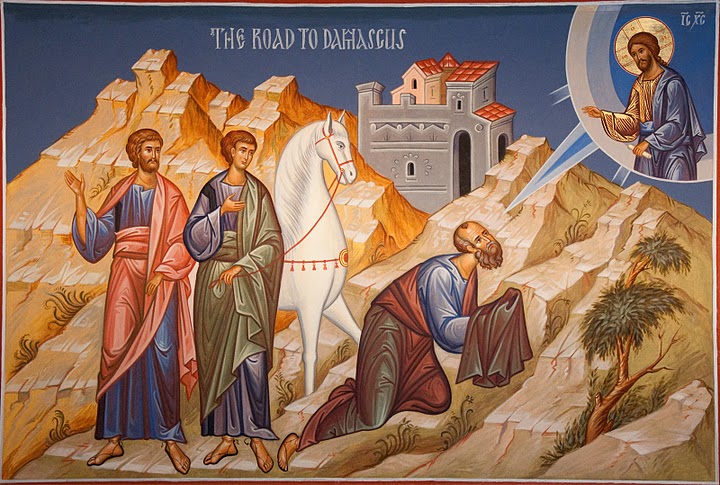
Meanwhile Saul, still breathing threats and murder against the disciples of the Lord, went to the high priest and asked him for letters to the synagogues at Damascus, so that if he found any who belonged to the Way, men or women, he might bring them bound to Jerusalem. Now as he was going along and approaching Damascus, suddenly a light from heaven flashed around him. He fell to the ground and heard a voice saying to him, ‘Saul, Saul, why do you persecute me?’ He asked, ‘Who are you, Lord?’ The reply came, ‘I am Jesus, whom you are persecuting. But get up and enter the city, and you will be told what you are to do.’ The men who were travelling with him stood speechless because they heard the voice but saw no one. Saul got up from the ground, and though his eyes were open, he could see nothing; so they led him by the hand and brought him into Damascus. For three days he was without sight, and neither ate nor drank.

Now there was a disciple in Damascus named Ananias. The Lord said to him in a vision, ‘Ananias.’ He answered, ‘Here I am, Lord.’ The Lord said to him, ‘Get up and go to the street called Straight, and at the house of Judas look for a man of Tarsus named Saul. At this moment he is praying, and he has seen in a vision a man named Ananias come in and lay his hands on him so that he might regain his sight.’ But Ananias answered, ‘Lord, I have heard from many about this man, how much evil he has done to your saints in Jerusalem; and here he has authority from the chief priests to bind all who invoke your name.’ But the Lord said to him, ‘Go, for he is an instrument whom I have chosen to bring my name before Gentiles and kings and before the people of Israel; I myself will show him how much he must suffer for the sake of my name.’ So Ananias went and entered the house. He laid his hands on Saul and said, ‘Brother Saul, the Lord Jesus, who appeared to you on your way here, has sent me so that you may regain your sight and be filled with the Holy Spirit.’ And immediately something like scales fell from his eyes, and his sight was restored. Then he got up and was baptized, and after taking some food, he regained his strength. Acts 9:1-19.

God has a really funny way of doing business. He choses a murderer with a speech impediment to lead His people out of Egypt, an ethically challenged chiseler to bear the name of the nation of Israel, and a murderous philanderer to unite the kingdom of His people. In today’s reading, Luke reports that despite the resurrection, Saul continued to breathe threats and murder against those who followed the Way. Let’s be clear about this: Saul was engaged in genocide against those who followed Christ.

And so, had the Lord asked me about his selection of Saul, like Ananias I would have asked Him, “Are you really sure this is the guy?” You see, not much in Saul’s life suggested that he would be the person most responsible for spreading the message of Jesus throughout the Empire. God, however, had something remarkable in mind. God knew something we really struggle against: people can change.

While en route to Damascus to continue in his campaign of annihilation, Saul (or Paul, in the Greek form of the name) encounters the risen Lord. Again, the reading meshes well into our Epiphany theme, as Scripture records that he was surrounded by a light from heaven.

This passage further reinforces our understanding of the Church as the body of Christ. Saul, of course, was persecuting the early Church. Jesus didn’t ask, “Why are you messing with my church?” Rather, Jesus asks Saul, “Why are you persecuting me?” Already, in the book of Acts, the Church is identified therefore with the body of Christ.

After his post-resurrection encounter with Jesus, Paul loses his sight for three days. This story fits very well within an idea we’ve already encountered, the distinction between physical observation and spiritual insight. And Paul must lose his physical powers of insight before he can gain a genuine spiritual vision. God was reshaping Paul’s understanding of the Lord and his entire world-vision. It’s as though this transformation, this conversion, required a complete reboot of his system. Paul must have gone through a terrible loneliness during this time. As Bonhoeffer once observed, we are never more isolated than we are in becoming a Christian, but the alienation occurs for the sake of a new community.

For most of us, our conversion experience will not look like this. Although I’ve run across them now and then, most folks will not find their conversion so complete or so dramatic. I’ve found that my conversion takes place in small increments, daily, through several small decisions to follow Jesus’ example, through self-denial and participation in the sacramental life with which the Church has blessed us, and mostly through God’s redeeming grace.

And yet, God chose Saul–this monster, this antagonist and enemy of the early Church. God saw within him “an instrument to bring my name before gentiles and kings and before the people of Israel.” It’s worth noting that Saul’s conversion required more of him than simply changing his mind about things. Saul’s conversion, like ours, carried along with it a call and a vocation. Rather than simply offering a new way of looking at things, his conversion required an apostolic commitment as Saul would be sent out to serve in the world. Ours does too.

So today, as we celebrate the Feast of St. Paul’s conversion, I hope this story serves as a reminder of the need for charity towards our enemies, and perhaps even charity towards ourselves. God may yet have in mind a way to use them (and us) for his redeeming work. As children of the Creator, we may all someday become new creatures, a great blessing and a great gift to the Church. Saul did.

May the peace of Christ disturb you profoundly,

Br. James

© 2012 James R. Dennis

Fishing for Souls

Now after John was arrested, Jesus came to Galilee, proclaiming the good news of God, and saying, “The time is fulfilled, and the kingdom of God has come near; repent, and believe in the good news.”

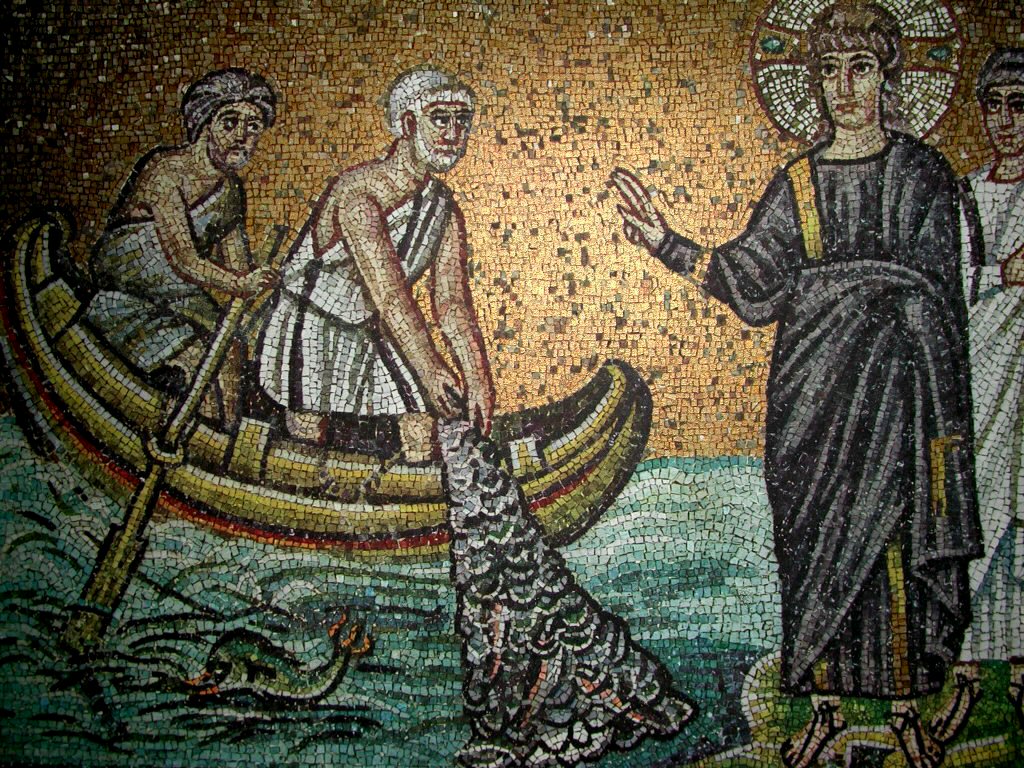
As Jesus passed along the Sea of Galilee, he saw Simon and his brother Andrew casting a net into the sea– for they were fishermen. And Jesus said to them, “Follow me and I will make you fish for people.” And immediately they left their nets and followed him. As he went a little farther, he saw James son of Zebedee and his brother John, who were in their boat mending the nets. Immediately he called them; and they left their father Zebedee in the boat with the hired men, and followed him. Mark 1:14-20.

Mark’s Gospel offers us some unique insights into the Christian life for the third week of Epiphany. After John the Baptist’s arrest, Jesus announces the imminence of the kingdom of God, requiring repentance and calling for hope (belief “in the good news”). Mark sets the story on the sea of Galilee, known for sudden storms. The men who made eked out their living fishing on these waters worked very hard, were heavily taxed, and struggled with many of the same day-to-day issues we know so well. I’ve known men like this, and they are not easily moved.

So, Jesus meets two sets of brothers: Simon and Andrew, and James and John (who Jesus later nicknamed the “Sons of Thunder”). He calls to them to follow him, and each of these men leave behind their work, their families and their homes to follow Jesus. As we discussed in the call of Samuel, God has a funny sense of timing, and his message often interrupts us when we’re trying to do something else. Perhaps these men were just ready to hear a message of hope and forgiveness. Perhaps they were ready to hear the message that evil doesn’t win and that there’s another way to live.

I think, however, that this arresting story of the origins of the Church sheds a good deal of light on the kind of man Jesus must have been. He must have been a remarkably compelling figure, this itinerant preacher walking along the Galilee. Mark’s Gospel reports that the decision to follow Jesus occurred “immediately”, suggesting that their hopes for the promised good news overcame their fears and their attachments. The passage also suggests these men felt a sense of urgency, that they couldn’t put off their walk with God any longer or take care of a few little things beforehand. May it be so with us, too.

The Gospel teaches us something important about our path to discipleship. Very few of us will start or travel down this path of conversion alone. Conversion, whether we’re turning away from or turning toward something, is a difficult process, and most of us will need to take a friend, a brother or a sister along for the journey. Jesus called these disciples into a vocation of hope and forgiveness and a relationship with the living God. These two sets of brothers felt impelled to leave behind their ordinary, workaday lives and follow Jesus. May it be so with us, too.

Finally, Scripture teaches us an important lesson about being a disciple. Then and now, following Christ will require that you’re going to have to leave some things behind. In the case of these men, it was their boats, their nets, their jobs and their families. For some of us, it may be habits, outlooks, destructive relationships, or the fears that bind us to the present moment. The disciples found a way to leave those things behind. May it be so with us, too.

Shabbat shalom,

James R. Dennis, O.P.

© 2012 James R. Dennis