Tag Archives: Jesus

Living In Love

Putting away falsehood, let all of us speak the truth to our neighbors, for we are members of one another. Be angry but do not sin; do not let the sun go down on your anger, and do not make room for the devil. Thieves must give up stealing; rather let them labor and work honestly with their own hands, so as to have something to share with the needy. Let no evil talk come out of your mouths, but only what is useful for building up, as there is need, so that your words may give grace to those who hear. And do not grieve the Holy Spirit of God, with which you were marked with a seal for the day of redemption. Put away from you all bitterness and wrath and anger and wrangling and slander, together with all malice, and be kind to one another, tenderhearted, forgiving one another, as God in Christ has forgiven you. Therefore be imitators of God, as beloved children, and live in love, as Christ loved us and gave himself up for us, a fragrant offering and sacrifice to God.  Ephesians 4:25-5:2.

The New Testament reading from the Lectionary is taken from the Letter to the Ephesians.  Most scholars date this letter between 80 and 100 A.D., as the Church is maturing and struggling to practice a Christian life in community. The writer (perhaps Paul or perhaps one of his disciples) is deeply concerned with the notion of relationships, and the idea that our relationships with each other mirror our relationships with God.

The lesson begins with the notion of truth, of “putting away falsehoods.” Deception inhibits any chance for real love, and dealing with each other honestly provides the foundation for our relationship with God.  The call to the Christian life is more than a call to avoid lying or manipulation; God calls us to live our lives transparently.

Ephesians offers a unique theology behind this call to the truth–not simply that deception makes God angry or will keep us out of heaven.  Rather, Christ calls us into the truth because our lives are intertwined, because we are each other’s limbs. Deception infects the entire body, of which we are a part.  By setting aside falsehood and deception, therefore, we avoid self-mutilation, the destruction of the body of which we are a constituent part.

Ephesians then warns us against anger, and against allowing it to fester. The text cautions us against letting the sun go down on our anger because allowing resentment to build up makes “room for the devil.”  In my family, we used to joke about Irish Alzheimer’s:  that’s where you forget everything except the grudges.  Ephesians cautions us to work out our difficulties with our brothers and sisters quickly, before the infection of rage and resentment begins to spread.

The writer of Ephesians cautions us about our speech, warning us to avoid quarreling and slander.  The language of encouragement should provide the fundamental grammar of Christians. Rather than gossip, criticism or idle speech, we should immerse ourselves in the vocabulary of comfort and inspiration. We must all become wildly proficient in the language of blessing.

Ephesians then directs us:  “be kind to another.” There’s nothing new in this message; Jesus gave the same direction regularly. For the Christian, compassion and forgiveness are the fundamental currency of our economy. Grace must become our lingua franca: the basis of all our relationships. The text calls us to imitate God’s love in our dealings with each other.  We are called into a kind of profligate, extravagant love in Christ.  As the Dalai Lama has said:  “Be kind whenever possible.  It is always possible.”

The Letter to the Ephesians teaches us about the profound correlation between this new relationship the early Church had discovered with Christ and the everyday, concrete relationships in the world.  It teaches that we can never divorce the our spiritual lives from our workaday associations in our families and communities.  Authentic Christian spirituality is never simply ethereal or private: we live it out every single day, with every person we meet and with every word we speak.

Shabbat Shalom,

James R. Dennis, O.P.

© 2012 James R. Dennis

No Hands But Ours

“God aids the valiant…both to you and to me He will give the help needed.”

–St. Teresa of Avila

Not all that long ago, I went through a very dispiriting week.  Three of my friends had been struggling with cancer.  The husband of my oldest friend in the world was being treated for bladder cancer at M.D. Anderson.  Another very close friend had just been diagnosed with stage 4 throat cancer.  That same week, my cousin was treated for the fourth reoccurrence of thyroid cancer.

Each of them had endured that ghastly, medieval horror we so unhelpfully call a “treatment”: chemotherapy.  Two had adopted children and taken them into their homes.  One of them is a single parent.  One of them had no insurance, so I had a little skin in the health care debate and I was terrified about what this might mean for my friend and the family.

I’m not sure why, but way too often the people I love and terminal illness have intersected.  All of that provides the backdrop for the week I was telling you about.  That Thursday morning I got a call that a friend of mine, a law school classmate with whom I played lots of golf and lots of 42 (a poor man’s bridge played with dominos), had been killed while riding his bicycle with his 17-year-old son.  The son had gotten winded and stopped to rest, while Larry rode ahead.  A few moments later, his son rode up on the scene of the accident where his father lay dying.  My friend Larry was struck by a car driven by a 22-year-old girl, and we’re not sure why she veered out of her lane of traffic.  Then on that Friday morning, I got another early morning phone call.  Another law school classmate of mine lost his 27-year-old son in a bizarre accident.

I reached a couple of thoughts about the gut wrenching kaleidoscope of these events.  The first of these is that I may be a bit of a Jonah, and would understand perfectly if folks were to scootch away or avert their eyes when they see me walking toward them.  Second, I think being a friend, being a Christian, is a contact sport.

As Teresa of Avila said, “Christ has no body on earth but yours, no hands, no feet on earth but yours.”  Nothing in this world is harder, or more essential to the Christian life, than being present while someone you love suffers and bearing witness to their pain with them.  I think that’s part of the power of the image of Mary at the Cross, watching and aching as her son gave up his life.  Seeing these events unfold around me, I’m reminded of something the Tin Man said in the Wizard of Oz: “Now I know I have a heart, because it’s breaking.”

Third, when I heard about my friend Larry’s accident, I actually found the strength, through God’s grace alone and no achievement of mine, to immediately say a prayer for the young woman who had struck him.  I have no idea how this accident will change her life or the life of her family, but I know she needs God’s presence through this.  And somehow, I felt better myself after praying for her.

A couple of years ago, I was asked if I was involved in pastoral care at the church, and I answered that no, I was not.  While my answer was honest, I’m not sure that it was accurate.  I think all of us are called upon, regardless of what we consider to be our ministry, to be the hands and face of Christ from time to time.  Maybe these events were just some sort of coincidence.  Or maybe, as Einstein once said, “Coincidence is God’s way of remaining anonymous.”

I think that what might pass in the secular world for caring and compassion is, for us Christians, a statement of our faith.  It is our way of cursing the darkness with which this world confronts us, and speaking to the love of Christ and the promise of Easter.  As the chaplain of Austin College recently observed, “Easter is not about denial, it’s about defiance.” Our caring for one another speaks to the power of love to overshadow pain.

Depending on the circumstance, as I have confronted these events, I may not have even mentioned Jesus or faith or prayer.  I tend to follow St. Francis’ advice in these circumstances, that we should preach the gospel in all times and in all places, but only use the words when necessary.  I hope that I won’t hear Jesus telling me someday that I did it wrong, that he won’t recognize me because I didn’t recognize him in this context.  I know that it is only through my faith that I can stand to watch people I love suffer, and that I can go on living without making sense of these events.  I’ve begun to believe that, for those of us who follow Jesus, the work of bearing witness to the love of God through moments of pain may be the real cost of taking up the cross.

God’s great peace on you and your house,

James R. Dennis, O.P.

© 2012 James R. Dennis

Deeds of Power

Jesus left that place and came to his hometown, and his disciples followed him. On the sabbath he began to teach in the synagogue, and many who heard him were astounded. They said, “Where did this man get all this? What is this wisdom that has been given to him? What deeds of power are being done by his hands! Is not this the carpenter, the son of Mary and brother of James and Joses and Judas and Simon, and are not his sisters here with us?” And they took offense at him. Then Jesus said to them, “Prophets are not without honor, except in their hometown, and among their own kin, and in their own house.” And he could do no deed of power there, except that he laid his hands on a few sick people and cured them. And he was amazed at their unbelief.

Then he went about among the villages teaching. He called the twelve and began to send them out two by two, and gave them authority over the unclean spirits. He ordered them to take nothing for their journey except a staff; no bread, no bag, no money in their belts; but to wear sandals and not to put on two tunics. He said to them, “Wherever you enter a house, stay there until you leave the place. If any place will not welcome you and they refuse to hear you, as you leave, shake off the dust that is on your feet as a testimony against them.” So they went out and proclaimed that all should repent. They cast out many demons, and anointed with oil many who were sick and cured them.  Mark 6:1-13.

Mark’s Gospel for the Sunday Lectionary offers us several insights into Jesus.  You may remember a couple of weeks back, as the disciples were caught in a terrible storm, they wondered,  “Who then is this, that even the wind and the sea obey him?” Mark 4:41.  Last week, in Chapter 5, we heard a partial answer to that question, in the stories of Jairus’ daughter and the woman who touched Jesus’ cloak.  I think today’s reading may also help us unlock the answer to that question.

Jesus returns to Nazareth, to his hometown.  Teaching at the synagogue, he astonishes the crowd there.  They marvel at his wisdom, his teaching, and at his “deeds of power.”  Like many of us, however, a profound distrust soon overcomes their sense of awe.  They wonder, “How can this be so?  We know Jesus, and we know his family.  He’s just a simple carpenter.”

Often, I think, we lose the irony of Mark’s next phrase.  “And he could do no deed of power there, except that he laid his hands on a few sick people and cured them.”  Most of us would probably find such a miraculous hearing sufficient, if not extraordinary.

Mark does seem to link, however, the occurrence of the miraculous with the community’s ability to trust God, with the community’s faith.  That’s an interesting reversal of the way we often think of miracles.  We sometimes think, “Lord, if you will only (insert something miraculous here), then I’ll be able to believe.”  Mark, however, suggests that miracles are a consequence of faith, rather than a cause of it.  (The theological footing here may not be completely sturdy, in that it suggests that God’s power hinges on us and our belief.  I have serious questions about that view, but Mark seems to suggest it strongly. I’m inclined to suggest an alternate hypothesis:  Our trust in God opens our eyes to the everyday miracles that surround us.)

In the next passage, Jesus continues his ministry, and actively begins the process of the disciples’ formation.  He sends the disciples out in pairs, giving them authority over “unclean spirits.”  He sends them out with only a staff, and no provisions for the journey.  Jesus sent them out to proclaim his message of repentance, and they cured many and cast out demons.  I think this notion of “travelling light” will also help us answer the question “Who then is this, that even the wind and the sea obey him?”

Like their Rabbi, the disciples would not travel with either pomp or plenty.  They travelled, as Jesus did, sharing in the people’s need and vulnerability.  The twelve would learn to abandon the illusion of self-sufficiency.  The disciples would have to learn to trust God’s people, to trust each other, and most importantly, to trust God.  They would learn to be the instruments of grace and faith, and learn to be the music those instruments played.  Through the Incarnation of this Jesus, they would learn what the Kingdom looked like, and learn that God wanted to bridge His separation from mankind.

Throughout their time with Christ, they would begin to understand the answer:  “Who then is this, that even the wind and the sea obey him?”  I hope we begin to understand, too.  Lord, we believe; help our unbelief.

Shabbat Shalom,

James R. Dennis, O.P.

© 2012 James R. Dennis

Loving Everyone

Do all you can to love everyone.  If you are not yet able to, at the very least don’t hate anyone.  Yet you won’t even manage this if you have not reached detachment from the things of this world.
You must love everyone with all your soul, hoping, however, only in God and honouring him with all your heart.
Christ’s friends are not loved by all, they sincerely love all.  The friends of this world are not loved by all, but neither do they love all.
 Christ’s friends persevere in their love right to the end.  The friends of this world persevere only so long as they do not find themselves in disagreement over worldly matters….
 This is the Love about which it is written:  “if I have prophetic powers, and understand all mysteries and have all knowledge, but have not love, I am nothing.” [I Cor. 13:2]
Whoever has love has God, because God is love.  [1 John 4:16].

                                       –Maximus the Confessor, Centuries on Charity

I found this wonderful bit of wisdom in the reading for today in Thomas Spidlik’s book, Drinking From the Hidden Fountain.  I have previously written about Maximus the Confessor (see here), and won’t repeat that discussion in this post. I have, however, always found Maximus to be a source of great wisdom.

Perhaps no part of the Christian life challenges us more than Jesus’ injunction that we are to love all of God’s children.  This means loving the clerk in the grocery store who really perturbs me, the fellow in the gym who seems so full of himself, and the horrible gossip at Church.  It means loving the people who’ve wounded me, even those who remain unrepentant.

The Christian life demands that we love without regard to the question of who deserves our affection, without regard to their kindness, without regard to their history, and without regard to their merit.  That’s no small part of what underlies the Parable of the Good Samaritan, and it certainly  provides the foundation for Jesus’ teaching:  “You have heard that it was said, ‘You shall love your neighbour and hate your enemy.’ But I say to you, Love your enemies and pray for those who persecute you, so that you may be children of your Father in heaven; for he makes his sun rise on the evil and on the good, and sends rain on the righteous and on the unrighteous.” Matt. 5:43-46.

Those of us who follow Jesus walk down a difficult path, especially the road of loving our enemies.  Too often, I hear people make the Faith sound easier than it is.  Following Christ is hard; it is as hard as the nails on the Cross.  St. Maximus urges us take the discipline of the Christian life seriously.  I need to hear his voice more often.

I wish you a safe and happy holiday, and may the peace of Christ disturb you profoundly,

James R. Dennis, O.P.

© 2012 James R. Dennis
So That She May Be Made Well, and Live

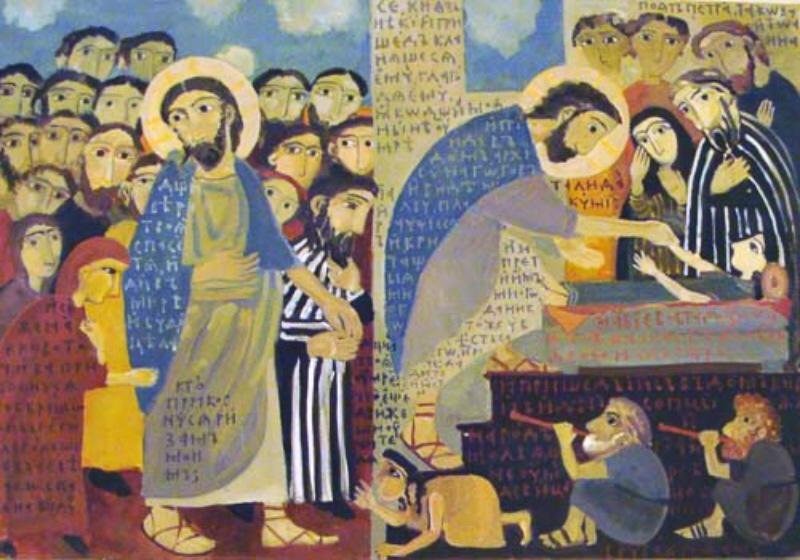
When Jesus had crossed again in the boat to the other side, a great crowd gathered around him; and he was by the sea. Then one of the leaders of the synagogue named Jairus came and, when he saw him, fell at his feet and begged him repeatedly, “My little daughter is at the point of death. Come and lay your hands on her, so that she may be made well, and live.” He went with him.

And a large crowd followed him and pressed in on him. Now there was a woman who had been suffering from hemorrhages for twelve years. She had endured much under many physicians, and had spent all that she had; and she was no better, but rather grew worse. She had heard about Jesus, and came up behind him in the crowd and touched his cloak, for she said, “If I but touch his clothes, I will be made well.” Immediately her hemorrhage stopped; and she felt in her body that she was healed of her disease. Immediately aware that power had gone forth from him, Jesus turned about in the crowd and said, “Who touched my clothes?” And his disciples said to him, “You see the crowd pressing in on you; how can you say, `Who touched me?'” He looked all around to see who had done it. But the woman, knowing what had happened to her, came in fear and trembling, fell down before him, and told him the whole truth. He said to her, “Daughter, your faith has made you well; go in peace, and be healed of your disease.”

While he was still speaking, some people came from the leader’s house to say, “Your daughter is dead. Why trouble the teacher any further?” But overhearing what they said, Jesus said to the leader of the synagogue, “Do not fear, only believe.” He allowed no one to follow him except Peter, James, and John, the brother of James. When they came to the house of the leader of the synagogue, he saw a commotion, people weeping and wailing loudly. When he had entered, he said to them, “Why do you make a commotion and weep? The child is not dead but sleeping.” And they laughed at him. Then he put them all outside, and took the child’s father and mother and those who were with him, and went in where the child was. He took her by the hand and said to her, “Talitha cum,” which means, “Little girl, get up!” And immediately the girl got up and began to walk about (she was twelve years of age). At this they were overcome with amazement. He strictly ordered them that no one should know this, and told them to give her something to eat.  Mark 5:21-43.

In today’s Gospel, Mark offers two portrayals of Jesus as a healer.  The first concerns the story of a man named Jairus whose daughter is dying.  Mark describes Jairus as a leader of the synogogue, which also reveals that some Jewish authorities looked up to and relied on Jesus.  While Jesus is on the way to help Jairus’ little girl, something remarkable happens.

Mark breaks into the story of Jairus and his daughter with an interlude, a story about a woman with a blood disorder.  This woman approaches Jesus, a woman who who had “suffered” and “endured” a lot.  Her disease had isolated her, hurt her, and left her penniless.  And yet, she believes that merely touching the hem of Jesus’ cloak will make her well.  She is cured, and moreover, Jesus tells her that her faith has made her well.

By the time Jesus arrives at Jairus’ home, the mourner’s announce that He has come to late and the child has already died.  Jesus counsels Jairus, “Do not fear, but trust.”  Jesus tells them that the child is not dead, but merely sleeping.  Jesus takes the little girl by her hand and tells her to get up, and she rises and begins to walk.

At the time of these events, Jairus’ daughter was twelve years old.  The woman had suffered from her hemoraging for twelve years.  These two are linked together, as the life flows out of them.  We might certainly read these stories in the light of the people of Israel (the twelve tribes).  One is a daughter of a man of honor and prestige, the other an “unclean” woman lost in her desperation.  Both the woman with the blood disorder and the little girl who had died are impure; by touching them, Jesus will share in this impurity.  And yet, through the touch of this unique Rabbi, both will find new life.

I think we miss the point of this narrative if we merely read it as a story about how Jesus was really good at conquering disease and even death.  I don’t think the message of the Incarnation was to simply to show us that God could work miracles.  Rather, God became man to show us how deeply he loved us and how he wanted to heal the wounds that separated us from Him.

Both Jairus and the woman with the blood disorder ask “to be made well” (sozo in the Greek).  This implies not just a curing them from their physical ailments, but also making them whole, restoring them, saving them.  Both Jairus’ daughter and the hemoraging woman were made well.  But Jesus offered them more than simply restoration of their health; He offered them life.

I don’t think these two stories are simply about Jesus’ remarkable power, or even about miracles.  Jesus didn’t come to show us how powerful He was; He came to show us how much God loved us.  He came to teach us about the extraordinary power of faith, and about the limitless compassion of the Living God.  And if we will reach out to touch His Son, we also will be made well, and live.

Shabbat Shalom,

James R. Dennis, O.P.

© 2012 James R. Dennis
Peace! Be Still!

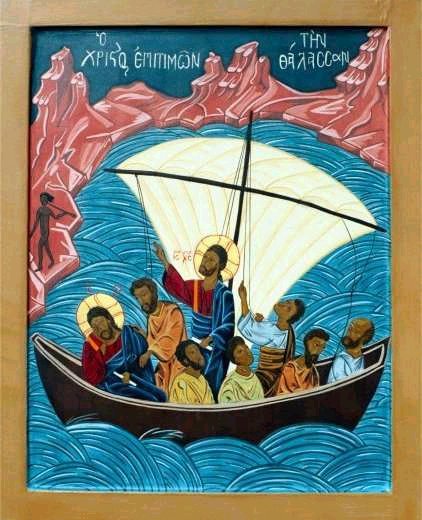
When evening had come, Jesus said to his disciples, “Let us go across to the other side.” And leaving the crowd behind, they took him with them in the boat, just as he was. Other boats were with him. A great windstorm arose, and the waves beat into the boat, so that the boat was already being swamped. But he was in the stern, asleep on the cushion; and they woke him up and said to him, “Teacher, do you not care that we are perishing?” He woke up and rebuked the wind, and said to the sea, “Peace! Be still!” Then the wind ceased, and there was a dead calm. He said to them, “Why are you afraid? Have you still no faith?” And they were filled with great awe and said to one another, “Who then is this, that even the wind and the sea obey him?”  Mark 4:35-41.

In the Gospel reading from today’s Lectionary, we find Jesus and the disciples after a long day of teaching and healing.  In fact, the crowds had swelled to such a point that Jesus had preached from the boat as the crowd listened on land.  Jesus devoted much of his teaching that day to explaining about the Kingdom of God.  I think we might interpret today’s Gospel in that context, although Jesus will now show the disciples what the Kingdom is like.

When a violent storm arises and threatens to swamp their boat, the disciples feel a genuine terror.  I have often asked the exact question that they raise:  “Do you not care that we are perishing?”  I have often asked God almost exactly the same question:  “Can you not see what’s going on down here?”  We wonder where God is while we struggle through our troubles, our danger, and our fears.  And yet, the disciples found that their rabbi was with them all along, sleeping in the stern of the boat.  So, this story suggests that while we are panicking in chaos and certain that we are perishing, Jesus remains right there with us, in the middle of the storm.

Mark tells us that Jesus rebuked the storm, telling the maelstrom:  “Peace!  Be still!” We all wish that we could give such instructions when chaos arrives.  What would happen if we could rebuke cancer, or automobile crashes, or church fights, telling them:  “Be still!”  Even the wind and the sea obeyed Jesus, but I suspect that’s mostly because Jesus had such a profound trust of the Father.

Earlier, I suggested that this Gospel passage, like those that immediately precede it, is about the Kingdom of God.  Jesus can sleep through the storm because He knows that God reigns over all, and wants to take care of, all creation.  While the control of meteorological events may seem beyond most of us, trusting God is well within our reach.  Perhaps then, we too can be still.

I wish you Sabbath peace,

James R. Dennis, O.P.

© 2012 James R. Dennis

Our Fathers

In my home, I grew up believing that there were four High Holy Days of the year, consisting of the Sunday of: the Augusta National Invitational (generally known as “The Masters”), the U.S. Open, the British Open, and the PGA.  One of them, the final round of the U.S. Open, always falls on Father’s Day.  On Father’s Day, more than most other days, I think of the question that folks sometime ask me: “If you could have anything in the world you wanted, what would that be?”  My answer is always the same:  I want one more round of golf with my Dad.

My first recollection is of going to the golf course with my father.  I couldn’t have been more than two or three years old, but still remember the smell of freshly cut grass.  I’m one of the kids who grew up on the back of a golf cart.

At around the same time, my family was building our first house.  My father made the carpenters leave a row of nails at around 3 feet high.  Every day, when my father got off from work, he would take me to our new house, and I would hammer the nails in, so that I could feel like I had a part in building our house.  My father could not have said any more clearly to me:  “You matter.  You are important, and have a critical role to play here.”

Years later, my father would drop my brother Patrick and me off at the golf course while it was still dark outside.  Those may still be my happiest memories.   In the half-light of a West Texas morning I learned that family mattered, that golf mattered, and that my brother mattered.  The latter took a while to sink in….

I also dearly love the conspiratorial bond that my father and I developed.  For example, my mother hated guns.  On my ninth birthday, after considerable unseemly begging, my father bought a .22 for me.  On our way home from the gun shop, my Dad looked at me and told me that “You don’t have to tell your mother everything you know about.”  He was a man of considerable wisdom.

Not long after that, my grandmother died.  I remember sitting next to my father in that small church in Rotan,Texas.  My father wore sunglasses throughout the service, so that no one could see that he was crying.  The boy who held his hand throughout the service could see those tears, however.  In some sense, that was an honor reserved for those he valued.  I was his son and he was my father.  He told me once that the process of elimination was no way to live my life.  He was right. When my father died, I gave his eulogy.  I was gravitationally compelled to recall Dylan Thomas’ eulogy of his own father: “And you, my father, on that sad height Curse, bless me now with your fierce tears I pray. Do not go gentle into that good night.”

There is something sacred about our fathers.  Scripture recognizes this in so many important ways.  When the disciples asked Jesus how to pray, he taught them to begin “Our Father….”  I don’t think there’s anything accidental about that.  John reports that Jesus said:  “I am the way, and the truth, and the life. No one comes to the Father except through me. If you know me, you will know my Father also. From now on you do know him and have seen him.” John 14.6-7.  Why did Jesus so often refer to God as “the Father”?  I don’t think there’s anything sexist going on here.  Rather, I think there’s a sacred recognition of what goes on between fathers and their children.

I have no intention of minimizing the roles of our mothers.  In fact, I grew up thinking of the Church as Holy Mother.  I do intend, however, to raise up our fathers as people worthy our recollection and of fatherhood as a role worth honoring.  I don’t think of our family lives, or of our church lives, as a zero sum game.  I think we can honor our fathers without minimizing our mothers.  In fact, I think we are morally and scripturally compelled to do so.

It is no coincidence that when he hung on the cross, betrayed by friends and compelled to His humanity in a sacrificial incarnation, Jesus cried out, “Abba, Abba.”  The closest translation of that word is “Daddy.”  When I am alone, when I am feeling weak, I often ask for my father’s help, as well as my Father’s help.  The cry for Daddy comes to us early in our lives, and we ought to remember those who so often answered it.

God has treated me better than I deserved.  Just as He gave me my own father, he has given me spiritual fathers who helped teach me about the things that matter.  The first of these, a priest named Joseph Armshaw, served in my parish in Odessa.  He helped me learn that we could meet God’s children in ways and places that we never expected, and that God’s love for us could manifest itself in liturgy and in thoughtful discussion.  He loved his parish, and more importantly, he loved his parishioners.

Somehow, I forgot those things for several years.  A long time later, I was reminded how God could reveal himself to us through spiritual fatherhood.  Two bishops named John MacNaughton and Robert Hibbs reminded me that our lives were sacred….particularly, that my life could be sacred, if I were willing.  In a devout and caring way, they reminded me that the process of elimination was no way to live my life.  As with so many of the men who have shown me what fatherhood means, they lent me some comfort and strength.  I hope in some way these remarks will tell all these men:  “Thanks.”

Shabbat Shalom,

James R. Dennis, O.P.

© 2012 James R. Dennis

Christian Freedom


 For you were called to freedom, brothers and sisters; only do not use your freedom as an opportunity for self-indulgence, but through love become slaves to one another. For the whole law is summed up in a single commandment, “You shall love your neighbor as yourself.” If, however, you bite and devour one another, take care that you are not consumed by one another. Gal. 5:13-15.

Today’s reading from the Daily Office offers us a glimpse of St. Paul’s notion of Christian freedom.  Earlier in the passage, Paul says that Christ has set us free for freedom.  Gal. 5:1.  Paul notes that Christ has freed us, not only from the yoke of the Law, but also from sin itself. 

Generally, we think of being freed from some sort of difficulty (financial debt, addiction, or a broken heart).  Jesus has not only freed us from the law, He has freed us for a new relationship with the Father.  Thus, St. Paul tells us our new freedom does not liberate us for self-gratification.  If that were so, we would simply trade one set of chains for another.

St. Paul’s next move is somewhat surprising and offers us one of those paradoxes that we so often encounter in Christianity (a virgin birth, Jesus as fully divine and fully human, loving our enemies, etc.).  Paul tells us that Christ brought us liberty so that we might become “slaves to one another.”  We might well ask, “What kind of freedom is that?”   

St. Paul argues that the contrary view of freedom (absolute liberty devoted to selfish goals)  leads to an “eat or be eaten” way of living.  He says, “If, however, you bite and devour one another, take care that you are not consumed by one another.”  His language here conjures up images of wild animals tearing each other apart.  (I’ve certainly been present at dinner parties which would suggest that Paul was right.)  We have too often demonstrated the capacity for greed, humiliation, violence and making a way for ourselves on the backs of others.  Paul is right; we consume each other.

 St. Paul offers us another way: the Way of the Cross.  He tells us “the only thing that counts is faith working through love.”  Gal. 5: 6. Paul believes this new relationship with God compels us toward a life of charity and compassion. This new relationship with Christ draws us into a life of serving each other.  There, we will encounter the freedom to be the sort of people God intended us to be.  Stated another way, Jesus freed us to become the Church, His mystical body.  Beyond compliance with a set of rules and beyond the “righteousness trap”, St. Paul calls us to a life of devoted service to God’s children. 

That life of devotion, of self-denying love, constitutes the essence of the Christian life.  Saint Paul does not see a life in community, spent in the service of God’s children, as the best sort of Christian life.  Rather, he sees it as the only life than can authentically be called “Christian.”

God watch over thee and me,

James R. Dennis, O.P.

© 2012 James R. Dennis

A Season For Everything

For everything there is a season, and a time for every matter under heaven: a time to be born, and a time to die; a time to plant, and a time to pluck up what is planted;  a time to kill, and a time to heal; a time to break down, and a time to build up;  a time to weep, and a time to laugh; a time to mourn, and a time to dance;  a time to throw away stones, and a time to gather stones together; a time to embrace, and a time to refrain from embracing;  a time to seek, and a time to lose; a time to keep, and a time to throw away; a time to tear, and a time to sew; a time to keep silence, and a time to speak; a time to love, and a time to hate; a time for war, and a time for peace.

What gain have the workers from their toil? I have seen the business that God has given to everyone to be busy with. He has made everything suitable for its time; moreover he has put a sense of past and future into their minds, yet they cannot find out what God has done from the beginning to the end. I know that there is nothing better for them than to be happy and enjoy themselves as long as they live; moreover, it is God’s gift that all should eat and drink and take pleasure in all their toil. I know that whatever God does endures forever; nothing can be added to it, nor anything taken from it; God has done this, so that all should stand in awe before him. That which is, already has been; that which is to be, already is; and God seeks out what has gone by.  Eccles. 3:1-15.

Today’s reading  from the Daily Office is taken from the book of Ecclesiastes.  We don’t know much about the writer of this book, who is generally referred to as Qoheleth, often translated as The Preacher or The Teacher.  Although the early Church attributed these writings to King Solomon, The Teacher probably lived much later, about 200-300 years before Jesus.

In the first section of the poem, The Teacher offers 14 pairs of events and their antipodes (keeping and throwing away, killing and healing, seeking and losing), which seem to offer a vision of a sort of balance within the universe.  Throughout the ancient world, the belief in specific, appropriate times ran very deep.  They looked for the right time to plant, to harvest, to build a house, or to begin a battle.  

Aligning one’s actions with divinely set times offered the best chance for success.  In a way, Jesus himself seems to have echoed this notion, having on one occasion told his mother “My hour has not yet come.”  John 2:4; see John 7:6. .  Later, in the Upper Room with the disciples, he said, “Father, the hour has come.”  John 17:1.  At a minimum, Jesus had a keen sense of divine time, and of working within God’s chronology.

The Teacher suggests that both within our lives, and within time itself, creation moves toward a kind of equilibrium.  The teacher also struggled, as many of us do, with questions about the real point of our existence, about the meaning of our sorrows and our joys.  Throughout all the seasons of our lives, God remains the only constant, and God alone remains sovereign.  Jesus announced that quite clearly when He told us, “The time is fulfilled, and the kingdom of God has come near ….”  Mark 1:15.  (Interestingly, these are the very first words the Savior speaks in Mark’s Gospel.) 

Although we struggle and strive, our efforts are mere vanities, as though we were “chasing after the wind.”  Eccles. 4: 16. None of our efforts will add to or subtract from God’s work.  As Rabbi Heschel taught, we will not be able to locate the meaning of our lives abstracted or apart from God.  As the Teacher observed, most of our work, and almost of all of the things we worry about, will pass away.  He tells us, however, that “whatever God does endures forever.”  Because we know that God loves us, we know that His love for us therefore will live forever.  In that, we find the good news, the Gospel.

May we feel that love today and throughout our time,

James R. Dennis, O.P.

© 2012 James R. Dennis

The Spirit of Truth

Jesus said to his disciples, “When the Advocate comes, whom I will send to you from the Father, the Spirit of truth who comes from the Father, he will testify on my behalf. You also are to testify because you have been with me from the beginning.

“I did not say these things to you from the beginning, because I was with you. But, now I am going to him who sent me; yet none of you asks me, `Where are you going?’ But because I have said these things to you, sorrow has filled your hearts. Nevertheless I tell you the truth: it is to your advantage that I go away, for if I do not go away, the Advocate will not come to you; but if I go, I will send him to you. And when he comes, he will prove the world wrong about sin and righteousness and judgment: about sin, because they do not believe in me; about righteousness, because I am going to the Father and you will see me no longer; about judgment, because the ruler of this world has been condemned.

“I still have many things to say to you, but you cannot bear them now. When the Spirit of truth comes, he will guide you into all the truth; for he will not speak on his own, but will speak whatever he hears, and he will declare to you the things that are to come. He will glorify me, because he will take what is mine and declare it to you. All that the Father has is mine. For this reason I said that he will take what is mine and declare it to you.”  John 15:26-27; 16:4b-15.

Today is the Feast of the Pentecost, which serves as the terminus of the cycle which marks and celebrates the life of Christ.  Easter has come and gone; Jesus has ascended to the Father. These events have filled the disciples’ hearts with sorrow.  Their Rabbi, their friend, is returning home and leaving them.

In other sense, however, we sometimes refer to as the birthday of the Church.    The Church must now learn to listen for the voice of God within the community of believers inspired by the Holy Spirit.  Jesus describes the Spirit as the Advocate (in Greek, parakletos).  The word parakletos connotes an advocate in a legal proceeding, who comes to the aid of a witness or a cause.  Just so, the Spirit will come to assist the disciples as they bear witness to the message of Jesus.  The term parakletos also connotes a comforter, an assistant and a companion.

Jesus has assured us of the presence of the Advocate, of the immediacy of the Spirit.  He promises that the Spirit will lead us into the truth. The Spirit will direct us through and to faith, a radical trust in the life and message of Jesus. Our Orthodox brothers and sisters refer to this process as theosis, a journey through which our lives become more and more deeply entwined with the life of the Father and the Son.  Remembering the image of Jesus as the vine, through the Spirit the life of the Father and the Son is grafted onto our lives, our history.

The reading today points also to the unity and interdependence of the Trinity.  Jesus teaches that “all that the Father has is mine” and that the Spirit will take what belongs to Jesus and declare it to us.  Jesus teaches that no member of the Trinity acts independently; similarly we need to learn to live interdependently. Pentecost involves learning to trust God as a companion, and learning to trust each other.

Henri Nouwen once wrote that “education to ministry is an education not to master God but to be mastered by God.”  Pentecost involves listening for the Trinitarian voice within the Church and in the world.  That voice will remain near us and within us.  Jesus promised us that the Spirit of Truth would offer us that sense of comfort, that sense of confidence, that sense of peace.

Pax Spiritus,

James R. Dennis, O.P.

© 2012 James R. Dennis