Tag Archives: God

A Great Chasm

Now he is comforted here, and you are in agony. Besides all this, between you and us a great chasm has been fixed…. (The full readings for this morning can be found here.)

In the name of the Living God, who is creating us, redeeming us, and sustaining us.

Well, good morning, everybody. So, in today’s gospel we encounter a man who’s having trouble with the afterlife and is concerned for his family. Whenever I hear this story, I think about a family we knew back in West Texas, the Beauchamp brothers.

Now, they were not nice people. In fact, everybody in the whole county knew the Beauchamp brothers. In business they were crooked, mean and cold-blooded. Well, one day, the older brother, Howard Beauchamp, he up and died. The younger brother, Ronnie, wanted to make sure that Howard got the finest funeral there had ever been in the county. He went down to the funeral home and bought a fine cherrywood coffin with silver hardware. Then he went to go see the minister.

The little church there was not doing so well. In fact, it was kind of falling apart at the seams. The air conditioner was old and tired, and the roof struggled to keep out the rain. Well, Ronnie Beauchamp, he went to the minister, and he offered him the Devil’s own bargain. He said, “Pastor, I will give your church half a million dollars if you will preach my brother’s funeral and tell everyone he was a saint.” Well, this was a real conflict for the preacher, because the church really needed that money, but he couldn’t lie from the pulpit.

So, the day of the funeral came around, and the whole town was there as the minister began to preach the funeral sermon.  He said, “The man you see in this coffin was a vile and debauched individual.  He was a liar, a thief, a bully, a great sinner, and he broke his mama’s heart.  He destroyed the fortunes, careers, and lives of countless people in this county, some of whom are here today. This man did every dirty, rotten thing you can think of.”

“But, the preacher added, … compared to his brother, he was a saint.”

Now, before we go any further, I want to make a couple of things clear. The passage we are reading isn’t a theological guide about how to get to heaven or how to avoid hell. This passage is one of Jesus’ parables—a riddle or a fable. So, I don’t think the rich man went to Hades because he was rich. And I don’t think Lazarus went to heaven because he was poor. But I do want us to start thinking this morning about the various chasms we encounter: chasms that separate us from each other, the gulfs between us and God—the chasms we come upon, and the chasms we help create.

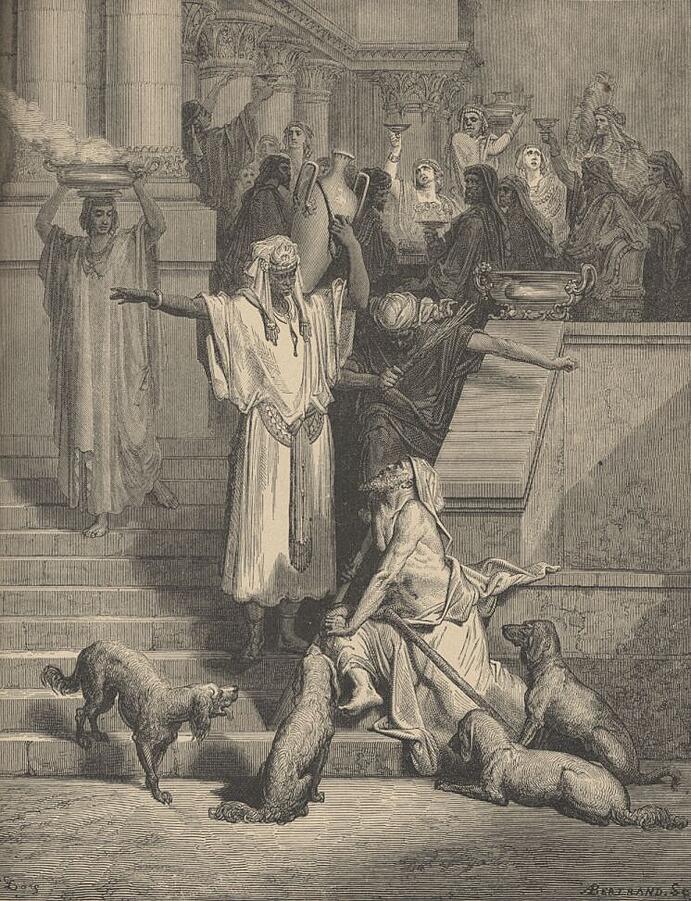
One of the first places we notice a gap, or a distance, is between the circumstances of these two men. We are told that every day, the rich man ate luxurious meals, and he wore fine linen and purple. On the other hand, we can imagine Lazarus in rags, and we’re told he’s covered in sores. He’s also starving, and dreams of eating even the crumbs or scraps from the rich man’s meals.

And although their lives were very different, they did not live far away from each other. In fact, Lazarus lived just outside the rich man’s gate. But we get the feeling the rich man never noticed Lazarus. In fact, I get the impression that the rich man had become quite adept at ignoring Lazarus at the gate, a kind of studied disregard, a well-rehearsed apathy. So, their lives on earth were very far apart; they were separated by a great economic and social chasm.

Then, when the two men die, we have one of those classic reversals of fortune that Luke loves. It’s already happened right from the outset of the story. You see, we know the name of the poor man in the story—his name is Lazarus, which means God’s help. We don’t, however, know the name of the other character; he’s just some rich guy. That’s not how things normally work. We remember the rich and the mighty, and too often the names of the poor and the hopeless are forgotten.

But when their earthly lives are over, the angels carry Lazarus to the bosom of Abraham. In other words, he has a place of peace and comfort and honor among the righteous dead. The rich man, however, finds himself being tormented in Hades. There’s a considerable distance, a chasm, between their circumstances. But even from the fiery pit, the rich man doesn’t seem to recognize his new situation yet. He’s still treating Lazarus like a slave. You see, the biggest lie the devil ever told us is that some lives are worth more than others, that some people are more important than others.

The rich man asks Abraham to send Lazarus with just a bit of water on his finger to ease the rich man’s suffering. Once again, here’s that Lucan reversal of fortune. Abraham tells the rich man: “Child, remember that during your lifetime you received your good things, and Lazarus in like manner evil things; but now he is comforted here, and you are in agony.”

The bigger problem, Abraham explains, is that vast chasm between Lazarus and the rich man. Now, maybe Jesus was trying to tell us that heaven is a long, long way away from hell, but I don’t think so. I think the distance between Lazarus and the rich man is simply the echo and amplification of the separation the rich man created while they were alive. In other words, to borrow an idea from Charles Dickens, they wear the chains they forged in life. Jesus reminds us that there is a deep and profound connection between how we live in this life and how we live in the next life.

So, what are we supposed to do with this passage? What am I supposed to do about the homeless man that I drove by on my way to church this morning? Am I supposed to give him a dollar? Buy him a meal? Pay for him to spend a night in a hotel room? If I do that, will Jesus let me into heaven?

I think the very last thing Jesus wanted to do in his parables was to give us easy answers to these questions. I think we were meant to struggle with this issue, to learn to listen to Moses and the prophets. I also think we have to find a way to close the tremendous gaps between ourselves and our brothers and sisters. We all know about the terrible gap of wealth inequality, and we saw the political distance widen in this country after Charlie Kirk was killed and both parties clawed at each other desperately for a spot on the moral high ground

My friends, as Doctor King warned us, “We must learn to live together as brothers and sisters or perish together as fools.” We know about the chasm between God’s children. I think the biggest chasm I have to struggle with every day is the gap between the man I am and the man I want to be, the distance between the life I’m leading, and the life Jesus wants for me.
I think the first thing is that we notice how deeply, how profoundly, God cares for the poor. This morning, the Psalmist tells us happy are those:

Who give justice to those who are oppressed,
and food to those who hunger.
The Lord sets the prisoners free;
the Lord opens the eyes of the blind;
the Lord lifts up those who are bowed down.

A friend of mine puts it a little differently. He likes to tell me that no one gets into heaven without a letter of recommendation from the poor.

Secondly, I think we have to find a way to bridge the gap between us and the broken-hearted of this world. We must find a way to reach across to those who are hungry, to those who live in hopelessness. And we’ve got to quit asking whether they deserve our help, our charity. Quite frankly, that is none of our business. God will figure that out.

I do believe charity is important, and yes, the rich man fails to tend to, or care about, the needs of Lazarus. But there was a sin that came before that, an earlier fault that made all the others possible. He didn’t even notice Lazarus. He didn’t notice the man at his gate. I don’t want to think about the number of times I’ve turned my glance away from the homeless and the poor. And the failure to notice them robs us of any chance we have to make a difference in their lives, to make a friend. So maybe we should begin by noticing them, and I mean this quite literally, for the love of God, notice them. Maybe if we go out of our way, just a little bit, we might learn to share our resources, and more importantly, to share our hearts. Amen.

James R. Dennis, O.P. © 2025

Things Hoped For

“Now faith is the assurance of things hoped for, the conviction of things not seen.” (The full readings for this morning can be found here.)

In the name of the living God, who is creating, redeeming, and sustaining us. Amen. Well good morning, good morning. I thought this morning we’d talk about faith, about different ways some folks have of understanding faith, and about what the scriptures can teach us about that.

When I think about faith, I am often reminded of my great great grandfather. You see, he had come to America from the Old Country, from Ireland. He settled for a while in the Boston area. And he was a very busy man, but a very devout man. Well, one day he had an appointment with the bishop, and he was running late. And there was no place left to park.

As I said, he was a very devout man. And he looked to the heavens and prayed. He said, “Lord, you know I’m here to see the bishop. You know I can’t be late, Lord, and you know there’s no place for me to park. So, I’ll tell you what I’ll do, if you help me find a parking place, I’ll go to mass every day for a month. He looked and there were still no places. And so he added, “And Lord, I’ll give up the whiskey.”

Well, it was a cloudy day that afternoon in Boston, but all of a sudden, the skies parted, and a bright beam of sunshine opened up to reveal a single parking spot right in front of the cathedral. And my ancestor looked up to heaven and said, “Never mind, Lord. I found one m’self.”

So, I want to suggest something to you, at least a starting premise for us to work from. I want to suggest that faith is much more about who we trust, or where we place our trust, than about what we believe. I’ll say that again: I wonder whether faith isn’t much more about who we trust, or where we place our trust, than about the ideas we have decided to accept.

Let’s look at a couple of examples that might help with that distinction. We all remember the story of Noah and the flood. The earliest claims of having found the Ark in which Noah sought shelter from the flood date back to around 700 BC. Since then, hundreds of people have claimed that they found the ark. Recently, one group is using ground penetrating radar at the Durupinar formation in Turkey and claim to have found the remains of a preserved vessel. But does that have anything to do with faith? If we could scientifically prove this was the ark, and found trace DNA from Noah, would our lives in faith be better?

If we could absolutely prove the story of Noah and the flood, we might have a very fine argument or some fascinating dinner conversation—we might even have some certainty.  But certainty is not an environment in which faith thrives. Because faith, the scripture teaches us, is the conviction of things not seen. Our discovery of the ark might prove something we could all see with our eyes, but faith looks beyond the visible, the provable, to what can only be seen with the heart.

Let’s examine question, the very old question of which religion offers us the surest path to salvation. So, we have been fighting about our beliefs for a long time: about whether you could have pictures of Jesus in the church, about calculating the date of Easter, and about how Jesus really really gets into the communion host. In the 1960s, one group of the Amish community separated from the main body of the Amish over the question of whether one could wear buttons, or whether one could only be true to their religion by fastening their clothes with hooks and eyes.

We can believe all sorts of things: our beliefs are the conclusions we are led to by our rational minds, the conclusions of our thinking. We can believe that our safety lies in our military might—nuclear submarines that can wipe our enemies off the map. Or you might belief in an afterlife in which all the meals are composed of chocolate cake and crème brûlée, where the streets are made of peanut brittle. Or maybe you believe the government is listening to our every thought through a complex system of internet connections, cell phones, and vaccinations.  I don’t really care whether you think  UFOs come down each summer to swim with the Loch Ness Monster and discuss how we faked the moon landing. You might believe that our salvation only lies in eating unleavened bread while listening to the Star-Spangled Banner and staring at an isosceles triangle.

I am not especially concerned with what you believe: Beliefs change; they are constructs of our mind. So, I’m not especially concerned with that. But I am profoundly concerned with your faith, with the place where your trust abides, and how that trust shapes the way you live your life.

That kind of faith reshapes the world and makes it ready for God’s word to vibrate through creation. This is a music that can only be heard with the heart, a music that assures us that God knows of our deepest hopes. Abraham heard that music of faith, and followed God when God told him to leave behind his home and everything he’d ever known. Abraham trusted God when God told him he would have children, even though both he and his wife were too old. And even when God asked him to give up his only son, Abraham trusted God and knew that somehow it would all work out right.

So, I’ll tell you a secret. I think that kind of trust, that deep faith or “assurance of things hoped for,” usually comes only after you’ve had your heart broken a time or two and learned where you can find shelter—who you can depend on, what you can trust. That kind of trust will necessarily influence our actions, influence how we walk through the world. In our modern world, faith (or trust) is so very hard to come by. We have become so jaded, so suspicious of each other and our institutions.

Back in the earliest days of the Church, those first Christians knew about sorrow, and suffering, and broken hearts. And it took them about 300 years to articulate who they could turn to, who they could trust. And they gathered together to work out their ideas down at a place called Nicaea. We still say their prayer, and we’ll recite it in just a moment.

They said they trusted God, “the maker of heaven and earth, of all that is, seen and unseen.” Do you hear that prayer echo in the reading from Hebrews: “the worlds were prepared by the word of God, so that what is seen was made from things that are not visible.” They trusted in Jesus, Mary’s boy, who promised he would be with them until the end of time. They had faith because Jesus told them it pleased his Father to give them the kingdom. The had faith in the Spirit which had moved across the waters, the Spirit which came upon them in baptism, and the Spirit which had inspired their Scriptures. And they trusted the Church, although they knew that from time to time a particular instance of the church might let them down.  But that’s not where their faith abided; no, they trusted in the whole church, which is the mystical body of Christ.

The great J.M. Barrie, who wrote Peter Pan, said, “All the world is made of faith, and trust, and pixie dust.” That sounds just about right. I know I have great hopes for us. That hope is invisible, but I am assured of it. “Lord, I believe. Help my unbelief.” Amen.

James R. Dennis, O.P. © 2025

The First Duty of Love


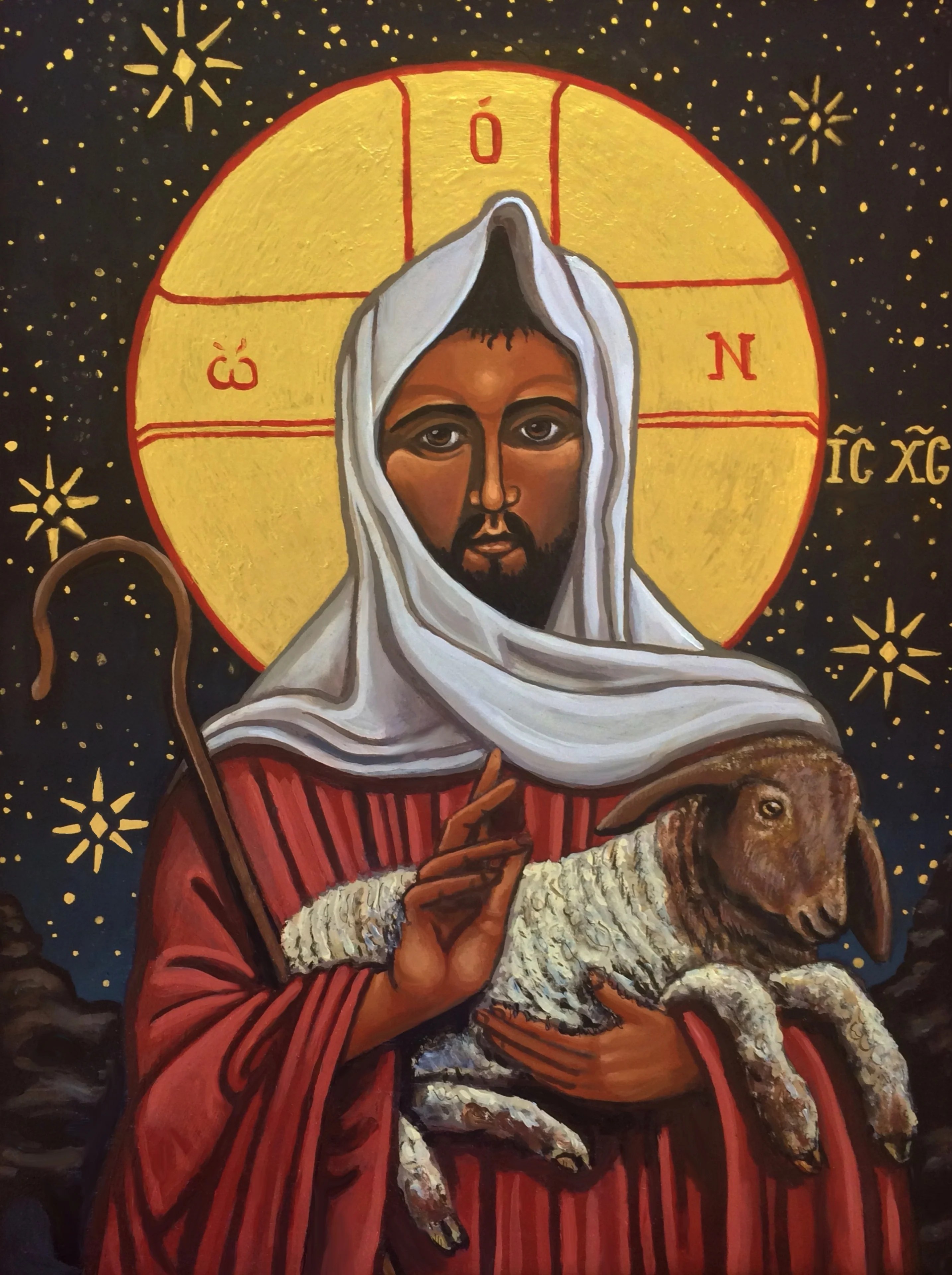
“I am the good shepherd. I know my own and my own know me, just as the Father knows me and I know the Father.” (The full readings for today can be found here.) In the name of the Living God, who is creating, redeeming, and sustaining us.

Well, good morning, everybody, good morning. You know, I’m not sure…no, I’m not sure at all. I’m not sure that I’m qualified to preach on this Good Shepherd Sunday. You see, my people were cattle people. They weren’t sheep people. And cattle people didn’t always get along with sheep people. By “not always,” I mean they never got along with each other.

And while there are a lot of differences between cattle and sheep, a couple of them come to mind. One of the biggest differences is that you can lead sheep, but you have to drive cattle. Unlike cattle, sheep will learn to follow. They build friendships and will stick up for one another. Like us, they are highly social animals, and when they are under stress or isolation, they become sad, and yes, even depressed. And they are very intelligent creatures; they recognize faces and voices. But like us, they will sometimes stray away from the herd, and need to be watched over.

In Jesus’ time, sheep were a mainstay of survival: they provided milk and cheese, and sometimes meat for the family and for sacrifices. They also provided wool for warm garments. But I think there’s something going on in John’s gospel than a discussion of first-century animal husbandry or livestock. I think this gospel reading is, at its core, about how we love, and how we are loved.

So, I think we should note a couple of things before we go on. And for this, I think we have to go all the way back to the beginning of John’s gospel, back to the very first time we meet this man called Jesus. You may remember that John was baptizing people in the river Jordan when he saw Jesus and shouted out: “Here is the lamb of God who takes away the sins of the world.” Now, lambs had been used as sacrificial animals for a long time by the Jewish people and were particularly associated with the holy feast of Passover.

We hear this same image, this same symbolic language in the last passage of John’s gospel, where the resurrected Jesus and Peter sit by a charcoal fire after breakfast.  And Jesus makes clear to Peter that Peter’s assurance of love carries with it a tender and sometimes difficult office, an obligation to feed his sheep. So, I want to suggest if we find this image being used in the beginning of John’s gospel, at the end of his gospel, and this morning pretty much in the middle of the gospel, we can probably safely assume that John thought this was important.

But as we read this, we might be forgiven if we have a moment of confusion. Is Jesus the lamb or the shepherd? Why is Peter feeding the sheep? Are we the sheep, or is Jesus the lamb? Quite frankly, it seems a bit complicated, and a little bewildering.

I think at least part of the answer lies, perhaps a bit veiled, in Jesus’ statement: “I am the good shepherd.” It’s one of what’s called the “I am” sayings of Jesus: you know, “I am the Bread of Life”, “I am the Light of the World”, “I am the vine,” and “I am the Good Shepherd.” In doing so, Jesus is aligning himself with a very old understanding of who God is. You remember the story from the Book of Exodus, when Moses asks God his name and God replies, “I am who I am.” For John, there is no difference between God and Jesus, the Word, the Logos. And for John, there is no difference between listening to Jesus and listening to God.

Jesus distinguishes his role from that of a hired hand. And at least part of the distinction has to do with how they react when the wolves come. Whether you’re a cattle person or a sheep person, you know about wolves. Lord have mercy, I believe we all know about wolves. You can find them in any walk of life—in business, in politics, and on our television screens. Sometimes those wolves come disguised as ambition or greed, sometimes as addictions, sometimes as failure, and sometimes as desperation.

You might argue that the distinction between the Good Shepherd and the hired hand is about their level of commitment. Perhaps the hired hand acts out of self-interest, while the Good Shepherd isn’t afraid of the wolves and understands his responsibilities. But I think there’s something more there. I think the Good Shepherd doesn’t run away when the wolves come because he acts out of something much more profound. Love, and only love, hangs around when the wolves come. Love, and only love, is willing to stand its ground when the situation gets risky. Only that kind of love is willing to lay down its life for the beloved.

Now, here’s the good news. We are the beloved. And Jesus is telling us that he loves us like that, that God loves us like that. And that kind of love doesn’t even ask what it costs, because it knows what it’s worth.
Later in this same Chapter of John, Jesus tells us “My sheep hear my voice. I know them, and they follow me.” I often wonder how well I’m listening for the voice of Jesus. When I get busy, when I get worried, or when I’m simply careless, it’s hard to hear.

You know, a very famous theologian named Paul Tillich said, “The first duty of love is to listen.” That’s worth repeating: “The first duty of love is to listen.” We have a lot of choices in this world as to which voices we’ll listen to. We can listen to the voices that tell us that our neighbors aren’t like us—voices that tell us that they’re not as smart as we are, or they’re freeloaders, or they’re dangerous. Or we can listen to the voices that tell us this world is full of risk and danger, that we might not have enough, or the voices that tell us that our lives will finally make sense if we just get that new car, that new outfit, that new iPhone, or earn enough to retire. We can listen to those voices that tell us that we’re not quite smart enough, not quite pretty enough, or not quite good enough.  

Or we can listen to the voice of the One who will never run away when the wolves come, the one who offers us forgiveness, the one who came to show us what an abundant life really looks like. We can listen to the One who laid down his life for us, who said he’d never leave us, who says he’s with us always, even to the end of time. That kind of voice, that kind of love, is hard to fathom; in fact, it’s one of life’s deepest mysteries.

We are sometimes told, “You are what you eat.” I think it’s equally true that we are what we listen to. The voices we hear can shape us in powerful ways. Genuine listening is an attitude of the heart, a vulnerability to the holy. If indeed the first duty of love is to listen, the choice we are compelled to make is which voice we are going to listen for. Maybe, just maybe, if we listen in love, we will hear the voice of the One who loves us limitlessly, who loves us fearlessly. Amen.

James R. Dennis, O.P. © 2024

Looking for the Light

While he was saying this, a cloud came and overshadowed them; and they were terrified as they entered the cloud. Then from the cloud came a voice that said, “This is my Son, my Chosen; listen to him!” (The full readings for today can be found here.)

            In the name of the Living God who creates, redeems, and sustains us. Well, good morning, everyone, good morning. First, I need to thank you all for your generous hospitality. It has been a joy and an honor to walk with you through this season of Epiphany. And I’m glad we could all be here together for this great feast day of the Church, the Feast of the Transfiguration.

            And we’ll get to the gospel for today, but before we do, I thought we might spend a few moments reviewing the magnificent kaleidoscope of images the Church has offered us during this season of Epiphany. We began with a crowd of people gathered around this strange prophet John who baptized Jesus by the river. And the sky broke open, and the Holy Spirit came down upon them like a dove, and God spoke: “I am well pleased with my Son, my beloved.” And I’m wondering if you good folk can ever hear God’s voice saying that about you, because I’m pretty sure that’s how God feels. And we wonder if that’s what a life with the Spirit is like—like being the favorite child.

            Now, turn that kaleidoscope just a little bit, and we find ourselves at a wedding. And we overhear Jesus’ mother, nudging him to do that God thing even though he says it’s not time yet. And we see this remarkable image: six stone jars, filled to the brim with astonishing wine. And we wonder if that’s what life with Jesus is like.

            The Church paints in a rich palette of wonder during epiphany—images of God manifest, God becoming clear to us in bright moments. If you sometimes go to church in the middle of the week, you found yourselves in Caesarea Philippi, considered a holy place for centuries, at the base of Mount Hermon, a place where springs of living water flowed out of nearby caves. And it’s there that Jesus asks that remarkable question: “But who do you say that I am?” Peter answers that he’s the Messiah, the son of the living God. But I think Epiphany is about each of us struggling to answer that question for ourselves. Who do you say that Jesus is? And we might wonder: Are we, too, the rocks upon which Jesus will build his church?

            And then, the next week we saw Jesus, back in his hometown, preaching his first sermon. And he told them about God setting the captives free, and blind people regaining their sight because this was the year of the Lord’s favor. And he rolled up the scroll, and he told them (and he’s still telling us): this is going on all around you. It’s happening now. And we ought to be looking around for it.

            And the next week, we heard the rest of that story. We heard how the congregation became angry because Jesus dared to suggest that God’s love wasn’t just for a select few, that it was available for everyone. And the people were so angry they wanted to throw Jesus off a cliff. And we might wonder about our place in that story.

            And then a week later, we saw these men out fishing on the lake, and they haven’t caught a thing all day until Jesus shows up and tells them to go out into the deep water. And when they do, they get so many fish that their nets are bursting with the catch. And I want you to try and imagine these boats, so full of fish that the boats are about to capsize. And when they return to shore, these men are compelled to follow Jesus wherever he goes, to follow him even to the Cross. And we begin to wonder if that’s what life with God is like—if it’s like going out into the deep water.

            And last week, we hear the story of a brother returning home and confronting his brothers who betrayed him, who almost killed him. And we heard how Joseph, the dreamer, and his brothers wept together. And many of us wept together. And we heard Jesus telling us that we had to forgive our enemies because that’s the kind of thing God does and we are God’s children. And we begin to understand what God is like and wonder if we too can act like that.

            All of this was kind of a long introduction to this morning’s Gospel, the story of the transfiguration. Now, transfiguration is a churchy word for change, but a particular kind of change: a change in which the light of God begins to shine through in a person’s life. And we began this morning with the story of Moses, coming down from the mountain having wandered for a long time in the desert, with the stone tablets. And the people saw that Moses’ encounter with God left his face shining because a genuine encounter with God will leave you changed.

            And we fast forward to the story of Jesus, who takes his friends up on the mountain to pray, and something remarkable happens. Suddenly, they see Jesus bathed in light, with Moses (who represents the law) and Elijah (who represents the prophets). And smack dab in the middle of them is Jesus, who’s about to make his last trip into Jerusalem. And a cloud comes over them and they’re terrified. You see, sometimes an encounter with the living God will do that: it’s not all unicorns and puppies and glitter.

And I want to make a suggestion. I’m not so sure that Jesus was changed at all. Maybe it was the disciples who had changed, and for the first time, they were able to see Jesus for who he really was. And we’ve come full circle, back to that first week of Epiphany, and we again hear God tell us that Jesus is God’s son, and we really need to listen to what he has to say.

            But the Church wants to leave us with one more image, one more tableau before we leave Epiphany. We see a father, begging Jesus for his help because his son is terribly ill with something like a seizure. And we think about those troubles in our own lives that will scarcely leave us. And we see the power of Jesus to heal us, even as he’s on his way to Jerusalem, even as he’s on his way to the Cross.

            Sometimes, we see God in these remarkable moments, like the Transfiguration. But more often, we see God in some very ordinary places and times: a crummy day of fishing, at a wedding, a troubled family reunion, a father frantically worried about a sick child, and yes, even a sermon that didn’t go so well. God has a funny habit of showing up when we don’t really expect it. God is kinda sneaky that way.

            Now, throughout this journey the Church has taken us on during the season of Epiphany, we’ve seen the stunning power of God, a light that enters into the darkness of our world. But in each of these passages, people saw the light of God because they were looking for it—sometimes, because they were desperate for it. It’s what one psychologist has referred to as the “scout mindset.”  Think of it like those puzzles you used to do when you were a child, where there were shapes of animals hidden in the trees or the landscape. And you could find them because you were looking carefully for them.

If we go looking for the problems or the trouble in this world, we will surely find thembecause they’re out there. On the other hand, if we are looking for the love of God and the ways it’s shown in the world, we’ll find that, too. Epiphany is about learning to look for the blinding incandescence of God in the world. We train our eyes to look for those moments in which the world is aglow with the burnished presence and love of Jesus. I have seen that light here, in this good Parish, and I know it’ll be here when I come back. Amen.


James R. Dennis, O.P. © 2022

Seeing All Things with New Eyes


How are they to hear without someone to proclaim him? And how are they to proclaim him unless they are sent? As it is written, ‘How beautiful are the feet of those who bring good news!’ 

In the name of the living God, who creates, redeems and sustains us.

Well, good evening, good evening my brothers and sisters. Welcome on this holy night, this night when we gather to celebrate the feast of our patron, St. Dominic. And a special blessing upon our brothers Jeffrey, Lee, Mike, Steve and Todd. I wish upon you the special blessing of awe, because what you are about to do is an awesome thing: not in the common parlance or the sense of Bill & Ted’s Excellent Adventure (“Awesome”), but in the ancient sense of the word. My hope for each of you is the blessing of awe, of fear and trembling at what you are about to do.

In episode V of the Star Wars saga, the Empire Strikes back, Luke Skywalker tries to assure the Jedi master Yoda: “I won’t fail you. I’m not afraid.” And Yoda replies, “Good. You will be. You will be.” When I made my life profession, almost 10 years ago, I was petrified. I was filled with what I now realize was a holy terror. Even that night, I wasn’t sure I was going to go through with it.

And there are good reasons to be afraid, because God is going to change your life in ways you don’t understand yet. And God is going to call you to do work you don’t want to do. God is going to call you to praise, even when you don’t agree with God’s work or understand God’s purposes.   And God is going to call you to be a blessing to God’s children, even when they don’t seem like they deserve a blessing, and you are called to enter into the darkest places of this life, to shine the lamp of God’s light and presence into those places. And God is calling you to preach, even when you don’t have anything to say. God is calling you to preach, even when the world is hostile, or worse, desperately uninterested in what you have to say.

The great theologian, Abraham Joshua Heschel wrote: “Awe precedes faith; it is at the root of faith. We must grow in awe in order to reach faith. We must be guided by awe to be worthy of faith. Awe rather than faith is the cardinal attitude of the religious….” He continued: “The meaning of awe is to realize that life takes place under wide horizons, horizons that range beyond the span of an individual life or even the life of a nation, a generation, or an era. Awe enables us to perceive in the world intimations of the divine, to sense in small things the beginning of infinite significance, to sense the ultimate in the common and the simple; to feel in the rush of the passing the stillness of the eternal.” And so, my brothers and sisters, I wish you the blessing of awe.

Our brother Thomas’s views rested very close to those of Heschel’s. In his Commentary on the Metaphysics, he wrote, “Because philosophy arises from awe, a philosopher is bound in his way to be a lover of myths and poetic fables. Poets and philosophers are alike in being big with wonder.”

Our world today lies in desperate need of awe. We have seen it all before and are wallowing in the doldrums of ennui. Proverbs teaches us that the people are dying for want of vision. We are paralyzed by our polarized politics. We live in ideological silos in which each side of the political spectrum is convinced that the other threatens the life of the country. The people are perishing for want of a vision.

In Texas, in my home state, there is a church called the Rod of Iron Ministries, which worships with AR-15 rifles and seeks to overcome “political satanism.” In the Middle East, some evangelical pastors are preaching that the Covid vaccine contains the “mark of the beast.” The people are dying for want of vision. And across the world, the loudest, shrillest, most divisive, and most authoritarian voices seem to have some strange gravitational pull on our political discussion. We have reached the point where an argument on Facebook looks like discourse, and that somehow passes for reason. The people are perishing for want of a vision.

I am old enough to remember the horrors of Abu Ghraib prison during the Gulf War. We actually engaged in a national debate over the question of whether torture was an effective way of obtaining information from prisoners. We didn’t ask the question of what kind of people we wanted to be; we asked whether it worked. My brothers and sisters, if we cannot find the humanity and dignity of each and every person we encounter, we will never stand in awe of the majesty of the God who created them.  The people are dying for want of a vision.

Last year, in Minneapolis, a police officer took an unarmed black man into custody and placed him in handcuffs. The officer then pressed his knee upon the black man’s neck for 8 minutes and 46 seconds until he died. And in India, where our Sister Pamela lives, over 4 million people have died of Covid. And it’s just another bloody statistic. We have lost the capacity for wonder; we have lost the capacity for awe. The people are dying for want of a vision. As the Book of Samuel observes, there is no lamp that will bring light to darkness of this world other than the light of God.

Who will bring that light to the people? Or, as the author of Romans asked: “How are they to believe in one of whom they have never heard? And how are they to hear without someone to proclaim him? And how are they to proclaim him unless they are sent?” How are they to proclaim him unless they are sent? It’s an important question. Well, my brothers and sisters, it’s an odd thing, but the Church has authorized me to do this. And I am sending you, each of you (Jeffrey, Lee, Mike, Steve, Todd, and every single Dominican sitting here or watching on your computers), to proclaim the love of Christ in world. That is your work, that is your vocation.

We are called to speak to the world of the love of God. We find ourselves in a moment in time, a moment in history, when “spin” is struggling against history, when some claim to have “alternative facts.” I cannot recall a time when the world so desperately needed that which the Dominicans proclaim: veritas, or truth. But the truth we need is not mine or yours. As John’s Gospel reminds us, Jesus said: “My teaching is not mine but his who sent me. Anyone who resolves to do the will of God will know whether the teaching is from God or whether I am speaking on my own. Those who speak on their own seek their own glory; but the one who seeks the glory of him who sent him is true, and there is nothing false in him.”

We are not called to announce to the world our own speculations or opinions. We are called to proclaim the glory of God, the wonder of God, the awe of God. We are called to preach to the world the desperately counter-cultural message that living for others is a better life than living for yourselves. We are called to preach that God is ready, that God is desperately eager, to forgive sinners. We are called to preach that there is a better way, a new life, waiting for every single child of God on this planet.

Tell them that Jesus is alive, that God is alive, in the world today. Tell them that how we treat the least of God’s children is the best indicia of how we feel about God. We are called to preach that Jesus offers a way out of pain, a way out of sorrow, and that the darkness in this world cannot and will not overcome the light of God. Preach that, my brothers and sisters. Preach that.

James R. Dennis, O.P. © 2021

The Still Hour


So beautiful is the still hour of the sea’s withdrawal, as beautiful as the sea’s return when encroaching waves pound up the beach, pressing to reach those dark rumpled chains of seaweed which mark the last high tide.
     We have so little faith in the ebb and flow of life, of love, of relationships.  We leap at the flow of the tide and resist in terror its ebb.  We are afraid it will never return.  We insist on permanence, on duration, on continuity; when the only continuity possible, in life as in love, is in growth and fluidity–in freedom in the sense that dancers are free, barely touching as they pass, but partners in the same pattern.  The only real security is not in owning or possessing, not in demanding or expecting, not in hoping even.  Security in a relationship lies neither in looking back to what it was in nostalgia, nor forward to what it might be in dread, but living in the present relationship and accepting it as it is now.

Today’s reading from Celtic Daily Prayer suggests a problem many of us struggle with in our spiritual lives:  the gravitational pull of the past and present which distracts us from the current movement of the Spirit. I wonder if that’s not, in part, what Jesus had in mind when he said, “[I]f I do not go away, the Advocate will not come to you.”  John 16:7.  As long as Jesus remained physically with the apostles, they were trapped in the memory of their failures or lost in their Messianic expectations for the future.  God had something quite different in store for them.

The past and the future bind us in a kind of Pushmi-pullyu struggle.  We hear this in our churches regularly.  “I really liked the music before they changed it” or “I’m really worried about the direction our new minister is moving the church.”  I think we do something similar in our own lives.  “I was not brought up in a home where reading the Bible was important so that’s just not a big part of my spiritual life.”  “Maybe once the kids are gone we will go to church more regularly.”  We feel the gravitational pull of the past and the present, sometimes longingly, sometimes full of anxiety, but always distracting us from the present moment.

Sometimes, we encounter the diversion of longing for a time when we felt really close to God, or when church offered a more meaningful experience.   In Letters to Malcolm,  C.S. Lewis compared this to shouting “Encore!” to God.  We tell the Almighty things were better before, and want Him to make it like it used to be.  Lewis wrote, “It would be rash to say that there is any prayer which God never grants. But the strongest candidate is the prayer we might express in the single word encore. And how should the Infinite repeat Himself? All space and time are too little for Him to utter Himself in them once.”

Whether we find ourselves diverted by the past or the future, we confront the difficulty of locating God (and ourselves) in the present moment.  The movement away from the immediate always assumes that God’s presence today will not suffice.  We go chasing after a richer yesterday or running away from a distressing tomorrow, and run the risk of overlooking the presence of the Spirit today.  Perhaps we undervalue the advice of the psalmist:  “Be still and know that I am God.”

Pax Christi,

James R. Dennis, O.P.

© 2012 James R. Dennis

Unblemished, Unqualified Mercy

But when a man with all his resolution rises up from his sins and turns wholly away from them, our faithful God then acts as if he had never fallen into sins.  For all his sins, God will not allow him for one moment to suffer.  Were they as many as all men have ever committed, God will never allow him to suffer for this.  With this man God can use all the simple tenderness that he has ever shown toward created beings.  If he now finds the man ready to be different, he will have no regard for what he used to be.  God is a God of the present.  Meister Eckhart, Counsels on Discernment (Counsel 12).

My Dominican brother, Meister Eckhart, lived from around 1260 to about 1327.  A teacher, a preacher, a mystic and a theologian, he wrote on the subjects of metaphysics and spiritual psychology.  Along with St. Bede the Venerable and St. Anselm, he serves as an icon of the intellectual spirit of the medieval period.  Like many who challenged the Church to think in fresh ways, he paid a heavy price for his ideas.  The Franciscan-led Inquisition charged Eckhart with heresy, although he apparently died before the verdict.

In this passage, Meister Eckhart writes about the stunning nature of God’s forgiveness, offering us an appropriate Lenten reflection.  Most of us are accustomed to thinking of forgiveness the way it works in the world.  The forgiveness of our brothers and sisters is often reluctant, half-hearted, and  incomplete.  Eckhart assures us that God’s forgiveness operates immediately and without reservation.

We often struggle with this notion, just as we strain against the idea of the “good thief” who was crucified alongside Jesus.  Jesus assured him, “Truly, I tell you, today you will be with me in paradise.”  Luke 23: 43.  There’s something about this last-minute conversion that we really struggle with.  After an entire lifetime mired in sin, as death approaches, the notion that one can turn things around upsets our sense of fairness.

The parable of the prodigal son (Luke 15:11-32) and the workers in the vineyard (Matt 20:1-16) similarly challenge our notion of equity.  Like the elder brother in the story of the prodigal, this just doesn’t seem right to us.  As Eckhart points out, however, God will not refuse those who repent with all their resolution.  Our instinct tells us there’s got to be some penalty for all that history of sin and disobedience.  Meister Eckhart answers that God is just not interested in “all that history.”

Mother Teresa said, “We need lots of love to forgive, and we need lots of humility to forget.  It is not complete forgiveness unless we forget also.  As long as we cannot forget we really have not forgiven fully.”  We pray for God to forgive us as we forgive those who’ve harmed us.  As we live into the Christian life, we encounter in God’s kingdom something much richer and more loving than fairness or justice.  We find mercy and grace.  If we will only place our feet in this water, the river of forgiveness will sweep us away.

Most of us will find this notion of complete forgiveness terribly challenging.  We struggle to let go of past wrongs and insults.  We strain to share the grace of the present moment.   It’s not an easy way; it’s the way of the Cross.

Lord, have mercy on me, a poor sinner.

James R. Dennis, O.P.

© 2012 James R. Dennis