Tag Archives: Dominican Order

Abiding in Him

I am the true vine, and my Father is the vine-grower. He removes every branch in me that bears no fruit. Every branch that bears fruit he prunes to make it bear more fruit. You have already been cleansed by the word that I have spoken to you. Abide in me as I abide in you. Just as the branch cannot bear fruit by itself unless it abides in the vine, neither can you unless you abide in me. I am the vine, you are the branches. Those who abide in me and I in them bear much fruit, because apart from me you can do nothing. Whoever does not abide in me is thrown away like a branch and withers; such branches are gathered, thrown into the fire, and burned. If you abide in me, and my words abide in you, ask for whatever you wish, and it will be done for you. My Father is glorified by this, that you bear much fruit and become my disciples. As the Father has loved me, so I have loved you; abide in my love. If you keep my commandments, you will abide in my love, just as I have kept my Father’s commandments and abide in his love. I have said these things to you so that my joy may be in you, and that your joy may be complete. John 15:1-11.

In the Gospel reading from today’s Daily Office, we find Jesus talking about His favorite topic: relationships.  I think Jesus cared more deeply about this subject than virtually any other, and perhaps we should, too.  In this remarkable passage, Jesus addresses our relationships with Him, with God the Father, and with each other.  I believe the refrain within this passage provides the key to Jesus’ meaning.  St. John uses the word “abide” eight times, so we should probably understand the sense in which he uses it.

One of the greatest problems we encounter in modernity is that vast number of people who feel adrift, who feel isolated from the world and cut off from anything that offers meaning in their lives.  As Willy Loman observed in Death of a Salesman, “After all the highways, and the trains, and the appointments, and the years, you end up worth more dead than alive.”  Jesus compared such lives to a branch cut away from the vine, which will ultimately wither.  He observed that “the branch cannot bear fruit unless it abides in the vine”.

All of us sometimes feel cut off from our source, and Jesus offers us the remedy:  “abide in me”, “abide in my love”.    Too often, we try to make our way alone.  We forget that relationships provide the very basis of the spiritual life.  To “abide with” means to participate in a very special sort of relationship.  To abide with Jesus and to abide in His love means that we will make Christ our spiritual home.

As with all relationships, abiding with Jesus involves a reciprocal settlement, a complementary arrangement.  Jesus said, “Abide in me as I abide in you.”  Thus, we should ask ourselves, “What sort of dwelling place have I prepared for the Lord?”  Jesus calls us not simply to remain with Him, but also to make a home for Him in our lives.  Unless we permit this mutual indwelling of Christ, we will find ourselves spiritually “dying on the vine”.

St. John does not suggest that we admire Jesus as a historical figure from the past, or that we attempt to emulate something that was quite wonderful once. To abide with Christ does not mean that we merely prepare for that day in the future when we might see Him.  Abiding with Jesus means to make our home with Him here and now.  The term implies persevering, remaining true, and lasting steadily.  When we abide with Christ, we will share St. Paul’s conviction “that neither death, nor life, nor angels, nor rulers, nor things present, nor things to come, nor powers, nor height, nor depth, nor anything else in all creation, will be able to separate us from the love of God in Christ Jesus our Lord.”  Romans 8:38-39.

Abiding connotes that we will remain with Jesus, and He will remain with us.  Like the branches on the vine, our continued existence depends on remaining connected to the Source of our lives.  If we allow the Word to make a home within our lives, we will feel the Divine pulsing and surging across all creation.  At that point, this holy relationship begins to determine how we act and how we love.  Thus, keeping the commandments becomes less like a burden, and more like a presence.  We are thereby grafted onto the tree of life, grafted onto the life of the Father, Son and Holy Spirit.  I think that’s exactly what St. John had in mind when he wrote about a time when our joy would be complete.

I wish you the joy of God’s presence,

James R. Dennis, O.P.

 © 2012 James R. Dennis
What Was From the Beginning

We declare to you what was from the beginning, what we have heard, what we have seen with our eyes, what we have looked at and touched with our hands, concerning the word of life– this life was revealed, and we have seen it and testify to it, and declare to you the eternal life that was with the Father and was revealed to us– we declare to you what we have seen and heard so that you also may have fellowship with us; and truly our fellowship is with the Father and with his Son Jesus Christ. We are writing these things so that our joy may be complete.

This is the message we have heard from him and proclaim to you, that God is light and in him there is no darkness at all. If we say that we have fellowship with him while we are walking in darkness, we lie and do not do what is true; but if we walk in the light as he himself is in the light, we have fellowship with one another, and the blood of Jesus his Son cleanses us from all sin. If we say that we have no sin, we deceive ourselves, and the truth is not in us. If we confess our sins, he who is faithful and just will forgive us our sins and cleanse us from all unrighteousness. If we say that we have not sinned, we make him a liar, and his word is not in us.

My little children, I am writing these things to you so that you may not sin. But if anyone does sin, we have an advocate with the Father, Jesus Christ the righteous; and he is the atoning sacrifice for our sins, and not for ours only but also for the sins of the whole world.  1 John 1-2:2.

Already within a generation or two of Jesus’ life, questions arose within the Christian community about the reality of the experience of Jesus.  Some had begun to question His humanity, others questioned His divinity, and many questioned exactly what this all meant.  In today’s reading from the Lectionary, St. John wrote to address those concerns, writing in the shadow of the Cross.

First, he assured his audience that Jesus was a very real human person.  He writes about the Jesus that was seen “and touched with our hands.”  John’s letter offers a deeply incarnational theology. For this reason, this passage complements the reading from John’s Gospel, which I’ve previously written about (here).  St. John describes Jesus as the “word of life”, and we hear the echoes of the opening of John’s Gospel: “In the beginning was the Word.”

John writes to assure that community, and us, that the resurrection involved a very tangible, physical reality.  John and the apostles shared in that divine life.    In that remarkable moment, the spiritual world and the physical world collided.  St. John tells us that this union, that fellowship, remains available to us all.

He addresses a couple of false claims that circulated throughout the Christian community at the time.  The first of these was the contention that sin was unimportant.  To this first claim, St. John responded that we cannot claim our share in God’s fellowship if we walk in sin.  Life with Christ, walking with Christ, will require that we walk in the light, and turn away from the darkness.

Secondly, John addresses the notion that of how our relationship with Christ (our fellowship) will change our lives.  Christianity does not inoculate us from sin.  Rather, “walking in the light” will expose our failures and open a path toward the grace of forgiveness.  Thus, St. John notes that we’re fooling ourselves if we deny our sin.  “If we confess our sins,” however, “he who is faithful and just will forgive us our sins and cleanse us from all unrighteousness.”

A number of scriptural passages refer to Jesus’ role as the judge of the world.  John offers a more comforting view of Christ:  that of an advocate.  Advocate may have had legal connotations, suggesting Jesus arguing for us as an attorney might do.  I’m inclined, however, to think of Jesus more as a friend who’s been down this road and has my back.

1 John, perhaps more than any other epistle in the Bible, is a love letter.  St. John wrote, “Beloved, let us love one another, because love is from God; everyone who loves is born of God and knows God.Whoever does not love does not know God, for God is love. God’s love was revealed among us in this way: God sent his only Son into the world so that we might live through him.” 1 John 4:7-9.

The Easter message  echoes throughout St. John’s letter.  He offers us a vision of Jesus welcoming us home, always ready to forgive, always ready to make a place for us.  We need only ask for it, and God’s mercy will fall down around us like a mighty river.

Shabbat shalom,

James R. Dennis, O.P.

© 2012 James R. Dennis

Live Like Someone Left the Gate Open

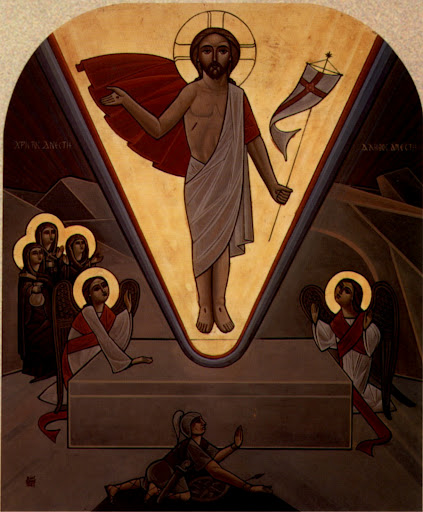
But the angel said to the women, “Do not be afraid; I know that you are looking for Jesus who was crucified. He is not here; for he has been raised, as he said. Come, see the place where he lay. Then go quickly and tell his disciples, ‘He has been raised from the dead, and indeed he is going ahead of you to Galilee; there you will see him.’ This is my message for you.” So they left the tomb quickly with fear and great joy, and ran to tell his disciples.  Matt. 28:5-8.

Okay, so after a week of daily blogging, I’m pretty sure I’ve about run out of interesting things to say.  I never tire, however, of discussing dogs.  I have lived with dogs  since about the age of five.  Most dogs spend the bulk of their lives with a pronounced, undismayed joy.  My dog, Georgia offers the perfect example of this unrelenting, joyful approach to the world.

So, I thought we should at least consider the notion of joy:  a great Christian virtue, a profound spiritual practice, and one of the clear indicia of our faith.  Particularly during the Easter season, we Christians should take a lesson and live like the gate has been left open.  In Matthew’s story of the resurrection, the angel tells Mary Magdalene and “the  other Mary” that Jesus has been raised.  Jesus’ disciples thought they knew how this rotten story ended. When they learned that they were wrong, they left the tomb “with great fear and great joy” and ran to tell Jesus’ followers this good news.

Matthew describes a curious mixture of emotions:  joy and fear, but I suspect that’s exactly what they felt.  They were fearful because they stood on deeply uncertain ground, and this sort of ambiguity would certainly leave one anxious.  They also felt great joy because their rabbi, their Messiah, and their friend still lived.  And so, they ran.  They ran like someone had left the gate open.  You see, that’s exactly what Jesus had done:  He had pried ajar  the gates of hell and flung open the gates of heaven.

In Here and Now, Henri Nouwen wrote, “We have to choose joy, and keep choosing it every day.  It is a choice based upon the knowledge that we belong to God and have found in God our refuge and our safety and that nothing, not even death, can take God away from us.”  So, my suggestion to you, during this holy season of Easter is “Live like someone left the gate open.”  Jesus has freed us from sin and death, and he left the gate to heaven wide open.

Happy Easter!

James R. Dennis, O.P.

© 2012 James R. Dennis

Whom Are You Looking For?

Early on the first day of the week, while it was still dark, Mary Magdalene came to the tomb and saw that the stone had been removed from the tomb. So she ran and went to Simon Peter and the other disciple, the one whom Jesus loved, and said to them, “They have taken the Lord out of the tomb, and we do not know where they have laid him.” Then Peter and the other disciple set out and went toward the tomb. The two were running together, but the other disciple outran Peter and reached the tomb first. He bent down to look in and saw the linen wrappings lying there, but he did not go in. Then Simon Peter came, following him, and went into the tomb. He saw the linen wrappings lying there, and the cloth that had been on Jesus’ head, not lying with the linen wrappings but rolled up in a place by itself. Then the other disciple, who reached the tomb first, also went in, and he saw and believed; for as yet they did not understand the scripture, that he must rise from the dead. Then the disciples returned to their homes.

But Mary stood weeping outside the tomb. As she wept, she bent over to look into the tomb; and she saw two angels in white, sitting where the body of Jesus had been lying, one at the head and the other at the feet. They said to her, “Woman, why are you weeping?” She said to them, “They have taken away my Lord, and I do not know where they have laid him.” When she had said this, she turned around and saw Jesus standing there, but she did not know that it was Jesus. Jesus said to her, “Woman, why are you weeping? Whom are you looking for?” Supposing him to be the gardener, she said to him, “Sir, if you have carried him away, tell me where you have laid him, and I will take him away.” Jesus said to her, “Mary!” She turned and said to him in Hebrew, “Rabbouni!” (which means Teacher). Jesus said to her, “Do not hold on to me, because I have not yet ascended to the Father. But go to my brothers and say to them, `I am ascending to my Father and your Father, to my God and your God.'” Mary Magdalene went and announced to the disciples, “I have seen the Lord”; and she told them that he had said these things to her.

In today’s Gospel reading, Mary, the beloved disciple, and Peter discover that Jesus is no longer in the tomb. St. John opens the story with Mary, walking to the Lord’s burial-place early in the morning before sunrise. We’ve studied John’s gospel well enough and long enough to know that he intends to convey a double meaning when he tells us that she walked to the tomb “while it was still dark”. I’m certain that for Magdalene and the other disciples, this was a terribly dark time.

St. John begins the story with a mystery: the body of Jesus is missing. The disciples first encounter only the physical evidence of what looks like a grave robbing. Someone has rolled the stone away, removed the body of the Christ, and left behind only the burial linens. Mary runs to get the other disciples. Peter and the beloved disciple confirm the absence of Jesus’ body, but none of them yet understands what this might mean. Mary then meets a man she assumes to be gardener, and without understanding it, she has encountered the risen Lord.

I’m struck by Jesus’ question to Mary, “For whom are you looking?” We’ve heard Him ask a similar question before. Jesus asked John the Baptist’s disciples, “What are you looking for?” John 1:38. When the soldiers come to the Garden of Gethsemane to arrest Him, Jesus asks them, “For whom are you looking?” John 18:4,7. We also recall in John’s Gospel that some Greeks came looking for Jesus. John 12: 20-21. I suspect that this Easter Sunday, our churches will be full of people who are looking for Jesus, even though some of them may not even know it.

Consistent with John’s repeated theme of misunderstandings, Mary mistakes Jesus for a gardener. Without knowing it, I believe she is right. I think St. John intentionally calls us back, not just to the garden of Gethsemane, but also to the Garden of Eden. Through his resurrection, Jesus has conquered death and re-made creation. That morning, Mary met Jesus and encountered the fulfilment of God’s directive: “Let there be light.” (Gen. 1:2).

It also strikes me that the tomb wasn’t really empty at all. That tomb was full of the visions and hopes of God’s people: dreams of a better world, dreams that they would be better people, dreams that death would not prevail, and dreams for reconciliation with God.

In a sense, that tomb resembles the stable in the Chronicles of Narnia: it is bigger on the inside than it is on the outside. The tomb contained God’s dreams for our life with Him. Within that tomb, the disciples will find the revelation that God’s promises were not empty. Those dreams they had weren’t in the tomb any longer; they were walking around and were alive! The shackles of sin and sorrow and death have been broken.

The passage ends with Mary’s affirmation of faith, despite the darkness of the horror on Golgotha: “I have seen the Lord.” I hope that, on this Easter Sunday, you are looking for Jesus. I’m certain that He is looking for you. And I hope that, like that good saint, we can tell the world : “We have seen the Lord.”

Happy Easter! He is risen!

James R. Dennis, O.P.

© 2012 James R. Dennis
What is Truth?

The Gospel reading for today, St. John’s Passion narrative (John 18:1-19:42) can be found here.

 Within St. John’s Gospel, the trial of Jesus looks a little like the Tower of Babel.  Jesus and Pilate really aren’t speaking the same language, leaving Pilate with the haunting question, “What is truth?”  While Pilate doesn’t know it, he’s about to hang the Truth up on a tree, like a scarecrow.  Rather than seeking understanding, Pilate’s question actually constitutes a desperate sort of evasion.  As Archbishop Rowan Williams has observed, “We constantly try to start from somewhere other than where we are.”  Whatever Pilate wanted to know, it didn’t have much to do with the Truth.

Within this trial, Jesus tells Pilate, “Everyone who belongs to the truth listens to my voice.”  This passage echoes with Jesus’ earlier claim:  “My sheep hear my voice.  I know them, and they follow me.  I give them eternal life, and they will never perish.”  John 10:27-28.  Good Friday, then, operates not so much as a historical marker as a beacon in the darkness, calling out for us to remember, to belong to the truth and listen to Christ’s voice.

The crowd then makes a monstrous barter, condemning Jesus and allowing Barabbas to go free.  I sometimes wonder what Barabbas did with the balance of his life, how he spent his remaining years.  Did this “bandit” come to comprehend what had happened?  I also wonder whether we, like Barabbas, understand that Jesus’ death means that we can live, and will never perish?

Pilate then has Jesus whipped, and Jesus returns before the crowd in a purple robe and a crown of thorns.  While Caesar wore a laurel wreath, we wince at the idea of this twisted symbol of Jesus’ kingdom.  After a Roman scourging, Pilate mocks Jesus and the crowd, telling them “Here is the man!”  (Ecce homo!).  The suggestion that this broken, frail, bloody person could be a king was laughable.  The soldiers mocked Christ by calling him “The King of the Jews.”  As usual, John places words of deep truth within the mouths of those who don’t understand what they’re saying.

The trial results in Jesus’ inevitable condemnation, and He carries his own cross to the Place of the Skull (Golgotha).  Even in this final hour, the world mocks Jesus under a sign bitterly describing Him as the King of the Jews. Jesus says “I am thirsty” and is given a sponge soaked in sour wine.  Here,we encounter St. John at his most ironic, at his most paradoxical understanding.  In this moment of shame, unbearable pain, and within this passion, God reveals His glory.  When Jesus spoke of being glorified, somehow, this is the moment He meant.

Jesus tells his mother that the beloved disciple is now her son; he tells His beloved follower that Mary is now his mother.  Just as He had done in life, in death, Jesus re-defines the nature of “family”.  Squarely confronting His own mortality, Jesus establishes a new notion of kinship (into which we all are adopted).

Finally, after a day filled with countless agonies, Jesus announces “It is finished.”  Through the life and death of Jesus, God’s glory has been fully made clear.  Somehow, this broken, pathetic figure wearing a crown of nettles manifests “glory.”  Nailed to the cross, we find glory in the intersection of divinity and humanity, the intersection of light and darkness, the intersection of life and death.

God has shown us the final consequences of our brokenness  and of our hatred.  Through it all, He has managed to reveal divine love despite everything we could do to avoid it.  His capacity to love and forgive always infinitely surpasses our capacity to wound, our capacity to destroy, and our capacity to distance ourselves from the Living God.

Lord Jesus Christ, have mercy on me, a poor sinner,

James R. Dennis, O.P.

© 2012 James R. Dennis

He Loved Them to the End

Now before the festival of the Passover, Jesus knew that his hour had come to depart from this world and go to the Father. Having loved his own who were in the world, he loved them to the end. The devil had already put it into the heart of Judas son of Simon Iscariot to betray him. And during supper Jesus, knowing that the Father had given all things into his hands, and that he had come from God and was going to God, got up from the table, took off his outer robe, and tied a towel around himself. Then he poured water into a basin and began to wash the disciples’ feet and to wipe them with the towel that was tied around him. He came to Simon Peter, who said to him, “Lord, are you going to wash my feet?” Jesus answered, “You do not know now what I am doing, but later you will understand.” Peter said to him, “You will never wash my feet.” Jesus answered, “Unless I wash you, you have no share with me.” Simon Peter said to him, “Lord, not my feet only but also my hands and my head!” Jesus said to him, “One who has bathed does not need to wash, except for the feet, but is entirely clean. And you are clean, though not all of you.” For he knew who was to betray him; for this reason he said, “Not all of you are clean.”

After he had washed their feet, had put on his robe, and had returned to the table, he said to them, “Do you know what I have done to you? You call me Teacher and Lord–and you are right, for that is what I am. So if I, your Lord and Teacher, have washed your feet, you also ought to wash one another’s feet. For I have set you an example, that you also should do as I have done to you. Very truly, I tell you, servants are not greater than their master, nor are messengers greater than the one who sent them. If you know these things, you are blessed if you do them.

Jesus said, “Now the Son of Man has been glorified, and God has been glorified in him. If God has been glorified in him, God will also glorify him in himself and will glorify him at once. Little children, I am with you only a little longer. You will look for me; and as I said to the Jews so now I say to you, `Where I am going, you cannot come.’ I give you a new commandment, that you love one another. Just as I have loved you, you also should love one another. By this everyone will know that you are my disciples, if you have love for one another.” John 13:1-17, 31b-35.

In the Lectionary reading for today, we feel the reverberation of Mary of Bethany’s act of devotion from Monday’s reading.    In many respects, today’s Gospel contains the adhesive which bonds all of the events of, and the readings for, Holy Week together.  St. John reports that Jesus knew that the hour of his death had come; this passage records how chose to spend his last hours with his friends.  “Having loved his own who were in the world, he loved them to the end.”

In washing the disciple’s feet, Jesus assumed the role of a servant, of a slave.  Reluctant to have his Rabbi assume this role, Peter protested.  Jesus assured Peter, however, that this way was the path to sharing in the life of Christ.  He teaches them that serving each other offers a great blessing.  Jesus teaches, “For I have set you an example, that you also should do as I have done to you.”

In a terribly poignant moment, Jesus calls his disciples “little children” and tells them his time with them has grown very short.  Jesus then offers them the great commandment:  to love each other as He has loved us.  We love each other because He loved us first, and showed us how to do it.  I’ve come to believe, the more time I spend in John’s Gospel, that there’s really only one sin:  the failure to love.

I have often heard church leaders talk about a “path to discipleship”, and I suppose that’s a useful discussion in some sense.  But Jesus says that there’s only one true marker of his disciples:  they love each other, reflecting Christ’s love.  Jesus paints a portrait of divine vulnerability, reflecting a God who entered into human history, subjected Himself to shame, and poured Himself out to show us how to live.  This moment in John’s Gospel, in which God acts like a slave, constitutes a critical moment of God’s self-revelation.  “This,” Jesus tells us, “this is what the Kingdom looks like.”

Love serves as the glue which binds the readings for Holy Week together.  Love rode into Jerusalem on a donkey.  Love filled the house with a fragrant oil.  Love lights the way so that the darkness will not overcome us.  Love surrounds us in a great cloud of witnesses.  And tomorrow, Love will be hoisted on a Cross.

Lord, have mercy on me, a sinner,

James R. Dennis, O.P.

© 2012 James R. Dennis

A Cloud of Witnesses

Therefore, since we are surrounded by so great a cloud of witnesses, let us also lay aside every weight and the sin that clings so closely, and let us run with perseverance the race that is set before us, looking to Jesus the pioneer and perfecter of our faith, who for the sake of the joy that was set before him endured the cross, disregarding its shame, and has taken his seat at the right hand of the throne of God.

Consider him who endured such hostility against himself from sinners, so that you may not grow weary or lose heart.  Heb. 12:1-3.

The Lectionary offers us this reading for Holy Week, and I thought we might reflect on it for a bit.  While we often think of it in the context of All Saints Day, it strikes me as terribly appropriate as a Holy Week reflection.  Certainly, our Lenten task consists of laying aside those burdens and separations that “cling so closely” to us.  We know that these weights, these sins, entangle us and swarm around us.  Lent offers us a chance to loosen those bonds.

The Epistle to the Hebrews reminds us that we are surrounded by a “great cloud of witnesses”.  It’s a remarkable and deeply poetic choice of words.  Often, we think of these witnesses as the great saints of the Church.  I’m inclined to think, however, also of those  who were present during those remarkable days of Jesus’ earthly ministry.  Jesus touched a remarkably diverse group of people. From the wedding guests at Cana to the blind man at the pool of Siloam to Lazarus of Bethany to the Roman centurion who cried out “Surely, this man was the son of God!”: they all bore witness to the redemptive power of the Lord.

And yet, this “pioneer and perfecter of our faith” , this Beloved Son of God, would cry out in agony from the Cross.  He would wonder, quoting the Psalms, why the Father had deserted Him.  He would wonder how He could feel so desperately alone.  Somehow, His mother and a few of his friends bore witness to this horror.  They offered to God that precious gift, the ministry of presence.  I’m wondering whether we can bear to watch, whether we will join into that cloud of witnesses during this Holy Week.  I’m wondering whether we can endure the Cross.

God watch over thee and me,

James R. Dennis, O.P.

Six Days Before the Passover

Six days before the Passover Jesus came to Bethany, the home of Lazarus, whom he had raised from the dead. There they gave a dinner for him. Martha served, and Lazarus was one of those at the table with him. Mary took a pound of costly perfume made of pure nard, anointed Jesus’ feet, and wiped them with her hair. The house was filled with the fragrance of the perfume. But Judas Iscariot, one of his disciples (the one who was about to betray him), said, “Why was this perfume not sold for three hundred denarii and the money given to the poor?” (He said this not because he cared about the poor, but because he was a thief; he kept the common purse and used to steal what was put into it.) Jesus said, “Leave her alone. She bought it so that she might keep it for the day of my burial. You always have the poor with you, but you do not always have me.” When the great crowd of the Jews learned that he was there, they came not only because of Jesus but also to see Lazarus, whom he had raised from the dead. So the chief priests planned to put Lazarus to death as well, since it was on account of him that many of the Jews were deserting and were believing in Jesus.  John 12:1-11.

Perhaps Mary of Bethany shows us the only authentic response to Holy Week: she responds with an extravagant love.  At a dinner for the Lord, she acted out of  lavish charity and kindness toward Jesus.  She anointed him for his death, filling the house with this remarkable and extravagant fragrance.  (Scholars report that this perfume would have cost the yearly wages of a laborer.)  I think St. John meant to remind us that following Jesus might sometimes require that we forego counting the cost of loving God.

Mary’s extravagance carries with it the sort of sensuality that would have made the other guests, and almost any good Jew, more than a little uncomfortable.  She anointed Jesus’ feet and wiped them dry with her hair.  No respectable Jewish woman would have behaved this way. Social custom would have limited this sort of affectionate behavior to a woman’s husband or perhaps her family, and even then, only in private.  Mary’s conduct  reflects a profoundly intimate relationship.

In anointing Jesus, Mary prefigures the preparation of His body for burial.  But although  Jesus awaited His death with his friends, the presence of Mary’s brother (Lazarus) reveals that death holds no finality here. Mary anoints Jesus for his burial while he is still living.  Lazarus, who was dead, has joined them for dinner.  We encounter here the intersection of death and life, woven together in a story of reckless mercy, in the context of having a meal together.  St. John teaches us that death will have its say, but not the last word.

John juxtaposes Mary’s remarkable fidelity with Judas’ treason.  Similarly, he contrasts the beauty of the perfume’s scent and this deeply affectionate moment with the ugly brutality of the impending crucifixion in which hatred seems to win the day.  St. John tells us these events took place six days before the Passover.  The timetable echoes with the days of creation, and through his Passion Jesus makes “all things new again”.  Jesus renews all creation through the his death on the Cross, a death by which love conquers fear, hatred and death itself.

Pax Christi,

James R. Dennis, O.P.

 © 2012 James R. Dennis

Unblemished, Unqualified Mercy

But when a man with all his resolution rises up from his sins and turns wholly away from them, our faithful God then acts as if he had never fallen into sins.  For all his sins, God will not allow him for one moment to suffer.  Were they as many as all men have ever committed, God will never allow him to suffer for this.  With this man God can use all the simple tenderness that he has ever shown toward created beings.  If he now finds the man ready to be different, he will have no regard for what he used to be.  God is a God of the present.  Meister Eckhart, Counsels on Discernment (Counsel 12).

My Dominican brother, Meister Eckhart, lived from around 1260 to about 1327.  A teacher, a preacher, a mystic and a theologian, he wrote on the subjects of metaphysics and spiritual psychology.  Along with St. Bede the Venerable and St. Anselm, he serves as an icon of the intellectual spirit of the medieval period.  Like many who challenged the Church to think in fresh ways, he paid a heavy price for his ideas.  The Franciscan-led Inquisition charged Eckhart with heresy, although he apparently died before the verdict.

In this passage, Meister Eckhart writes about the stunning nature of God’s forgiveness, offering us an appropriate Lenten reflection.  Most of us are accustomed to thinking of forgiveness the way it works in the world.  The forgiveness of our brothers and sisters is often reluctant, half-hearted, and  incomplete.  Eckhart assures us that God’s forgiveness operates immediately and without reservation.

We often struggle with this notion, just as we strain against the idea of the “good thief” who was crucified alongside Jesus.  Jesus assured him, “Truly, I tell you, today you will be with me in paradise.”  Luke 23: 43.  There’s something about this last-minute conversion that we really struggle with.  After an entire lifetime mired in sin, as death approaches, the notion that one can turn things around upsets our sense of fairness.

The parable of the prodigal son (Luke 15:11-32) and the workers in the vineyard (Matt 20:1-16) similarly challenge our notion of equity.  Like the elder brother in the story of the prodigal, this just doesn’t seem right to us.  As Eckhart points out, however, God will not refuse those who repent with all their resolution.  Our instinct tells us there’s got to be some penalty for all that history of sin and disobedience.  Meister Eckhart answers that God is just not interested in “all that history.”

Mother Teresa said, “We need lots of love to forgive, and we need lots of humility to forget.  It is not complete forgiveness unless we forget also.  As long as we cannot forget we really have not forgiven fully.”  We pray for God to forgive us as we forgive those who’ve harmed us.  As we live into the Christian life, we encounter in God’s kingdom something much richer and more loving than fairness or justice.  We find mercy and grace.  If we will only place our feet in this water, the river of forgiveness will sweep us away.

Most of us will find this notion of complete forgiveness terribly challenging.  We struggle to let go of past wrongs and insults.  We strain to share the grace of the present moment.   It’s not an easy way; it’s the way of the Cross.

Lord, have mercy on me, a poor sinner.

James R. Dennis, O.P.

© 2012 James R. Dennis

The Cost We Will Pay

Observe, admire and obey may be given as the novice’s watchwords.  The ideal must not remain an ideal, but has to be realized at whatever the cost.  The cost is heroism.

–St. John Cassian

I found this observation from St. John Cassian in Celtic Daily Prayer.  It spoke to me for a number of reasons.  Today, I will leave for Louisiana for a meeting of my house within the Anglican Order of Preachers (the Dominicans).  Most folks consider Cassian the father of monasticism in the West.  So, in a broad sense, as my brothers and sisters gather, we meet in imitation of Abba Cassian.

In this little passage, St. Cassian gives advice to those who are novices in a religious order.  In most religious orders today, one begins the process of discerning whether one has a vocation as a postulant.  After some period of study, reflection, prayer and a goodly amount of questioning, one can request to become a novice.  Novices have been admitted to a specific religious order as “beginners” and will generally remain novices for at least a year or two.

Cassian suggests that novices are called to: (1) observe; (2) admire; and (3) obey. In other words, they are learning how to follow and imitate their brothers and sisters.  In an even broader sense, all monastics and all Christians are called into the imitation of our rabbi, Jesus Christ.  While we all seek to imitate our Lord, we should not be surprised that others along the same path may arrive at a different place.  As Thomas a Kempis (wrote The Imitation of Christ) observed, “A book has but one voice, but it does not instruct everyone alike.”

Cassian warns that our ideals must not remain ideals; we must bring them to fruition.  It will not suffice to say we follow Christ; we must become Christ-like (a process our Orthodox brothers and sisters call theosis).  As I’ve observed before, the Christian life is not a spectator sport.

Cassian also warns us that this effort carries a significant price:  “The cost is heroism.”  Jesus calls us to set aside our insecurities, our self-doubts, and even our inadequacies.  We must be prepared to face epic failure as we stumble, struggle and stutter our way into our new life in Christ.  Jesus called those who are willing to pay that price his friends; He called them disciples.

Pax Christi,

James R. Dennis, O.P.

© 2012 James R. Dennis