Tag Archives: Resurrection

Whom Are You Looking For? (An Easter Sermon)

Woman, why are you weeping? Whom are you looking for?” (The full readings for this morning can be found here.)

In the name of the living God, who is creating, redeeming, and sustaining us. Well, good morning, good morning. And, because we haven’t been able to say it during those long 40 days of Lent: Alleluia!

Don’t you hate it when you lose something? It’s very frustrating, it’s unsettling. Say, you have something very precious, or something terribly dangerous, and you lock it up and put it away where no one can get to it. You hide it, or seal it up, or bury it, and when you go back, it’s not there. You search and search, but it’s just not there anymore. But, I’m getting ahead of myself.

I want us to imagine the desperation of these disciples, particularly Mary Magdalene and the women who go to anoint Jesus’ body. They had lost just about everything you could lose. Some had betrayed him, some had denied him, many had run away, and almost none of them could bear to watch this horror show. They had lost their dreams of a life with God, their vision that finally someone was going to do something about the Romans and their brutal occupation. They had lost their hopes for a better world, and many of them lost their self-image, their idea of who they were. And so, these women come to anoint their dead friend, to honor their dead. As Henry Nouwen wrote, “Compassion asks us to go where it hurts…” Now, I don’t think those women went to the grave that morning out of a sense of religious obligation, or some concept of duty. I think they went there out of love for their friend.

Now, we humans have known something for a very long time. We have known it ever since we crawled or loped out of the savannah, ever since those prehistoric people left their handprints on the Cueva de los Manos in Spain. We have known that “dead is dead.” Science teaches it, our experience teaches it, and our feelings of loss teach it. Dead is dead. Our broken hearts have always instructed us about the finality of death. Death is the end of the story. Or, is it?

Today’s gospel calls that assumption into question. As these women go to mourn their losses, they find that the stone has been rolled away and the tomb is empty. Don’t you hate it when you’ve put something away for safekeeping and then it’s missing? And after the other disciples have confirmed that Jesus’ body is gone, Mary remains at the tomb weeping. And she doesn’t recognize Jesus at first. Grief is like that, clouding our vision and consuming our ability to focus on anything but loss. And it’s not until Jesus calls her by name that she recognizes him. My hope, no, my prayer for each of us is that we can hear God calling our names, calling us out of grief and loss and into new life.

Jesus then asks her a very pointed, and very important, question: “Whom are you looking for? In our world of heartache, loss, death, and empire, it takes a good deal of courage to go looking for Jesus. It takes a good deal of hope and strength to entertain the notion that death might not be the end of the story. Love is like that, you see. Love always goes looking for the beloved. Even when it’s scary, even when there are Roman guards there, even when it seems hopeless—love goes looking.

So, I want you to look here at the genius of John’s gospel. If you were with us for the Good Friday service, you’ll remember what John said. “Now there was a garden in the place where he was crucified, and in the garden there was a new tomb in which no one had ever been laid. And so, because it was the Jewish day of Preparation, and the tomb was nearby, they laid Jesus there.” Our story this morning is also set in that same garden.

If you were with us for the Vigil, you heard that story from Genesis of the very first day, the story of light coming into the world. So, I want us to look carefully at what that masterful poet John is telling us in his gospel this morning. John says these events took place “Early on the first day….” The first day. These events took place in a garden. The story of our creation takes place in a garden. This is no accident. There are no coincidences in John’s gospel. I think John is trying to tell us that the story of Jesus’ resurrection is the story of God recreating the world.  It’s the story of Jesus “making all things new again.”

Now, the forces of empire knew exactly where they had put Jesus. He was sealed in a tomb, safely locked away where he could not cause them any trouble. In this story, the might of empire is represented by the soldiers guarding the tomb. Look at the reversal that takes place when they are confronted with the power of resurrection, the power of new life. John says, “For fear of him the guards shook and became like dead men.”

God is in the business of creating life where there was no life before. St. Paul notes that the grave has lost its finality, writing: “O death, where is thy sting?” But I probably prefer the formulation of that fine mystic, the English poet John Donne, who said:

Death, be not proud, though some have called thee
Mighty and dreadful, for thou art not so;
For those whom thou think’st thou dost overthrow
Die not, poor Death, nor yet canst thou kill me.

Death is not the end of the story. It’s not even a period, not even a semicolon. Death is nothing more than a comma, a brief pause. You see, when Jesus walked out of the tomb, he didn’t come out alone. God’s love escaped from the tomb, escaped from the grave where the forces of empire tried to contain it.

So, we come back to these stories, these same stories, year after year at about this same time. The church calls them the stories of Jesus’ passion and resurrection. But in a broader sense, they are something more: they are love stories. In fact, they are our love stories. They are stories of God’s love for you and me, of God’s love for humanity.

This is our theology of hope; this is why we call ourselves an Easter People. Our gospel this morning teaches us that the forces of empire do not win. The powers of fear and intimidation and violence do not prevail. Death and grief do not have the last word. Darkness and the forces of hell do not win. Love always wins. Always. And even though we go down to the grave, we make our song: Alleluia, Alleluia, Alleluia!

James R. Dennis, O.P. © 2022

In the Beginning Again (Homily for the Great Vigil)

He is not here; for he has been raised, as he said. Come, see the place where he lay. (The full readings for today can be found here.)

            Good evening, my friends, good evening. And welcome to the Great Vigil of Easter.

Did you notice that opening line of that very first reading? It’s such a fabulous first line, a cardinal statement: “In the beginning when God created the heavens and the earth, the earth was a formless void and darkness covered the face of the deep, while a wind from God swept over the face of the waters. Then God said, ‘Let there be light’; and there was light. And God saw that the light was good; and God separated the light from the darkness.”

But we might well wonder, Why is the Church giving us that story this evening, as we celebrate the great vigil? What does this have to do with Easter—with the empty tomb? It’s almost as if the Church were trying to tell us something, as if the Church were offering a glimpse into the nature of God through the lens of these readings. I think the Church is trying to give us some insight into God’s professional life, God’s business. You see, I think God is in the business of creating life where there was no life before. And there’s only one reason for that sort of creative impulse, that need to form and shape something new. But I’m getting ahead of myself.

So, I want us to imagine the state of mind of the disciples, particularly these women, going to anoint Jesus’ body for his burial. Not only have they witnessed the brutal horror of Jesus’ death, not only have they lost their friend and teacher, but they’ve also seen a dream die. They had dreamed of a life with Jesus, of a life filled with God’s love; they had dreamed of a better world. So they went to the tomb to honor their friend, to honor their loss, to honor the dead.

But they didn’t find any death there, because our God is not the God of the dead, but of the living. Our God, as we said earlier, is in the business of new life. Our God is in the business of calling light out of the darkness, of creating new life out of nothing more than His love.

We see that new life happening this evening, right before our eyes. God is on the loose again tonight at St. Christopher By the Sea, doing that God thing. God is about to make a new thing, another Genesis story, in the baptisms of Addison and Wayne. And, while we don’t know yet what paths they will walk down in their lives to come, we know who will always walk with them.

Looking back to the readings tonight, I’m pretty sure that the forces of empire were certain that the story of Jesus was over. In fact, they were certain he was not only dead, but buried. But God, like love, is never static; neither God nor love will be contained. And I want to suggest to you that something more than Jesus escaped from that grave—pure love rolled away the stone, unadulterated love walked out of that tomb, and love told those dear women that he would meet them again in Galilee.

Many of us have tried to keep God in a box. We try to create a spiritual ghetto—over here is where I keep my work life, and over here is where I keep my family stuff, and this box here is where I keep my religion. That box we try to keep God in, well, it’s nothing more than a grave, a tomb. And if today’s Gospel teaches us anything, it teaches us that God will not stay where we put Him. This is our hope; this is why we call ourselves Easter people, my friends. He is not dead; he is risen. Alleluia!

James R. Dennis, O.P. © 2022
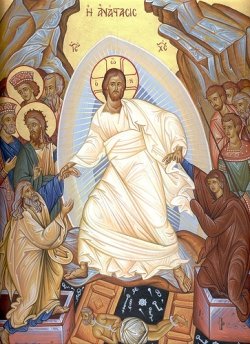


Whom Are You Looking For?

Early on the first day of the week, while it was still dark, Mary Magdalene came to the tomb and saw that the stone had been removed from the tomb. So she ran and went to Simon Peter and the other disciple, the one whom Jesus loved, and said to them, “They have taken the Lord out of the tomb, and we do not know where they have laid him.” Then Peter and the other disciple set out and went toward the tomb. The two were running together, but the other disciple outran Peter and reached the tomb first. He bent down to look in and saw the linen wrappings lying there, but he did not go in. Then Simon Peter came, following him, and went into the tomb. He saw the linen wrappings lying there, and the cloth that had been on Jesus’ head, not lying with the linen wrappings but rolled up in a place by itself. Then the other disciple, who reached the tomb first, also went in, and he saw and believed; for as yet they did not understand the scripture, that he must rise from the dead. Then the disciples returned to their homes.

But Mary stood weeping outside the tomb. As she wept, she bent over to look into the tomb; and she saw two angels in white, sitting where the body of Jesus had been lying, one at the head and the other at the feet. They said to her, “Woman, why are you weeping?” She said to them, “They have taken away my Lord, and I do not know where they have laid him.” When she had said this, she turned around and saw Jesus standing there, but she did not know that it was Jesus. Jesus said to her, “Woman, why are you weeping? Whom are you looking for?” Supposing him to be the gardener, she said to him, “Sir, if you have carried him away, tell me where you have laid him, and I will take him away.” Jesus said to her, “Mary!” She turned and said to him in Hebrew, “Rabbouni!” (which means Teacher). Jesus said to her, “Do not hold on to me, because I have not yet ascended to the Father. But go to my brothers and say to them, `I am ascending to my Father and your Father, to my God and your God.'” Mary Magdalene went and announced to the disciples, “I have seen the Lord”; and she told them that he had said these things to her.

In today’s Gospel reading, Mary, the beloved disciple, and Peter discover that Jesus is no longer in the tomb. St. John opens the story with Mary, walking to the Lord’s burial-place early in the morning before sunrise. We’ve studied John’s gospel well enough and long enough to know that he intends to convey a double meaning when he tells us that she walked to the tomb “while it was still dark”. I’m certain that for Magdalene and the other disciples, this was a terribly dark time.

St. John begins the story with a mystery: the body of Jesus is missing. The disciples first encounter only the physical evidence of what looks like a grave robbing. Someone has rolled the stone away, removed the body of the Christ, and left behind only the burial linens. Mary runs to get the other disciples. Peter and the beloved disciple confirm the absence of Jesus’ body, but none of them yet understands what this might mean. Mary then meets a man she assumes to be gardener, and without understanding it, she has encountered the risen Lord.

I’m struck by Jesus’ question to Mary, “For whom are you looking?” We’ve heard Him ask a similar question before. Jesus asked John the Baptist’s disciples, “What are you looking for?” John 1:38. When the soldiers come to the Garden of Gethsemane to arrest Him, Jesus asks them, “For whom are you looking?” John 18:4,7. We also recall in John’s Gospel that some Greeks came looking for Jesus. John 12: 20-21. I suspect that this Easter Sunday, our churches will be full of people who are looking for Jesus, even though some of them may not even know it.

Consistent with John’s repeated theme of misunderstandings, Mary mistakes Jesus for a gardener. Without knowing it, I believe she is right. I think St. John intentionally calls us back, not just to the garden of Gethsemane, but also to the Garden of Eden. Through his resurrection, Jesus has conquered death and re-made creation. That morning, Mary met Jesus and encountered the fulfilment of God’s directive: “Let there be light.” (Gen. 1:2).

It also strikes me that the tomb wasn’t really empty at all. That tomb was full of the visions and hopes of God’s people: dreams of a better world, dreams that they would be better people, dreams that death would not prevail, and dreams for reconciliation with God.

In a sense, that tomb resembles the stable in the Chronicles of Narnia: it is bigger on the inside than it is on the outside. The tomb contained God’s dreams for our life with Him. Within that tomb, the disciples will find the revelation that God’s promises were not empty. Those dreams they had weren’t in the tomb any longer; they were walking around and were alive! The shackles of sin and sorrow and death have been broken.

The passage ends with Mary’s affirmation of faith, despite the darkness of the horror on Golgotha: “I have seen the Lord.” I hope that, on this Easter Sunday, you are looking for Jesus. I’m certain that He is looking for you. And I hope that, like that good saint, we can tell the world : “We have seen the Lord.”

Happy Easter! He is risen!

James R. Dennis, O.P.

© 2012 James R. Dennis

Six Days Before the Passover

Six days before the Passover Jesus came to Bethany, the home of Lazarus, whom he had raised from the dead. There they gave a dinner for him. Martha served, and Lazarus was one of those at the table with him. Mary took a pound of costly perfume made of pure nard, anointed Jesus’ feet, and wiped them with her hair. The house was filled with the fragrance of the perfume. But Judas Iscariot, one of his disciples (the one who was about to betray him), said, “Why was this perfume not sold for three hundred denarii and the money given to the poor?” (He said this not because he cared about the poor, but because he was a thief; he kept the common purse and used to steal what was put into it.) Jesus said, “Leave her alone. She bought it so that she might keep it for the day of my burial. You always have the poor with you, but you do not always have me.” When the great crowd of the Jews learned that he was there, they came not only because of Jesus but also to see Lazarus, whom he had raised from the dead. So the chief priests planned to put Lazarus to death as well, since it was on account of him that many of the Jews were deserting and were believing in Jesus.  John 12:1-11.

Perhaps Mary of Bethany shows us the only authentic response to Holy Week: she responds with an extravagant love.  At a dinner for the Lord, she acted out of  lavish charity and kindness toward Jesus.  She anointed him for his death, filling the house with this remarkable and extravagant fragrance.  (Scholars report that this perfume would have cost the yearly wages of a laborer.)  I think St. John meant to remind us that following Jesus might sometimes require that we forego counting the cost of loving God.

Mary’s extravagance carries with it the sort of sensuality that would have made the other guests, and almost any good Jew, more than a little uncomfortable.  She anointed Jesus’ feet and wiped them dry with her hair.  No respectable Jewish woman would have behaved this way. Social custom would have limited this sort of affectionate behavior to a woman’s husband or perhaps her family, and even then, only in private.  Mary’s conduct  reflects a profoundly intimate relationship.

In anointing Jesus, Mary prefigures the preparation of His body for burial.  But although  Jesus awaited His death with his friends, the presence of Mary’s brother (Lazarus) reveals that death holds no finality here. Mary anoints Jesus for his burial while he is still living.  Lazarus, who was dead, has joined them for dinner.  We encounter here the intersection of death and life, woven together in a story of reckless mercy, in the context of having a meal together.  St. John teaches us that death will have its say, but not the last word.

John juxtaposes Mary’s remarkable fidelity with Judas’ treason.  Similarly, he contrasts the beauty of the perfume’s scent and this deeply affectionate moment with the ugly brutality of the impending crucifixion in which hatred seems to win the day.  St. John tells us these events took place six days before the Passover.  The timetable echoes with the days of creation, and through his Passion Jesus makes “all things new again”.  Jesus renews all creation through the his death on the Cross, a death by which love conquers fear, hatred and death itself.

Pax Christi,

James R. Dennis, O.P.

 © 2012 James R. Dennis