Tag Archives: Religion

What Jesus Came to Do

Jesus left the synagogue at Capernaum, and entered the house of Simon and Andrew, with James and John. Now Simon’s mother-in-law was in bed with a fever, and they told him about her at once. He came and took her by the hand and lifted her up. Then the fever left her, and she began to serve them.

That evening, at sundown, they brought to him all who were sick or possessed with demons. And the whole city was gathered around the door. And he cured many who were sick with various diseases, and cast out many demons; and he would not permit the demons to speak, because they knew him.

In the morning, while it was still very dark, he got up and went out to a deserted place, and there he prayed.  And Simon and his companions hunted for him. When they found him, they said to him, “Everyone is searching for you.” He answered, “Let us go on to the neighboring towns, so that I may proclaim the message there also; for that is what I came out to do.” And he went throughout Galilee, proclaiming the message in their synagogues and casting out demons.  Mark 1:29-39.

In the Lectionary reading today, Jesus leaves the synagogue at Capernaum and travels to the home of Peter’s mother-in-law.  She has taken to her bed with a fever, which often presented a life-threatening condition in those days.  Jesus takes her by the hand and lifts her up.  That phrase, “lifted her up” resonates with meaning, calling to mind Jesus being lifted up on the cross and lifted up from the grave.  Jesus restores her to health, and restores her to her community.

We see a pattern begin to emerge in Jesus’ ministry.  The holiness and purity laws of the day would have required that one separate oneself from those who were ill, especially those who were spiritually diseased or who suffered from a moral infection.  Rather than shunning them, Jesus rushed to them.  At the time, this offered a new teaching, something really extraordinary.

That evening, word of Jesus’ healing ministry begins to spread and the house is surrounded by those who need Jesus’ healing touch.  Having had some involvement in the work of pastoral care, this passage from the Gospel rings remarkably true.  Pastoral care is the church’s growth industry in a world that groans in pain and cries out for God’s presence.

Jesus then engages in a practice we’ve seen before, and we’ll see again and again.  Having preached, having healed, he retreats “to a deserted place” and prayed.  Jesus knew what we so often ignore:  even the work of ministry can become empty and debilitating unless we allow the Father to refresh and renew us in prayer. Or perhaps Jesus knew what many of us so often forget: when we’ve come into direct contact with the overwhelming power of God to touch people’s lives, sometimes a bit of silent reflection offers the best and perhaps the only authentic response.

Peter and the disciples then encourage Jesus to return to Capernaum, where everyone is looking for him.  The disciples make the same mistake many of us do when we’ve encountered God doing something wonderful.  They suggest, “Do it again!”    As C.S. Lewis noted,  we are swimming upstream spiritually when we tell God “Encore!”  In Letters to Malcolm, Lewis observed : “It is no good angling for the rich moments. God sometimes seems to speak to us most intimately when he catches us, as it were, off our guard.”  Our fixation with that last event, that former experience, or that past feeling may well divert our attention from the new wonders God is already working.

Jesus tells the disciples that they need to go into “the neighboring towns”, which would have meant leaving the city of Capernaum and going into the countryside.  Here, we again see Jesus engage in a practice that will form a routine for Him:  (1) engage in ministry (proclaiming the Good News and healing the brokenhearted); (2) retreat and refresh in prayer; (3) expand the ministry to another place and people; and (4) repeat.  Those who follow Christ should seriously consider the wisdom of this regime.  It’s what we came here to do, too.

I wish you a good and holy Sabbath,

James R. Dennis, O.P.

© 2012 James R. Dennis

St. Brigid’s Day

Today is the feast day of St. Brigid of Kildare.  The people of Ireland love her dearly, as do the people who love the people of Ireland (folks like me).  The legends about Brigid far outweigh the facts known about her.   She was born around 450.  Her parents may have been baptized by  St. Patrick.

We know she founded a Christian community at Kildare, primarily for women.  She had a profound influence on the Church in Ireland.    She may have been consecrated as a bishop.  (Thus, she is often depicted with a bishop’s crozier.)  When others protested that he improperly bestowed this Holy Order on a woman, Bishop Mel reportedly replied “No power have I in this matter.”  He suggested that God alone had chosen Brigid for that Holy Office.

Brigid understood that the physical needs of the poor intersected with their spiritual needs. We remember Brigid for her profound hospitality, her unflinching generosity, and her extraordinary compassion.   I pray that her spirit will grow within the Church today, which so desperately needs it.

I found this prayer for today within the wonderful Celtic Book of Daily prayer.  I hope you find as much life and joy and light in it as I do.

I would welcome the poor
and honor them
I would welcome the sick
in the presence of angels
and ask God to bless and
embrace us all.

Seeing a stranger approach,
I would put food in the eating place,
drink in the drinking place,
music in the listening place,
and look with joy for the blessing of God,
who often comes to my home
in the blessing of a stranger.

God bless you and those you love,

James R. Dennis, O.P.

© 2012 James R. Dennis
Fishing for Souls

Now after John was arrested, Jesus came to Galilee, proclaiming the good news of God, and saying, “The time is fulfilled, and the kingdom of God has come near; repent, and believe in the good news.”

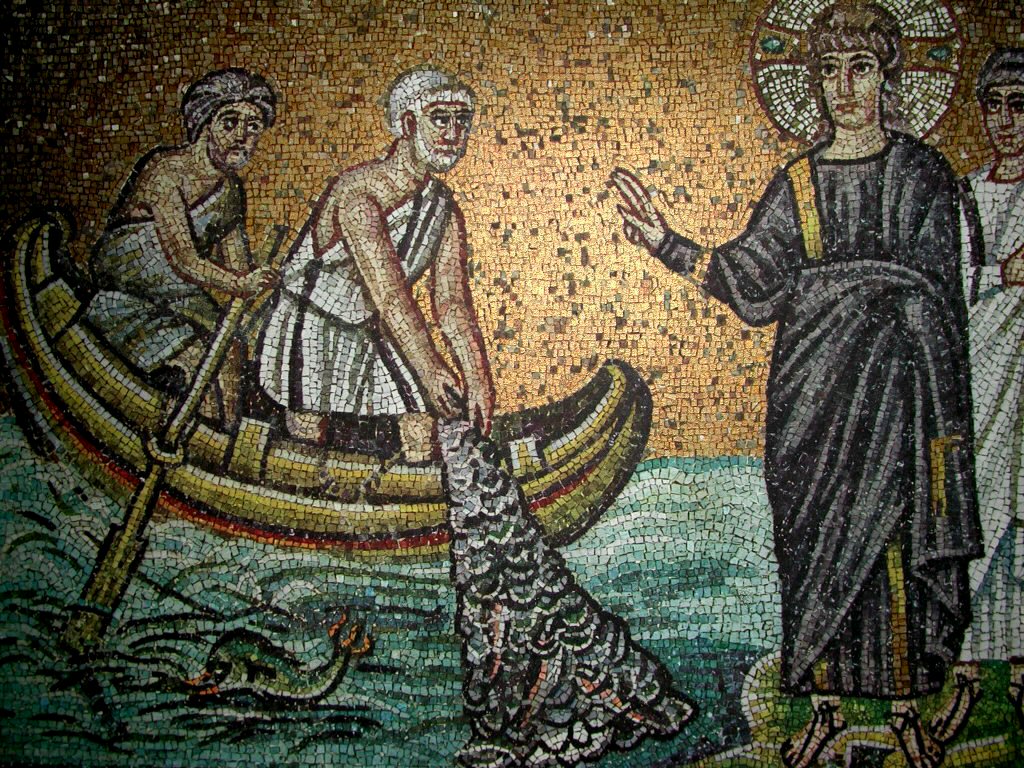
As Jesus passed along the Sea of Galilee, he saw Simon and his brother Andrew casting a net into the sea– for they were fishermen. And Jesus said to them, “Follow me and I will make you fish for people.” And immediately they left their nets and followed him. As he went a little farther, he saw James son of Zebedee and his brother John, who were in their boat mending the nets. Immediately he called them; and they left their father Zebedee in the boat with the hired men, and followed him. Mark 1:14-20.

Mark’s Gospel offers us some unique insights into the Christian life for the third week of Epiphany. After John the Baptist’s arrest, Jesus announces the imminence of the kingdom of God, requiring repentance and calling for hope (belief “in the good news”). Mark sets the story on the sea of Galilee, known for sudden storms. The men who made eked out their living fishing on these waters worked very hard, were heavily taxed, and struggled with many of the same day-to-day issues we know so well. I’ve known men like this, and they are not easily moved.

So, Jesus meets two sets of brothers: Simon and Andrew, and James and John (who Jesus later nicknamed the “Sons of Thunder”). He calls to them to follow him, and each of these men leave behind their work, their families and their homes to follow Jesus. As we discussed in the call of Samuel, God has a funny sense of timing, and his message often interrupts us when we’re trying to do something else. Perhaps these men were just ready to hear a message of hope and forgiveness. Perhaps they were ready to hear the message that evil doesn’t win and that there’s another way to live.

I think, however, that this arresting story of the origins of the Church sheds a good deal of light on the kind of man Jesus must have been. He must have been a remarkably compelling figure, this itinerant preacher walking along the Galilee. Mark’s Gospel reports that the decision to follow Jesus occurred “immediately”, suggesting that their hopes for the promised good news overcame their fears and their attachments. The passage also suggests these men felt a sense of urgency, that they couldn’t put off their walk with God any longer or take care of a few little things beforehand. May it be so with us, too.

The Gospel teaches us something important about our path to discipleship. Very few of us will start or travel down this path of conversion alone. Conversion, whether we’re turning away from or turning toward something, is a difficult process, and most of us will need to take a friend, a brother or a sister along for the journey. Jesus called these disciples into a vocation of hope and forgiveness and a relationship with the living God. These two sets of brothers felt impelled to leave behind their ordinary, workaday lives and follow Jesus. May it be so with us, too.

Finally, Scripture teaches us an important lesson about being a disciple. Then and now, following Christ will require that you’re going to have to leave some things behind. In the case of these men, it was their boats, their nets, their jobs and their families. For some of us, it may be habits, outlooks, destructive relationships, or the fears that bind us to the present moment. The disciples found a way to leave those things behind. May it be so with us, too.

Shabbat shalom,

James R. Dennis, O.P.

© 2012 James R. Dennis

What Are You Looking For?

The next day John again was standing with two of his disciples, and as he watched Jesus walk by, he exclaimed, ‘Look, here is the Lamb of God!’ The two disciples heard him say this, and they followed Jesus. When Jesus turned and saw them following, he said to them, ‘What are you looking for?’ They said to him, ‘Rabbi’ (which translated means Teacher), ‘where are you staying?’ He said to them, ‘Come and see.’  John 1:35-39.

In the Daily Office today, we read the Gospel of John, which again offers us a fine reading for the season of Epiphany.  Once again, we encounter John the Baptist, this time on the day after Jesus’ baptism.  As Jesus passes by, John again announces that Jesus is the Lamb of God.  

Rather than stepping into the spotlight, John  illuminates Jesus.  That phrase, “the Lamb of God”, would have carried immediate connotations for his Jewish audience.  The Passover operated as the pivot point for the Jewish people’s understanding of their salvation, and the Passover meal was lamb.  John thus bears witness that Jesus offers their deliverance. 

Andrew and another of John’s disciples hear this startling announcement and begin following Jesus.  The next passage provides us with insight into the kind of man Jesus was.  John doesn’t record Jesus announcing his ministry in a dramatic proclamation.  Jesus doesn’t attract his disciples with miracles or a sermon or a sales pitch. There’s nothing ecstatic or charismatic in his response. A friend of mine has recently convinced me that all forms of ministry (teaching, preaching, liturgy, outreach, and evangelism) are, at their core, pastoral

Jesus’ first question to the disciples reveals his pastoral nature:  “What are you seeking?  What do you think is missing?”  The world brims with people who are looking for something:  God, happiness, wealth, enlightenment or something new and exciting.  Each of us who claims to follow Christ, however, should regularly ask ourselves that very question:  “What are you looking for?”  If our response is something other than Jesus, we might want to reorient our pursuits.  Jesus’ question may call to mind God’s first question to mankind, “Where are you?”  Gen. 3:9. 

The disciples then ask Jesus, “Rabbi, where are you staying?”  That translation leaves a bit to be desired.  Their question wasn’t so much “Where are you spending the night?”  Rather, they wanted to know where Jesus lived, where he dwelt, where he “abided.”  We would do well to think here of another passage in John’s Gospel:  “Abide in me as I abide in you.”  John 15:4.  The disciples aren’t asking so much about geography as they are beginning to probe his teaching, his “yoke”, and his idea of relationships.  Jesus’ remarkable response, “Come and see”, will shape the lives of his disciples forever. 

In the Gospel of John, the word “see” always involves something more than one might understand initially.  The Greek word orapo connotes more than visual observation.  It suggests spiritual vision, insight or understanding.  Jesus thus invites these two disciples to follow him, understand and find what they are looking for.  He’s extending the same invitation to you, and to me.

Pax,

James R. Dennis, O.P.

 © 2012 James R. Dennis


The Beloved

John the baptizer appeared in the wilderness, proclaiming a baptism of repentance for the forgiveness of sins. And people from the whole Judean countryside and all the people of Jerusalem were going out to him, and were baptized by him in the river Jordan, confessing their sins. Now John was clothed with camel’s hair, with a leather belt around his waist, and he ate locusts and wild honey. He proclaimed, “The one who is more powerful than I is coming after me; I am not worthy to stoop down and untie the thong of his sandals. I have baptized you with water; but he will baptize you with the Holy Spirit.”

In those days Jesus came from Nazareth of Galilee and was baptized by John in the Jordan. And just as he was coming up out of the water, he saw the heavens torn apart and the Spirit descending like a dove on him. And a voice came from heaven, “You are my Son, the Beloved; with you I am well pleased.” Mark 1:4-11.

The Lectionary offers us this reading from Mark’s Gospel on this first Sunday of the season of Epiphany.  The Greek word epiphaino translates roughly as the appearance or manifestation of the light.  This Gospel reading fits perfectly within that idea, and you’ll remember that we previously discussed  Jesus had describing himself as the “light of the world.”

I’ve always been fascinated with the issue of Jesus’ understanding of himself:  what did the incarnate Lord understand about his role, and when did he begin to understand it?  The story of Jesus’ baptism offers us some remarkable insight into these questions.

The story begins with a character we’ve become familiar with, John the Baptist.  Now, at the time, the practice of ritual purification was fairly common.  John seems to have been doing something different, though, in this rite of baptism. More than just a ceremonial cleansing, John appears to have called  his followers to a spiritual act of  initiation.   Rather than a regular ritual purification, John seems to be engaged in something unique, radical and challenging at the time. 

John’s baptism would have challenged the institutional church of the day, offering baptism for the forgiveness of sins.  John lacked any institutional authority and forgiving sins lay within the exclusive jurisdiction of the Temple priests.  Like most of the prophets, John presents himself as a fanatic, an outsider and a critic of the status quo.  So, when Jesus endorses John’s ministry, his baptism itself challenged the authority of the Temple. 

Jesus shared in listening to John’s prophetic call. He waded into the same waters as the rest of John’s followers. He approaches John just as everyone else came to John. Thus, Jesus shared those waters with all humanity. And then, something astonishing happened….

Earlier, we talked about the collision of heaven and earth in Jesus’ nativity.  We discussed the notion that the Incarnation changed the very fabric of space and time.  We see those ideas reinforced in this remarkable story of the Epiphany, as God begins to reveal Himself, to “enlighten” the world a bit.

 As Jesus comes forth from the water, Mark reports that the heavens were “torn open.”  That terribly interesting phrase, “torn open”, suggests this was no peaceful, gentle encounter.  Mark uses that same word, “torn”, to describe the separation of the Temple curtain after Jesus “breathed his last” on Golgotha.  As the veil separating heaven and earth rips apart, the Spirit emerges.

These remarkable events unfold as Jesus (whose very name means “God saves”)  emerges from the water.  The story reverberates with the memory of the Jewish people emerging the Red Sea, their principle narrative of salvation.  And then, from the heavens, God claims Jesus as His son, the Beloved.

I’d encourage you to engage in an exercise.  I’d like you to think back to your own baptism.  And I’d like you to imagine that same voice announcing that you are God’s child, and His beloved.  I believe it’s important that we become acclimated to that idea.  It may offer the first step in going beyond celebrating an Epiphany to living out the Epiphany and spreading the light of Christ into the dark places of the world.  My friend, Father Mike Marsh noted recently ( here)  that God calls each of us to “become Epiphany”.  Our vocation and our challenge lies in manifesting God’s love, helping His people hear that voice as the heavens are torn apart.

Shabbat shalom,

James R. Dennis, O.P.

  © 2012 James R. Dennis

All Who Heard It Were Amazed

In that region there were shepherds living in the fields, keeping watch over their flock by night. Then an angel of the Lord stood before them, and the glory of the Lord shone around them, and they were terrified. But the angel said to them, “Do not be afraid; for see– I am bringing you good news of great joy for all the people: to you is born this day in the city of David a Savior, who is the Messiah, the Lord. This will be a sign for you: you will find a child wrapped in bands of cloth and lying in a manger.” And suddenly there was with the angel a multitude of the heavenly host, praising God and saying,

 Glory to God in the highest heaven,
            and on earth peace among those whom he favors!”

When the angels had left them and gone into heaven, the shepherds said to one another, “Let us go now to Bethlehem and see this thing that has taken place, which the Lord has made known to us.” So they went with haste and found Mary and Joseph, and the child lying in the manger. When they saw this, they made known what had been told them about this child; and all who heard it were amazed at what the shepherds told them. But Mary treasured all these words and pondered them in her heart.  Luke 2:  8-19.

Reading Luke’s gospel, we find ourselves awe-struck by the events unfolding here:  heaven and earth have intersected, they have collided,  in this desolate, remote little place.  When locating his entry into human history, God chose neither Rome (the headquarters of the world’s superpower) nor Jerusalem (the seat of religious authority).  

This isn’t just an “out-of-the-way” little spot; the manger is decidedly uncomfortable.  The text makes that clear, noting that there was no room at the inn, and they found their place among the animals.  In no small way, the Holy Family’s rejection by the world (“no room at the inn”), foreshadows and points us toward the Cross, where Jesus is again rejected by the world. 

Similarly, the angels announce Jesus’ entry into human history to a meager group of shepherds.  The angels announce this collision of heaven and earth  to those who are poor, anonymous, not especially important or powerful, and probably misfits in the world.  Curiously, God’s makes Himself present first to those who just don’t seem to matter very much to anyone but the Lord of Heaven.

The angels told these shepherds, men camouflaged by their obscurity, that the Messiah, their savior and ours, lay in a manger among the beasts of the earth.  They ran to spread the news, and are still spreading it.  I’m wondering, can we be amazed at these events?  Can we set aside  our malaise and the mortification of the commonplace, and recognize that the birth of the Christ child is happening now, all around us?  I pray we can.

This Christmas day, I wish you the joy and peace of knowing that God is with us, and that Jesus has come to share God’s dreams for this world.  Love is raining down all around us.  And I’d ask that you save a few moments from your joy to pray and care for those who cannot yet feel that love, those who are broken-hearted, or hungry or alone today. 

Emmanuel, my friends,

James R. Dennis, O.P.

 © 2011 James R. Dennis

My Lord and My God!

But Thomas (who was called the Twin), one of the twelve, was not with them when Jesus came. So the other disciples told him, ‘We have seen the Lord.’ But he said to them, ‘Unless I see the mark of the nails in his hands, and put my finger in the mark of the nails and my hand in his side, I will not believe.’

A week later his disciples were again in the house, and Thomas was with them. Although the doors were shut, Jesus came and stood among them and said, ‘Peace be with you.’ Then he said to Thomas, ‘Put your finger here and see my hands. Reach out your hand and put it in my side. Do not doubt but believe.’ Thomas answered him, ‘My Lord and my God!’  John 20: 24-28.

On December 21, the church celebrates the Feast of St. Thomas, sometimes known as the Doubting Thomas.  This feast day may seem like a bit of an interruption in our Advent preparation, but I hope to convince you that it makes perfect sense.

For the past few weeks, we’ve been discussing the Incarnation.  Of course, the Latin root of that word is carnis, which means meat or flesh. So, the term Incarnation means that God became flesh and bone, that the immortal became mortal, that the spiritual became physical. God, in a sense, consecrated humanity by entering into our history.  

This was  not, however, some metaphysical entry, nor some encounter with an ethereal spirit.  No, Scripture tells us that Christ was born into human history, born among the animals in a stable or a cave or a stall.  This Incarnation was lowly, mean and decidedly real.

Similarly, in this story of St. Thomas, we learn that even the resurrected Christ bears the scars of his entry into human history, of his encounter with human sin.  Thomas doubted the reality of the resurrected Christ, and would not permit himself to believe until he saw the marks of that encounter in Jesus’ flesh.

I don’t think we should judge Thomas too harshly.  Most of us will face serious doubts at one point or another, and maybe face them again and again.  Perhaps because of my Jesuit education, I’m inclined to think a rigorous examination of our faith is healthy.  Otherwise, we consign ourselves to something I believe is perhaps more dangerous, a faith that is five miles wide and a quarter- inch thick.  Many of us have prayed, in some desperate hour, “Lord, I believe; help my unbelief.”  I certainly have, and so feel  a certain spiritual kinship with this good Apostle.

“Then Thomas answered him, ‘My Lord and my God!'” I think the point of this Gospel reading is not so much how Thomas came to the conclusion, but that he ultimately reached the conclusion of the  sovereignty and divinity of the Incarnate Word. 

So, we’ve been talking about what Advent means, in terms of the triumph of hope and promise over desolation and darkness.  Advent calls us to look beyond what John Newman called “the shadows and deceits of this shifting scene of time and sense”.  And as we approach again the entry of Jesus into the world, we hear Christ calling to us, “Do not doubt, but believe.” 

Emmanuel, God is with us.

James R. Dennis, O.P.

 © 2011 James R. Dennis


Binding Up the Brokenhearted

The spirit of the Lord GOD is upon me,
           because the LORD has anointed me;
he has sent me to bring good news to the oppressed,
          to bind up the brokenhearted,
to proclaim liberty to the captives,
          and release to the prisoners;
to proclaim the year of the LORD’s favor,
          and the day of vengeance of our God;
          to comfort all who mourn;
to provide for those who mourn in Zion—
          to give them a garland instead of ashes,
the oil of gladness instead of mourning,
          the mantle of praise instead of a faint spirit.  Is. 61: 1-3.

In many respects, this passage from the book of Isaiah provides the perfect Advent reflection.  It gathers up many of the emotions of the people of Israel after the Babylonian exile.   King Nebuchadnezzar and his army had destroyed the Temple, the place where God and man intersected.  Many had been sold into bondage; families were scattered and broken.  The Jews had been humiliated and these were “the worst hard times”.    And Isaiah rose to tell them God remained with them, somehow, in all this mess.

Isaiah refers back to the book of Leviticus, to proclaim the year of jubilee.  (In the year of jubilee, which occurred every fifty years, the prisoners were released, and all debts were forgiven. )  We see this theme running throughout Scripture (both the Old and New Testaments):  God comes to shower his blessings on those whose spirits have been crushed and whose hearts have been broken.  God’s focus doesn’t rest on the superpowers, the wealthy, the priests or the religious elite.  Isaiah thus proclaimed that God was at work; the days of sorrow were over and the days of joy had begun.

 This passage from Isaiah should sound very familiar to Christian readers.  This is the exact passage Jesus reads from in the synagogue when he returns to his hometown, Nazareth.  When Jesus read from this scroll, he announced:  “Today this scripture has been fulfilled in your hearing.”  Luke 4:20.  I think this reveals two important messages.  First, it tells us a good deal about Jesus’ understanding of his mission.  He came to bind up the brokenhearted, to release the prisoners and set the captives free, and to bring sight to the blind.

 If we take the Incarnation seriously and believe that we really are the body of Christ the second message of this Scripture becomes clear:  if we follow Jesus, this is our mission as well.  Because of the Incarnation, our task is clear:  we are to tend to the brokenhearted, the blind, those who mourn, and those who are enslaved.  Sometimes, those conditions may be literal, and sometimes they may be spiritual.  Either way, that’s the purpose and the proper function of the Body of Christ.

Thus, Advent announces something deeply joyous, a joy that reaches far beyond our understanding.  As Rabbi Heschel once wrote:

There is not enough grandeur in our souls
To be able to unravel in words
The knot of time and eternity.
One should like to sing for all men,
For all generations…
There is a song in the wind
And joy in the trees.

Our joy approaches, and the whole earth quickens as the Word nears.

Shabbat Shalom,

James R. Dennis, O.P.

 © 2011 James R. Dennis

Dying of Thirst

Hear this, you that trample on the needy, and bring to ruin the poor of the land, saying, “When will the new moon be over so that we may sell grain; and the sabbath, so that we may offer wheat for sale? We will make the ephah small and the shekel great, and practice deceit with false balances, buying the poor for silver and the needy for a pair of sandals, and selling the sweepings of the wheat.”

….

The time is surely coming, says the Lord GOD, when I will send a famine on the land; not a famine of bread, or a thirst for water, but of hearing the words of the LORD. They shall wander from sea to sea, and from north to east; they shall run to and fro, seeking the word of the LORD, but they shall not find it. In that day the beautiful young women and the young men shall faint for thirst.  Amos 8: 4-13.

In the Daily Office reading from the Old Testament, we find the prophet Amos acting in the quintessential role of the prophet:  he speaks as a social critic, calling the people of Israel to change their ways.  At first blush, we might wonder what this has to do with us today and how this reading fits into our understanding of Advent.   

Amos speaks out against a terrible social and spiritual problem:  deceit.  Particularly, he is concerned with those who take advantage of the poor.  We don’t have to look very  far to find modern examples suggesting that this is still a problem.  Our newspapers remind us  that there’s nothing archaic about Amos’ concern.  From pools of mortgage-backed securities to deceptive bank  and credit card practices to borrowers who take out loans that they know they cannot repay, we encounter the problem of deceit every day.  But, for the sake of our souls, rather than looking at the headlines, we should search our lives for the ways in which our own deception has separated us from God.  If I have a superpower in this life, it’s my capacity for deception and self-deception. 

Amos believed  that the problem had become so widespread that he compared it to a moral famine and a spiritual drought.  He believed that sharp dealings and deception would result in our inability to hear God in the world.  He wrote about people going from “sea to sea, and from north to east” looking for some whisper of God, and not being able to find it.  That’s the state of the people in first century Palestine:  they knew that their spiritual lives were withering without God’s word, without God’s presence.

Amos summed up our Advent expectation, hoping for a day when justice would “roll down like waters, and righteousness like an everflowing stream.”  Amos 5: 24.  In the Collect for this second we of Advent we pray:  “Merciful God, who sent your messengers the prophets to preach repentance and prepare the way for our salvation: Give us grace to heed their warnings and forsake our sins, that we may greet with joy the coming of Jesus Christ our Redeemer.” 

Like Amos, we pray for the end of this famine, for this spiritual drought.  We hope for a day when justice, honor and fairness would roll across the land like an  overflowing torrential river.  That’s our Advent hope, as well.  The people of Israel were spiritually parched, dying for God’s word.  Advent tells us that Word is coming. 

God give you peace and a spirit of wonder,

James R. Dennis, O.P.

 © 2011 James R. Dennis

The Feast of the Holy Cross

Today, on the Feast of the Holy Cross, I thought I’d share a thought from one of our Franciscan brothers.

“God wants useable instruments who will carry the mystery, the weight of glory, and the burden of sin simultaneously, who can bear the darkness and the light, who can hold the paradox of incarnation–flesh and spirit, human and divine, joy and suffering at the same time, just as Jesus did.”

–Fr. Richard Rohr, Things Hidden

Pax,

James R. Dennis, O.P.