Tag Archives: Jesus

What Are You Looking For?

The next day John again was standing with two of his disciples, and as he watched Jesus walk by, he exclaimed, ‘Look, here is the Lamb of God!’ The two disciples heard him say this, and they followed Jesus. When Jesus turned and saw them following, he said to them, ‘What are you looking for?’ They said to him, ‘Rabbi’ (which translated means Teacher), ‘where are you staying?’ He said to them, ‘Come and see.’  John 1:35-39.

In the Daily Office today, we read the Gospel of John, which again offers us a fine reading for the season of Epiphany.  Once again, we encounter John the Baptist, this time on the day after Jesus’ baptism.  As Jesus passes by, John again announces that Jesus is the Lamb of God.  

Rather than stepping into the spotlight, John  illuminates Jesus.  That phrase, “the Lamb of God”, would have carried immediate connotations for his Jewish audience.  The Passover operated as the pivot point for the Jewish people’s understanding of their salvation, and the Passover meal was lamb.  John thus bears witness that Jesus offers their deliverance. 

Andrew and another of John’s disciples hear this startling announcement and begin following Jesus.  The next passage provides us with insight into the kind of man Jesus was.  John doesn’t record Jesus announcing his ministry in a dramatic proclamation.  Jesus doesn’t attract his disciples with miracles or a sermon or a sales pitch. There’s nothing ecstatic or charismatic in his response. A friend of mine has recently convinced me that all forms of ministry (teaching, preaching, liturgy, outreach, and evangelism) are, at their core, pastoral

Jesus’ first question to the disciples reveals his pastoral nature:  “What are you seeking?  What do you think is missing?”  The world brims with people who are looking for something:  God, happiness, wealth, enlightenment or something new and exciting.  Each of us who claims to follow Christ, however, should regularly ask ourselves that very question:  “What are you looking for?”  If our response is something other than Jesus, we might want to reorient our pursuits.  Jesus’ question may call to mind God’s first question to mankind, “Where are you?”  Gen. 3:9. 

The disciples then ask Jesus, “Rabbi, where are you staying?”  That translation leaves a bit to be desired.  Their question wasn’t so much “Where are you spending the night?”  Rather, they wanted to know where Jesus lived, where he dwelt, where he “abided.”  We would do well to think here of another passage in John’s Gospel:  “Abide in me as I abide in you.”  John 15:4.  The disciples aren’t asking so much about geography as they are beginning to probe his teaching, his “yoke”, and his idea of relationships.  Jesus’ remarkable response, “Come and see”, will shape the lives of his disciples forever. 

In the Gospel of John, the word “see” always involves something more than one might understand initially.  The Greek word orapo connotes more than visual observation.  It suggests spiritual vision, insight or understanding.  Jesus thus invites these two disciples to follow him, understand and find what they are looking for.  He’s extending the same invitation to you, and to me.

Pax,

James R. Dennis, O.P.

 © 2012 James R. Dennis


The Pool of Siloam

As he walked along, he saw a man blind from birth. His disciples asked him, “Rabbi, who sinned, this man or his parents, that he was born blind?” Jesus answered, “Neither this man nor his parents sinned; he was born blind so that God’s works might be revealed in him. We must work the works of him who sent me while it is day; night is coming when no one can work. As long as I am in the world, I am the light of the world.” When he had said this, he spat on the ground and made mud with the saliva and spread the mud on the man’s eyes, saying to him, “Go, wash in the pool of Siloam” (which means Sent). Then he went and washed and came back able to see.

Jesus heard that they [the Pharisees] had driven him out, and when he found him, he said, “Do you believe in the Son of Man?” He answered, “And who is he, sir? Tell me, so that I may believe in him.” Jesus said to him, “You have seen him, and the one speaking with you is he.” He said, “Lord, I believe.”  John 9:1-7; 35-38.

I regularly travel with some friends to a camp in the Sangre de Christo mountains of New Mexico.  There, away from the lights of the city, when the sun sets in the forest, I’m always struck by just how dark it can get.  That kind of darkness impresses us with fear, with vulnerability and with isolation.  I suspect that’s exactly the sort of life the man born blind led until his encounter with Jesus.

In the Daily Office today, we find the story of Jesus and that man, set out in the ninth chapter of John’s Gospel.  It’s a powerful story, powerful enough to have inspired the former slave-trader John Newton to pen one of our favorite hymns, Amazing Grace.  (“I was blind, but now I see.”)  This story also illustrates two of the attributes of Jesus’ name described by Bernard of Clairvaux in my last post:  Jesus is light and Jesus is healing.

Back then, the Jewish people associated blindness and most any sort of physical infirmity with sin.  The disciples echo this assumption, asking whether this blindness resulted from this man’s sin or the sins of his parents.  That assumption, expressly rejected by Jesus, lingers on with us today.  From illness to  natural disaster, people and their “religious” leaders try to assign the fault for these events to some past moral failure.  Jesus refuses to take part in that speculation. 

Blindness and many other physical infirmities would exclude one from the Temple, from the place where good devout Jews could encounter God.  In almost every icon depicting the story, therefore, we see the Temple in the background.  The man born blind, therefore, becomes a sort of icon for those who the religious structure of that time excluded.  And into the darkness that enveloped this man, Jesus enters and describes himself as the “light of the world.”

Jesus spits on the ground and makes mud which he spreads on the man’s eyes.  It’s an interesting and curious approach to this man’s predicament, but I think part of the key to understanding this story lies just a couple of sentences earlier.  Rather than explaining to the disciples the real cause of this man’s blindness, Jesus tells them:  “We must work the works of him who sent me….” Having been sent by God, Jesus must engage in God’s work.  Jesus didn’t need a poultice to cure this man’s blindness, but I think he intentionally invoked the image of God’s creation of Adam.  Just as God created Adam from the clay (mud) of the earth, Jesus will re-create this blind man’s life.

Jesus then instructs the man to wash himself in the pool of Siloam.  (Notice that this is the work for which God “sent” Jesus into the world, and the very name of the pool means “sent”.)  The Jewish people used that pool as a place for ritual purification, necessary for entry into the Temple.  The man born blind is thus “baptized” back into the community of those eligible to encounter God in that Holy Place and his sight returns.   The pool, intended as a place for purification, has become a place for healing and reconciliation.

Now, all this transpires on the Sabbath, and provides the Pharisees with one more instance of Jesus’ disregard for the religious traditions (and authorities) of the day.  The Pharisees convince themselves that Jesus is a great sinner, just like the man born blind, whom they expel. John thus makes clear that they remain in the darkness, spiritually blind.

When Jesus encounters the man born blind later, the man confesses his faith in Jesus as the Messiah, the Son of Man.  There are few moments in Scripture more poignant than his final acknowledgement:  “Lord, I believe.” 

I’m wondering, who is unwelcome today and who have we excluded because their “sin” disqualifies them?  Like the Pharisees, have we fallen in love with doing “churchy things” rather than falling in love with God and his children? Are we instruments of reconciliation in the world, or do we place obstacles in the path of those who want and need God’s help?  And perhaps more importantly, I wonder where are the dark places in the world and in our lives not yet illuminated by the light of Christ?

Pax Christi,

James R. Dennis, O.P.

 © 2012 James R. Dennis


Name This Child


After eight days had passed, it was time to circumcise the child; and he was called Jesus, the name given by the angel before he was conceived in the womb.  Luke 2:  21

Today, the Episcopal Church celebrates the Feast of the Holy Name of Jesus.  Most families view naming our children as an incredibly important decision.  Many ponder the issue for months, and even years.  Often, the name of a child will ring with significance for the family, sometimes borrowing the name of the father or of an important ancestor.  Sometimes, families will examine books filled with baby names and their meanings.  Sometimes, parents name the child after a city, or favorite character in a book or a movie. How then, does one go about naming the incarnate son of God?

Now, throughout the Old Testament, we encounter several stories of God being pretty careful about revealing his name.  In Exodus, God tells Moses:  “‘I am the Lord.’ I appeared to Abraham, Isaac, and Jacob as God Almighty, but by my name ‘The Lord’ I did not make myself known to them.”  Ex. 6:2-3.  Similarly, God tells Moses, “I Am Who I Am.”  Ex. 3: 14. This divine ambiguity becomes so ingrained into the Jewish understanding of the divine that the name of God could not, and still cannot, be spoken by the Jewish people.

Luke’s Gospel reports that Gabriel told Mary to name the child “Jesus” (Yeshua in the Hebrew).  Luke 1:31.  Mathew reports that an angel of the Lord instructed Joseph to name the child Jesus.  Matt. 1:21.  In both stories, God clearly directs Jesus’ parents about his name.  Jesus’ name results, therefore, from both divine and human activity.

In first century Palestine, the name Yeshua (“God saves” or “God is salvation”) was a fairly common name.  It echoed with meaning, invoking the name of one of the heroes of the Exodus, the central narrative of the Jewish people.  But I think there’s something more at work here:  in the very name of his incarnate son, God engages in the process of self-revelation.  The Lord is telling us what He’s like, answering questions the Jewish people had raised for years about the nature and name of God.

Traditionally, devout Jews named their male children as part of the rite of circumcision, which constituted part of the Abrahamic covenant.  We find God’s self-revelation, then, in the midst of the ritual fulfilling the covenant.  And God, through his participation in the naming of this child, reveals Himself and Jesus’ mission to us:  salvation. 

One of my favorite monastics, St. Bernard of Clairvaux, wrote about the name of Jesus.  He said that the Jesus’ very name was light, food and medicine.  Jesus brought light into the darkness of a world dominated by power, dominance, sin and death.  John’s Gospel teaches that Jesus “was the light of all people. The light shines in the darkness, and the darkness did not overcome it.”  Jesus described himself as “the bread of life.”  He brought food that “restores the wearied faculties, strengthens virtue, [and] gives vigor to good and holy habits…”  Bernard of Clairvaux, 15th Sermon on the Canticle of Canticles.  The name of Jesus serves as medicine for souls in torment, and all the illnesses of this world.  We remember how often Jesus was engaged in healing, and how the disciples were able to heal through the invocation of Jesus’ name.

And so today, we celebrate the naming of our Lord, we recognize the name:

     that is above every name,
so that at the name of Jesus
     every knee should bend,
     in heaven and on earth and under the earth,
and every tongue should confess
     that Jesus Christ is Lord,
     to the glory of God the Father.   Phil. 2:9-11.

In the life of Christ, God has revealed Himself as meek, humble and self-denying.  In the name of Jesus, God tells us that He is deeply concerned with our salvation.  In the midst of the muck and stench of the manger, through the joy of the wedding at Cana, in the sorrow of Lazarus’ tomb, and despite the horror of Golgatha, God saves.  That’s got to be Good News.

Shabbat shalom,

James R. Dennis, O.P.

 © 2012 James R. Dennis
The Holy Innocents

Now after they [the Magi] had left, an angel of the Lord appeared to Joseph in a dream and said, “Get up, take the child and his mother, and flee to Egypt, and remain there until I tell you; for Herod is about to search for the child, to destroy him.” Then Joseph got up, took the child and his mother by night, and went to Egypt, and remained there until the death of Herod. This was to fulfill what had been spoken by the Lord through the prophet, “Out of Egypt I have called my son.”

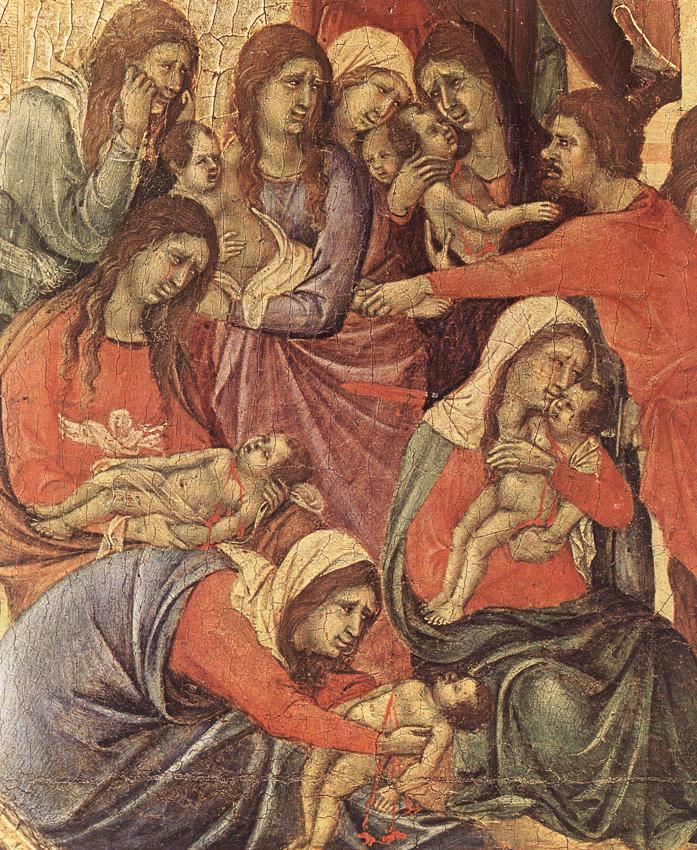
When Herod saw that he had been tricked by the wise men, he was infuriated, and he sent and killed all the children in and around Bethlehem who were two years old or under, according to the time that he had learned from the wise men. Then was fulfilled what had been spoken through the prophet Jeremiah:  “A voice was heard in Ramah, wailing and loud lamentation, Rachel weeping for her children; she refused to be consoled, because they are no more.”  Matt. 2:11-18.

Today the Church remembers the slaughter of the Holy Innocents. Here, we encounter a ghastly and appalling story, but I think there are several lessons we can take from this narrative.  We should first examine the character of Herod (known to historians as Herod the Great).  Although Herod greatly expanded the Second Temple, he also murdered many rabbis and members of his own family.  He collaborated with the Roman occupation, and he reigned with a demented savagery.

While scholars may question the historical accuracy of this account in Matthew’s gospel, Matthew’s portrayal meshes well with what we know of Herod’s character.  At the root of these frightening events, we find a genuine insight into Herod’s depravity.  Herod fears losing power, and that phobia sparks his maniacal infanticide.  Into this world, the Christ child is born.

The world hasn’t changed much.  From Dachau to Serbia to Darfur, Herod is still afraid, and the slaughter of the innocents continues.  And this remains the world into which Christ enters.  And ultimately, Christ offers himself as a victim of our savage history.

Matthew offers another insight in this story.  The Holy Family protects the Christ child, traveling to Egypt to escape Herod’s rage.  Matthew refers to Hos. 11:1 and Exodus 4:22-23 with a purpose.  He’s telling his audience that Jesus is the new Moses:  just as Moses delivered the chosen people from slavery, Jesus will free them from sin and death.   Moses and the Prophets reveal God’s dedication to mankind’s salvation; in the Christ child, that dedication becomes incarnate.

I’m also fascinated with the impulse of Mary and Joseph:  I think there’s something more at work here than the simple protective impulse of Jesus’ parents.  You see, I think they’re still out there in the world today: Pharoah, Herod, Stalin, Pol Pot and the other slaves to fear and hatred. 

So, I think Matthew asks us, are we willing to shelter Jesus?  What are we willing to do to protect Christ in the world?  Because I think Matthew and the Church are telling us that our Christmas joy never takes place in a historical vacuum, and the world can be a place of deadly and senseless violence.  As my great-aunt once cautioned me, “May the peace of Christ disturb you greatly.”

Pax,

James R. Dennis, O.P.

 © 2011 James R. Dennis


All Who Heard It Were Amazed

In that region there were shepherds living in the fields, keeping watch over their flock by night. Then an angel of the Lord stood before them, and the glory of the Lord shone around them, and they were terrified. But the angel said to them, “Do not be afraid; for see– I am bringing you good news of great joy for all the people: to you is born this day in the city of David a Savior, who is the Messiah, the Lord. This will be a sign for you: you will find a child wrapped in bands of cloth and lying in a manger.” And suddenly there was with the angel a multitude of the heavenly host, praising God and saying,

 Glory to God in the highest heaven,
            and on earth peace among those whom he favors!”

When the angels had left them and gone into heaven, the shepherds said to one another, “Let us go now to Bethlehem and see this thing that has taken place, which the Lord has made known to us.” So they went with haste and found Mary and Joseph, and the child lying in the manger. When they saw this, they made known what had been told them about this child; and all who heard it were amazed at what the shepherds told them. But Mary treasured all these words and pondered them in her heart.  Luke 2:  8-19.

Reading Luke’s gospel, we find ourselves awe-struck by the events unfolding here:  heaven and earth have intersected, they have collided,  in this desolate, remote little place.  When locating his entry into human history, God chose neither Rome (the headquarters of the world’s superpower) nor Jerusalem (the seat of religious authority).  

This isn’t just an “out-of-the-way” little spot; the manger is decidedly uncomfortable.  The text makes that clear, noting that there was no room at the inn, and they found their place among the animals.  In no small way, the Holy Family’s rejection by the world (“no room at the inn”), foreshadows and points us toward the Cross, where Jesus is again rejected by the world. 

Similarly, the angels announce Jesus’ entry into human history to a meager group of shepherds.  The angels announce this collision of heaven and earth  to those who are poor, anonymous, not especially important or powerful, and probably misfits in the world.  Curiously, God’s makes Himself present first to those who just don’t seem to matter very much to anyone but the Lord of Heaven.

The angels told these shepherds, men camouflaged by their obscurity, that the Messiah, their savior and ours, lay in a manger among the beasts of the earth.  They ran to spread the news, and are still spreading it.  I’m wondering, can we be amazed at these events?  Can we set aside  our malaise and the mortification of the commonplace, and recognize that the birth of the Christ child is happening now, all around us?  I pray we can.

This Christmas day, I wish you the joy and peace of knowing that God is with us, and that Jesus has come to share God’s dreams for this world.  Love is raining down all around us.  And I’d ask that you save a few moments from your joy to pray and care for those who cannot yet feel that love, those who are broken-hearted, or hungry or alone today. 

Emmanuel, my friends,

James R. Dennis, O.P.

 © 2011 James R. Dennis

Nothing Will Be Impossible

In the sixth month the angel Gabriel was sent by God to a town in Galilee called Nazareth, to a virgin engaged to a man whose name was Joseph, of the house of David. The virgin’s name was Mary. And he came to her and said, “Greetings, favored one! The Lord is with you.” But she was much perplexed by his words and pondered what sort of greeting this might be. The angel said to her, “Do not be afraid, Mary, for you have found favor with God. And now, you will conceive in your womb and bear a son, and you will name him Jesus. He will be great, and will be called the Son of the Most High, and the Lord God will give to him the throne of his ancestor David. He will reign over the house of Jacob forever, and of his kingdom there will be no end.” Mary said to the angel, “How can this be, since I am a virgin?” The angel said to her, “The Holy Spirit will come upon you, and the power of the Most High will overshadow you; therefore the child to be born will be holy; he will be called Son of God. And now, your relative Elizabeth in her old age has also conceived a son; and this is the sixth month for her who was said to be barren. For nothing will be impossible with God.” Then Mary said, “Here am I, the servant of the Lord; let it be with me according to your word.” Then the angel departed from her. Luke 1: 26-38.

So, we pretty much all know this story.  In fact, most of us have heard the Annunciation story so often that it’s lost some of its impact.  If we’re not careful, we can forget just how remarkable and surprising this story is.

In the first place, let’s look at the context.  After centuries of war, occupation and exile, the Jewish people were mired in hopelessness.  Mary, or Miriam as she would have been called, lived on a dead-end street in a long-forgotten town at the far corner of the Roman empire.  More importantly, she was a woman. In that culture at that time, being a woman means nothing much that’s important would happen to her.  So, the angel Gabriel’s announcement that “The Lord is with you” would have startled Luke’s audience. 

This passage clearly echoes Gabriel’s earlier announcement to Zechariah, the father of John the Baptist.  So, St. Luke reminds us that God is up to something astonishing here, involving both Mary and Elizabeth.  God’s action in this regard actually begins much earlier, in the creation story.  In the birth narratives of both John the Baptist and Jesus we find God engaged in the same sort of thing we encountered in Genesis:  creation ex nihilo (from nothing).  The angel even tells Mary that God is doing precisely that with her cousin Elizabeth.  The notion of the virgin birth therefore raises the idea of the Lord resuming the work begun in creation:  re-creating the world.

But let’s return our focus to Miriam, the Theotokos.  Gabriel announces that she will bear a son and name him Jesus. (The name Jesus is the Greek form of the Hebrew name Joshua, who led the people of Israel into the Promised Land.  Thus, his very name involves the notion of God keeping his promises, fulfilling the covenant.) As was the case with the John, God seems terribly interested in Jesus’ name, as though the words themselves would act as icons of God’s power working in the world. 

Now, while the coming of the Messiah might have constituted very good news for the people of Israel, it might not have sounded like such good news for Miriam.  An unwed mother, at best, would provide the people of Nazareth with a fine scandal.  It’s the sort of thing that could get a girl killed.  I think the Holy Mother understood perfectly well the cost that she might have to pay for bringing God into the world. 

Jesus’ conception through the Holy Spirit will resonate later in the story of his baptism in the Jordan, as a dove descends and the voice of God announces that Jesus is God’s beloved son.  So, these two birth narratives (Jesus and John) will reconnect years later as Jesus begins his public ministry and God claims him as his own son.  All these things happen through Mary’s “fiat”:  “Let it be done with me according to your word.”  Mary thus serves as the real gateway of the Incarnation.

I wonder how many of us are able to hear God’s message in our own lives:  “The Lord is with you.”  Can we come to think of ourselves as  “favored ones”?  Can we bear the Christ child, and are we willing to bring him into the world?  Are we willing to respond, “Let it be with me”?   I ask these things because those same questions that the Holy Mother faced, well, I think the Gospel asks them of you and of me.  While it’s certainly true that God intended to draw Mary into his plan to re-create and redeem the world, I  believe He has exactly the same intent for us.

The Advent message centers on hope and promise, and setting aside our despair and our terror.  The season of Advent recognizes, as it’s so desperately difficult for us to see sometimes, that nothing will be impossible for God.   And while Gabriel says that as a matter of fact, I think for most of us it’s a kind of a prayer: a prayer we might say more often.

Shabbat shalom,

James R. Dennis, O.P. 

© 2011 James R. Dennis

Binding Up the Brokenhearted

The spirit of the Lord GOD is upon me,
           because the LORD has anointed me;
he has sent me to bring good news to the oppressed,
          to bind up the brokenhearted,
to proclaim liberty to the captives,
          and release to the prisoners;
to proclaim the year of the LORD’s favor,
          and the day of vengeance of our God;
          to comfort all who mourn;
to provide for those who mourn in Zion—
          to give them a garland instead of ashes,
the oil of gladness instead of mourning,
          the mantle of praise instead of a faint spirit.  Is. 61: 1-3.

In many respects, this passage from the book of Isaiah provides the perfect Advent reflection.  It gathers up many of the emotions of the people of Israel after the Babylonian exile.   King Nebuchadnezzar and his army had destroyed the Temple, the place where God and man intersected.  Many had been sold into bondage; families were scattered and broken.  The Jews had been humiliated and these were “the worst hard times”.    And Isaiah rose to tell them God remained with them, somehow, in all this mess.

Isaiah refers back to the book of Leviticus, to proclaim the year of jubilee.  (In the year of jubilee, which occurred every fifty years, the prisoners were released, and all debts were forgiven. )  We see this theme running throughout Scripture (both the Old and New Testaments):  God comes to shower his blessings on those whose spirits have been crushed and whose hearts have been broken.  God’s focus doesn’t rest on the superpowers, the wealthy, the priests or the religious elite.  Isaiah thus proclaimed that God was at work; the days of sorrow were over and the days of joy had begun.

 This passage from Isaiah should sound very familiar to Christian readers.  This is the exact passage Jesus reads from in the synagogue when he returns to his hometown, Nazareth.  When Jesus read from this scroll, he announced:  “Today this scripture has been fulfilled in your hearing.”  Luke 4:20.  I think this reveals two important messages.  First, it tells us a good deal about Jesus’ understanding of his mission.  He came to bind up the brokenhearted, to release the prisoners and set the captives free, and to bring sight to the blind.

 If we take the Incarnation seriously and believe that we really are the body of Christ the second message of this Scripture becomes clear:  if we follow Jesus, this is our mission as well.  Because of the Incarnation, our task is clear:  we are to tend to the brokenhearted, the blind, those who mourn, and those who are enslaved.  Sometimes, those conditions may be literal, and sometimes they may be spiritual.  Either way, that’s the purpose and the proper function of the Body of Christ.

Thus, Advent announces something deeply joyous, a joy that reaches far beyond our understanding.  As Rabbi Heschel once wrote:

There is not enough grandeur in our souls
To be able to unravel in words
The knot of time and eternity.
One should like to sing for all men,
For all generations…
There is a song in the wind
And joy in the trees.

Our joy approaches, and the whole earth quickens as the Word nears.

Shabbat Shalom,

James R. Dennis, O.P.

 © 2011 James R. Dennis

Looking For the Kingdom

Then the king will say to those at his right hand, ‘Come, you that are blessed by my Father, inherit the kingdom prepared for you from the foundation of the world; for I was hungry and you gave me food, I was thirsty and you gave me something to drink, I was a stranger and you welcomed me, I was naked and you gave me clothing, I was sick and you took care of me, I was in prison and you visited me.’  Then the righteous will answer him, ‘Lord, when was it that we saw you hungry and gave you food, or thirsty and gave you something to drink?  And when was it that we saw you a stranger and welcomed you, or naked and gave you clothing?  And when was it that we saw you sick or in prison and visited you?’  And the king will answer them, ‘Truly I tell you, just as you did it to one of the least of these who are members of my family, you did it to me.’  Then he will say to those at his left hand, ‘You that are accursed, depart from me into the eternal fire prepared for the devil and his angels;for I was hungry and you gave me no food, I was thirsty and you gave me nothing to drink, I was a stranger and you did not welcome me, naked and you did not give me clothing, sick and in prison and you did not visit me.’ Then they also will answer, ‘Lord, when was it that we saw you hungry or thirsty or a stranger or naked or sick or in prison, and did not take care of you?’  Then he will answer them, ‘Truly I tell you, just as you did not do it to one of the least of these, you did not do it to me.’  Matt. 25: 34-46.

By now, we Christians should be accustomed to the notion of an invisible reality.  We believe in an unseen God at work in the world, that simple bread and wine are transformed every week into the body and blood of Jesus, and that the Church operates as the mystical body of Christ today.  So, the reading from today’s Lectionary shouldn’t surprise us:  Christ tells us that somehow our works of charity reveal and reflect His presence in the world.

Charity doesn’t mean simply rich people writing checks to poor people, and it’s quite different from what we think of as philanthropy.  It’s Latin root is caritas, meaning loving-kindness.  In Greek the word is agape, and in Hebrew, the word is chesed.  The ancient Christian virtue of charity both glorifies and reflect’s God’s love.  In no small measure, charity is less about what we do and more about who we are.

Let’s return to the notion of this invisible reality about which Jesus is teaching us.  He tells us that our charity (our ability to love our ability to see his love and be his love) to those on the margins of society actually reveals our love for Him.  This is the tricky part:  “Just as you did it to one of the least of these who are members of my family, you did it to me.”  Jesus tells us that through the mystery of the  incarnation, every one of us can still encounter the Living Christ.  Our compassion for the hungry, the stranger,  the sick and the prisoners will allow us to find Jesus.  If we take Scripture seriously, we are all compelled to accept this mystical reality.

This entire discussion takes place within the context of Jesus telling us that our ability to love without flinching provides the standard by which the sheep and the goats will be separated.  Our salvation depends on our charity.  Jesus offers all this as an explanation of what the Kingdom is like. 

I don’t think Jesus is simply talking about heaven, or about some distant time when we’ll find out what it’s like to see the face of God.  Remember, Jesus also told us, “the kingdom of God is among you now.”  Luke 17:21. 

I know:  the world today doesn’t look much like the Kingdom.  That sick lady in the hospital, that homeless smelly old man, and that tattooed gang member in the County Jail:  they just don’t seem to have much in common with the Son of God.  But I believe in the invisible reality that Jesus told us we couldn’t yet see.  And I believe that our charity will  form our souls and will reveal the kingdom among us.

Shabbat Shalom,

James R. Dennis, O.P.

© 2011 James R. Dennis

Sh’ma Yisrael

During this interstice between the High Holy Days of Rosh Hashanah and Yom Kippur, I thought we’d examine the Sh’ma Yisrael, or Shema. For many observant Jews, the Shema offers the central prayer service of Judaism. The recitation of this prayer twice daily is a commandment. As a good Jew, Jesus would certainly have followed this practice. Deuteronomy instructs us that we shall say this prayer upon lying down and rising up. Deut. 6-7. Some have suggested that the Shema functions less as a prayer than as a creed, a statement of the binding principles of the Jewish faith.

The first section of the prayer begins: “Hear, oh Israel, the Lord our God is One. You shall love the Lord your God with all your heart, and with all your soul and with all your might.” We might examine those two sentences more closely.

The opening line of the Shema reminds God’s people of God’s oneness. This sometimes seems counterintuitive to us. God created the universe in all its complexity, hears the prayers of billions and billions of people and knows their needs. God authored gravity and the immense power of the stars. Surely, that God is incredibly complex. Sometimes, God seems like such a decent fellow, when all is going well and our bellies are full. At other times, when life isn’t going so well, we perceive God as uncaring, or perhaps even vengeful. Yet the Shema reminds us that of the simplicity of God, despite the complexity we might perceive.

St. Thomas wrote often of the simplicity of God. Summa Theologiae 1.3.7; Summa contra Gentiles 1.22.9-10. In fact, Aquinas described God as “infinitely simple.” The Oneness, or simplicity of God, provides the unifying power, the unifying event and idea for our disparate perceptions. No other ideology or vision or philosophy can replace God as the single, ultimate ground of meaning. The Shema expresses God’s sovereignty, God’s kingship, over all creation and creatures.

St. John comments on God’s oneness when he observes quite simply that “God is love.” 1 John 4:8. This leads us directly to the second passage of the Shema which continues: “And you shall love the Lord your God with all your heart, and with all your soul and with all your might.” This passage suggests that our love of the Lord must be single-minded: there is no room here for duplicity. If we truly loved unambiguously, there would be little space in our hearts for the separation of sin. Learning to love God this way requires a great deal of us. Great love always does. The Shema provides the central focus of our spirituality: loving God. But it also teaches that where we encounter love, we encounter the divine center of things.

Jesus clearly understood the central nature of the Shema. A scribe asked Christ, “Which is the greatest commandment?” Jesus answered directly from the Shema:

Jesus answered, ‘The first is, ‘Hear, O Israel: the Lord our God, the Lord is one; you shall love the Lord your God with all your heart, and with all your soul, and with all your mind, and with all your strength.’”

Mark 12: 29-30. Jesus then added a gloss to the Shema, taking his reference from Leviticus:

“The second is this, ‘You shall love your neighbour as yourself.’ There is no other commandment greater than these.”

Mark 12:32. Jesus teaches that these two commandments provide the framework, the scaffolding, for the balance of the Scriptures. Matt. 22:40. Because “our neighbors” are made in the image of God, our love of them reveals the depth of our love of the Almighty. Our capacity to love God is bounded by our capacity to love “our neighbors.”

Understanding the Shema, then, isn’t something clever or broad-minded Christians can discuss at cocktail parties. It provides us with a deep and profound understanding of who Jesus was and what he thought was important. Praying the Shema at morning and in the evening, then, helps us to understand Christ. We have a great deal to learn from our Jewish brothers and sisters. Jesus thought so, anyway.

Shabbat Shalom,

James R. Dennis, O.P.

© 2011 James R. Dennis

A God We Can Do Business With

When those hired about five o’clock came, each of them received the usual daily wage. Now when the first came, they thought they would receive more; but each of  them also received the usual daily wage. And when they received it, they grumbled against the landowner, saying, `These last worked only one hour, and you have made them equal to us who have borne the burden of the day and the scorching heat.’ But he replied to one of them, `Friend, I am doing you no wrong; did you not agree with me for the usual daily wage? Take what belongs to you and go; I choose to give to this last the same as I give to you. Am I not allowed to do what I choose with what belongs to me? Or are you envious because I am generous?’ So the last will be first, and the first will be last.”  Matthew 20: 9-16

The parable of the laborers challenges us to our very core, because here Jesus is asking us to re-think something very fundamental:  our idea of fairness.  This is hard for us, because having eaten of the tree of the knowledge of good and evil, we have a pretty good idea of what is fair and what isn’t.  And there’s something about the notion of people who worked all day being paid the same as those who worked for just an hour that just doesn’t seem right.  But Jesus is doing something more than simply challenging our notion of justice:  he’s challenging our very notion of God.

Because one of the things we want, perhaps more than anything else, is a God we with whom we can strike a bargain.  We want a God we can do business with.  I want to agree with God that if  He will take away my receding hairline, then I will pray every night.  Or we want to tell God that if we lead reasonably holy lives, then He will take good care of us and nothing much bad will happen.  Or we want to cut a deal that if we don’t do anything really bad, and go to church most Sundays, then he’ll let us into heaven.  We want a God we can understand, dicker with, and hold to a particular set of rules.  We want a God with whom we can do business.

Jesus teaches us, however, that this is not the sort of God we have.  He teaches us that the normal rules don’t apply here, that the first will be last and the last will be first.  He teaches that our notion of fairness doesn’t even come close to God’s mercy.  This is one of the problems with the prosperity gospel and with preachers who suggest that hurricanes are God’s judgment on certain places or that diseases like AIDS are God’s judgment on a given community.  Jesus regularly taught that God doesn’t work that way.  He said:  “Or those eighteen who were killed when the tower of Siloam fell on them—do you think that they were worse offenders than all the others living in Jerusalem?”  Luke 13:4.  This is just one of the ways, as a dear friend of mine observed, in which biblical fundamentalism is fundamentally un-biblical.  Even the parable of the prodigal son calls upon us to re-think what fairness really looks like to a God of limitless compassion.

Jesus teaches that our notion of fairness deeply underestimates the Kingdom, where the first will be last and the last will be first.  We don’t have a God we can do business with, or a God we can hold to a given set of contractual obligations.  Instead, we have a God who calls us into a covenant which is based on a loving relationship rather than a set of contractual rights to which we can hold the Almighty to when things aren’t “fair.”  Rather than a God we can do business with, Jesus teaches that we will find a God of infinite mercy and grace.  I think that’s probably a better deal anyway.

Shabbat Shalom,

James R. Dennis, O.P.

© 2011 James R. Dennis