Tag Archives: Gospel

What Jesus Came to Do

Jesus left the synagogue at Capernaum, and entered the house of Simon and Andrew, with James and John. Now Simon’s mother-in-law was in bed with a fever, and they told him about her at once. He came and took her by the hand and lifted her up. Then the fever left her, and she began to serve them.

That evening, at sundown, they brought to him all who were sick or possessed with demons. And the whole city was gathered around the door. And he cured many who were sick with various diseases, and cast out many demons; and he would not permit the demons to speak, because they knew him.

In the morning, while it was still very dark, he got up and went out to a deserted place, and there he prayed.  And Simon and his companions hunted for him. When they found him, they said to him, “Everyone is searching for you.” He answered, “Let us go on to the neighboring towns, so that I may proclaim the message there also; for that is what I came out to do.” And he went throughout Galilee, proclaiming the message in their synagogues and casting out demons.  Mark 1:29-39.

In the Lectionary reading today, Jesus leaves the synagogue at Capernaum and travels to the home of Peter’s mother-in-law.  She has taken to her bed with a fever, which often presented a life-threatening condition in those days.  Jesus takes her by the hand and lifts her up.  That phrase, “lifted her up” resonates with meaning, calling to mind Jesus being lifted up on the cross and lifted up from the grave.  Jesus restores her to health, and restores her to her community.

We see a pattern begin to emerge in Jesus’ ministry.  The holiness and purity laws of the day would have required that one separate oneself from those who were ill, especially those who were spiritually diseased or who suffered from a moral infection.  Rather than shunning them, Jesus rushed to them.  At the time, this offered a new teaching, something really extraordinary.

That evening, word of Jesus’ healing ministry begins to spread and the house is surrounded by those who need Jesus’ healing touch.  Having had some involvement in the work of pastoral care, this passage from the Gospel rings remarkably true.  Pastoral care is the church’s growth industry in a world that groans in pain and cries out for God’s presence.

Jesus then engages in a practice we’ve seen before, and we’ll see again and again.  Having preached, having healed, he retreats “to a deserted place” and prayed.  Jesus knew what we so often ignore:  even the work of ministry can become empty and debilitating unless we allow the Father to refresh and renew us in prayer. Or perhaps Jesus knew what many of us so often forget: when we’ve come into direct contact with the overwhelming power of God to touch people’s lives, sometimes a bit of silent reflection offers the best and perhaps the only authentic response.

Peter and the disciples then encourage Jesus to return to Capernaum, where everyone is looking for him.  The disciples make the same mistake many of us do when we’ve encountered God doing something wonderful.  They suggest, “Do it again!”    As C.S. Lewis noted,  we are swimming upstream spiritually when we tell God “Encore!”  In Letters to Malcolm, Lewis observed : “It is no good angling for the rich moments. God sometimes seems to speak to us most intimately when he catches us, as it were, off our guard.”  Our fixation with that last event, that former experience, or that past feeling may well divert our attention from the new wonders God is already working.

Jesus tells the disciples that they need to go into “the neighboring towns”, which would have meant leaving the city of Capernaum and going into the countryside.  Here, we again see Jesus engage in a practice that will form a routine for Him:  (1) engage in ministry (proclaiming the Good News and healing the brokenhearted); (2) retreat and refresh in prayer; (3) expand the ministry to another place and people; and (4) repeat.  Those who follow Christ should seriously consider the wisdom of this regime.  It’s what we came here to do, too.

I wish you a good and holy Sabbath,

James R. Dennis, O.P.

© 2012 James R. Dennis
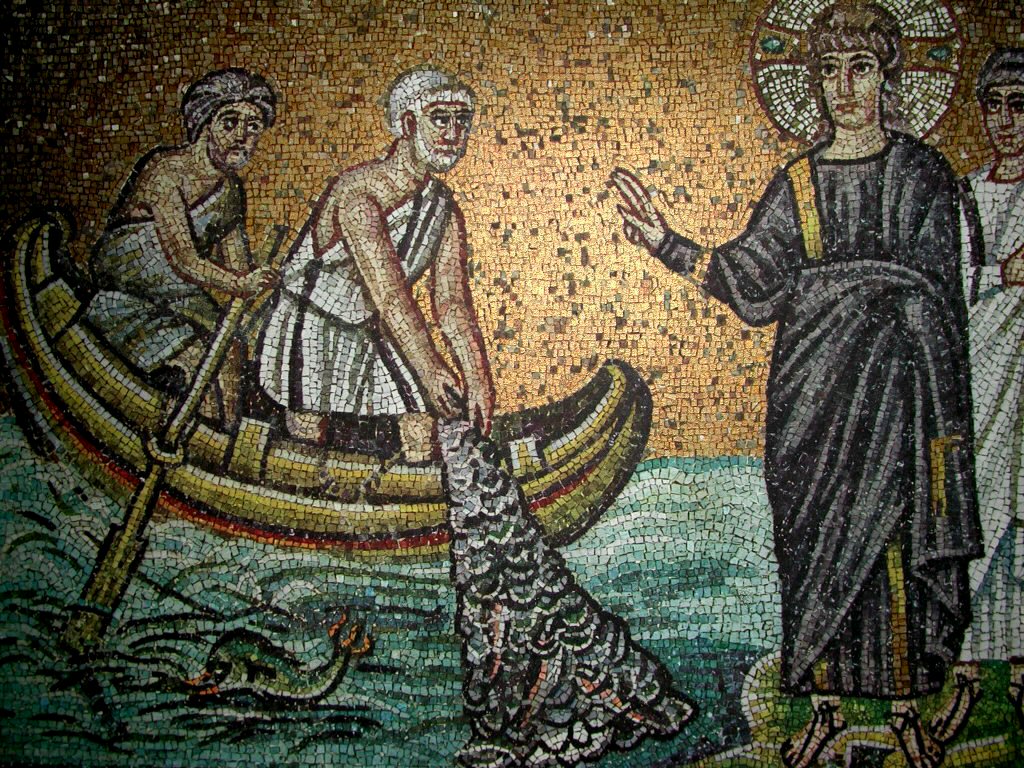
Fishing for Souls

Now after John was arrested, Jesus came to Galilee, proclaiming the good news of God, and saying, “The time is fulfilled, and the kingdom of God has come near; repent, and believe in the good news.”

As Jesus passed along the Sea of Galilee, he saw Simon and his brother Andrew casting a net into the sea– for they were fishermen. And Jesus said to them, “Follow me and I will make you fish for people.” And immediately they left their nets and followed him. As he went a little farther, he saw James son of Zebedee and his brother John, who were in their boat mending the nets. Immediately he called them; and they left their father Zebedee in the boat with the hired men, and followed him. Mark 1:14-20.

Mark’s Gospel offers us some unique insights into the Christian life for the third week of Epiphany. After John the Baptist’s arrest, Jesus announces the imminence of the kingdom of God, requiring repentance and calling for hope (belief “in the good news”). Mark sets the story on the sea of Galilee, known for sudden storms. The men who made eked out their living fishing on these waters worked very hard, were heavily taxed, and struggled with many of the same day-to-day issues we know so well. I’ve known men like this, and they are not easily moved.

So, Jesus meets two sets of brothers: Simon and Andrew, and James and John (who Jesus later nicknamed the “Sons of Thunder”). He calls to them to follow him, and each of these men leave behind their work, their families and their homes to follow Jesus. As we discussed in the call of Samuel, God has a funny sense of timing, and his message often interrupts us when we’re trying to do something else. Perhaps these men were just ready to hear a message of hope and forgiveness. Perhaps they were ready to hear the message that evil doesn’t win and that there’s another way to live.

I think, however, that this arresting story of the origins of the Church sheds a good deal of light on the kind of man Jesus must have been. He must have been a remarkably compelling figure, this itinerant preacher walking along the Galilee. Mark’s Gospel reports that the decision to follow Jesus occurred “immediately”, suggesting that their hopes for the promised good news overcame their fears and their attachments. The passage also suggests these men felt a sense of urgency, that they couldn’t put off their walk with God any longer or take care of a few little things beforehand. May it be so with us, too.

The Gospel teaches us something important about our path to discipleship. Very few of us will start or travel down this path of conversion alone. Conversion, whether we’re turning away from or turning toward something, is a difficult process, and most of us will need to take a friend, a brother or a sister along for the journey. Jesus called these disciples into a vocation of hope and forgiveness and a relationship with the living God. These two sets of brothers felt impelled to leave behind their ordinary, workaday lives and follow Jesus. May it be so with us, too.

Finally, Scripture teaches us an important lesson about being a disciple. Then and now, following Christ will require that you’re going to have to leave some things behind. In the case of these men, it was their boats, their nets, their jobs and their families. For some of us, it may be habits, outlooks, destructive relationships, or the fears that bind us to the present moment. The disciples found a way to leave those things behind. May it be so with us, too.

Shabbat shalom,

James R. Dennis, O.P.

© 2012 James R. Dennis

September 11

It was, by all accounts, a beautiful late summer morning.  The temperatures were in the upper sixties, and the sun shone brightly against a brilliant blue sky.  At 8:46, American flight 11 traveling from Boston to Los Angeles crashed into the North Tower.  There were 91 passengers aboard.  At 9:03, United Airlines flight number 175 flew into the South Tower.  It carried 65 passengers, as it travelled from Logan Airport to  Los Angeles.  Then, at 9:30, American Airlines flight 77, which carried 64 passengers, crashed into the Pentagon. A total 2,996 people died, including the 19 hijackers.  At 10:10 a.m., United Airlines flight 93 crashed in rural Shanksville, Pennsylvania killing all 44 passengers aboard.

I thought we might consider those events ten years ago, about the consequences of that day, and particularly the changes in our spiritual lives as a result of that morning.  Among those consequences, our nation has been at war for the last ten years.  4,442 soldiers gave their lives in Operation Iraqi Freedom, and over 1,600 died in Operation Enduring Freedom.  It is extremely difficult to estimate the number of civilian casualties of these wars, but most calculations range somewhere between 150,000 and 1.2 million.  Estimates of the costs of these wars range between one and three trillion dollars, and they continue to mount.

We mourn the deaths of the 2,996 Americans who lost their lives ten years ago, and we may also mourn the hundreds of thousands of Iraqis and Afghans who have died since then.  We might also mourn the shameless treatment of prisoners in Abu Ghraib, and the wisdom of a place like Guantanamo Bay.  We might mourn the loss of our civil liberties in the Patriot Act and the Foreign Intelligence Services Act, which now authorizes searches of emails and wiretapping without judicial review.  We actually engaged in a national debate about whether torture was acceptable, and somehow that debate seemed to hinge on a cost-benefit analysis.

The September 11 attacks led to a remarkable resurgence of faith, or at least faithful activity.  People across the nation filled our churches and rediscovered a need for a spiritual answer to a very worldly problem.  We are right to wonder why people turn to God in times of crisis, but cannot sustain that conversion.  The biblical witness, however, teaches that we have been doing that for thousands of years.  Somehow, as our fears are calmed and our wounds are bound, our spiritual indifference resumes.  While time has healed some of those wounds, we have also acquired a sort of national amnesia about how sorrowful, broken and vulnerable we felt.

One of the other consequences of that day is our national fear, and perhaps prejudice, of those who practice the Muslim faith.  I’m not sure who the boogeyman was on September the 10th, but after September 11, he clearly had a middle-eastern face.  Somehow, these men became “Muslim terrorists,” although we did not use the term “Christian terrorists” to describe the Ku Klux Klan.  As Kofi Anan, has observed so wisely, the problem lies “not with the faith but with the faithful.”

We might look to the reflection of the Archbishop of Washington on this subject.  He said:

All violent acts of injustice, acts of destruction, and the taking of innocent life find their origin in the attitudes of the human heart. Evil dwells within. Jesus told us it is not what enters in from outside that defiles a person but the things that come from within are what defile. (Mark 7:15).

The great cosmic struggle between good and evil, between light and darkness, between peace and war, between harmony and violence, between love and hatred, begins first in each human heart, is waged there – and true peace depends on the outcome.

I am deeply troubled by the observation of Archbishop Desmond Tutu, who said: “We failed the biggest test posed by the 9/11 outrage: In our anger and dismay we failed to recognize our common humanity, that we are made for love and that acts such as those committed on that day are an aberration.”

There’s a certain irony in the name of the massive bureaucracy we created in the wake of September 11:  the Department of Homeland Security.  To create that department and fund our wars, we have incurred a national debt of trillions of dollars.  We might well ask about the security risks posed by that debt.  I suspect the people of Jericho felt very secure behind their walls, and the Philistines probably felt very safe with Goliath on their side.  The Egyptians probably rightly thought of themselves as a superpower as they approached the Red Sea.

I wonder if we really ever will achieve security, and I think the Scriptural witness suggests that our only security, our only real safety, lies in God.   Our spiritual efforts to move forward and get past that day may require us to take a great many risks.  Then again, the Cross is full of just such risks.

Pax,

James R. Dennis, O.P.

© 2011 James R. Dennis