Tag Archives: discipleship

Holy, Holy, Holy

In the year that King Uzziah died, I saw the Lord sitting on a throne, high and lofty; and the hem of his robe filled the temple. Seraphs were in attendance above him; each had six wings: with two they covered their faces, and with two they covered their feet, and with two they flew. And one called to another and said:

“Holy, holy, holy is the LORD of hosts;
the whole earth is full of his glory.”

The pivots on the thresholds shook at the voices of those who called, and the house filled with smoke. And I said: “Woe is me! I am lost, for I am a man of unclean lips, and I live among a people of unclean lips; yet my eyes have seen the King, the LORD of hosts!”

Then one of the seraphs flew to me, holding a live coal that had been taken from the altar with a pair of tongs. The seraph touched my mouth with it and said: “Now that this has touched your lips, your guilt has departed and your sin is blotted out.” Then I heard the voice of the Lord saying, “Whom shall I send, and who will go for us?” And I said, “Here am I; send me!”  Isaiah 6:1-8.

In today’s reading from the Lectionary,  Isaiah describes the vision in which he received the call to his vocation as a prophet.  He locates this mystical moment at a very specific time,  “the year that King Uzziah died.”  King Uzziah had enjoyed a long reign (783-742 B.C.), during which Judah achieved the summit of its power.   The economic, agricultural, and military resources of the country increased substantially during his rule.    Like a Greek tragedy, however, Uzziah’s strength emerged as his great weakness.  He usurped the power of the priesthood, ultimately leading to an outbreak of leprosy on his forehead which precluded him from entering the Temple.  II Chron 26:18-21. 

The death of the King, especially under such metaphorical circumstances, placed the kingdom in a time of mourning and uncertainty. It was a time, as Shakespeare observed, to “sit upon the ground and tell sad stories of the death of kings”.   Richard II.  Upon entering the Temple during this troubling moment, Isaiah receives a mystical vision of God which sets the fledgling prophet on a unique path.  (It’s worth reminding ourselves that the prophets’ primary function was not foretelling the future.  They acted as the voice of the Lord, most often in the role of social critics.)

Isaiah has the remarkable experience of actually seeing the Lord (“Adonai”) in this vision.  Surrounding Adonai are seraphs who cry to each other, “Holy, holy, holy is the Lord of hosts, the whole earth is full of his glory.”  The threefold repetition of the Lord’s holiness should resonate with us particularly on Trinity Sunday.   

Like a number of Christian mystics, Isaiah’s initial response to this intense and personal encounter with the Almighty is one of profound humility, even inadequacy.  He says:  “I am a man of unclean lips, and I live among a people of unclean lips….” Overcome with a feeling of acute inadequacy, Isaiah expresses profound awe at this vision.

Rather than offering a word of consolation, one of the seraphs touches his lips with a burning coal, burning away his sin and freeing him to speak God’s word.  As a priest explained to me when I was a young boy, within this passage the seer is seared. I think for many of us this rings true:  our vocation does not always arise from a remarkably joyous event, nor does it occur without some pain. And yet, somehow this burning moment will both heal and enable Isaiah to become God’s voice.  Having been thus cleansed and healed, Isaiah can now hear God’s call and answer “Here I am; send me!”  In a very rich sense, that vision will provide the touchstone upon which the balance of Isaiah’s life and ministry will depend.

Too often, our world seems to have devolved into a pathology of the ordinary, where nothing is sacred.  For so many people, their experience of life and creation strikes them as commonplace, as profoundly ordinary.  This passage offers us a glimpse of something completely different.  Isaiah suggests a vision of creation brimming over with the divine, “full of his glory.”

For many of us in liturgical churches, the cry of the seraphs (“Holy, holy, holy”, known as the sanctus) now serves as a part of our weekly worship.  When we hear that wonderful hymn, I wonder if we also hear a call to our own vocation.  I wonder if we can hear the Lord asking, “Whom shall I send?” and whether we will answer that question. Isaiah’s encounter with the Living God changed him forever.  I pray that ours will, too.

Shabbat Shalom,

James R. Dennis, O.P.

© 2012 James R. Dennis

The Spirit of Truth

Jesus said to his disciples, “When the Advocate comes, whom I will send to you from the Father, the Spirit of truth who comes from the Father, he will testify on my behalf. You also are to testify because you have been with me from the beginning.

“I did not say these things to you from the beginning, because I was with you. But, now I am going to him who sent me; yet none of you asks me, `Where are you going?’ But because I have said these things to you, sorrow has filled your hearts. Nevertheless I tell you the truth: it is to your advantage that I go away, for if I do not go away, the Advocate will not come to you; but if I go, I will send him to you. And when he comes, he will prove the world wrong about sin and righteousness and judgment: about sin, because they do not believe in me; about righteousness, because I am going to the Father and you will see me no longer; about judgment, because the ruler of this world has been condemned.

“I still have many things to say to you, but you cannot bear them now. When the Spirit of truth comes, he will guide you into all the truth; for he will not speak on his own, but will speak whatever he hears, and he will declare to you the things that are to come. He will glorify me, because he will take what is mine and declare it to you. All that the Father has is mine. For this reason I said that he will take what is mine and declare it to you.”  John 15:26-27; 16:4b-15.

Today is the Feast of the Pentecost, which serves as the terminus of the cycle which marks and celebrates the life of Christ.  Easter has come and gone; Jesus has ascended to the Father. These events have filled the disciples’ hearts with sorrow.  Their Rabbi, their friend, is returning home and leaving them.

In other sense, however, we sometimes refer to as the birthday of the Church.    The Church must now learn to listen for the voice of God within the community of believers inspired by the Holy Spirit.  Jesus describes the Spirit as the Advocate (in Greek, parakletos).  The word parakletos connotes an advocate in a legal proceeding, who comes to the aid of a witness or a cause.  Just so, the Spirit will come to assist the disciples as they bear witness to the message of Jesus.  The term parakletos also connotes a comforter, an assistant and a companion.

Jesus has assured us of the presence of the Advocate, of the immediacy of the Spirit.  He promises that the Spirit will lead us into the truth. The Spirit will direct us through and to faith, a radical trust in the life and message of Jesus. Our Orthodox brothers and sisters refer to this process as theosis, a journey through which our lives become more and more deeply entwined with the life of the Father and the Son.  Remembering the image of Jesus as the vine, through the Spirit the life of the Father and the Son is grafted onto our lives, our history.

The reading today points also to the unity and interdependence of the Trinity.  Jesus teaches that “all that the Father has is mine” and that the Spirit will take what belongs to Jesus and declare it to us.  Jesus teaches that no member of the Trinity acts independently; similarly we need to learn to live interdependently. Pentecost involves learning to trust God as a companion, and learning to trust each other.

Henri Nouwen once wrote that “education to ministry is an education not to master God but to be mastered by God.”  Pentecost involves listening for the Trinitarian voice within the Church and in the world.  That voice will remain near us and within us.  Jesus promised us that the Spirit of Truth would offer us that sense of comfort, that sense of confidence, that sense of peace.

Pax Spiritus,

James R. Dennis, O.P.

© 2012 James R. Dennis

A Study of Wisdom

     Augustine said:      “The wise will shine like stars and those who can make others wise will be bright with eternal splendour.”      “Feed your soul on divine readings; they will prepare for you a spiritual feast.”  
Jerome said:
     “It is much better to speak the truth clumsily than to wax eloquently with a lie.”
Gregory said:      “Wisdom is to fear God and keep far from evil.”
“The beginning of wisdom is to avoid evil:  the second stage is to do good.”
     “Whoever wants to understand what he is hearing must hasten to translate what he has already heard into action.”
     Isadore said:      “Simplicity joined with ignorance is called stupidity: simplicity joined with prudence is called wisdom.”

Defensor Gramaticus Book of Sparkling Sayings, 18

Again, I found this piece in today’s readings from Drinking From the Hidden Fountain.  From a very early age, I have been attracted to the notion of wisdom, particularly as distinct (although not always separate) from intellect.  Wisdom seems to call for a special kind of “knowing”, and implies patience, simplicity, kindness, and carefulness.  In my experience, although intellect may be a personal quality, wisdom most often comes from community.

In the spiritual setting, that community involves listening creatively to the voices around us, including the voices of the past.  Holy Scripture, when read carefully, offers us the collective wisdom of the Church. That “great cloud of witnesses”, the saints who have gone before us, they get a vote, too.  Similarly, the we sometimes locate wisdom collective voice of the Church.

I particularly like the quotation from Gregory, suggesting that our notion of wisdom is always incomplete if we simply try and avoid evil.  Real wisdom lies in seeking out the good.  Rather than simply avoiding sin, we are called to make this world a better place:  alleviating suffering, helping out the poor, visiting those who are sick or in prison, and binding up the brokenhearted.  Perhaps there we will find wisdom, in the translation from a good idea to a committed heart.

God watch over thee and me,

James R. Dennis, O.P.

© 2012 James R. Dennis

A Study of Wisdom

Augustine said:
     “The wise will shine like stars and those who can make others wise will be bright with eternal splendour.”
     “Feed your soul on divine readings; they will prepare for you a spiritual feast.”
Jerome said:
     “It is much better to speak the truth clumsily than to wax eloquently with a lie.”
Gregory said:
     “Wisdom is to fear God and keep far from evil.”
     “The beginning of wisdom is to avoid evil:  the second stage is to do good.”
     “Whoever wants to understand what he is hearing must hasten to translate what he has already heard into action.”
Isadore said:
     “Simplicity joined with ignorance is called stupidity: simplicity joined with prudence is called wisdom.”
Defensor Gramaticus
Book of Sparkling Sayings, 18

Again, I found this piece in today’s readings from Drinking From the Hidden Fountain.  From a very early age, I have been attracted to the notion of wisdom, particularly as distinct (although not always seperate) from intellect.  Wisdom seems to call for a special kind of “knowing”, and implies patience, simplicity, kindness, and carefulness.  In my experience, although intellect may be a personal quality, wisdom most often comes from community.

In the spiritual setting, that community involves listening creatively to the voices around us, including the voices of the past.  Holy Scripture, when read carefully, offers us the collective wisdom of the Church. That “great cloud of witnesses”, the saints who have gone before us, they get a vote, too.  Similarly, the we sometimes locate wisdom collective voice of the Church.

I particularly like the quotation from Gregory, suggesting that our notion of wisdom is always incomplete if we simply try and avoid evil.  Real wisdom lies in seeking out the good.  Rather than simply avoiding sin, we are called to make this world a better place:  alleviating suffering, helping out the poor, visiting those who are sick or in prison, and binding up the brokenhearted.  Perhaps there we will find wisdom, in the translation from a good idea to a committed heart.

God watch over thee and me,

James R. Dennis, O.P.

© 2012 James R. Dennis

Standing on Holy Ground


Moses was keeping the flock of his father-in-law Jethro, the priest of Midian; he led his flock beyond the wilderness, and came to Horeb, the mountain of God. There the angel of the Lord appeared to him in a flame of fire out of a bush; he looked, and the bush was blazing, yet it was not consumed. Then Moses said, “I must turn aside and look at this great sight, and see why the bush is not burned up.” When the Lord saw that he had turned aside to see, God called to him out of the bush, “Moses, Moses!” And he said, “Here I am.” Then he said, “Come no closer! Remove the sandals from your feet, for the place on which you are standing is holy ground.” He said further, “I am the God of your father, the God of Abraham, the God of Isaac, and the God of Jacob.” And Moses hid his face, for he was afraid to look at God.

Then the Lord said, “I have observed the misery of my people who are in Egypt; I have heard their cry on account of their taskmasters. Indeed, I know their sufferings, and I have come down to deliver them from the Egyptians, and to bring them up out of that land to a good and broad land, a land flowing with milk and honey, to the country of the Canaanites, the Hittites, the Amorites, the Perizzites, the Hivites, and the Jebusites. The cry of the Israelites has now come to me; I have also seen how the Egyptians oppress them. So come, I will send you to Pharaoh to bring my people, the Israelites, out of Egypt.”

But Moses said to God, “Who am I that I should go to Pharaoh, and bring the Israelites out of Egypt?” He said, “I will be with you; and this shall be the sign for you that it is I who sent you: when you have brought the people out of Egypt, you shall worship God on this mountain.”  But Moses said to God, “If I come to the Israelites and say to them, ‘The God of your ancestors has sent me to you,’ and they ask me, ‘What is his name?’ what shall I say to them?” God said to Moses, “I AM WHO I AM.” He said further, “Thus you shall say to the Israelites, ‘I AM has sent me to you.’“ God also said to Moses, “Thus you shall say to the Israelites, ‘The Lord, the God of your ancestors, the God of Abraham, the God of Isaac, and the God of Jacob, has sent me to you’: This is my name forever, and this my title for all generations. Exodus 3:1-15.

I found this reading in the Daily Office for today.  The passage begins with Moses engaged in an everyday sort of task.  He’s tending to his father-in-law’s flock; he’s working.  Moses has not set out on a spiritual journey, he hasn’t gone into the desert to retreat and encounter the Infinite.  Like most of us, God confronts Moses when he’s busy trying to do something else.

We should also note that Moses is pretty much homeless when this remarkable event happens.  Although an Israelite child, he was adopted by the Egyptians and lived among them until he killed an Egyptian overseer.  He runs away from the wrath of Pharoah into the land of Midian.  And as we know from the balance of the story, Moses will spend the bulk of his life wandering.  (It’s a bit ironic that he ends up finding a homeland for his people, but not for himself.)  In fact, Moses offers a revealing glimpse into himself when he says, “I have been an alien living in a foreign land.”  Gen. 2:22.  I think lots of folks feel that way, constantly looking for a home.

As Moses encounters this burning bush, YHWH tells him to remove his sandals because he is standing on holy ground.  The removal of one’s sandals not only signifies that one has arrived at a sacred space, but also (within many cultures) suggests that one has entered a home.  Therefore Moses, the wanderer, finds his home with the Lord.

Two questions from this passage echo into each of our lives, and will shape the course of our faith.  The first is the question Moses asks of the Lord:  “Who am I?”  Moses wants to know his own authority to preach truth to power, and it’s a question most of us have faced at one time or another.  Who am I to be God’s voice in this troubled world?  Who am I to speak out against something that’s wrong?

We should find the second question equally troubling, and equally determinative for us.  Moses asks the Lord (the God of Abraham, the God of Isaac, and the God of our ancestors), “Who are you?”  Moses wants to know exactly what he’s going to tell people about who he met in the burning bush.  He wants to understand the Almighty; he wants to know God’s name.

The answer Moses heard, “I AM WHO I AM,” probably didn’t leave him completely satisfied.  The name “I AM” obviously conjures up so many of Jesus’ “I am” statements (the bread of life, the light of the world, the good shepherd, etc).  In this case, however, we might find particular encouragement in Jesus’ assurance:  “I AM with you always, even to the end of the age.”  Matt. 28:20.

Many of us still hear the reverberations of these two questions, “Who am I?” and “Who is God?” As we begin to answer them, I think we may find the story of Moses even more rich.  Once Moses begins to understand the answers (a rudimentary and incomplete understanding) God immediately sends him on a mission.  In Moses’ case, the mission involves confronting Pharoah and leading the people into Israel as God saves His people.  In our case, that mission may be completely different.  But only through that journey, which will last for the rest of his life, will Moses come to more fully understand who God is and who Moses is.

The journey leads him to a deeper understanding of YHWH, which leads him to a deeper understanding of himself, which leads him further along the journey.  I believe that’s part of the reason why the Exodus became the overarching narrative of the Jewish people, and why it remains so important today.

Shabbat Shalom,

James R. Dennis, O.P.

© 2012 James R. Dennis

The Gift of Peace

     You cannot acquire the gift of the peace if by your anger you destroy the peace of the Lord.
     True patience is to suffer the wrongs done to us by others in an unruffled spirit and without feeling resentment.  Patience bears with others because it loves them; to bear with them and yet to hate them is not the virtue of patience but a smokescreen for anger.
     True patience grows with the growth of love.  We put up with our neighbours to the extent that we love them.  If you love, you are patient.  If you cease loving, you will cease being patient.  The less we love, the less patience we show.
     If we truly preserve patience in our souls, we are martyrs without being killed.

                                            –Gregory the Great, Defensor Gramaticus

I found this bit of wisdom in the reading for today in a wonderful little book, Drinking From the Hidden Fountain:  A Patristic Breviary.  Pope Gregory I wrote the reading for today.  The Roman Catholic Church, the Eastern Orthodox faith, the Anglican Church and some Lutheran churches recognize Gregory as a saint.  The first pope to spring from the monastic tradition, he is the patron saint of musicians, students and teachers.

Gregory was born around 540 A.D., and lived in very tumultuous times for the Church which included the defeat of the Roman Empire by the Goths, famine and a plague that killed over a third of the population.  The papacy was virtually forced on Gregory, who longed for the monastic life.  Although he was deeply interested in and involved with the liturgy, Gregory probably had no substantial involvement with Gregorian chant which bears his name.  (Gregorian chant was first written down in the early 9th century.)  He made extensive use of the title servus servorum Dei (servant of the servants of God) in official documents, revealing a deep and abiding humility.

In this short little selection from Gregory, we see a hint of his humility and catch a glimpse of why he was so deeply loved and revered.  Gregory points out how deeply our anger undermines the peace we so desperately long for and need.  Yet although we want peace in our lives, we just aren’t willing to let go of our anger and resentments.

He encourages us to turn to the ancient Christian virtue of patience.  St. Paul recognized patience as one of the gifts of the Spirit.  Gal. 5:22.  St. Thomas Aquinas wrote:  “Patience is one of the humble, workaday virtues; but it is, in a real sense, the root and guardian of all virtues, not causing them, but removing obstacles to their operation. Do away with patience and the gates are open for a flood of discontent and sin.”

Long before psychology taught us about passive/aggressive behavior, St. Gregory described it:  “Patience bears with others because it loves them; to bear with them and yet to hate them is not the virtue of patience but a smokescreen for anger.”  Most anger arises from a lack of patience.  In fact, many of our intemperate statements begin:  “I’ve just about lost my patience with . . . . (insert the object of our rage here).”

Our impatience usually carries with it either an implicit message of our moral superiority or wrongs that we cannot or  will not release. We are so anxious to claim the moral high ground that we forget that Jesus blessed the poor in spirit and the meek rather than the righteously indignant. Patience requires the understanding that although our brothers and sisters may not yet be the people God intends them to be, neither are we.

St. Gregory correctly showed us the link between patience and love.  Again, Paul had noted this link in Scripture, writing:  “Love is patient; love is kind.”  Learning to love means learning and practicing patience.  Admittedly, it’s not my strongest gift, but I know that if I want to create a peaceful life and a peaceful world, that path begins with patience.

Pax Christi,

James R. Dennis, O.P.

© 2012 James R. Dennis
Remade in the Likeness of the Son

We were made “in the likeness of God.”  But in course of time that image has become obscured, like a  face on a very old portrait, dimmed with dust and dirt.

When a portrait is spoiled, the only way to  renew it is for the subject to come back to the studio and sit  for the artist all over again. That is why Christ came–to make  it possible for the divine image in man to be recreated. We were  made in God’s likeness; we are remade in the likeness of his  Son.

To bring about this re-creation, Christ still  comes to men and lives among them. In a special way he comes  to his Church, his “body”, to show us what the “image  of God” is really like.

What a responsibility the Church has, to be  Christ’s “body,” showing him to those who are unwilling  or unable to see him in providence, or in creation! Through the  Word of God lived out in the Body of Christ they can come to  the Father, and themselves be made again “in the likeness  of God.”

Last week we celebrated the feast day of St. Athanasius, who lived from around 296 A.D. until 373.  He was the 20th bishop of Alexandria, which was a center of the Christian faith at that time.  He fought against the Arian heresy, which suggested that God the Father created the Son (and thus called into question the co-equality of the Trinity) .

Athanasius defended traditional trinitarian doctrine even when it required him to stand against other powerful bishops and two emperors.  For a good while, he lived in exile, fleeing to seek shelter for a time with the Desert Fathers.  His steadfast devotion to the Trinity despite political and religious opposition led to his nickname Athanasius Contra Mundum (Athanasius Against the World).  The Roman Catholic Church considers him one of the four great Doctors of the Church, and the Eastern Orthodox Church regards him as one of the Great Doctors also.

In the quotations above, St. Athanasius reminds us that although we were created in God’s image, that likeness had become marred over time.  (I find this formulation much more sound, and more palatable than Calvin’s notion that we had fallen into “total depravity”.)  He then suggests that the Incarnation of Jesus became necessary because we had strayed so far from God’s original likeness.  God sent his Son, he argues, to restore creation to His original intent.

But Athanasius argues the Incarnation didn’t end two thousand years ago, in fact he teaches that it hasn’t ended yet.  He says, “To bring about this re-creation, Christ still  comes to men and lives among them.”  In prayer, in the eucharist, and in our love for each other, we still encounter the Living Christ.  C.S. Lewis echoed this view when he wrote, “God became man to turn creatures into sons: not simply to produce better men of the old kind but to produce a new kind of man.”  Through the mystery of the Incarnation, God calls his creation back to Himself.  I think that’s what Jesus had in mind when He talked about His sheep, who know His voice.

Athanasius then recognizes the wonderful and terrible burden on the Church.  As the mystical body of Christ, the Church must make the Incarnate Christ visible to a troubled world.  The Church must reveal Jesus and the Father to those who are “unwilling or unable” to recognize them otherwise.  By drawing everyone to the Father and the Son (through the power of the Spirit), the Church participates in the re-creation of the world.  Heaven help us if we’re not doing that.  Heaven help us indeed.

God watch over thee and me,

James R. Dennis, O.P.

© 2012 James R. Dennis

Not One Letter, Not One Stroke of a Letter

“Do not think that I have come to abolish the law or the prophets; I have come not to abolish but to fulfill. For truly I tell you, until heaven and earth pass away, not one letter, not one stroke of a letter, will pass from the law until all is accomplished.  Therefore, whoever breaks one of the least of these commandments, and teaches others to do the same, will be called least in the kingdom of heaven; but whoever does them and teaches them will be called great in the kingdom of heaven. For I tell you, unless your righteousness exceeds that of the scribes and Pharisees, you will never enter the kingdom of heaven.  Matt. 5:17-20.

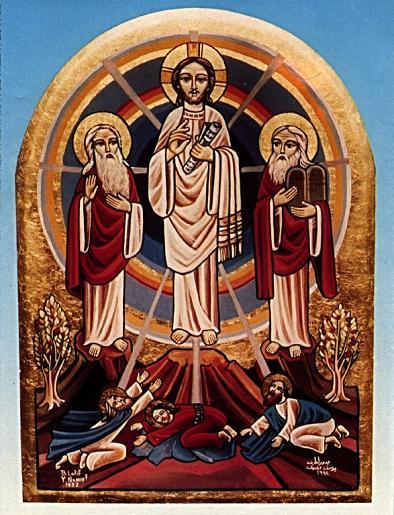
In the Gospel from today’s Daily Office, Jesus emphasizes his continuity with God’s message to His people, a message first announced in the law and the prophets.  That continuity shines forth in the story of the Transfiguration, which St. Matthew records at Matt. 17:1-9 and which the icon above depicts.  As God announces Jesus as his beloved Son, Christ appears flanked by Moses and Elijah.  We might wonder, “Why those two heroes of the Old Testament?”  Moses and Elijah, respectively, represented the Law (given by Moses) and the prophets.  Jesus comes as the full flowering, the conclusion or completion of the law and the prophets.

Rather than encouraging his disciples to abandon Scripture, he asks them to take it seriously. Like many of us today, the Pharisees and scribes had read scripture as calling us into a worthiness competition.  We find the perfect example of that view in the parable of the Pharisee and the tax collector.  (Luke 18:9-14; see here).  Jesus completes the law and the prophets by showing us that God’s love and grace has nothing to do with our worthiness.

A legalistic vision of Scripture works externally, requiring people to confirm to rules and to require such conformity from those around them.  Jesus calls us to internalize the Scripture, allowing it to transform our hearts so that we can live more deeply into it.  Legalism mistakes the packaging for the contents.  Thus, he tells his disciples that must go beyond the righteousness of the scribes and Pharisees.  The impulse to legalism always calls us into a kind of idolatry, in which we substitute performance of a given set of obligations for a relationship with the living God.

Jesus asks us to move forward from the notion of right action to the idea of a right relationship with God. We find an example of what Jesus means in Matthew 23:23.  There, He notes that the Pharisees “tithe mint, dill, and cummin, but have neglected the weightier matters of the law: justice and mercy and faith.”  Jesus doesn’t ask us to reject the Law (the Torah), merely to examine the principles which underlie it.  When our principle objective becomes a relationship with the Almighty that pushes us toward justice and mercy and faith, we will read the Law in the right context.

Jesus brings that Law into its fullness, pointing out how narrowly the people had come to understand God’s purposes.  The problem wasn’t that the scribes and Pharisees overvalued the Law; the problem lay in their underestimation of God’s purposes.  Thus, Jesus taught that the good Samaritan actually lived into loving his neighbor, while a more legalistic or superficial view asked, “And who is my neighbor?” Luke 10:29.  Like many of us today, while the scribes may have known exactly what the words of the law said, they had completely missed what they meant.  They had captured the notion of compliance, but missed the blessing of God’s spirit reshaping their lives.

I pray that we find that blessing today.

James R. Dennis, O.P.

© 2012 James R. Dennis

Touch Me and See

While the disciples were telling how they had seen Jesus risen from the dead, Jesus himself stood among them and said to them, “Peace be with you.” They were startled and terrified, and thought that they were seeing a ghost. He said to them, “Why are you frightened, and why do doubts arise in your hearts? Look at my hands and my feet; see that it is I myself. Touch me and see; for a ghost does not have flesh and bones as you see that I have.” And when he had said this, he showed them his hands and his feet. While in their joy they were disbelieving and still wondering, he said to them, “Have you anything here to eat?” They gave him a piece of broiled fish, and he took it and ate in their presence.

Then he said to them, “These are my words that I spoke to you while I was still with you– that everything written about me in the law of Moses, the prophets, and the psalms must be fulfilled.” Then he opened their minds to understand the scriptures, and he said to them, “Thus it is written, that the Messiah is to suffer and to rise from the dead on the third day, and that repentance and forgiveness of sins is to be proclaimed in his name to all nations, beginning from Jerusalem. You are witnesses of these things.”  Luke 24:36b-48.

Today, we encounter the Risen Christ in the Gospel of St. Luke. This passage follows directly after the story of the disciples on the road to Emmaus.  As is true of so many stories of encounters with Jesus after the resurrection, the disciples do not appear to recognize Jesus immediately, and “thought they were seeing a ghost”.  In the Emmaus story, “their eyes were kept from recognizing him.”  Luke 24:16.

We’re left with the impression that there was something about the resurrected Jesus which was contiguous, and yet discontiguous with the man they knew.  While they struggled with the apparent discontinuity, at times this resurrected Jesus seemed quite familiar.  The resurrected Lord could be apprehended, but always escaped both recognition and understanding.  And yet, He bore the marks of his entry into human history; the scars bearing witness to His torture were unmistakable.

Just as the wounded Christ still bears the marks of human history, for the disciples, the trauma of the cross still remained brutally fresh.  He bore the marks of death, but had vacated the tomb.  The resurrected Jesus proved that death itself was nothing but an empty shell which could not separate us from the Source of Life.

Jesus offered to the disciples exactly what he offers to us today.  He told them, “Peace be with you.”  He offered them the peace that comes with knowing their friend still lived, and this wasn’t some ghost.  He showed them that He was “flesh and bone” and he ate some fish with them.  And lots of folks correctly point out that Jesus did this to assure them that he wasn’t simply a spiritual apparition, that He was real.   While that’s certainly true, I think it misses a big part of the story and the import of that broiled fish.

We remember that in the 22nd chapter of Luke, Jesus instituted the Lord’s Supper, asking that we celebrate the Eucharist in His memory.  He told the disciples that he would neither eat nor “drink of the fruit of the vine until the kingdom of God comes.” Luke 22:18.  Thus, when Jesus dines with his disciples on the road to Emmaus and in this passage, He announces the arrival of God’s kingdom.  He calls the disciples as witnesses, not only to His bodily resurrection, but also to the inauguration of the kingdom He spoke about so often while He walked among them.  In the language of an everyday meal, He told them the reign of God had begun, and invited them to share in it.  Thus, he directs them to share the good news of repentance and forgiveness of sins to everyone.

Of course, one passage from this reading resonates particularly with me.  Having lived through the bone-chilling barbarity of the crucifixion, the confusion of confronting their resurrected rabbi, Jesus offers a simple prayer for his disciples:  “Peace be with you.”  The disciples surely felt a miasma of emotions:  terror, shame, failure, regret and doubt.  Although escaping comprehension, Jesus offered them a bit of sanctuary within that simple shalom.

Luke describes the disciples thus:  “While in their joy they were disbelieving and still wondering….”  I think that description applies to many of us who have had a variety of encounters with Christ, and still wonder.  Even the very faithful are sometimes very fearful.  And yet, Jesus calls such people (people like you and me) to be His witnesses.   I hope and pray that as we touch Him and see, that same peace Jesus offered to His followers arises within each of us.

Shabbat shalom,

James R. Dennis, O.P.

© 2012 James R. Dennis

Abiding in Him

I am the true vine, and my Father is the vine-grower. He removes every branch in me that bears no fruit. Every branch that bears fruit he prunes to make it bear more fruit. You have already been cleansed by the word that I have spoken to you. Abide in me as I abide in you. Just as the branch cannot bear fruit by itself unless it abides in the vine, neither can you unless you abide in me. I am the vine, you are the branches. Those who abide in me and I in them bear much fruit, because apart from me you can do nothing. Whoever does not abide in me is thrown away like a branch and withers; such branches are gathered, thrown into the fire, and burned. If you abide in me, and my words abide in you, ask for whatever you wish, and it will be done for you. My Father is glorified by this, that you bear much fruit and become my disciples. As the Father has loved me, so I have loved you; abide in my love. If you keep my commandments, you will abide in my love, just as I have kept my Father’s commandments and abide in his love. I have said these things to you so that my joy may be in you, and that your joy may be complete. John 15:1-11.

In the Gospel reading from today’s Daily Office, we find Jesus talking about His favorite topic: relationships.  I think Jesus cared more deeply about this subject than virtually any other, and perhaps we should, too.  In this remarkable passage, Jesus addresses our relationships with Him, with God the Father, and with each other.  I believe the refrain within this passage provides the key to Jesus’ meaning.  St. John uses the word “abide” eight times, so we should probably understand the sense in which he uses it.

One of the greatest problems we encounter in modernity is that vast number of people who feel adrift, who feel isolated from the world and cut off from anything that offers meaning in their lives.  As Willy Loman observed in Death of a Salesman, “After all the highways, and the trains, and the appointments, and the years, you end up worth more dead than alive.”  Jesus compared such lives to a branch cut away from the vine, which will ultimately wither.  He observed that “the branch cannot bear fruit unless it abides in the vine”.

All of us sometimes feel cut off from our source, and Jesus offers us the remedy:  “abide in me”, “abide in my love”.    Too often, we try to make our way alone.  We forget that relationships provide the very basis of the spiritual life.  To “abide with” means to participate in a very special sort of relationship.  To abide with Jesus and to abide in His love means that we will make Christ our spiritual home.

As with all relationships, abiding with Jesus involves a reciprocal settlement, a complementary arrangement.  Jesus said, “Abide in me as I abide in you.”  Thus, we should ask ourselves, “What sort of dwelling place have I prepared for the Lord?”  Jesus calls us not simply to remain with Him, but also to make a home for Him in our lives.  Unless we permit this mutual indwelling of Christ, we will find ourselves spiritually “dying on the vine”.

St. John does not suggest that we admire Jesus as a historical figure from the past, or that we attempt to emulate something that was quite wonderful once. To abide with Christ does not mean that we merely prepare for that day in the future when we might see Him.  Abiding with Jesus means to make our home with Him here and now.  The term implies persevering, remaining true, and lasting steadily.  When we abide with Christ, we will share St. Paul’s conviction “that neither death, nor life, nor angels, nor rulers, nor things present, nor things to come, nor powers, nor height, nor depth, nor anything else in all creation, will be able to separate us from the love of God in Christ Jesus our Lord.”  Romans 8:38-39.

Abiding connotes that we will remain with Jesus, and He will remain with us.  Like the branches on the vine, our continued existence depends on remaining connected to the Source of our lives.  If we allow the Word to make a home within our lives, we will feel the Divine pulsing and surging across all creation.  At that point, this holy relationship begins to determine how we act and how we love.  Thus, keeping the commandments becomes less like a burden, and more like a presence.  We are thereby grafted onto the tree of life, grafted onto the life of the Father, Son and Holy Spirit.  I think that’s exactly what St. John had in mind when he wrote about a time when our joy would be complete.

I wish you the joy of God’s presence,

James R. Dennis, O.P.

 © 2012 James R. Dennis