Tag Archives: Disciples

He Loved Them to the End

Now before the festival of the Passover, Jesus knew that his hour had come to depart from this world and go to the Father. Having loved his own who were in the world, he loved them to the end. The devil had already put it into the heart of Judas son of Simon Iscariot to betray him. And during supper Jesus, knowing that the Father had given all things into his hands, and that he had come from God and was going to God, got up from the table, took off his outer robe, and tied a towel around himself. Then he poured water into a basin and began to wash the disciples’ feet and to wipe them with the towel that was tied around him. He came to Simon Peter, who said to him, “Lord, are you going to wash my feet?” Jesus answered, “You do not know now what I am doing, but later you will understand.” Peter said to him, “You will never wash my feet.” Jesus answered, “Unless I wash you, you have no share with me.” Simon Peter said to him, “Lord, not my feet only but also my hands and my head!” Jesus said to him, “One who has bathed does not need to wash, except for the feet, but is entirely clean. And you are clean, though not all of you.” For he knew who was to betray him; for this reason he said, “Not all of you are clean.”

After he had washed their feet, had put on his robe, and had returned to the table, he said to them, “Do you know what I have done to you? You call me Teacher and Lord–and you are right, for that is what I am. So if I, your Lord and Teacher, have washed your feet, you also ought to wash one another’s feet. For I have set you an example, that you also should do as I have done to you. Very truly, I tell you, servants are not greater than their master, nor are messengers greater than the one who sent them. If you know these things, you are blessed if you do them.

Jesus said, “Now the Son of Man has been glorified, and God has been glorified in him. If God has been glorified in him, God will also glorify him in himself and will glorify him at once. Little children, I am with you only a little longer. You will look for me; and as I said to the Jews so now I say to you, `Where I am going, you cannot come.’ I give you a new commandment, that you love one another. Just as I have loved you, you also should love one another. By this everyone will know that you are my disciples, if you have love for one another.” John 13:1-17, 31b-35.

In the Lectionary reading for today, we feel the reverberation of Mary of Bethany’s act of devotion from Monday’s reading.    In many respects, today’s Gospel contains the adhesive which bonds all of the events of, and the readings for, Holy Week together.  St. John reports that Jesus knew that the hour of his death had come; this passage records how chose to spend his last hours with his friends.  “Having loved his own who were in the world, he loved them to the end.”

In washing the disciple’s feet, Jesus assumed the role of a servant, of a slave.  Reluctant to have his Rabbi assume this role, Peter protested.  Jesus assured Peter, however, that this way was the path to sharing in the life of Christ.  He teaches them that serving each other offers a great blessing.  Jesus teaches, “For I have set you an example, that you also should do as I have done to you.”

In a terribly poignant moment, Jesus calls his disciples “little children” and tells them his time with them has grown very short.  Jesus then offers them the great commandment:  to love each other as He has loved us.  We love each other because He loved us first, and showed us how to do it.  I’ve come to believe, the more time I spend in John’s Gospel, that there’s really only one sin:  the failure to love.

I have often heard church leaders talk about a “path to discipleship”, and I suppose that’s a useful discussion in some sense.  But Jesus says that there’s only one true marker of his disciples:  they love each other, reflecting Christ’s love.  Jesus paints a portrait of divine vulnerability, reflecting a God who entered into human history, subjected Himself to shame, and poured Himself out to show us how to live.  This moment in John’s Gospel, in which God acts like a slave, constitutes a critical moment of God’s self-revelation.  “This,” Jesus tells us, “this is what the Kingdom looks like.”

Love serves as the glue which binds the readings for Holy Week together.  Love rode into Jerusalem on a donkey.  Love filled the house with a fragrant oil.  Love lights the way so that the darkness will not overcome us.  Love surrounds us in a great cloud of witnesses.  And tomorrow, Love will be hoisted on a Cross.

Lord, have mercy on me, a sinner,

James R. Dennis, O.P.

© 2012 James R. Dennis

A Cloud of Witnesses

Therefore, since we are surrounded by so great a cloud of witnesses, let us also lay aside every weight and the sin that clings so closely, and let us run with perseverance the race that is set before us, looking to Jesus the pioneer and perfecter of our faith, who for the sake of the joy that was set before him endured the cross, disregarding its shame, and has taken his seat at the right hand of the throne of God.

Consider him who endured such hostility against himself from sinners, so that you may not grow weary or lose heart.  Heb. 12:1-3.

The Lectionary offers us this reading for Holy Week, and I thought we might reflect on it for a bit.  While we often think of it in the context of All Saints Day, it strikes me as terribly appropriate as a Holy Week reflection.  Certainly, our Lenten task consists of laying aside those burdens and separations that “cling so closely” to us.  We know that these weights, these sins, entangle us and swarm around us.  Lent offers us a chance to loosen those bonds.

The Epistle to the Hebrews reminds us that we are surrounded by a “great cloud of witnesses”.  It’s a remarkable and deeply poetic choice of words.  Often, we think of these witnesses as the great saints of the Church.  I’m inclined to think, however, also of those  who were present during those remarkable days of Jesus’ earthly ministry.  Jesus touched a remarkably diverse group of people. From the wedding guests at Cana to the blind man at the pool of Siloam to Lazarus of Bethany to the Roman centurion who cried out “Surely, this man was the son of God!”: they all bore witness to the redemptive power of the Lord.

And yet, this “pioneer and perfecter of our faith” , this Beloved Son of God, would cry out in agony from the Cross.  He would wonder, quoting the Psalms, why the Father had deserted Him.  He would wonder how He could feel so desperately alone.  Somehow, His mother and a few of his friends bore witness to this horror.  They offered to God that precious gift, the ministry of presence.  I’m wondering whether we can bear to watch, whether we will join into that cloud of witnesses during this Holy Week.  I’m wondering whether we can endure the Cross.

God watch over thee and me,

James R. Dennis, O.P.

While You Have the Light

Jesus answered, “This voice has come for your sake, not for mine. Now is the judgment of this world; now the ruler of this world will be driven out. And I, when I am lifted up from the earth, will draw all people to myself.” He said this to indicate the kind of death he was to die. The crowd answered him, “We have heard from the law that the Messiah remains forever. How can you say that the Son of Man must be lifted up? Who is this Son of Man?” Jesus said to them, “The light is with you for a little longer. Walk while you have the light, so that the darkness may not overtake you. If you walk in the darkness, you do not know where you are going. While you have the light, believe in the light, so that you may become children of light.” After Jesus said this, he departed and hid from them.   John 12:30-36.

As a child, I always dreaded that moment in the evening when my mother turned off the light.  I was firmly convinced of monsters and the idea that they had particular sway during the night-time hours.  (Up until the age of around eight, my chosen career path was “vampire killer.”)  Years later, I decided that while there are certainly monsters in the world, we make our own evil.  Now, I’ve come full circle and have accepted that there really is something out there called evil, and that evil is a spiritual reality.

In this passage from John’s Gospel, Jesus encourages us to walk in the light “so that the darkness may not overtake you.”  Once overtaken by darkness, we struggle to see where we’re going.  We take the wrong path; we get lost.  Jesus tells us that “the light is with you for a little longer.”  Deep into this journey through Holy Week, we get the feeling that we are walking at dusk, as the light is fading.

This passage resonates with the opening of John’s Gospel, which described the life of Jesus as the light of all people.  “The true light, which enlightens everyone, was coming into the world.”  John 1:9.  If we believe in this light, we become children of God, or “children of light.”  John seems to suggest that living into our Christian life will work a fundamental change in our spiritual DNA.  As we travel through these scriptural pilgrimages during Holy Week, we should remember that Jesus calls us to become children of the light, reflecting the light of Christ into all the dark places of the world.

Jesus does not suggest that His followers will not experience the darkness.  Good Friday teaches us that’s just not the case.  Christianity does not operate as some sort of good luck charm or talisman against the darkness.  Jesus’ assures us of something quite different.  He tells us that the darkness will not “overcome” those who walk with Him.  Once again, that’s got to be good news.

God watch over thee and me,

James R. Dennis, O.P.

© 2012 James R. Dennis

Six Days Before the Passover

Six days before the Passover Jesus came to Bethany, the home of Lazarus, whom he had raised from the dead. There they gave a dinner for him. Martha served, and Lazarus was one of those at the table with him. Mary took a pound of costly perfume made of pure nard, anointed Jesus’ feet, and wiped them with her hair. The house was filled with the fragrance of the perfume. But Judas Iscariot, one of his disciples (the one who was about to betray him), said, “Why was this perfume not sold for three hundred denarii and the money given to the poor?” (He said this not because he cared about the poor, but because he was a thief; he kept the common purse and used to steal what was put into it.) Jesus said, “Leave her alone. She bought it so that she might keep it for the day of my burial. You always have the poor with you, but you do not always have me.” When the great crowd of the Jews learned that he was there, they came not only because of Jesus but also to see Lazarus, whom he had raised from the dead. So the chief priests planned to put Lazarus to death as well, since it was on account of him that many of the Jews were deserting and were believing in Jesus.  John 12:1-11.

Perhaps Mary of Bethany shows us the only authentic response to Holy Week: she responds with an extravagant love.  At a dinner for the Lord, she acted out of  lavish charity and kindness toward Jesus.  She anointed him for his death, filling the house with this remarkable and extravagant fragrance.  (Scholars report that this perfume would have cost the yearly wages of a laborer.)  I think St. John meant to remind us that following Jesus might sometimes require that we forego counting the cost of loving God.

Mary’s extravagance carries with it the sort of sensuality that would have made the other guests, and almost any good Jew, more than a little uncomfortable.  She anointed Jesus’ feet and wiped them dry with her hair.  No respectable Jewish woman would have behaved this way. Social custom would have limited this sort of affectionate behavior to a woman’s husband or perhaps her family, and even then, only in private.  Mary’s conduct  reflects a profoundly intimate relationship.

In anointing Jesus, Mary prefigures the preparation of His body for burial.  But although  Jesus awaited His death with his friends, the presence of Mary’s brother (Lazarus) reveals that death holds no finality here. Mary anoints Jesus for his burial while he is still living.  Lazarus, who was dead, has joined them for dinner.  We encounter here the intersection of death and life, woven together in a story of reckless mercy, in the context of having a meal together.  St. John teaches us that death will have its say, but not the last word.

John juxtaposes Mary’s remarkable fidelity with Judas’ treason.  Similarly, he contrasts the beauty of the perfume’s scent and this deeply affectionate moment with the ugly brutality of the impending crucifixion in which hatred seems to win the day.  St. John tells us these events took place six days before the Passover.  The timetable echoes with the days of creation, and through his Passion Jesus makes “all things new again”.  Jesus renews all creation through the his death on the Cross, a death by which love conquers fear, hatred and death itself.

Pax Christi,

James R. Dennis, O.P.

 © 2012 James R. Dennis

Hosanna!

The next day the great crowd that had come to the festival heard that Jesus was coming to Jerusalem. So they took branches of palm trees and went out to meet him, shouting, “Hosanna! Blessed is the one who comes in the name of the Lord– the King of Israel!” Jesus found a young donkey and sat on it; as it is written: “Do not be afraid, daughter of Zion. Look, your king is coming, sitting on a donkey’s colt!” His disciples did not understand these things at first; but when Jesus was glorified, then they remembered that these things had been written of him and had been done to him.  John 12:12-16.

Once Jesus raised Lazarus from the dead, the chief priests and the Pharisees ordered anyone who knew of Jesus’ location to reveal it so that they could arrest him.  John 11:57.  So when Jesus entered into Jerusalem amid all this acclamation, He was already in trouble.  In response to this, He acted provocatively, subversively, and prophetically.  The crowd carried palm branches, perhaps echoing the crowd’s exultation at Simon driving the pagans out of Jerusalem as described in 1 Maccabees 13:49-52.  Historically, the people of God carried palms to celebrate a military victory.

The crowd greeted Jesus with one of the psalms of ascent, saying “Blessed is he who comes in the name of the Lord.”  Psalm 118:26. They proclaimed Jesus as the Messiah, during the festival of the Passover (a celebration of the liberation of God’s chosen people).

As Marcus Borg and John Dominic Crossan have suggested, Pilate may have entered the city  at about the same time, traveling with a legion of combat-hardened Roman soldiers.  Jesus arrived from the east; Pilate approached Jerusalem from the west.  Entering on an ass rather than in a military procession, Jesus may even have intentionally mocked the fanfare of Pilate’s entry into the city.  One didn’t need to be a scholar or a theologian to see trouble coming.

Typical of John’s sense of irony, the crowds announce Jesus as the King of Israel.  While they are right, they don’t understand what they’re saying.  For all the wrong reasons, they proclaim the beginning of a new kingdom.  Ultimately, they will decide that Jesus isn’t the Messiah, or at least that he’s the wrong kind of Messiah.  Jesus signals the nature of his kingdom by riding in on an ass, a humble mount, in sharp contrast with the Roman war horses and chariots.

We have this remarkable image, then, of two parades.  On Palm Sunday, Jesus rides into Jerusalem amid shouts of adulation and triumph.  (You can almost hear the whispers in the crowd:  “Now we’ll show those Romans who’s boss.”)  The crowd shouts “Hosanna”, which probably best translates as “we pray, save us!”  Nothing about this procession would have amused the Romans as the city of Jerusalem swelled to about four times its usual population.

By Friday, Jesus will march in another parade, carrying shame on his back, stumbling toward Golgotha.  While the crowd praises Jesus as their Messiah, only a few days later his cross will bear sign mockingly describing Him as The King of the Jews.  Hindsight and God’s grace alone will permit the disciples to make sense of these two processions.  At the time, their meaning was lost in the din of the crowd’s shouts and jeers.

Shabbat shalom,

James R. Dennis, O.P.

© 2012 James R. Dennis

We Wish to See Jesus

Now among those who went up to worship at the festival were some Greeks. They came to Philip, who was from Bethsaida in Galilee, and said to him, “Sir, we wish to see Jesus.” Philip went and told Andrew; then Andrew and Philip went and told Jesus. Jesus answered them, “The hour has come for the Son of Man to be glorified. Very truly, I tell you, unless a grain of wheat falls into the earth and dies, it remains just a single grain; but if it dies, it bears much fruit. Those who love their life lose it, and those who hate their life in this world will keep it for eternal life. Whoever serves me must follow me, and where I am, there will my servant be also. Whoever serves me, the Father will honor.

“Now my soul is troubled. And what should I say– `Father, save me from this hour’? No, it is for this reason that I have come to this hour. Father, glorify your name.” Then a voice came from heaven, “I have glorified it, and I will glorify it again.” The crowd standing there heard it and said that it was thunder. Others said, “An angel has spoken to him.” Jesus answered, “This voice has come for your sake, not for mine. Now is the judgment of this world; now the ruler of this world will be driven out. And I, when I am lifted up from the earth, will draw all people to myself.” He said this to indicate the kind of death he was to die.  John 12: 20-33.

In today’s passage from John’s Gospel, we feel the imminent approach of the Passion, as though the gravitational forces surrounding the Cross were drawing Christ to them.  Just as these Greeks (who may have been Gentiles or may have been Hellenized Jews) come seeking after Jesus, Christ announces that His ministry is coming to its fruition.  It’s a terribly strange notion of fruition, however, because Jesus teaches his disciples that while he will be “glorified”, His glorification will entail His death.  Jesus compares Himself to a grain of wheat, a self-description consistent with his earlier announcement:  “I am the bread of life.”  John 6:35.

While the world struggles to see Jesus in his glory, Jesus teaches that death isn’t the end of the story.  Placing this story in context, Jesus hinted at this teaching earlier.  We should recall that just one chapter earlier, Jesus raised Lazarus from the dead.  We already have a sense, therefore, that Jesus’ ministry will entail a redefinition of “dying”.  This new understanding will entail the notion that surrendering our autonomy (serving Jesus rather than ourselves) and involves following Jesus even following Him through death’s door.

Jesus does not face these facts lightly, admitting that this prospect troubles His soul.  I suspect it shook Him to his core, just as it should trouble us.  Despite these terrible struggles, Jesus knows that the reason for the Incarnation lies within this hour, within these events. God then announces His intention to use these horrific events for the glory of His name and kingdom.  As is so often the case in John’s Gospel, however, the people misunderstand and think it’s just the thunder, or maybe an angel.

Once again, John plays upon the double-meaning of the notion of Jesus being “lifted up”. This time, the phrase  carries with it the double meaning of Jesus lifted up on the cross, and his ascension into heaven.  Again, this passage recalls Moses lifting up the bronze serpents in the wilderness, healing those who look upon it.  Jesus says that when He is lifted up from the earth, He will draw all people to Himself.

Now, we begin to get a sense of the remarkable gravitational pull of Jesus and the cross, drawing all of mankind into their vortex.  In that gravitational maelstrom, we will encounter the unbearable weight of the cross, which even Christ could not carry alone.  Within that vortex, we find love, hatred, beauty and pain, humanity, and God.

In the 26th verse of this passage, Jesus tells his followers, “Whoever serves me must follow me, and where I am there will be my servant also.”  This passage echoes with the name God offers Moses as the name of the divine.  Ex. 3:14  (“I Am Who I Am”).  Following Jesus requires presence, but offers the gift of the presence of the Father.

If, like those first century Greeks, we “wish to see Jesus”, this is no time to cover our eyes.  It’s happening now; “the hour has come”.  Jesus views these events as God’s judgment on the world, which will bring about the expulsion of our Ancient Enemy.  (In the Greek, the word for that judgment is krisis, from which we derive our word “crisis”.)  Jesus came for this time, and those who follow Him must go through this Passion with Christ.

Shabbat shalom,

James R. Dennis, O.P.

© 2012 James R. Dennis

The Cost We Will Pay

Observe, admire and obey may be given as the novice’s watchwords.  The ideal must not remain an ideal, but has to be realized at whatever the cost.  The cost is heroism.

–St. John Cassian

I found this observation from St. John Cassian in Celtic Daily Prayer.  It spoke to me for a number of reasons.  Today, I will leave for Louisiana for a meeting of my house within the Anglican Order of Preachers (the Dominicans).  Most folks consider Cassian the father of monasticism in the West.  So, in a broad sense, as my brothers and sisters gather, we meet in imitation of Abba Cassian.

In this little passage, St. Cassian gives advice to those who are novices in a religious order.  In most religious orders today, one begins the process of discerning whether one has a vocation as a postulant.  After some period of study, reflection, prayer and a goodly amount of questioning, one can request to become a novice.  Novices have been admitted to a specific religious order as “beginners” and will generally remain novices for at least a year or two.

Cassian suggests that novices are called to: (1) observe; (2) admire; and (3) obey. In other words, they are learning how to follow and imitate their brothers and sisters.  In an even broader sense, all monastics and all Christians are called into the imitation of our rabbi, Jesus Christ.  While we all seek to imitate our Lord, we should not be surprised that others along the same path may arrive at a different place.  As Thomas a Kempis (wrote The Imitation of Christ) observed, “A book has but one voice, but it does not instruct everyone alike.”

Cassian warns that our ideals must not remain ideals; we must bring them to fruition.  It will not suffice to say we follow Christ; we must become Christ-like (a process our Orthodox brothers and sisters call theosis).  As I’ve observed before, the Christian life is not a spectator sport.

Cassian also warns us that this effort carries a significant price:  “The cost is heroism.”  Jesus calls us to set aside our insecurities, our self-doubts, and even our inadequacies.  We must be prepared to face epic failure as we stumble, struggle and stutter our way into our new life in Christ.  Jesus called those who are willing to pay that price his friends; He called them disciples.

Pax Christi,

James R. Dennis, O.P.

© 2012 James R. Dennis

Cleaning (God’s) House

The Passover of the Jews was near, and Jesus went up to Jerusalem. In the temple he found people selling cattle, sheep, and doves, and the money changers seated at their tables. Making a whip of cords, he drove all of them out of the temple, both the sheep and the cattle. He also poured out the coins of the money changers and overturned their tables. He told those who were selling the doves, “Take these things out of here! Stop making my Father’s house a marketplace!” His disciples remembered that it was written, “Zeal for your house will consume me.” The Jews then said to him, “What sign can you show us for doing this?” Jesus answered them, “Destroy this temple, and in three days I will raise it up.” The Jews then said, “This temple has been under construction for forty-six years, and will you raise it up in three days?” But he was speaking of the temple of his body. After he was raised from the dead, his disciples remembered that he had said this; and they believed the scripture and the word that Jesus had spoken.  John 2: 13-22.

Few paths offer a quicker road to trouble than criticizing someone’s religion or their politics.  Almost certainly, Jesus knew that about us, and travelling down that road got Him killed.  In today’s reading from the Lectionary, Jesus criticized both the religion and the politics of the Judean authorities of that time.

The Temple stood as a monument to something sacred and holy:  it represented the intersection of heaven and earth, the dwelling place of the Living God, and a visible symbol of both national identity and God’s covenant with the Jewish people.  Most people would perceive an attack on the Temple  as an attack on the faith (and the nation) itself.  These events took place as the city of Jerusalem swelled with the Passover crowds.

All four Gospels record this event, one of the few occasions on which Jesus became deeply angry.  In the other three Gospels, Jesus calls the Temple a “den of thieves.”  John places this event near the beginning of Jesus’ public ministry, as opposed to the synoptic Gospels which place it much later.

Jesus apparently became enraged upon observing the barriers thrown up by the priestly authorities, barriers which stood between God and His people.  For example, because Roman coins were forbidden in the Temple, they had to be exchanged (at a substantial discount) for the currency of the Temple.

The Temple authorities also collaborated with the Roman occupation, and Jesus overturned that table as well.  In John’s Gospel, Jesus  insults the Temple culture, calling it a “marketplace.”  Trading on access to the Holy was then, and still remains, a special kind of blasphemy.  Jesus became enraged when He saw the Sacred being traded like a commodity.  I think we underestimate the Gospel if we see this as a historical criticism of “the Jews” back then.

Our churches still seek to collaborate with political power.  We still fall under the thrall of a purity system that separates the righteous from the sinners, the holy from the impure and the whole from those who are broken.  We might well examine the ways in which we still place obstacles in the paths of those who come looking for God.  We might wonder whether our churches, like the Temple in Jesus’ time, have become comfortable monuments to the status quo.  We might ask whether our houses of worship have become mutual admiration societies rather than instruments of change.  Perhaps we should share the Savior’s sense of outrage when we encounter it.

The Judean authorities asked Jesus to provide them with a sign (seimeion), in other words, to show them the authority by which Jesus issues this prophetic condemnation.  Asked for an explanation, Jesus replies with an enigma.  Jesus responds that upon the destruction of “this temple”, he will raise it up in three days.  As is so often the case in John’s Gospel, Jesus is misunderstood.  (We find the classic example of this in Jesus’ trial as Pilate questions Him.  John 18, 19.)  Jesus speaks of the sanctuary of His body; the Judeans think He’s talking about the architecture.

Ultimately, Jesus will displace the Temple as the intersection of heaven and earth.  As He told the Samaritan woman only two chapters later, “the hour is coming when you will worship the Father neither on this mountain nor in Jerusalem.”  John 4:21. Further, Jesus’ death would signal the final sacrifice, rendering the Temple culture obsolete. Jesus thus appropriates the functions of the Temple for Himself.  The life of Christ would come to operate as the new meeting place for those seeking El Shaddai (God Almighty).

Like the Temple culture of Jesus’ time, many of us would still prefer a God we could do business with (see here).  Jesus offers us something radically different:  He offers Himself.  He becomes the locus point (the alpha and the omega) where human history intersects with the Father. He has been raised as the new edifice where we can encounter the holy.

As we come to this new Temple, Jesus doesn’t expect us to bring a dove or to engage in some special ritual.  He asks us to take the whip into our own hands, and chase away everything that separates us from God. He asks us to come and offer ourselves, our whole lives, without reservation. He asks us to take up our cross and follow Him.

Shabbat shalom,

James R. Dennis, O.P.

© 2012 James R. Dennis

Fishing for Souls

Now after John was arrested, Jesus came to Galilee, proclaiming the good news of God, and saying, “The time is fulfilled, and the kingdom of God has come near; repent, and believe in the good news.”

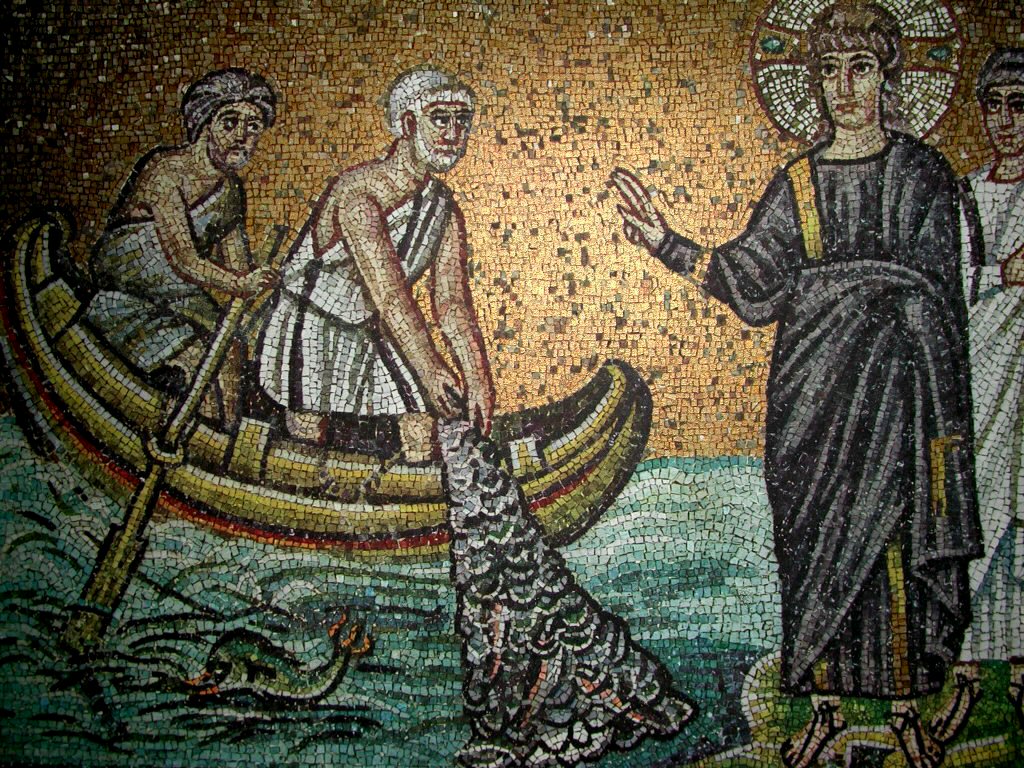
As Jesus passed along the Sea of Galilee, he saw Simon and his brother Andrew casting a net into the sea– for they were fishermen. And Jesus said to them, “Follow me and I will make you fish for people.” And immediately they left their nets and followed him. As he went a little farther, he saw James son of Zebedee and his brother John, who were in their boat mending the nets. Immediately he called them; and they left their father Zebedee in the boat with the hired men, and followed him. Mark 1:14-20.

Mark’s Gospel offers us some unique insights into the Christian life for the third week of Epiphany. After John the Baptist’s arrest, Jesus announces the imminence of the kingdom of God, requiring repentance and calling for hope (belief “in the good news”). Mark sets the story on the sea of Galilee, known for sudden storms. The men who made eked out their living fishing on these waters worked very hard, were heavily taxed, and struggled with many of the same day-to-day issues we know so well. I’ve known men like this, and they are not easily moved.

So, Jesus meets two sets of brothers: Simon and Andrew, and James and John (who Jesus later nicknamed the “Sons of Thunder”). He calls to them to follow him, and each of these men leave behind their work, their families and their homes to follow Jesus. As we discussed in the call of Samuel, God has a funny sense of timing, and his message often interrupts us when we’re trying to do something else. Perhaps these men were just ready to hear a message of hope and forgiveness. Perhaps they were ready to hear the message that evil doesn’t win and that there’s another way to live.

I think, however, that this arresting story of the origins of the Church sheds a good deal of light on the kind of man Jesus must have been. He must have been a remarkably compelling figure, this itinerant preacher walking along the Galilee. Mark’s Gospel reports that the decision to follow Jesus occurred “immediately”, suggesting that their hopes for the promised good news overcame their fears and their attachments. The passage also suggests these men felt a sense of urgency, that they couldn’t put off their walk with God any longer or take care of a few little things beforehand. May it be so with us, too.

The Gospel teaches us something important about our path to discipleship. Very few of us will start or travel down this path of conversion alone. Conversion, whether we’re turning away from or turning toward something, is a difficult process, and most of us will need to take a friend, a brother or a sister along for the journey. Jesus called these disciples into a vocation of hope and forgiveness and a relationship with the living God. These two sets of brothers felt impelled to leave behind their ordinary, workaday lives and follow Jesus. May it be so with us, too.

Finally, Scripture teaches us an important lesson about being a disciple. Then and now, following Christ will require that you’re going to have to leave some things behind. In the case of these men, it was their boats, their nets, their jobs and their families. For some of us, it may be habits, outlooks, destructive relationships, or the fears that bind us to the present moment. The disciples found a way to leave those things behind. May it be so with us, too.

Shabbat shalom,

James R. Dennis, O.P.

© 2012 James R. Dennis
What Are You Looking For?

The next day John again was standing with two of his disciples, and as he watched Jesus walk by, he exclaimed, ‘Look, here is the Lamb of God!’ The two disciples heard him say this, and they followed Jesus. When Jesus turned and saw them following, he said to them, ‘What are you looking for?’ They said to him, ‘Rabbi’ (which translated means Teacher), ‘where are you staying?’ He said to them, ‘Come and see.’  John 1:35-39.

In the Daily Office today, we read the Gospel of John, which again offers us a fine reading for the season of Epiphany.  Once again, we encounter John the Baptist, this time on the day after Jesus’ baptism.  As Jesus passes by, John again announces that Jesus is the Lamb of God.  

Rather than stepping into the spotlight, John  illuminates Jesus.  That phrase, “the Lamb of God”, would have carried immediate connotations for his Jewish audience.  The Passover operated as the pivot point for the Jewish people’s understanding of their salvation, and the Passover meal was lamb.  John thus bears witness that Jesus offers their deliverance. 

Andrew and another of John’s disciples hear this startling announcement and begin following Jesus.  The next passage provides us with insight into the kind of man Jesus was.  John doesn’t record Jesus announcing his ministry in a dramatic proclamation.  Jesus doesn’t attract his disciples with miracles or a sermon or a sales pitch. There’s nothing ecstatic or charismatic in his response. A friend of mine has recently convinced me that all forms of ministry (teaching, preaching, liturgy, outreach, and evangelism) are, at their core, pastoral

Jesus’ first question to the disciples reveals his pastoral nature:  “What are you seeking?  What do you think is missing?”  The world brims with people who are looking for something:  God, happiness, wealth, enlightenment or something new and exciting.  Each of us who claims to follow Christ, however, should regularly ask ourselves that very question:  “What are you looking for?”  If our response is something other than Jesus, we might want to reorient our pursuits.  Jesus’ question may call to mind God’s first question to mankind, “Where are you?”  Gen. 3:9. 

The disciples then ask Jesus, “Rabbi, where are you staying?”  That translation leaves a bit to be desired.  Their question wasn’t so much “Where are you spending the night?”  Rather, they wanted to know where Jesus lived, where he dwelt, where he “abided.”  We would do well to think here of another passage in John’s Gospel:  “Abide in me as I abide in you.”  John 15:4.  The disciples aren’t asking so much about geography as they are beginning to probe his teaching, his “yoke”, and his idea of relationships.  Jesus’ remarkable response, “Come and see”, will shape the lives of his disciples forever. 

In the Gospel of John, the word “see” always involves something more than one might understand initially.  The Greek word orapo connotes more than visual observation.  It suggests spiritual vision, insight or understanding.  Jesus thus invites these two disciples to follow him, understand and find what they are looking for.  He’s extending the same invitation to you, and to me.

Pax,

James R. Dennis, O.P.

 © 2012 James R. Dennis