

Let it be done for you as you wish.” And her daughter was healed instantly Matt. 15:28. The full readings for today can be found here.
In the name of the Living God: by whom we are being created, redeemed and sustained.
You know, I have met a lot of priests. Many of them are my friends. And to be honest with you, I’m really not sure why. Because they treat me so bad. They really do. When it’s time for the Good Samaritan, or the little baby Jesus in the manger, my phone is silent—as silent as a midnight graveyard. But when the lectionary rolls around to Jesus calling a woman with a sick child a dog, all my friends have a conflict: “Brother James, could you come preach for me this Sunday?” And all the sudden my phone is ringing like the bells of Notre Dame.
I want to talk about that, but I want to put this story in a bit of context. You know, I love borders. I have spent most of my life near the border, and spent 25 years living right on the border with Mexico. And one of the things I love the most is the intersection of two cultures, the way culture is porous, even when a border may not be. When you live near a border, you come to realize just how fluid and flexible borders can be.
We see it in our meals: I learned very early on that enchiladas and huevos rancheros and carne asada just made life better. We see it in our families, as blended families soften our hard hearts, and all a sudden that’s not just some immigrant, that’s my grandchild, or my uncle, my tio. And we see it in our language: words and phrases cross cultural boundaries with absolute sovereignty, with no constraints. So, in Mexico, if you need to leave your car to go shopping, you’ll look for el parquing, or for breakfast you might have a cereal called los confleis, and the device you use for with your computer is el maus. And it travels in both directions: Our words corral, ranch, stampede all came from Spanish. We have states called Arizona and Florida, and even the name of your own town, Blanco comes from the Spanish. Borders and the confluence of cultures are fascinating.
My favorite border story comes from Mother Teresa, who was crossing one day into Israel. The border guards there asked her if she was carrying any weapons, and she replied, “Oh yes. I have my rosary and I have my prayer books.”
So, this morning, we find Jesus crossing from Jewish territory into the area of Tyre and Sidon, into Gentile country, into the land of the Canaanites. You remember the Canaanites; they were the people in the Old Testament who continually worshipped idols and were always in fights with the people of Israel. They really didn’t get along with the Jewish people, in fact, Jews would routinely refer to these Gentile pagans as “dogs.” It was a commonly used slur for the Canaanites, but it seems shocking when we hear that slur being used by Jesus. We might ask ourselves, “Was Jesus just having a very bad day?” Maybe we begin to get a sense that something more is going on here when we look at Jesus’ family tree and find three Canaanite women there: Tamar, Rahab, and Ruth. As I said, the border changes things.
We learn just how elastic things are on the border when this woman cries out: “Have mercy on me, Lord, Son of David; my daughter is tormented by a demon.” So, here’s a gentile woman, who calls Jesus “Lord” and the “Son of David.” She may be a pagan, but she’s speaking a pretty solidly Jewish language. In this borderland, this woman doesn’t seem to fit any of the fixed markers of a pagan or a Gentile.
Jesus seems to ignore her, then tells her, “I was sent only to the lost sheep of the house of Israel.” In other words, I’m not here for you; you’re outside my borders. But then, the story begins to shift, and there’s an interesting shift in the plot. This woman, this Canaanite woman, kneels before Jesus and begs, “Lord, help me.” And things begin to change. They enter into a conversation. It’s worth noting that Matthew says this woman knelt before Jesus.
Jesus tells her that it wouldn’t be fair to take the children’s food and give it to the dogs. And it’s shocking, and it’s uncomfortable to hear Jesus say that. But maybe we should remember a couple of things here. First, remember from Matthew’s gospel the parable about the workers who showed up early in the morning getting paid the same as those who showed up late in the afternoon? I don’t think Jesus gave a hoot about what’s fair; I think he was fiercely indifferent to our ideas of fairness. I think Jesus knew God’s mercy was lavish, that there was enough of it for everyone. And I think this woman knew it, too. And as for the slur about calling this woman a dog, well, as we observed earlier, Jesus had a little “dog” blood in him, too.
And look at this woman’s response, in the context of how desperate she is for Jesus to help her daughter. She doesn’t get her feelings hurt, she doesn’t lose her nerve or her persistence. She tells Jesus even the dogs eat the crumbs that fall from the table. In other words, there’s enough for everyone to eat—to quote that old hymn, “There’s a wideness in God’s mercy.” In God’s economy, supplies of grace and blessings are not limited. God’s love and mercy cross every border we try to establish, skirt around all our barricades, and break down every wall. Now, here’s the tricky part: none of that was news to Jesus.
So, I want to pause that story and go back to the first part of our gospel today. Jesus is talking about the Jewish dietary laws, which are sometimes called the Purity Codes. And there were lots of these regulations, governing who you couldn’t spend your time with (like tax collectors), who you could and couldn’t touch (like lepers), and what you could eat and what you couldn’t eat. And all these rules operated as a kind of a border, a border between what was holy and the things and people that were not. And Jesus rejects this notion, he challenges this border.
Jesus tells us, it’s not what you put into your mouth, it’s what comes out of it that’s the problem. The problem isn’t what you eat; the problem is the slander and gossip and envy in your heart. So, your borders were all wrong. Holiness has a lot more to do with what’s in your heart than with what you eat. That’s the real border.
So, now we return to this woman, begging for Jesus to help her, to heal her child. And I think Jesus looked into her heart and knew that whatever border separated them, he was going to cross it. He tells her that she has great faith, and here I don’t think faith has anything to do with some intellectual proposition that she’s going to accept. I think it has to do with who she trusts. She is willing to give up her dignity, her pride, and her self-respect because she trusts that Jesus can help her daughter. And Jesus, having looked into her heart, is willing to cross the borders that separate them. He assures her that her prayers have been heard and answered.
So, I think it’s worth asking ourselves, “What are the borders that I have that separate me from God?” A lot of us have created a spiritual ghetto, isolated God and Jesus to an hour on Sunday morning. Jesus, you can have a bit of time while I’m in church, but I don’t want you coming with me to work, or when I’m arguing with my family, and I don’t want you getting into my politics, and I sure don’t want to see you on the golf course.
There’s a fellow named Russell Moore, who used to be a top official with the Southern Baptist Convention and is now the editor of Christianity Today. And he and several other pastors talked about preaching on turning the other cheek and preaching the Sermon on the Mount. And they were accosted by their congregation for preaching on “liberal talking points.” And when these pastors would reply “I’m literally quoting Jesus Christ” their congregations would answer “Yes, but that doesn’t work anymore. That’s weak.” Moore concludes that our church today is in a crisis, a crisis in which the teachings of Jesus Christ are considered subversive. I think that happens because some of us have created a border between Jesus and our politics.
And I think Moore may be right: we are in a crisis. But here’s the good news: if we trust Jesus, if we let him into our lives and take him seriously, he will knock down every false border we’ve created until there’s nothing left standing between us and God. Amen.
James R. Dennis, O.P. © 2023


 The full readings for today can be found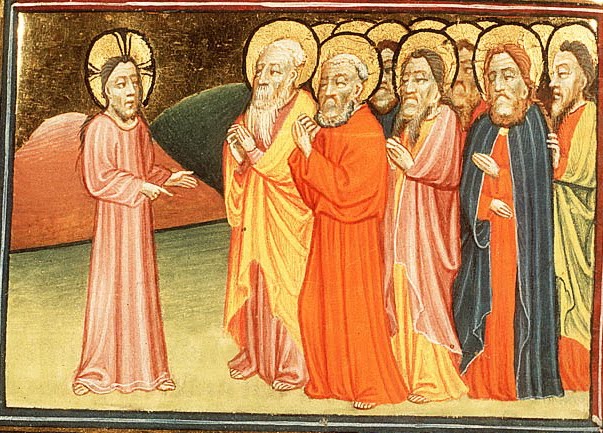

 Domini Canes