Tag Archives: Bible

A Great Chasm

Now he is comforted here, and you are in agony. Besides all this, between you and us a great chasm has been fixed…. (The full readings for this morning can be found here.)

In the name of the Living God, who is creating us, redeeming us, and sustaining us.

Well, good morning, everybody. So, in today’s gospel we encounter a man who’s having trouble with the afterlife and is concerned for his family. Whenever I hear this story, I think about a family we knew back in West Texas, the Beauchamp brothers.

Now, they were not nice people. In fact, everybody in the whole county knew the Beauchamp brothers. In business they were crooked, mean and cold-blooded. Well, one day, the older brother, Howard Beauchamp, he up and died. The younger brother, Ronnie, wanted to make sure that Howard got the finest funeral there had ever been in the county. He went down to the funeral home and bought a fine cherrywood coffin with silver hardware. Then he went to go see the minister.

The little church there was not doing so well. In fact, it was kind of falling apart at the seams. The air conditioner was old and tired, and the roof struggled to keep out the rain. Well, Ronnie Beauchamp, he went to the minister, and he offered him the Devil’s own bargain. He said, “Pastor, I will give your church half a million dollars if you will preach my brother’s funeral and tell everyone he was a saint.” Well, this was a real conflict for the preacher, because the church really needed that money, but he couldn’t lie from the pulpit.

So, the day of the funeral came around, and the whole town was there as the minister began to preach the funeral sermon.  He said, “The man you see in this coffin was a vile and debauched individual.  He was a liar, a thief, a bully, a great sinner, and he broke his mama’s heart.  He destroyed the fortunes, careers, and lives of countless people in this county, some of whom are here today. This man did every dirty, rotten thing you can think of.”

“But, the preacher added, … compared to his brother, he was a saint.”

Now, before we go any further, I want to make a couple of things clear. The passage we are reading isn’t a theological guide about how to get to heaven or how to avoid hell. This passage is one of Jesus’ parables—a riddle or a fable. So, I don’t think the rich man went to Hades because he was rich. And I don’t think Lazarus went to heaven because he was poor. But I do want us to start thinking this morning about the various chasms we encounter: chasms that separate us from each other, the gulfs between us and God—the chasms we come upon, and the chasms we help create.

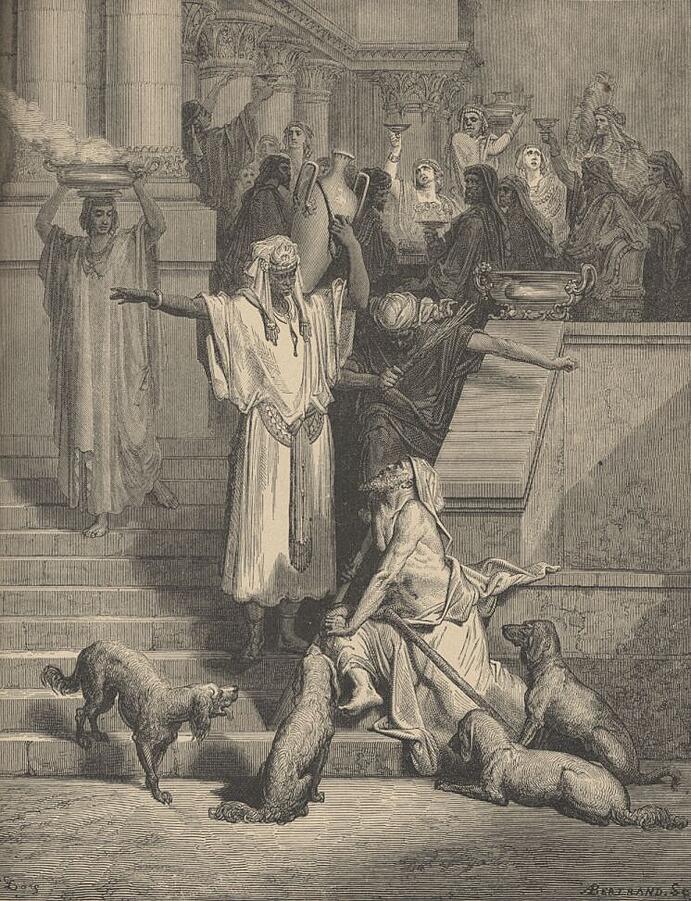
One of the first places we notice a gap, or a distance, is between the circumstances of these two men. We are told that every day, the rich man ate luxurious meals, and he wore fine linen and purple. On the other hand, we can imagine Lazarus in rags, and we’re told he’s covered in sores. He’s also starving, and dreams of eating even the crumbs or scraps from the rich man’s meals.

And although their lives were very different, they did not live far away from each other. In fact, Lazarus lived just outside the rich man’s gate. But we get the feeling the rich man never noticed Lazarus. In fact, I get the impression that the rich man had become quite adept at ignoring Lazarus at the gate, a kind of studied disregard, a well-rehearsed apathy. So, their lives on earth were very far apart; they were separated by a great economic and social chasm.

Then, when the two men die, we have one of those classic reversals of fortune that Luke loves. It’s already happened right from the outset of the story. You see, we know the name of the poor man in the story—his name is Lazarus, which means God’s help. We don’t, however, know the name of the other character; he’s just some rich guy. That’s not how things normally work. We remember the rich and the mighty, and too often the names of the poor and the hopeless are forgotten.

But when their earthly lives are over, the angels carry Lazarus to the bosom of Abraham. In other words, he has a place of peace and comfort and honor among the righteous dead. The rich man, however, finds himself being tormented in Hades. There’s a considerable distance, a chasm, between their circumstances. But even from the fiery pit, the rich man doesn’t seem to recognize his new situation yet. He’s still treating Lazarus like a slave. You see, the biggest lie the devil ever told us is that some lives are worth more than others, that some people are more important than others.

The rich man asks Abraham to send Lazarus with just a bit of water on his finger to ease the rich man’s suffering. Once again, here’s that Lucan reversal of fortune. Abraham tells the rich man: “Child, remember that during your lifetime you received your good things, and Lazarus in like manner evil things; but now he is comforted here, and you are in agony.”

The bigger problem, Abraham explains, is that vast chasm between Lazarus and the rich man. Now, maybe Jesus was trying to tell us that heaven is a long, long way away from hell, but I don’t think so. I think the distance between Lazarus and the rich man is simply the echo and amplification of the separation the rich man created while they were alive. In other words, to borrow an idea from Charles Dickens, they wear the chains they forged in life. Jesus reminds us that there is a deep and profound connection between how we live in this life and how we live in the next life.

So, what are we supposed to do with this passage? What am I supposed to do about the homeless man that I drove by on my way to church this morning? Am I supposed to give him a dollar? Buy him a meal? Pay for him to spend a night in a hotel room? If I do that, will Jesus let me into heaven?

I think the very last thing Jesus wanted to do in his parables was to give us easy answers to these questions. I think we were meant to struggle with this issue, to learn to listen to Moses and the prophets. I also think we have to find a way to close the tremendous gaps between ourselves and our brothers and sisters. We all know about the terrible gap of wealth inequality, and we saw the political distance widen in this country after Charlie Kirk was killed and both parties clawed at each other desperately for a spot on the moral high ground

My friends, as Doctor King warned us, “We must learn to live together as brothers and sisters or perish together as fools.” We know about the chasm between God’s children. I think the biggest chasm I have to struggle with every day is the gap between the man I am and the man I want to be, the distance between the life I’m leading, and the life Jesus wants for me.
I think the first thing is that we notice how deeply, how profoundly, God cares for the poor. This morning, the Psalmist tells us happy are those:

Who give justice to those who are oppressed,
and food to those who hunger.
The Lord sets the prisoners free;
the Lord opens the eyes of the blind;
the Lord lifts up those who are bowed down.

A friend of mine puts it a little differently. He likes to tell me that no one gets into heaven without a letter of recommendation from the poor.

Secondly, I think we have to find a way to bridge the gap between us and the broken-hearted of this world. We must find a way to reach across to those who are hungry, to those who live in hopelessness. And we’ve got to quit asking whether they deserve our help, our charity. Quite frankly, that is none of our business. God will figure that out.

I do believe charity is important, and yes, the rich man fails to tend to, or care about, the needs of Lazarus. But there was a sin that came before that, an earlier fault that made all the others possible. He didn’t even notice Lazarus. He didn’t notice the man at his gate. I don’t want to think about the number of times I’ve turned my glance away from the homeless and the poor. And the failure to notice them robs us of any chance we have to make a difference in their lives, to make a friend. So maybe we should begin by noticing them, and I mean this quite literally, for the love of God, notice them. Maybe if we go out of our way, just a little bit, we might learn to share our resources, and more importantly, to share our hearts. Amen.

James R. Dennis, O.P. © 2025

Things Hoped For

“Now faith is the assurance of things hoped for, the conviction of things not seen.” (The full readings for this morning can be found here.)

In the name of the living God, who is creating, redeeming, and sustaining us. Amen. Well good morning, good morning. I thought this morning we’d talk about faith, about different ways some folks have of understanding faith, and about what the scriptures can teach us about that.

When I think about faith, I am often reminded of my great great grandfather. You see, he had come to America from the Old Country, from Ireland. He settled for a while in the Boston area. And he was a very busy man, but a very devout man. Well, one day he had an appointment with the bishop, and he was running late. And there was no place left to park.

As I said, he was a very devout man. And he looked to the heavens and prayed. He said, “Lord, you know I’m here to see the bishop. You know I can’t be late, Lord, and you know there’s no place for me to park. So, I’ll tell you what I’ll do, if you help me find a parking place, I’ll go to mass every day for a month. He looked and there were still no places. And so he added, “And Lord, I’ll give up the whiskey.”

Well, it was a cloudy day that afternoon in Boston, but all of a sudden, the skies parted, and a bright beam of sunshine opened up to reveal a single parking spot right in front of the cathedral. And my ancestor looked up to heaven and said, “Never mind, Lord. I found one m’self.”

So, I want to suggest something to you, at least a starting premise for us to work from. I want to suggest that faith is much more about who we trust, or where we place our trust, than about what we believe. I’ll say that again: I wonder whether faith isn’t much more about who we trust, or where we place our trust, than about the ideas we have decided to accept.

Let’s look at a couple of examples that might help with that distinction. We all remember the story of Noah and the flood. The earliest claims of having found the Ark in which Noah sought shelter from the flood date back to around 700 BC. Since then, hundreds of people have claimed that they found the ark. Recently, one group is using ground penetrating radar at the Durupinar formation in Turkey and claim to have found the remains of a preserved vessel. But does that have anything to do with faith? If we could scientifically prove this was the ark, and found trace DNA from Noah, would our lives in faith be better?

If we could absolutely prove the story of Noah and the flood, we might have a very fine argument or some fascinating dinner conversation—we might even have some certainty.  But certainty is not an environment in which faith thrives. Because faith, the scripture teaches us, is the conviction of things not seen. Our discovery of the ark might prove something we could all see with our eyes, but faith looks beyond the visible, the provable, to what can only be seen with the heart.

Let’s examine question, the very old question of which religion offers us the surest path to salvation. So, we have been fighting about our beliefs for a long time: about whether you could have pictures of Jesus in the church, about calculating the date of Easter, and about how Jesus really really gets into the communion host. In the 1960s, one group of the Amish community separated from the main body of the Amish over the question of whether one could wear buttons, or whether one could only be true to their religion by fastening their clothes with hooks and eyes.

We can believe all sorts of things: our beliefs are the conclusions we are led to by our rational minds, the conclusions of our thinking. We can believe that our safety lies in our military might—nuclear submarines that can wipe our enemies off the map. Or you might belief in an afterlife in which all the meals are composed of chocolate cake and crème brûlée, where the streets are made of peanut brittle. Or maybe you believe the government is listening to our every thought through a complex system of internet connections, cell phones, and vaccinations.  I don’t really care whether you think  UFOs come down each summer to swim with the Loch Ness Monster and discuss how we faked the moon landing. You might believe that our salvation only lies in eating unleavened bread while listening to the Star-Spangled Banner and staring at an isosceles triangle.

I am not especially concerned with what you believe: Beliefs change; they are constructs of our mind. So, I’m not especially concerned with that. But I am profoundly concerned with your faith, with the place where your trust abides, and how that trust shapes the way you live your life.

That kind of faith reshapes the world and makes it ready for God’s word to vibrate through creation. This is a music that can only be heard with the heart, a music that assures us that God knows of our deepest hopes. Abraham heard that music of faith, and followed God when God told him to leave behind his home and everything he’d ever known. Abraham trusted God when God told him he would have children, even though both he and his wife were too old. And even when God asked him to give up his only son, Abraham trusted God and knew that somehow it would all work out right.

So, I’ll tell you a secret. I think that kind of trust, that deep faith or “assurance of things hoped for,” usually comes only after you’ve had your heart broken a time or two and learned where you can find shelter—who you can depend on, what you can trust. That kind of trust will necessarily influence our actions, influence how we walk through the world. In our modern world, faith (or trust) is so very hard to come by. We have become so jaded, so suspicious of each other and our institutions.

Back in the earliest days of the Church, those first Christians knew about sorrow, and suffering, and broken hearts. And it took them about 300 years to articulate who they could turn to, who they could trust. And they gathered together to work out their ideas down at a place called Nicaea. We still say their prayer, and we’ll recite it in just a moment.

They said they trusted God, “the maker of heaven and earth, of all that is, seen and unseen.” Do you hear that prayer echo in the reading from Hebrews: “the worlds were prepared by the word of God, so that what is seen was made from things that are not visible.” They trusted in Jesus, Mary’s boy, who promised he would be with them until the end of time. They had faith because Jesus told them it pleased his Father to give them the kingdom. The had faith in the Spirit which had moved across the waters, the Spirit which came upon them in baptism, and the Spirit which had inspired their Scriptures. And they trusted the Church, although they knew that from time to time a particular instance of the church might let them down.  But that’s not where their faith abided; no, they trusted in the whole church, which is the mystical body of Christ.

The great J.M. Barrie, who wrote Peter Pan, said, “All the world is made of faith, and trust, and pixie dust.” That sounds just about right. I know I have great hopes for us. That hope is invisible, but I am assured of it. “Lord, I believe. Help my unbelief.” Amen.

James R. Dennis, O.P. © 2025

Let No One Put Assunder

“It is to such as these that the Kingdom of God belongs.” (The full text of our readings can be found here.)

In the name of the Living God, who is creating, redeeming, and sustaining us. Well, good morning, everyone, good morning.

You know, I grew up out in West Texas. And when I was a young man I engaged in some pretty risky behavior. Now and then I would drink too much. And I liked fast cars, and liked to see how fast they would go. And I would date these girls..well, if you’ve ever been to a rodeo…well, they were barrel racers. And I want to assure you that they are, every single one of them, loco. I mean not average plain old crazy…they were fancy crazy, with glitter and everything, and some of them were mean, too.

So, I know what it means to walk into a room full of trouble. But when you walk into a church full of people you really don’t know all that well, about a third to half of whom have been divorced, including the guy in the pulpit, to preach a sermon on the topic of divorce, well, that’s next-level hazardous; that’s right on the border between silly and imbalanced. But here in the diocese of West Texas when there’s a really foolish, precarious situation, one that really no one with good sense would mess with, I’m the guy they call. Because, as we all know, fools rush in where angels dare not tread.

So, let’s turn to this passage of Scripture, a passage that has been poorly understood, horribly misused, and cruelly interpreted.  Let’s try to look at this story in context, beginning with the historical context.

The first thing we need to understand is that whatever sort of divorce Jesus was talking about, divorce in first-century Palestine had very little to do with the sort of divorce we may have had some experience with. Ancient Israel, like most of the ancient world, was patriarchal, and wives were regarded as the property of their husbands. Thus, while a husband could divorce his wife, the wife had no reciprocal ability to divorce her husband. Marriages were not based on our current notions of romantic love between two persons but on considerations of property, status, and honor between two families. If a husband did divorce his wife, she and the children would  probably end up penniless, begging, or something worse

Now let’s look at this story in the textual context, in the context of a story that Mark is telling us. This discussion takes place when Jesus is answering certain questions he’s asked by the Pharisees, asked to test him or to trap him. In this passage, Jesus isn’t asked about how God feels about divorce, or even how Jesus feels about divorce. Rather, they ask Jesus a question they already know the answer to—they ask him what the law says. Now, the Pharisees were a lot of things, but mostly, they were a group devoted to understanding, preserving, and interpreting the law. So, they didn’t come to Jesus with a genuine question, but rather with a snare.

Now let’s look at this story in the broader Gospel context about Jesus’ relationship with the law. Everything we know tells us that Jesus’ relationship with the law was….well, complicated. When Jesus’ disciples were accused of breaking Jewish law by plucking grain and eating it as they walked along on the Sabbath, Jesus responded that David and his companions ate the consecrated bread that the law reserved for the priests.  When the Pharisees caught a woman in adultery and were going to stone her as the law directed, Jesus told them that the one without sin should throw the first rock. The Pharisees constantly criticized Jesus for healing on the Sabbath, which he did so regularly one might conclude that Jesus was looking for trouble. And I think he was: I think Jesus was looking for what the great John Lewis called “Good Trouble.”

It seems to me that in this morning’s reading, Jesus is doing what he did so often. I think he was forcing us to overcome our legalism and look more deeply at the principles that underlie the law, and to look more deeply within ourselves. Jesus tells us the problem isn’t with our legal situation but with our medical situation—with the hardening of our hearts.  He says Moses only gave you the commandment concerning divorce because of the hardness of your hearts. If you’ve ever walked through a divorce with one of the parties, or with a couple, you know how hard our hearts can get. If you’ve ever watched children go through a custody battle, you know how hard our hearts can become.

Rather than involving himself in a debate about the circumstances in which divorce might be permissible, Jesus (as he so often did) calls us to examine the first principles behind marriage. Part of that first principle Jesus turns to is the story of creation: we were not made to be alone; we were made for life in common, a life in love.

We know of many reasons why a marriage can fail: infidelity; alcohol and substance abuse; workplace stress; financial stress; mental illness; disagreements over parenting styles; religious differences; physical and mental abuse. Like the psalmist says, we’re “just a little lower than the angels.” Very rarely have I encountered a situation where one party was completely to blame and the other party was completely blameless in the failure of the marriage. Divorce can leave behind emotional and spiritual wreckage. And sometimes I have seen circumstances where ending the marriage was the least wrong answer two people had available to them. Because whatever the marriage covenant is, I’m pretty sure God didn’t intend it to be a suicide pact.

I have known way too many people, mostly women, who were berated and shamed by churches and church leaders when their marriage ended in divorce. And I don’t know how Jesus would feel about all the reasons modern marriages break down. But I do know how Jesus felt about our habit of judging each other and I know how he felt about cruelty. I know that, for all of us, hardness of heart is a spiritual issue. Our lives can become so very isolated, so very disintegrated, so very fragmented.

Today’s Scripture isn’t really about the legality of our justifications for divorce. It’s about how we overcome our natural hard-heartedness and learn to live lives that are full of compassion and vulnerability and courage. It’s about learning to live into God’s dreams for the world rather than our failures and disappointments. That’s the only way we’ll discover the real intimacy God intended for us and the real blessing of a life spent in gratitude and the joy of delighting in each other. I’m pretty sure if we start off in that direction we might find the kingdom of God. That’s the kind of life I want, and I hope you want it, too. Amen.

James R. Dennis, O.P. © 2024

The Border Crisis

Let it be done for you as you wish.” And her daughter was healed instantly Matt. 15:28. The full readings for today can be found here.

In the name of the Living God: by whom we are being created, redeemed and sustained.

          You know, I have met a lot of priests. Many of them are my friends. And to be honest with you, I’m really not sure why. Because they treat me so bad. They really do. When it’s time for the Good Samaritan, or the little baby Jesus in the manger, my phone is silent—as silent as a midnight graveyard. But when the lectionary rolls around to Jesus calling a woman with a sick child a dog, all my friends have a conflict: “Brother James, could you come preach for me this Sunday?”  And all the sudden my phone is ringing like the bells of Notre Dame.

          I want to talk about that, but I want to put this story in a bit of context. You know, I love borders. I have spent most of my life near the border, and spent 25 years living right on the border with Mexico. And one of the things I love the most is the intersection of two cultures, the way culture is porous, even when a border may not be. When you live near a border, you come to realize just how fluid and flexible borders can be.

We see it in our meals: I learned very early on that enchiladas and huevos rancheros and carne asada just made life better. We see it in our families, as blended families soften our hard hearts, and all a sudden that’s not just some immigrant, that’s my grandchild, or my uncle, my tio. And we see it in our language: words and phrases cross cultural boundaries with absolute sovereignty, with no constraints. So, in Mexico, if you need to leave your car to go shopping, you’ll look for el parquing, or for breakfast you might have a cereal called los confleis, and the device you use for with your computer is el maus. And it travels in both directions: Our words corral, ranch, stampede all came from Spanish. We have states called Arizona and Florida, and even the name of your own town, Blanco comes from the Spanish. Borders and the confluence of cultures are fascinating.

My favorite border story comes from Mother Teresa, who was crossing one day into Israel. The border guards there asked her if she was carrying any weapons, and she replied, “Oh yes. I have my rosary and I have my prayer books.”

So, this morning, we find Jesus crossing from Jewish territory into the area of Tyre and Sidon, into Gentile country, into the land of the Canaanites. You remember the Canaanites; they were the people in the Old Testament who continually worshipped idols and were always in fights with the people of Israel. They really didn’t get along with the Jewish people, in fact, Jews would routinely refer to these Gentile pagans as “dogs.” It was a commonly used slur for the Canaanites, but it seems shocking when we hear that slur being used by Jesus. We might ask ourselves, “Was Jesus just having a very bad day?” Maybe we begin to get a sense that something more is going on here when we look at Jesus’ family tree and find three Canaanite women there: Tamar, Rahab, and Ruth. As I said, the border changes things.

We learn just how elastic things are on the border when this woman cries out: “Have mercy on me, Lord, Son of David; my daughter is tormented by a demon.” So, here’s a gentile woman, who calls Jesus “Lord” and the “Son of David.” She may be a pagan, but she’s speaking a pretty solidly Jewish language. In this borderland, this woman doesn’t seem to fit any of the fixed markers of a pagan or a Gentile.

Jesus seems to ignore her, then tells her, “I was sent only to the lost sheep of the house of Israel.” In other words, I’m not here for you; you’re outside my borders. But then, the story begins to shift, and there’s an interesting shift in the plot. This woman, this Canaanite woman, kneels before Jesus and begs, “Lord, help me.” And things begin to change. They enter into a conversation.  It’s worth noting that Matthew says this woman knelt before Jesus.  

Jesus tells her that it wouldn’t be fair to take the children’s food and give it to the dogs. And it’s shocking, and it’s uncomfortable to hear Jesus say that. But maybe we should remember a couple of things here. First, remember from Matthew’s gospel the parable about the workers who showed up early in the morning getting paid the same as those who showed up late in the afternoon? I don’t think Jesus gave a hoot about what’s fair; I think he was fiercely indifferent to our ideas of fairness. I think Jesus knew God’s mercy was lavish, that there was enough of it for everyone. And I think this woman knew it, too. And as for the slur about calling this woman a dog, well, as we observed earlier, Jesus had a little “dog” blood in him, too.

And look at this woman’s response, in the context of how desperate she is for Jesus to help her daughter. She doesn’t get her feelings hurt, she doesn’t lose her nerve or her persistence. She tells Jesus even the dogs eat the crumbs that fall from the table. In other words, there’s enough for everyone to eat—to quote that old hymn, “There’s a wideness in God’s mercy.” In God’s economy, supplies of grace and blessings are not limited. God’s love and mercy cross every border we try to establish, skirt around all our barricades, and break down every wall. Now, here’s the tricky part: none of that was news to Jesus.

So, I want to pause that story and go back to the first part of our gospel today. Jesus is talking about the Jewish dietary laws, which are sometimes called the Purity Codes. And there were lots of these regulations, governing who you couldn’t spend your time with (like tax collectors), who you could and couldn’t touch (like lepers), and what you could eat and what you couldn’t eat. And all these rules operated as a kind of a border, a border between what was holy and the things and people that were not. And Jesus rejects this notion, he challenges this border.

Jesus tells us, it’s not what you put into your mouth, it’s what comes out of it that’s the problem. The problem isn’t what you eat; the problem is the slander and gossip and envy in your heart. So, your borders were all wrong. Holiness has a lot more to do with what’s in your heart than with what you eat. That’s the real border.

So, now we return to this woman, begging for Jesus to help her, to heal her child. And I think Jesus looked into her heart and knew that whatever border separated them, he was going to cross it. He tells her that she has great faith, and here I don’t think faith has anything to do with some intellectual proposition that she’s going to accept. I think it has to do with who she trusts. She is willing to give up her dignity, her pride, and her self-respect because she trusts that Jesus can help her daughter. And Jesus, having looked into her heart, is willing to cross the borders that separate them. He assures her that her prayers have been heard and answered.

So, I think it’s worth asking ourselves, “What are the borders that I have that separate me from God?” A lot of us have created a spiritual ghetto, isolated God and Jesus to an hour on Sunday morning. Jesus, you can have a bit of time while I’m in church, but I don’t want you coming with me to work, or when I’m arguing with my family, and I don’t want you getting into my politics, and I sure don’t want to see you on the golf course.

There’s a fellow named Russell Moore, who used to be a top official with the Southern Baptist Convention and is now the editor of Christianity Today. And he and several other pastors talked about preaching on turning the other cheek and preaching the Sermon on the Mount. And they were accosted by their congregation for preaching on “liberal talking points.” And when these pastors would reply “I’m literally quoting Jesus Christ” their congregations would answer “Yes, but that doesn’t work anymore. That’s weak.” Moore concludes that our church today is in a crisis, a crisis in which the teachings of Jesus Christ are considered subversive. I think that happens because some of us have created a border between Jesus and our politics.

And I think Moore may be right: we are in a crisis. But here’s the good news: if we trust Jesus, if we let him into our lives and take him seriously, he will knock down every false border we’ve created until there’s nothing left standing between us and God. Amen.

James R. Dennis, O.P. © 2023

Seeing with Eyes of Blessing

When Jesus saw the crowds, he went up the mountain . . . .Then he began to speak, and taught them. Matt. 5:1. (The full text for this morning’s readings can be found here.)

In the name of the Living God, who is making all things new. Good morning, good morning. I want to thank Father Holloway for asking me back again and thank you all once more for your generous hospitality.

You know, there’s an idea floating around in Christianity today, and it’s been around for a while. This notion still has a lot of adherents today, and you can hear many of them on television. But this doctrine is well summed up in a story that Oral Roberts used to tell. It goes back to a time in 1947 when Roberts was going through a time of crisis in his life and ministry.

Well, around this time, through a friend who owned a Buick dealership, Roberts was able to acquire a brand-new shiny Buick automobile. According to Roberts, the “new car became a symbol to me of what a man can do if he would believe God.” His first book on this topic was entitled “God’s Formula for Success and Prosperity.” Like I said, that notion is still running around today. And that idea, which suggests that God’s love for us can be measured by our financial well-being, is sometimes called the Prosperity Gospel.

And there’s a theological term for it. We call it poppycock. We call it gibberish; we call it balderdash. If you have any doubts about it, all you need to do is study today’s gospel—because that’s not what Jesus is saying. Not at all.

Now, this story appears very early in Matthew’s gospel. Jesus is baptized, he calls his disciples and then begins teaching and healing and the crowds start following him. And this story describes Jesus’ very first sermon, the first teaching that Matthew records. And Matthew wants to place Jesus in a historical context and a spiritual context. Like Moses, Jesus ascends to the mountain. Matthew wants to point his readers—us—to the notion that Jesus is the new Moses.

Rather than a tablet of laws, however, Jesus offers us a set of descriptions or signposts that point the way to the kingdom of heaven. Rather than a set of rules, he describes the surprising people that God treasures, and along the way shows us what a life with God would look like. They describe a divine reality we already live in, but can’t always see.

When we look at the world, any fool can see that meek don’t look very blessed. They didn’t inherit the earth then, and they’re still not inheriting it. And the merciful, they don’t seem to get much mercy. I’ve known way too many who mourn and they are still looking for their comfort. I’ve seen too many peacemakers laughed at, scorned and called unpatriotic. And those who hunger and thirst for righteousness, well, they’re still hungry and they’re still thirsty.

If we’re really honest as we look at the world today, we’d say something like blessed are the well-to-do, for they can send their kids to good schools. And blessed are the really attractive people in this world, because their road is going to be a lot easier. Or, too often, blessed are those without much of a conscience, because they will find a way to get it done even when it’s built on deception or hurting good people. If we’re honest, we have to admit that the world Jesus describes is not really the world we’ve made for ourselves.

But it can be. In one sense, I think these beatitudes are a daring protest against the world around us. Jesus is announcing: this is not how God meant for us to live. This is not how things have to be. God sees this world very differently than most people do. And if we want to share in this kingdom-vision, we can begin by reexamining our values and the people who are down on their luck. Because in God’s story, in God’s story, we find some very surprising heroes.

These beatitudes teach us that the people that God calls holy, the people that God cherishes, are those who are vulnerable. Not the spiritual whizkids, but the poor in spirit. This world admires those who are strong, follows those who are influential, and marvels at blustery braggarts. But those are not the people that God embraces.  

We can hear echoes of other parts of the gospel here. When Mary finds out she’s pregnant, she announces that God is going to scatter the proud and lift up the lowly. He will send the rich away empty and fill the bellies of the poor. He will pull the mighty from their seats and raise up the meek. Or maybe we hear the echo of Jesus saying that the first will be last and the last will be first. Or maybe we hear the resonance of Jesus telling us that the stone that the builder has rejected has become the cornerstone. All of us have experienced, at one time or another, that sort of rejection. We have all, at some time, been broken.

If we look at the people Jesus is talking about, the people this world rejects and calls losers, we find one common trait. They are vulnerable. The beatitudes teach us that the people God calls holy are broken people. And maybe that’s where we’ll find an insight into God’s mercy: it evades the appearance of perfection and reaches into the broken parts of the world to mend it. And maybe, just maybe, if we drink from the deep well of grace, we’ll learn to be like children, who show their scars like medals they’ve won.

I think that Jesus offered us these beatitudes, these blessings, to show us the world that God sees, to show us a vision that is too often clouded by the cataracts of sin and self-assurance.  The gospel text today begins with the idea that Jesus “saw” the crowds. There’s a world of difference between looking and seeing. I think Jesus turned his penetrating gaze right into the broken hearts and souls of those very ordinary people who were listening to him.

So maybe that’s the challenge of today’s gospel. Maybe we are called to look upon the broken people—the vulnerable people in this world—and see them as a blessing. Maybe this passage calls out to us to bless them, and be blessed by them. I think Jesus’ vision of the kingdom calls us to see the world through the lens of mercy, through the eyes of those with pure hearts, from the perspective of those who’ve experienced a terrible loss.

These blessings are a protest against the world-as-it-is, and a call for us to reshape our lives as a people who have experienced the gift of failure. Jesus teaches us that our full humanity lies along the road of loss and the messiness of want and longing. Our deep hope, as opposed to a superficial optimism, lies in learning to live with compassion.

Sometimes I look at God’s one, holy, catholic, and apostolic church, and I think it is the light of the world. And sometimes, I look at it, and I think it’s the Island of Broken Toys. And on my best days, on my very best days, I can look at it and see that it is both. Amen.

James R. Dennis, O.P. © 2022

The Unjust Judge

In that city there was a widow who kept coming to him and saying, `Grant me justice against my opponent.’ Luke 18. (The full readings for this morning can be found here.)

In the name of the Living God, who is creating, redeeming, and sustaining us.  Well, good morning, good morning. It’s good to be with you again here at St. Michael’s. And many thanks to Brynn and all of you for your generous hospitality.

So, this morning in the lectionary, the Church offers us this story which is sometimes called the parable of the unjust judge. And this passage of the Gospel reminds me of one of my favorite stories about the religious life. Several years ago, there was a young woman who became a nun. And she made her vows and entered the convent. Now the rules of this particular Order required that she be cloistered and keep silence, although every ten years the sisters were allowed to say two words. So, for the first ten years, she was assigned to make the beds. And she changed the sheets, and washed them,  and made every bed throughout the monastery. And at the end of that ten years, she went to the Mother Superior and said, “Bed hard.” Well, the next ten years, she was assigned to the kitchen. And she peeled the potatoes and cooked the oatmeal and cleaned every pot in that monastery. And at the end of that ten years, she went to the Mother Superior and told her, “Kitchen hot.”

After ten long years she was next assigned to clean the bathrooms. And she washed every sink and bathtub and scrubbed every toilet they had. And at the end of that ten years, she went to the Mother Superior and said, “I quit.” And the elder nun looked at her and said, “Good. You haven’t done anything but nag me since you got here.” Contrary to that story, and today’s gospel, I don’t think prayer has much to do with nagging God.

And we may be a little confused by this parable, or by many of them. The Hebrew word for parable is mashal, which carries with it connotations of a story, or an allegory, or a riddle. And many of these parables may leave us scratching our heads, including the one this morning, but that’s their function. They’re kind of like a picture frame that is intentionally hung so that it’s not level, so that we’ll have to really think about and puzzle over what’s portrayed. These parables are meant to make us think, to examine, and to turn an idea over in our minds until we come to a deeper understanding of it. And the broader question that I think Luke wants us to look at is how do we think prayer operates, and what does faithful living look like in a fallen world?

So, let’s take a deeper look at this parable and see what it offers us. Jesus begins his story: “In a certain city there was a judge who neither feared God nor had respect for people.” Oh, I’ve been to that city. And I’m pretty sure that I know that judge. I was a lawyer for a very long time, and on more than one occasion, I ran across that judge who did not fear God nor respect people. And without revealing too much about this judge, I can tell you that the county seat is Beaumont. Now, I should have known there was going to be a problem because in French the name Beaumont means “beautiful mountain.”  Have y’all ever been to Jefferson County? Well, it’s not beautiful, and there’s no mountain.

Seriously, if you’ve ever met someone like that—someone who doesn’t fear God and doesn’t respect people—you know how truly frightening a person that is. And I don’t think for a moment, Jesus is trying to tell us that God is like that. The God we worship loved and respected humanity, embraced all sorts of people, prayed regularly, and his blood watered the hill we call Golgotha. I want to circle back to the contrast between God and this unjust judge in just a moment, but first let’s look at one of the other characters in the story.

When we examine the widow in this parable, we remember the biblical direction about taking care of widows because in that world they were fragile and vulnerable. And yet this widow doesn’t seem vulnerable at all. She constantly goes to the unjust judge asking for justice against her opponent. Some translators tell us the better translation is “give me revenge.” And we might re-think our notion of her as fragile when we realize that the judge is actually being worn out by this woman.

So, is Jesus actually telling us that the real secret to a rich prayer life is becoming a bother to God, pestering the Almighty until He just gives in? Somehow, I don’t think that’s the point, especially since Jesus is on the receiving end of so many of our prayers. Now, there are some folks, and a few preachers, who will tell you that if you close your eyes real hard, and give money to the church, and believe just right, God will give you anything you ask for—as if the Almighty were some sort of a cross between a celestial ATM and a divine Santa Claus. We have a name for that sort of theology. We call it “heresy.”

I think Jesus is talking to us about two things. First, he’s telling us not to lose heart. And it’s so easy in this world to lose heart. There are unjust judges everywhere. Our political discourse has been reduced to the snarkiest common denominator. And in our prayer life, help never seems to come as quickly as we’d like, if it comes at all. And if we view prayer as a transaction, we might lose heart all the more quickly.  I don’t think our prayer life is like a Vegas slot machine, where if we just keeping putting in enough tokens, we’ll hit the jackpot.

            I do think, however, it’s like another bible story, one we didn’t hear today but I’ll bet you know it. I think our prayer life is a lot like the story of Jacob. And you’ll remember that Jacob was trying to come back home, knowing that his brother Esau was furious with him and he’s worried that his brother is coming to kill him. And that night a man comes to Jacob and wrestles with him. And the scripture is unclear about whether Jacob is wrestling with a man, or an angel, or with God himself. The two of them wrestle all night.  And although in the struggle Jacob’s hip is thrown out of joint, he tells his opponent, “I will not let you go unless you bless me.”

Our prayer life is like holding onto God, struggling with God all night, even when we are injured in the struggle. It is a stubborn insistence on a blessing, oftentimes a blessing we do not yet understand. As Saint Paul says, we train ourselves to be persistent whether the time is favorable or unfavorable. We will wrestle all night, holding on for that blessing. We will lift up our eyes to the hills, knowing that our help can only come from the Lord. And if we remain obstinate, if we stubbornly cling to God even when our strength is failing, the Son of Man will return to find that we are a faithful people. Amen.

James R. Dennis, O.P. © 2022

The Beginning of the Good News

The time is fulfilled, and the kingdom of God has come near. (The full readings for this morning can be found here.)


In the name of the Living God, who is creating, redeeming, and sustaining us.

Well, good morning, everybody, good morning. And welcome as we join together to celebrate the feast day of our patron saint, St. Mark. And I’ve been wondering….no, no, I’ll talk about that later.

So, today, we hear the opening of Mark’s gospel. And our friend Mark’s gospel is unique. There’s no fancy star in the sky, there’s no manger or shepherds, or wise men. There’s no trip into Egypt, or Jesus at the dawn of creation. He begins the story with a baptism. Jesus’ story, for Mark, begins with his baptism. And I wonder, I just wonder, if that doesn’t tell us something about Mark’s community. I think for his community, and maybe for ours, too, the story of who we are begins with our baptism. It is as though Mark sets aside genealogy, history, geography and political context, and tells us: “If you really want to know about a person, learn about their baptism.” Because for Mark and his community, that’s our real beginning. There, we’ll find the real origin of our lives.

We really don’t know all that much about Mark. By the way, I’ve been really trying…no, we’ll talk about that later. We don’t know much about Mark although we think his community may have lived somewhere around Rome. And we believe his community suffered under the early persecutions of the Christian Church.

So, I mentioned today was the feast of St. Mark. It is also the Sunday after Easter, which is sometimes called Low Sunday or if you really want to be arcane, Quasimodo Sunday. If you’ve read much Victor Hugo, you know that the famous hunchback named Quasimodo was left and found at the Cathedral of Notre Dame on the Sunday after Easter. Now some people say it’s called Low Sunday because of the contrast to the High Holy Days of Easter. Some people will tell you that it’s because church attendance is generally low. So you see, I’ve been trying to convince myself…I’ve been working for the last several weeks to convince myself, that’s it’s just a coincidence that today is the day our clergy asked me to preach. But so far, I haven’t had any luck at all.

So, back to this Gospel passage. We think Mark’s community was a fairly small band of persecuted Christians. And certainly, the community of early followers of Jesus would have known hard times. They were occupied by the Roman empire, subjected to a harsh system of domination and taxation; the poor were everywhere, and their religious system was collaborating with these villains. And our patron Mark tells us: Now, hear the word of the Lord. “See, I am sending my messenger ahead of you.”

Onto this stage, into this troubled setting, strides this eccentric, bizarre, maybe whimsical character. He is neither charming nor winsome. He rants. He is uncombed and indecorous and unkempt. He’s dressed in camel hair and eats honey and locusts. Now, I don’t care how much honey you cover a plate of locusts with; it still tastes like bugs. And he is amazing. He is amazing mostly because the people come from miles around to hear him preach baptism and the forgiveness of sins.

He seems so irrelevant to the problems people are facing. Their politics were a mess. John preached baptism. Poverty was everywhere. John preached the forgiveness of sins. And the amazing part is that the crowds were drawn to him. I think he’s still out there today, preaching like a madman. Vladimir Putin has ravaged Ukraine and committed terrible war crimes. John is preaching baptism. Look at our troubled economy, look at all this rising inflation. John is preaching the forgiveness of sins.  He’s still out there, preaching, as though the solution to our worldly problems lay in the spiritual realm.

And most of us, we don’t really like all that confession of sins part. We are a prideful people, and we cherish our self-esteem. We would much rather mount a good defense, or proclaim our denial, or offer a fine excuse rather make than a simple confession. The truth is, when I look back on my life, I have sinned some, I have sinned again, and I have sinned some more. It’s so hard to announce, as the old Prayer Book used to teach us, “There is no health in us.” We cannot avoid our shame; we cannot ignore it. But we can overcome it and find forgiveness. This is not comfortable, but it is the way to healing.

And there is John, calling to us, crying out in the wilderness, telling us this is the way to God. And that way always seems to lead through our baptism and our willingness to confess our failures—just as we will confess them before we come to this altar for communion.

Now, power is a dangerous thing, and perhaps spiritual authority is the most dangerous of all. It’s a strong temptation, but we can take note of John’s spiritual maturity in his recognition of his role. He knows he’s not the center of the story. It requires a lot to know that you’re the messenger and not the message. He tells the crowd that One “who is more powerful than I is coming after me; I am not worthy to stoop down and untie the thong of his sandals. I have baptized you with water; but he will baptize you with the Holy Spirit.” It’s hard to resist the limelight, but John’s humility speaks of the authenticity of his encounter with the divine. This is John’s confession: “I am not worthy. I’m not worthy to stoop down and untie his sandals. I’m not worthy.”

And then Jesus, the one who is worthy, comes to the river Jordan, to be baptized by John. We might wonder, “Why did Jesus need to be baptized?” We believe, and we’ll say so in just a few minutes, in one baptism for the forgiveness of sins. So, why did Jesus, who was without sin, need a baptism? I think perhaps this was simply one of the many ways in which Jesus came to share with us in our humanity. He shared with us in the waters of baptism so that we might share with him in that Easter resurrection.,
And then, Jesus comes out of the water and a voice from the heavens announces that he is God’s beloved child, just as we are the beloved children of the Holy One. And as Jesus comes out of the water, the heavens are torn apart and the Holy Spirit, in the form of a dove, descends upon him. Here, we have this remarkable collision of holiness, this intersection of the three members of the Trinity (Father, Son, and Holy Spirit) at the river Jordan.  But it is the Spirit that drives Jesus into the desert, into the wilderness for his time of trial and temptation.

And only after these events, after God’s affirmation of all that he is doing and all that he is, only after he is cajoled and tested in the desert, can Jesus announce to us all that it is time. This is the very time when God’s kingdom has come near. And it’s odd that we return to this story, the beginning of Mark’s gospel, right after we’ve heard the end of the story—Jesus’ passion and resurrection. But perhaps that displacement, that warp and weft of time, may remind us that we are no longer in ordinary, standard time. We are entering into sacred time here.


You see, Mark tells us, very carefully, I believe, that this is only the beginning of the good news. That story is still being written, in your life and mine. We who have been immersed in the water and the Spirit, we who have confessed, repented, and forgiven, we have our own story to tell about the good news of Jesus Christ. Tell that story out, my brothers and sisters, and tell them that the kingdom of God has come near. Amen.

James R. Dennis, O.P. © 2022

The Homecoming

The full readings for this morning can be found here:

But while he was still far off, his father saw him and was filled with compassion; he ran and put his arms around him and kissed him.

In the name of the Living God, Father, Son and Holy Spirit.

Good morning. How’s your Lent going?  It’s the fourth Sunday of Lent, so we’re about knee deep in it. And you know, somewhere between the global pandemic, the Russian Invasion, and events in this parish, I think it’s about the lentiest Lent I’ve ever lented. But here we are, and this morning, the Church has offered us this magnificent story. We call this story the prodigal son. That word “prodigal” makes me wonder. It means extravagant, lavish, or sometimes wasteful spending and I promise you we’ll come back to that next week.

It’s one of my favorite stories, a story about how we should treat terrible sinners—you know, people like you and like me. So Jesus tells us this story that captures the essence of not only this season of repentance, but also of the heart of Christianity.

And he begins, “There was a man who had two sons.” Now, I think Jesus’ audience, when they heard this introduction, would have immediately thought, “Uh oh. There’s going to be trouble.” Because these people knew their Scripture, and they would have immediately thought of Cain and Abel, Jacob and Essau, and perhaps of Joseph and his brothers.

You see, I had several brothers, and I understand what kind of trouble younger brothers can be. But in this story, the younger son goes to his father and says: “Father, give me the share of the property that will belong to me.” Now, we may miss the import of this request. In that world, at that time, that was in essence the younger son saying, “I wish you were dead” or at least, “You’re taking too long to die.” But the father complies and gives his younger son his inheritance early. So, the younger boy gathers all he has and goes off to a foreign country.

Oh, I know about that foreign country. I’ve spent time there. You see, there was a time in my life when, if you had asked me, I would have told you that I spent all my money on fine clothes, fast cars, good wine, and pretty women. The rest of it, I wasted. These are years when my father referred to me as Count No-Account. So, I’ve been in that foreign country where the younger brother went. And the boy spends everything he has on dissolute living and then trouble comes: a famine strikes the land. You see, there’s one thing about that foreign country: it’s a lot of fun—until it isn’t anymore.

And we know how far this younger son has fallen, because here’s this good Jewish boy in a gentile country feeding the pigs. Feeding the pigs! I mean, that’s no place for a good Jewish kid. And Luke tells us he would gladly have eaten the pig food, but “no one gave him anything.” “No one gave him anything.” That’s the way the world is sometimes, when you’re down on your luck. And it’s hard to find a way out.

But then, Luke tells us, something remarkable happens. The younger brother has what you might call an epiphany, or a moment of grace, or maybe he’s just desperate. But look at what Luke says: “when he came to himself.” Now, that phrase implies more than just a change of mind, it implies that for a while he had been lost to himself, he had wandered away, he had forgotten who he was. And while we may not have run off with daddy’s money, most of us have forgotten who we are at some point. And he decides to go home, even if that means being treated like one of his father’s hired hands.

And now the story gets really good. Luke tells us, “But while he was still far off, his father saw him and was filled with compassion; he ran and put his arms around him and kissed him.” That may be my favorite line in all of Scripture. Do you know why the father saw him from a long way off? Because he was looking for him. I suspect he’d been looking for him to come home ever since the boy left. And I take great comfort in that, in the idea of a God who is always anxious for us to come back home. Maybe I find that notion reassuring because…well, I’ve been a long way off myself.

The younger son tells his father, “I have sinned against heaven and before you; I am no longer worthy to be called your son.” He confronted his failures, and he recognized that the heavy cost of them. He recognized they might cost him his place in the family, just as our own failures carry a cost. We might add a pause here in the story, as the father weighs his response to the younger son’s words. But the father, in a moment of lavish generosity and forgiveness, tells the servants: Dress this boy up in something fancy and let’s have a party, “let us eat and celebrate; for this son of mine was dead and is alive again; he was lost and is found!”

And in a real sense, the younger son was dead to his father. He was gone; he was lost. Look at the father’s response: there’s no price to be paid for re-entry into the family; there’s no penance to be done. The father is full of nothing other than joy at his son’s return. Now, we call this parable the prodigal son, and remember that word prodigal means lavish or extravagant. But, I think we could just as easily call it “prodigal father,” because his response of love and forgiveness is just as extravagant as was his son’s spending.

And the family begins to celebrate the boy’s return—well, not everybody in the family joins in the party, the pachanga. The elder son, the good son, who never did a thing to take advantage of his father, can’t even bear to come into the house. Some of us may identify with that older son: he’s responsible; he does what’s expected of him; and he’s very good at keeping score. In fact, he is shacked and bound by his rage.

The older son tells his father: “For all these years I have been working like a slave for you, and I have never disobeyed your command; yet you have never given me even a young goat so that I might celebrate with my friends. But when this son of yours came back, who has devoured your property with prostitutes, you killed the fatted calf for him!” And in the world he lives in, he’s right. He lives in a world of the zero-sum game, where anytime someone gets ahead, you’re falling behind. We call that an economy of scarcity. He cannot even bring himself to recognize his brother. Look at what he says: not my brother has come back, but this son of yours came back.

The problem isn’t that he has a sense of right and wrong. The problem is that he is a prisoner of it, chained to his sense of injustice. He can’t even go into the house. That’s a hard way to live. He reminds me of something we used to say about my family. We said that we suffered from a genetic case of Irish Alzheimer’s—that’s where you forget everything except the grudges.

Let’s contrast his response to that of the father, who tells him: “Son, you are always with me, and all that is mine is yours. But we had to celebrate and rejoice, because this brother of yours was dead and has come to life; he was lost and has been found.” Contrast the older son, who says “this son of yours” with the father, who says “this brother of yours.” The father had to celebrate because the joy and forgiveness overflowed from him. The elder son lives in an economy of scarcity; the father lives in something much closer to what we call the economy of grace, or God’s economy. In the economy of grace, love and forgiveness are the currency, the coin of the realm. And that’s the world, the economy, in which the father has chosen to live.

Now, here’s the brilliance of this story, the genius of this tale: we don’t know the end of the story. We don’t know if the older brother accepted his father’s invitation to join in the celebration. We don’t even know if he ever came into the party, into the house. We don’t know if the younger brother really did change his ways, or if he fell back into his old lifestyle. And I think Jesus meant for that story to remain unfinished, because we get to write that ending every single day in our own lives. We can choose to live like the younger brother, the older brother, or the father. We get to write the ending of this wonderful story in the way we live. It’s your story. Make it a good one.            

Amen.

James R. Dennis, O.P. © 2022

Let Me See

Continue reading

A Change Is Gonna Come

Transfiguration

Six days later, Jesus took with him Peter and James and his brother John and led them up a high mountain, by themselves. And he was transfigured before them, and his face shone like the sun, and his clothes became dazzling white. Suddenly there appeared to them Moses and Elijah, talking with him. Then Peter said to Jesus, “Lord, it is good for us to be here; if you wish, I will make three dwellings here, one for you, one for Moses, and one for Elijah.” While he was still speaking, suddenly a bright cloud overshadowed them, and from the cloud a voice said, “This is my Son, the Beloved; with him I am well pleased; listen to him!” When the disciples heard this, they fell to the ground and were overcome by fear. But Jesus came and touched them, saying, “Get up and do not be afraid.” And when they looked up, they saw no one except Jesus himself alone.
As they were coming down the mountain, Jesus ordered them, “Tell no one about the vision until after the Son of Man has been raised from the dead.” Matthew 17:1-9.  (The full readings for today can be found here.)

But Jesus came and touched them, saying, “Get up and do not be afraid.”

In the name of the Living God: who creates, redeems, and sanctifies us.

Good morning, good morning. So, in today’s gospel, we hear Matthew’s story of Jesus being transfigured, in the Greek, the word is metamorphosis. So, it’s a story about change.

But before we get there, I thought we might review our journey through this season of Epiphany, and see where the Scriptures have taken us this season. We began this journey with the story of the wise men, these men from the east, these Gentiles who were following a star. Matthew told us how the new life of Jesus on earth had implications for the cosmos. Even the sky has changed. Now maybe that was a new star, or a comet. Or maybe, just maybe, these wise men were simply able to see something that was always there, hidden in plain sight. Maybe they could see God at work in the heavens because, well, they were looking for it.

The following week we were down at the river Jordan, where John was baptizing and announced that the kingdom of God was near. John, that holy wild man, announced that we would need to repent, to change, because God was in our midst. And as Jesus comes out of the water, having been baptized, we hear the same voice we heard this morning. “This is my son, my beloved.”

So, on the second Sunday after Epiphany, we heard John’s version of that same baptism, and heard John the Baptist testify that Jesus was the son of God. And we heard Jesus call his disciples, who had overheard John proclaim Jesus as the lamb of God. And as the disciples are drawn to Jesus, Andrew goes and tells his brother we have found the Mashiach, the Messiah. And when his brother Simon goes to Jesus, Jesus tells him you’re not going to be Simon anymore; you’re going to be Cephas, or Peter. Again, we mark the notion of change: you’re going to be a different person, so you need a new name.

The following week, we heard Matthew’s version of that story. And we heard Jesus reminding us to repent, to change, because God’s kingdom is breaking into the world. And Jesus called to Simon and Andrew, telling them to leave behind their jobs as fishermen and follow him. And they did. Because encountering the Christ, encountering Jesus, will require us to change.

And then in the fourth week, we heard Jesus tell us that we were salt and light. In fact, he went further than that. He said that we were the light of the world! Us? The people who bicker all day about politics? The people who live so selfishly, who are consumed with being entertained rather than enriched, the people whose fear motivates them far more than their love? Yes, us. In fact, he said we were the light of the world. He said, “Let your light shine before others, so that they may see your good works and give glory to your Father in heaven.” That is our calling; that is our place in the kingdom. That, my friends, is going to require a change.

And last week, we heard Jesus say, “You have heard that it was said to those of ancient times, ‘You shall not murder’; and ‘whoever murders shall be liable to judgment.’ But I say to you that if you are angry with a brother or sister, you will be liable to judgment.” Jesus reminds us that it’s not just about what we do, but what we think and what we say. Last week, Jesus told us: “So when you are offering your gift at the altar, if you remember that your brother or sister has something against you, leave your gift there before the altar and go; first be reconciled to your brother or sister, and then come and offer your gift.” This is not just about what we do, it’s about our hearts. My brothers and sisters, we are going to have to change.

And that gets us to the gospel for this week. The story takes place, in Matthew’s phrase, six days later. We might ask, “Six days after what?” Well, it’s six days after Jesus announces he’s going to Jerusalem: Jerusalem, the city that kills prophets. And there aren’t any coincidences in Matthew’s gospel. That six days harkens us back to the story of creation in Genesis. Because what Jesus is going to do there, in Jerusalem, well, it’s going to make a new creation. It’s going to make all things new. And nothing is going to be the same after that.

Jesus and his disciples go up on a mountain. And there, Jesus is transfigured; he is changed. His face shines like the sun. Now, maybe Jesus is changed, or maybe for the first time the disciples can see Jesus for who he was all along. Maybe for the first time they can see that hidden reality, the reality that’s not beyond this world, but within this world and sometimes obscured by our shallow expectations. And they see Jesus, talking with Moses and Elijah.

It’s worth noting that both Moses and Elijah encountered God on a mountain. And like Moses, Jesus’ face shines with the reflection of the God he meets there. Now, for the Jewish people (people like Matthew), Moses was the lawgiver, who brought the people the Torah. And Elijah was considered perhaps the greatest of the prophets. And there they were, on the mountain, with Jesus, upon whom all the law and all the prophets hang.

And the disciples hear God’s voice, echoing from Jesus’ baptism. “This is my beloved son.” And this time, the voice of the Lord adds something. “Listen to him!” So, here we have the core of our journey through epiphany: here is the light; here is the way the world changes; listen to him.

And change, well, our response to change hasn’t evolved much since the first century. Whether it’s a divorce, the loss of a job, or a deep spiritual movement in ourselves, change frightens us. And I think that’s why Jesus reached out to his disciples, touched them, and said, “Get up and do not be afraid.” He’s still telling us that today.

So, as we reflect upon our journey through the season of epiphany, we look forward to the next season into which the Church calls us: the holy season of Lent. Here we find our opportunity to really change our lives: to become the light of the world. And it’s about so much more than giving up sweets, or bread, or meat. Lent is about drawing closer to God, repenting of our mistakes and setting out on a new life, a better life, a more abundant life.

If all we do during Lent is give up chocolate, that’s not a Lenten discipline, that’s a diet. And that’s fine, but that’s not the life we’re called into. We are called during that Holy Season to abandon anything that gets between us and God, to lay down our burdens and begin again.

I thought I’d close this morning with something from one of my favorite saints, St. Sam of Mississippi. He wrote,

It’s been too hard living, And I’m afraid to die
‘Cause I don’t know what’s up there
Beyond the sky

It’s been a long, long time coming
But I know, but I know a change is gonna come
Oh yes it is
Oh my, oh my, oh my

And so that’s my prayer for us this Sunday. Let us become that change; let us incarnate that change. Let that change come. Let it come. Amen.

James R. Dennis, O.P. © 2020