Tag Archives: Anglican, Bible, Disciple

The Grace of Charity

If you have received from God the gift of knowledge, however limited, beware of neglecting charity and temperance.  They are virtues which radically purify the soul from passions and so open the way of knowledge continually.
The way of spiritual knowledge passes through inner freedom and humility.  Without them we shall never see the Lord.
“Knowledge puffs up whereas charity builds up.”  [1 Cor. 8:1.]  Therefore, unite knowledge with charity and by being cleansed from pride you will build yourself up and all those who are your neighbors.

Charity takes its power to build up from the fact that it is never envious nor unkind.  It is natural for knowledge to bring with it, at the beginning anyway, some measure of presumption and envy.  But charity overcomes these defects:  presumption because “it is not puffed up” and envy because “it is patient and kind.”  [1 Cor. 13:4]

Anyone who has knowledge, therefore, ought also to have charity, because charity can save his spirit from injury.
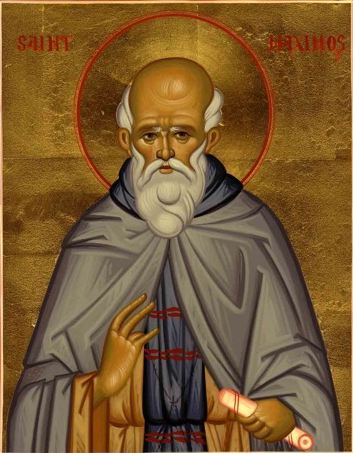
      –Maximus the Confessor (from Drinking from the Hidden Fountain)

The Dominican Order expects its brothers and sisters to spend an hour a day in prayer and an hour a day in study of Holy Scripture and theology.  Frankly, I love that part of the rubric of my Order, because learning and study come easy to me.  Maximus the Confessor reminds me that maybe it comes a bit too easy.

Maximus was a monk who lived from around 580 to 662.  Most scholars believe that he was born in Constantinople; we know he was tried there for heresy.  Maximus suffered both exile and torture for the faith.  After his death, the Church declared his innocence of the charge of heresy.  Both the Orthodox and Roman Catholic churches recognize him as a saint and a Father of the Church.  He famously said, “Theology without practice is the theology of demons.”

Looking to the reading today, Maximus reminds us that our study and our learning must be rooted in the ancient Christian practice of charity.  Charity carried a slightly different meaning then; it meant more than simply giving money to the poor.  Charity meant loving kindness without limits.  This notion was related to the Hebrew concept of chesed or the Greek word agape.

Thomas Aquinas said that all the virtues pointed toward charity, the highest of the virtues, and charity (or love) makes all the other virtues possible.  Charity is a grace, and we practice charity because we were first loved by God.  Charity relates closely to humility because both enable us to lay aside our own desires and concerns for a while.  As a friend of mine observed, the Christian virtue of humility doesn’t mean we think less of ourselves; it means we think of ourselves less.

Maximus reminds us that all our study, all our theology, will leave us parched and withered unless we drink from the well of charity.  Our knowledge is always deeply incomplete and inadequate.  Rabbi Heschel once said, “The tree of knowledge grows upon the soil of mystery.”  Part of that mystery lies in God’s limitless capacity to love, and our capacity to reflect His love through the practice of charity.  Thus, as Heschel observed, “When I was young I admired clever people.  Now that I am old, I admire kind people.”

I wish you a good and holy Lent,

James R. Dennis, O.P.

© 2012 James R. Dennis

N.B.  Earlier this week, through a computer glitch or some sort of (as yet unknown) operator error, this post was erroneously published as a draft with many, many typos.  I was mortified.  The irony of that event, in a post about humility is not lost on me, and I hope you’ll accept my apologies.

Cleaning (God’s) House

The Passover of the Jews was near, and Jesus went up to Jerusalem. In the temple he found people selling cattle, sheep, and doves, and the money changers seated at their tables. Making a whip of cords, he drove all of them out of the temple, both the sheep and the cattle. He also poured out the coins of the money changers and overturned their tables. He told those who were selling the doves, “Take these things out of here! Stop making my Father’s house a marketplace!” His disciples remembered that it was written, “Zeal for your house will consume me.” The Jews then said to him, “What sign can you show us for doing this?” Jesus answered them, “Destroy this temple, and in three days I will raise it up.” The Jews then said, “This temple has been under construction for forty-six years, and will you raise it up in three days?” But he was speaking of the temple of his body. After he was raised from the dead, his disciples remembered that he had said this; and they believed the scripture and the word that Jesus had spoken.  John 2: 13-22.

Few paths offer a quicker road to trouble than criticizing someone’s religion or their politics.  Almost certainly, Jesus knew that about us, and travelling down that road got Him killed.  In today’s reading from the Lectionary, Jesus criticized both the religion and the politics of the Judean authorities of that time.

The Temple stood as a monument to something sacred and holy:  it represented the intersection of heaven and earth, the dwelling place of the Living God, and a visible symbol of both national identity and God’s covenant with the Jewish people.  Most people would perceive an attack on the Temple  as an attack on the faith (and the nation) itself.  These events took place as the city of Jerusalem swelled with the Passover crowds.

All four Gospels record this event, one of the few occasions on which Jesus became deeply angry.  In the other three Gospels, Jesus calls the Temple a “den of thieves.”  John places this event near the beginning of Jesus’ public ministry, as opposed to the synoptic Gospels which place it much later.

Jesus apparently became enraged upon observing the barriers thrown up by the priestly authorities, barriers which stood between God and His people.  For example, because Roman coins were forbidden in the Temple, they had to be exchanged (at a substantial discount) for the currency of the Temple.

The Temple authorities also collaborated with the Roman occupation, and Jesus overturned that table as well.  In John’s Gospel, Jesus  insults the Temple culture, calling it a “marketplace.”  Trading on access to the Holy was then, and still remains, a special kind of blasphemy.  Jesus became enraged when He saw the Sacred being traded like a commodity.  I think we underestimate the Gospel if we see this as a historical criticism of “the Jews” back then.

Our churches still seek to collaborate with political power.  We still fall under the thrall of a purity system that separates the righteous from the sinners, the holy from the impure and the whole from those who are broken.  We might well examine the ways in which we still place obstacles in the paths of those who come looking for God.  We might wonder whether our churches, like the Temple in Jesus’ time, have become comfortable monuments to the status quo.  We might ask whether our houses of worship have become mutual admiration societies rather than instruments of change.  Perhaps we should share the Savior’s sense of outrage when we encounter it.

The Judean authorities asked Jesus to provide them with a sign (seimeion), in other words, to show them the authority by which Jesus issues this prophetic condemnation.  Asked for an explanation, Jesus replies with an enigma.  Jesus responds that upon the destruction of “this temple”, he will raise it up in three days.  As is so often the case in John’s Gospel, Jesus is misunderstood.  (We find the classic example of this in Jesus’ trial as Pilate questions Him.  John 18, 19.)  Jesus speaks of the sanctuary of His body; the Judeans think He’s talking about the architecture.

Ultimately, Jesus will displace the Temple as the intersection of heaven and earth.  As He told the Samaritan woman only two chapters later, “the hour is coming when you will worship the Father neither on this mountain nor in Jerusalem.”  John 4:21. Further, Jesus’ death would signal the final sacrifice, rendering the Temple culture obsolete. Jesus thus appropriates the functions of the Temple for Himself.  The life of Christ would come to operate as the new meeting place for those seeking El Shaddai (God Almighty).

Like the Temple culture of Jesus’ time, many of us would still prefer a God we could do business with (see here).  Jesus offers us something radically different:  He offers Himself.  He becomes the locus point (the alpha and the omega) where human history intersects with the Father. He has been raised as the new edifice where we can encounter the holy.

As we come to this new Temple, Jesus doesn’t expect us to bring a dove or to engage in some special ritual.  He asks us to take the whip into our own hands, and chase away everything that separates us from God. He asks us to come and offer ourselves, our whole lives, without reservation. He asks us to take up our cross and follow Him.

Shabbat shalom,

James R. Dennis, O.P.

© 2012 James R. Dennis

The Greater Danger

We see also that the greater danger does not come from outside us.  It comes from within.  It comes from our very selves.  The enemy is within us.  Within us is the very progenitor of our error; within us, I say, dwells our adversary.  Hence, we must examine our aims, explore the habits of our minds, be watchful over our thoughts and over the desires of our heart.
Let us therefore not seek for causes outside ourselves nor blame others for them.  Let us acknowledge our guilt.  For we must willingly attribute to ourselves, not to others, whatever evil we can avoid doing when we so choose.  St. Ambrose (Bishop of Milan), The Six Days of Creation 1, 31-32.

Again, I found this bit of wisdom in the Readings for the Daily Office from the Early Church.  St. Ambrose was the Bishop of Milan, and lived in the fourth century.  He fought against the Arian heresy (which held that Jesus had not existed eternally and was subordinate to God the Father).  He often stood against imperial authority and was one of the four original Doctors of the Church.

Ambrose rightly points to one of our great shortcomings:  our willingness to justify ourselves by blaming others.  It’s a very old problem, dating back to the first sin recorded in Scripture.  When God asks Adam whether he has eaten of the tree of the knowledge of good and evil, Adam replies:  “The woman whom you gave to be with me, she gave me fruit from the tree and I ate.”  Gen. 3:12.  Adam thus inaugurates our primary strategy for dealing with sin:  justifying ourselves by spreading the blame.  In essence, Adam said that Eve bore the real responsibility for this offense, along with God who gave her to him.

Scripture offers a very clear witness on this point.  Jesus asked, “Why do you see the speck in your neighbour’seye, but do not notice the log in your own eye?”  Luke 6:41.  Perhaps more to the point, St. John reminds us:  “If we say that we have no sin, we deceive ourselves, and the truth is not in us.If we confess our sins, he who is faithful and just will forgive us our sins and cleanse us from all unrighteousness.”  1 John 1: 8-9.

Our desperate efforts to justify what we’ve done, to justify ourselves before the Almighty, place our souls in grave peril.  Christ invites us to drink from the cup of forgiveness, and yet we turn away and deny that we are thirsty.  As C.S. Lewis observed:  “We poison the wine as He decants it into us; murder a melody He would play with us as the instrument…Hence all sin, whatever else it is, is sacrilege.” We want so fiercely to be “good” people, and perhaps even more frantically to appear to be “good” people.  I think in part we feel this way because we do not really trust in God’s infinite capacity to love and forgive. 

I wonder, at our core, how many of us really trust God?  The psalmist wrote that our Father would not refuse a broken and contrite heart.  The real risk to our spiritual lives lies, as St. Ambrose observed, lies in our stubborn insistence on externalizing evil, rather than recognizing the ways in which we’ve separated ourselves from God.

God watch over thee and me,

James R. Dennis, O.P.

© 2012 James R. Dennis

Laughter From the Barren Places

When Abram was ninety-nine years old, the LORD appeared to Abram, and said to him, “I am God Almighty; walk before me, and be blameless. And I will make my covenant between me and you, and will make you exceedingly numerous.” Then Abram fell on his face; and God said to him, “As for me, this is my covenant with you: You shall be the ancestor of a multitude of nations. No longer shall your name be Abram, but your name shall be Abraham; for I have made you the ancestor of a multitude of nations. I will make you exceedingly fruitful; and I will make nations of you, and kings shall come from you. I will establish my covenant between me and you, and your offspring after you throughout their generations, for an everlasting covenant, to be God to you and to your offspring after you.”

God said to Abraham, “As for Sarah your wife, you shall not call her Sarai, but Sarah shall be her name. I will bless her, and moreover I will give you a son by her. I will bless her, and she shall give rise to nations; kings of peoples shall come from her.”  Gen. 17: 1-7, 15-16.

In today’s Lectionary reading, we  continue with the notion of covenant from last week’s Old Testament reading about Noah.  Here, we encounter Abram as an old man.  Twenty-four years earlier, God had instructed Abram to move from his home in Haran. Abram left behind his home and his family; he left behind his past.  Although Abram’s very name meant “father of the multitudes”, deep into their old age he and his wife Sarai had no children.  Despite God’s promises that his descendants would number as many as the stars, Sarai remained barren.

When God re-named him Abraham (“the father of many nations”), it must’ve seemed like a bit of a cruel joke.  And when God re-named his wife Sarah (which means “princess”), that must have made her wince a bit.  And when God told him that  wife would be the mother of nations and kings would spring from her, the whole thing must have seemed….well, just not very likely.

In the very next verse, we learn that Abraham laughed at the whole idea.  Gen. 17:17.  And when Sarah heard the news, she couldn’t help but laugh, too.  Gen. 18:12.  God has a funny sense of humor, and the whole idea struck them as a bit absurd.  And yet, very late in their lives, laughter (which translates as “Yizhak” or “Isaac”) will spring from their marriage.  Their laughter at the absurdity of God’s promise will become laughter of joy.  But, I’m getting ahead of the story…

In those days, at that time, being childless meant a deep and fundamental kind of failure.  (Some folks still perceive infertility that way today, or at least as deeply heartbreaking.) God’s repeated promises seemed to mock the reality of Abram and Sarai’s long struggle with infertility.  So when God Almighty (“El Shaddai”) repeats his promise, Abram falls to the earth, and we can imagine him hoping desperately that somehow the Almighty can bring his dreams to fruition and bless him with an heir.

As happens so often in Scripture, the significance of this event is marked by a re-naming.  We’ve seen it happen to Simon (“Peter), to Jacob (“Israel”), and now to Abram (“Abraham”) and Sarai (“Sarah”).  In each instance, the assignment of a new name implies both a new understanding of mission and a re-making of God’s creation.  It connotes a change so thoroughgoing that the old name simply would no longer suffice.  In this passage, the Lord reveals also himself, using a new name (“El Shaddai”) for the first time.  The name reflects this new covenantal relationship, implying limitless capacity.

This reading offers us several important insights during this Lenten season.  God calls each of us into the covenant He established with Abraham and which was revealed most clearly in the life, death and resurrection of Jesus.  He wants to take the places in our lives which are broken and barren and create new life there.  He wants to turn our laughter of incredulity into laughter of joy.  Just like Abraham, God calls us to walk with Him, so that all our steps are taken with and toward God.  And mostly, He wants us to become living icons of this covenant, to trust in His vision for all of creation and its redemption.  And, I think, God wants us all to laugh, deeply and with great joy.

Shabbat shalom,

James R. Dennis, O.P.

© 2012 James R. Dennis

Rabbi, Teach Us How to Pray

The Master of peace and unity would not have each of us pray singly and severally, since when we pray we are not to pray only for ourselves.  For we neither say: “My Father, who art in heaven” nor “Give me this day my bread”; nor does each of one of individually pray for our own debt to be forgiven, nor do we ask that we alone should not be led into temptation, nor that we only should be delivered from evil.

Our prayer is general and for all; and when we pray, we pray not for one person but for us all, because we are all one.  God, the Master of peace and concord, so willed that one should pray for all, even as he himself bore us all.  St. Cyprian, Treatise on the Lord’s Prayer.

I found this commentary on the Lord’s Prayer in a wonderful book, Readings for the Daily Office from the Early Church.  St. Cyprian lived in the third century in and around Carthage, in northern Africa.  He lived during a time of great trials for the Church, a time of plague, famine, schism and persecution.  He died for the faith in 258 A.D.

I recently wrote about the nature of evil, which always works to separate us: from God, from our brothers and sisters and from our true selves.  Unlike sin, which separates, prayer works to unify.  Cyprian rightly reminds us that God has woven our lives together.  Jesus called upon us to recognize that bond in the Lord’s Prayer.  If we take a look at the very first two words of the prayer (“Our Father”) we recognize our common origin.  We aren’t like a family; we are a family.

When I was a boy at Burnet Elementary School, one of my classmates accosted me on the playground and asked me if I had accepted Jesus Christ as my personal savior.  This question took place in a fairly big crowd of kids, and that event may be my first memory of genuine peer pressure.  I answered, “Well, yes, and no….I think He came to save the whole world.”

I’m not sure how well I understood the theology behind what I said.  (I’m pretty sure it was not a popular answer.)  On the other hand, I think this statement recognized an important concept:  I cannot really separate God’s love for me from my love for His children.  The Lord’s Prayer, and St. Cyprian, call us into that recognition.  I cannot pray for my daily bread alone; my brother’s bread must be just as important.

This notion underlies a good deal of Christian theology.  All were made in the image of God.  The forgiveness of us all must be my concern and my prayer.  One of my favorite writers on prayer, Rabbi Heschel, noted:  “The purpose of prayer is not the same as the purpose of speech.  The purpose of speech is to inform; the purpose of prayer is to partake.”

When we pray the Lord’s Prayer, we partake in the hopes and the troubles and the gratitude of our brothers and sisters.  We also share in God’s hopes and concerns for all His children.  We thus knit our lives together with God’s dreams for the kingdom: the kingdom which has not yet come and the kingdom which is already here and present.  During this holy season, let’s pray for each other and for God’s presence to fall down upon all our lives like a steady rain.

God watch over thee and me,

James R. Dennis, O.P.

© 2012 James R. Dennis

Out Into the Wilderness

In those days Jesus came from Nazareth of Galilee and was baptized by John in the Jordan. And just as he was coming up out of the water, he saw the heavens torn apart and the Spirit descending like a dove on him. And a voice came from heaven, “You are my Son, the Beloved; with you I am well pleased.” And the Spirit immediately drove him out into the wilderness. He was in the wilderness forty days, tempted by Satan; and he was with the wild beasts; and the angels waited on him.  Mark 1:9-13.

This portion of the reading from this week’s Lectionary  illustrates two important ideas relevant to our Lenten discussions.  The first is the principle of resistance.  In Mark’s Gospel, Jesus emerges from the water, a voice from heaven announces that he is the beloved son of God.  There’s a Greek phrase that Mark uses throughout his Gospel, kai euthos.  It’s most often translated as “immediately” or “just then.”  Mark reports that immediately after this wonderful moment, right after this transcendent announcement, the Spirit drove Jesus into the wilderness.

It seems an odd thing:  Jesus has just been consecrated to his vocation as the Messiah, the savior, and immediately He’s sent to the desert to face temptation.  We get a sense of the loneliness of Jesus’ situation, an isolation illustrated by the notion of “the wilderness.”  (In this sense, Jesus will share the Genesis experience of being “cast out” with us, will share in the Exodus experience of wandering in the wilderness.)  The phrase “the wilderness” connotes chaos, fear and a landscape where death and sin become a real possibility.

I think many of us have shared that experience:  just when we think things are going well, when we’ve decided to turn a corner on our relationship with God, we are thrust into that wilderness.  As Michael Corleone famously observed, “Just when I thought I was out, they pull me back in.”

As we work through our Lenten disciplines, attempting to find our way through the wilderness, we shouldn’t be surprised when we encounter this “resistance” to change.  Sometimes, we may find that our Ancient Enemy views this as an opportune time drag us down again.  Sometimes, we may provide our own resistance, or even find resistance from our friends or our families.  And then, we may confront one of the greatest lies Satan tells us:  “Things are never going to change.  This is just too hard.  Life wasn’t so bad before.”

Even while he was in the wilderness with the “wild beasts”, Mark reports that the angels waited on Jesus.  Now, the angels acted as the messengers of God.  I think Mark is trying to tell us that even in that wilderness of spiritual desolation, God will not leave us alone.  Somehow, someway, God will speak words of comfort, courage and peace.  Learning to listen for them when we are ravaged by our terrors, that’s the tricky part.

Mark’s Gospel describes Jesus as having been “tempted by Satan”.  As usual, Mark doesn’t provide many of the particulars here.  Both Matthew and Luke offer more detail about the specific temptations Christ suffered.  We do know one thing about Satan, however.  Jesus said that Satan “does not stand in the truth, because there is no truth in him. When he lies, he speaks according to his own nature, for he is a liar and the father of lies.”  John 8:44.  In this teaching, Jesus illustrates for us something important about the very nature of sin.

I believe that most sin, if not all sin, originates with a lie.  The German people could not have burned 6 million Jews without first deceiving themselves into the belief that the Jews were less than human.  We Americans could not have participated in the brutality of slave labor and the  slave trade without first believing that the Africans were “chattel”, that they were animals.  Or maybe we persuade ourselves that we haven’t had that much to drink, and we’ll have just one more glass of wine before driving home.  Sin generally originates in a lie, because deception is the currency of sin.

In my law practice, I’ve handled a number of cases of embezzlement.  In almost every case, the employee has convinced themselves that their employer has taken advantage of them somehow, and they’re merely recovering what the employer should have given them. I think I understand these folks because if I have a superpower, it’s my ability to deceive myself and rationalize.  And when I stray “out into the wilderness”, I find that deception is the native language of sin.

If we begin to view sin as separation from God, rather than simply doing something naughty, we start to see the subtle danger here.  Jesus described himself as the way, the truth and the life.  Of course, the Father of Lies must separate us from the Truth. Using this Lent as an opportunity for genuine reconciliation, therefore, requires that our self-examination must be firmly rooted in the unyielding truth.  As we approach Jesus, the closer we come, the further we move away from Our Ancient Enemy.

C.S. Lewis once observed “There is no neutral ground in the universe; every square inch, every split second, is claimed by God and counter-claimed by Satan.” God always seeks our union with Him; Satan always seeks to divide us from God and his children.  I pray we use this season of Lent to reflect on those things which operate to come between us from the Almighty, and to take a few steps back towards our real home.

Shabbat shalom,

James R. Dennis, O.P.

© 2012 James R. Dennis

Be Merciful to Me, a Sinner

He also told this parable to some who trusted in themselves that they were righteous and regarded others with contempt: ‘Two men went up to the temple to pray, one a Pharisee and the other a tax-collector. The Pharisee, standing by himself, was praying thus, “God, I thank you that I am not like other people: thieves, rogues, adulterers, or even like this tax-collector. I fast twice a week; I give a tenth of all my income.” But the tax-collector, standing far off, would not even look up to heaven, but was beating his breast and saying, “God, be merciful to me, a sinner!” I tell you, this man went down to his home justified rather than the other; for all who exalt themselves will be humbled, but all who humble themselves will be exalted.’ Luke 18:  9-14.

Sometime today, a priest will mark my forehead with ashes and remind me that I came from the dust, and that I’ll return there.  Those ashes mark the beginning of the Holy Season of Lent.  I hope to use this time to reflect on the complex nature of sin, the Lenten practices which might heal us, and the holy custom of reconciliation  with God.

If we view Lent as simply an occaision on which we give up something we enjoy (sweets, red wine, or our double mocha macchiato), I think we have barely scratched the surface.  Lent serves as a time for putting down our arms and making peace with the God who calls us back to Him.  During this season, we drink the bitter medicine that will hopefully heal our wounds and lead us closer to the Lord of Heaven.

In today’s Gospel reading, we find two men praying in the temple: a Pharisee and a tax collector (who you’ll sometimes see called a publican).  In first century Palestine, good Jews despised the tax collectors or at least saw them as deeply flawed and unclean.  In the first place, tax collectors collaborated with the pagan Roman empire occupying their holy homeland.  Further, most of them could not survive on their income as collectors, and had to cheat people in order to make their living.

On the other hand, the Pharisees were devout, prayerful men who tried to live according to the law of Moses.  The Pharisee in this parable has even gone beyond the Mosaic law, fasting twice a week rather than once. His prayer, however, reveals that he has become mired in the spiritual quicksand of self-admiration.  He believes he can rely on his own righteous behavior to justify himself before God.

Jesus contrasts this sense of spiritual self-sufficiency with the humility of the tax collector, who knows that he is a sinner and asks for God’s mercy.  He can rely on nothing other than God’s grace.  In one of Jesus’ classic inversions, the tax collector is sanctified.  The Pharisee has fastidiously done all the right things (fasting and tithing), but has somehow missed the point.  Like many of us, the Pharisee believes he has actually done God a favor by being so moral.  The tax collector approaches God with a contrite heart, knowing that he’s let God down once again.

This parable offers us the first step in that process:  rigorous self-examination and coming to terms with our failures.  We need to resist our instinctive compulsion to see and present ourselves as righteous (or perhaps guilty of only minor infractions) while we view others as the real sinners, or perhaps see others as the real source of our sin.  As we take a hard look at our lives, some of what we see may make us wince; some of it may make us want to turn away.  That’s the very stuff we need to work on, because those are the weak spots where our separation from the Holy begins.

Often, when we look at what we’ve done and what we’ve failed to do, we may consider our situation rather hopeless.  Our sins constantly separate us from God, and despite our good efforts, we cannot avoid them.  Like the Pharisee, we’re lost in self-deception, self-aggrandisement and our myopic respect for our virtues.  I don’t think the Pharisee was a particularly evil man; rather, his pride blinded him to his own situation.  His self-absorption prevented any real self-understanding.

We pray a fairly desperate prayer in my church: “We have no power within ourselves to help ourselves.”  Our only refuge looks like the most dangerous place for us, standing naked before God who sees all, and who somehow finds a way in impossible situations.  This all begins with a good, hard look at our lives, the things we’ve done, and the ways we’ve distanced ourselves from God.  Jesus thought so, anyway.

I wish you a good and holy Lent,

James R. Dennis

© 2012 James R. Dennis

You Have Asked a Hard Thing

Now when the LORD was about to take Elijah up to heaven by a whirlwind, Elijah and Elisha were on their way from Gilgal. Elijah said to Elisha, “Stay here; for the LORD has sent me as far as Bethel.” But Elisha said, “As the LORD lives, and as you yourself live, I will not leave you.” So they went down to Bethel. The company of prophets who were in Bethel came out to Elisha, and said to him, “Do you know that today the LORD will take your master away from you?” And he said, “Yes, I know; keep silent.”

Elijah said to him, “Elisha, stay here; for the LORD has sent me to Jericho.” But he said, “As the LORD lives, and as you yourself live, I will not leave you.” So they came to Jericho. The company of prophets who were at Jericho drew near to Elisha, and said to him, “Do you know that today the LORD will take your master away from you?” And he answered, “Yes, I know; be silent.”

Then Elijah said to him, “Stay here; for the LORD has sent me to the Jordan.” But he said, “As the LORD lives, and as you yourself live, I will not leave you.” So the two of them went on. Fifty men of the company of prophets also went, and stood at some distance from them, as they both were standing by the Jordan. Then Elijah took his mantle and rolled it up, and struck the water; the water was parted to the one side and to the other, until the two of them crossed on dry ground.

When they had crossed, Elijah said to Elisha, “Tell me what I may do for you, before I am taken from you.” Elisha said, “Please let me inherit a double share of your spirit.” He responded, “You have asked a hard thing; yet, if you see me as I am being taken from you, it will be granted you; if not, it will not.” As they continued walking and talking, a chariot of fire and horses of fire separated the two of them, and Elijah ascended in a whirlwind into heaven. Elisha kept watching and crying out, “Father, father! The chariots of Israel and its horsemen!” But when he could no longer see him, he grasped his own clothes and tore them in two pieces.  2 Kings 2: 1-12.

We are nearing the end of the season of Epiphany, a season when we mark the ways God reveals Himself in the world.  This season affords us a wonderful time to remember Elijah and his student Elisha.  As this passage begins, Elijah is nearing the end of his days.  At the Lord’s instruction, he has already placed his mantle (the symbol of his prophetic spirituality) on Elisha.  1 Kings 19: 19.

Elijah must travel to Bethel, and suggests that Elisha remain behind.  Some scholars have suggested that Elijah is testing Elisha’s loyalty.  I think something different is happening here.   Perhaps Elijah wants to spare Elisha the pain of this moment.  Perhaps he wants to spare himself the heartbreak of that last goodbye.  It’s no secret that Elijah’s death is near;  prophets along the way, at Bethel  and Jericho remind Elisha of this.  Elisha tells these voices to remain silent.   While Elisha remains committed to accompanying his friend and teacher towards his death, the tremendous sense of loss and mystery defy language.  Words simply fail at moments like these.

While on their journey, Elijah parts the river Jordan, revealing himself as the second Moses.  The progress of their journey–from Gilgal to Jericho to the Jordan–reminds us of the people’s journey as they enter into the promised land.

In the central passage of the story, Elijah asks what he can do for his student, his friend, before he dies.  Elisha asks for a “double share” of his spirit.  Under Deuteronomic law, the eldest son would receive a double portion of his father’s estate.  (Deut. 21:15-17).  Elijah responds that he has asked “a hard thing.”  Elijah knows that this spiritual inheritance is God’s to give, and not his own. More than just a student of the great prophet, it’s clear that Elisha considers himself the spiritual child of Elijah.  This meaning becomes clear when Elijah is taken up into the whirlwind and Elisha cries out, “Father!  Father!”

So, it seems to me that this passage, like today’s Gospel reading on the Transfiguration, centers on the notion of translation.  Jesus’ divinity is translated into a language the disciples can understand.  Elijah, the prophet who stood alone, is translated into a life with the Father.  And Elisha is translated into his new role as the spiritual heir of his teacher.  Coincidentally (and I really don’t believe in coincidences), these things all happen in the context of a journey.  I think Holy Scripture is making a very important point:  we cannot  be transfigured into God’s new creation by remaining in the same place.

I hope to see you on the road.

Shabbat Shalom,

James R. Dennis, O.P.

© 2012 James R. Dennis

The Good Shepherd

“I am the good shepherd. The good shepherd lays down his life for the sheep.   The hired hand, who is not the shepherd and does not own the sheep, sees the wolf coming and leaves the sheep and runs away-and the wolf snatches them and scatters them.  The hired hand runs away because a hired hand does not care for the sheep.  I am the good shepherd. I know my own and my own know me,  just as the Father knows me and I know the Father.  And I lay down my life for the sheep.  I have other sheep that do not belong to this fold. I must bring them also, and they will listen to my voice. So there will be one flock, one shepherd.  For this reason the Father loves me, because I lay down my life in order to take it up again.  No one takes  it from me, but I lay it down of my own accord. I have power to lay it down, and I have power to take it up again. I have received this command from my Father.”  John 10:11-18.

This reading from John’s Gospel offers a rich passage, and those who know it well may have lost some appreciation for its texture.  First, when Jesus says “I am the good shepherd”, He presents us with one of the seven “I Am” statements.  These include “I am”: the bread of life;  the light of the world; the gate or door; the good shepherd; the resurrection and the life; the way, the truth and the life; and the vine.  Each of these statements resonates with God’s self description found in Exodus 3:14 (“I Am Who Am”).  In other words, John offers us a clear claim of the divinity of Jesus through these statements.

Jesus’ description of himself as a good shepherd also resonates with God’s announcement in the Old Testament:  “For thus says the Lord God: I myself will search for my sheep, and will seek them out.  As shepherds seek out their flocks when they are among their scattered sheep, so I will seek out my sheep.”  Ezek.  34: 11-12.    From his deathbed, Jacob declared that God had been the shepherd “all of my life to this day.”  Gen 48:24.  Jesus’ description of himself further calls to mind the 23rd Psalm.  Thus, Jesus locates himself firmly within the Davidic line:  a shepherd king.

We also need to grasp just how startling Jesus’ understanding of himself as a “good shepherd” would have been to a first century audience.  At that time, shepherds would have been considered am ha’aretz (people of the land or people of the dirt).  Shepherds were considered dirty, coarse, boorish, and uncivilized.  Rabbinic Judaism looked down on shepherds, who did not regularly keep the commandments.  Because of their work, they may not have even kept the Sabbath.

The shepherds of first century Palestine were also a rough lot, solitary men of tremendous courage.  They had to protect the flock from lions, bears, wolves and other predators.  Rather than the gentle, pastoral image we may have inherited from the Romantic poets, shepherds were fierce fighters who were prepared for dangerous combat when necessary to protect their sheep.  For example, David learned about battle by protecting his father’s sheep from predators.  1 Sam. 17:33-37.

So, there’s something in Jesus’ description of himself as “the good shepherd” that subverts our understanding and upends our expectations.  Jesus also contrasts himself with “the hired hands” who run away in the face of a wolf.  He thus begins to teach about his commitment to us, a commitment that disregards his own safety, that disregards his own life.  This commitment, this covenant, finds its root in love, and in the Father’s love for Jesus and in Jesus’ love for the Father.  Jesus teaches not only about the nature of His love for the disciples, but also about his love for every one of us.   In essence, Jesus tells us:  “I will not abandon you.”

Jesus then tells us that his sheep will listen to his voice.  I wonder how well we do that today.  Setting aside the question of listening, do we even recognize Jesus’ voice when he calls?  Christ then offers a remarkable insight that speaks to our fractured Church today.  He speaks of unity:  “So there will be one flock, one shepherd.”  When we encounter discord, schism, and fracture in the world, we can rest assured that at least one party (and perhaps all) are not listening to Jesus.

I believe this remarkable passage ultimately centers upon the overarching Christian commandment:  love God and love each other.  As Desmond Tutu once observed, “Nothing is too much trouble for love.”  Love binds the sheep to the shepherd, and binds the shepherd to his flock.  We understand the risks inherent in the practice of love, risks that will ultimately lead to Golgotha.  Despite these risks, in the final analysis, the Gospel teaches us that nothing else really matters.

God watch over thee and me,

James R. Dennis, O.P.

© 2012 James R. Dennis

If You Choose, You Can Make Me Clean

A leper came to Jesus begging him, and kneeling he said to him, “If you choose, you can make me clean.” Moved with pity, Jesus stretched out his hand and touched him, and said to him, “I do choose. Be made clean!” Immediately the leprosy left him, and he was made clean. After sternly warning him he sent him away at once, saying to him, “See that you say nothing to anyone; but go, show yourself to the priest, and offer for your cleansing what Moses commanded, as a testimony to them.” But he went out and began to proclaim it freely, and to spread the word, so that Jesus could no longer go into a town openly, but stayed out in the country; and people came to him from every quarter.  Mark 1:40-45.

At some point in our lives, most of us have experienced the pain, shame and loneliness of being an outsider.  In today’s Gospel reading, we find a man who knew that isolation intimately.  At that time, leprosy and most skin diseases were treated as a kind of plague.  Because of his illness, the community shunned him, and the Mosaic law justified and condoned their fears.  He had no right to approach Jesus, and Jesus had no business having anything to do with him, let alone touching him.

This man lived the life of walking ghost, or perhaps more accurately, a walking corpse. As a leper, this “unclean” man could not enter the Temple; he could not even enter any community other a community of other lepers.  Jesus enters into this ostracism by touching him and sharing in his uncleanness.

This man’s statement (“If you choose, you can make me clean”) carries a number of messages within it.  First, we can hear the pain in the voice of a man who simply doesn’t have the power to help himself.  We also hear a remarkable affirmation of faith in Jesus’ healing power.  And perhaps we also hear just a hint of a challenge to Jesus’ willingness to reach out to this man.

Jesus then tells the man something that God’s been trying to convey throughout the Old Testament:  I choose to heal you.  The text thus illustrates an important idea of divine freedom, reaching out to restore God’s creation.  As He did with Sarah and Abraham, as He did in the Exodus, and as he did on the Cross, God instinctively exercises His freedom to redeem our broken lives.  I think Jesus is telling us:  “This is what the kingdom looks like.”

Mark describes Jesus as “moved with pity”.  The phrase suggests a very deep emotional response, the sort of reaction that you feel deep within your gut.  It has also sometimes been translated as “moved with anger”.  I suspect that Jesus felt a certain anger at all those things which separate men from God, and perhaps at the lack of depth or vision in the priestly interpretation of the holiness code.  Perhaps Jesus was angry  with the very notion, embedded into this man by a life as a lonely outcast, that God would choose anything other than to heal him.

Regardless of whether Jesus was moved with pity or anger, we shouldn’t miss the important point:  His immediate response to this emotion was to reach out, to redeem and to restore.

Jesus then gives this man a strict warning not to tell anyone, but to simply present himself at the temple.  This instruction falls into what theologians call the “Messianic secret.”  In this passage and many others, Jesus often instructs those He heals (and even the demons he casts out) to keep quiet about what they’ve seen.  We get the impression that until the Resurrection (which would clearly reveal the meaning of Christ’s life) Jesus tried to avoid an incomplete understanding of his ministry.

Despite Jesus’ warning, the man begins to proclaim the news about Jesus.  This leads to a curious and ironic reversal.  While the man was originally kept from society, Jesus now finds himself an outsider because of his fame and the press of the crowds.  Cleansed of his disease, the man can now rejoin his town and family.  Having restored this man to his health and freedom,  Jesus could no longer travel freely and had to remain “out in the country” .  Jesus therefore becomes an outsider himself, no longer able to go to the towns and villages.  Even Jesus finds himself marginalized, and thus those who follow him should not be surprised when it happens to us, too.

In one sense, this passage is about risk.  Jesus took a tremendous risk in healing this man, risking contamination.  Jesus also took a risk in asking for this man’s assurance of secrecy, risking his own isolation.  By subjecting Himself to human history and sin, Jesus risked our judgment and condemnation.  In fact, the Gospels point to the final risk of the Incarnation, the Cross.

I think today’s Gospel reading teaches us another important lesson.  Mark illustrates one of the core tenets of the Christian faith:  ours is religion for the last kids picked for dodge ball, the kids no one wants to dance with, and those who always get their hearts broken.  We shouldn’t read this as a story about something that happened once, a long time ago; Jesus still choses to make us clean, to restore us and heal us.  Following Jesus is all about second chances.  It was for this man in today’s Gospel.  And it is for you and me, too.

Shabbat shalom,

James R. Dennis

© 2012 James R. Dennis