Two Kinds of People

Anointing-His-Feet-2

The full readings for today can be found here. The Gospel reading follows below:

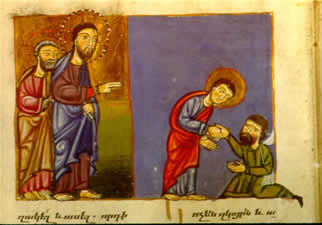
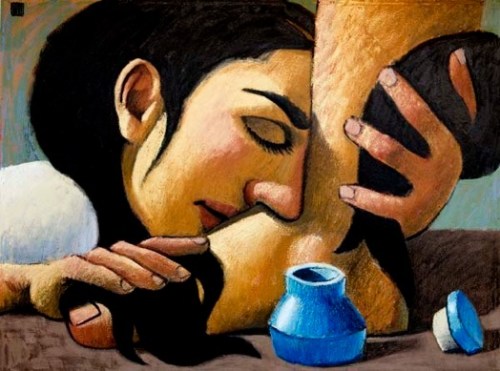
One of the Pharisees asked Jesus to eat with him, and he went into the Pharisee’s house and took his place at the table. And a woman in the city, who was a sinner, having learned that he was eating in the Pharisee’s house, brought an alabaster jar of ointment. She stood behind him at his feet, weeping, and began to bathe his feet with her tears and to dry them with her hair. Then she continued kissing his feet and anointing them with the ointment. Now when the Pharisee who had invited him saw it, he said to himself, “If this man were a prophet, he would have known who and what kind of woman this is who is touching him– that she is a sinner.” Jesus spoke up and said to him, “Simon, I have something to say to you.” “Teacher,” he replied, “Speak.” “A certain creditor had two debtors; one owed five hundred denarii, and the other fifty. When they could not pay, he canceled the debts for both of them. Now which of them will love him more?” Simon answered, “I suppose the one for whom he canceled the greater debt.” And Jesus said to him, “You have judged rightly.” Then turning toward the woman, he said to Simon, “Do you see this woman? I entered your house; you gave me no water for my feet, but she has bathed my feet with her tears and dried them with her hair. You gave me no kiss, but from the time I came in she has not stopped kissing my feet. You did not anoint my head with oil, but she has anointed my feet with ointment. Therefore, I tell you, her sins, which were many, have been forgiven; hence she has shown great love. But the one to whom little is forgiven, loves little.” Then he said to her, “Your sins are forgiven.” But those who were at the table with him began to say among themselves, “Who is this who even forgives sins?” And he said to the woman, “Your faith has saved you; go in peace.”

Soon afterwards he went on through cities and villages, proclaiming and bringing the good news of the kingdom of God. The twelve were with him, as well as some women who had been cured of evil spirits and infirmities: Mary, called Magdalene, from whom seven demons had gone out, and Joanna, the wife of Herod’s steward Chuza, and Susanna, and many others, who provided for them out of their resources.

Then turning toward the woman, he said to Simon, “Do you see this woman?

In the name of the living God: Father, Son and Holy Spirit.

It was back in my hometown, Odessa, Texas, in the mid-1990s. My father had retired, along with two of his closest friends, from the oilfield where they spent almost all their working lives, and I had gone home to visit my family. And Dad used to meet with these two friends at the bank every Tuesday morning for coffee, because the coffee was free and they were notorious cheapskates.

Now, these men became known as the Board of Directors, and each of them had a given area of responsibility. Luther Stewart was a worldly man, and so he was put in charge of politics. Homer Pittman was from Oklahoma, and he was in charge of weather because people from Oklahoma know a lot about weather. And because I was a lawyer, my father was in charge of the O.J. Simpson trial. And if something went wrong in their area of responsibility (the wind blew too much, or Judge Ito made a ruling no one could understand) the board member in charge of that area would catch nine different kinds of perdition.

So, one day I was with them, taking my coffee, and Homer Pittman opined that there were two kinds of people in this world: people who were just chasing money, and people who weren’t. Well, we discussed that for a while, and then Luther Stewart suggested that there were in fact two kinds of people in the world, but they were people who were happy by nature and people who weren’t. On the way home my father (a man of considerable wisdom) looked at me and said, “James, I think there are two kinds of people in this world. There’s people who think there’s two kinds of people, and people who don’t.”

So, in today’s Gospel, we find Jesus spending time with two kinds of people: sinners and Pharisees. And we come to realize that most of us fall into one or the other of these categories. And the extra-good news is that we don’t have to choose one or the other. Many of us are skilled enough that we can be both, sometimes at the same time.

You know, I love Luke’s Gospel. As I read it, I can’t wait to find out who Jesus is going to spend his time with next: blind people, the lame, lepers, Gentiles, Roman soldiers and prostitutes. It’s like he went around, looking for people no one else liked, people no one with good sense would pay any attention to, misfits and scoundrels. It’s like he didn’t care what other people thought about him. And just in case you missed that observation, Luke tells us at the end of the story that Jesus went and passed his time with people who had been possessed of evil spirits and diseases.

Jesus has a habit of doing this kind of thing. Whenever we draw a line in the sand and say “on this side of the line is where God happens,” Jesus walks across that line. And then, he hops back over to the other side, and then, he hops back. That’s especially true when people try to tell Jesus who is worthy of God’s love.

So, we have this woman, this woman of the city, this sinner. She’s the kind of woman most people avert their eyes from when they encounter her. She’s the kind of woman most people try to ignore. She has the invisibility of the forgotten. And Jesus has to ask the Pharisee Simon, “Do you see this woman?”

That’s just the kind of guy Jesus is. Archbishop Desmond Tutu once observed, “We may be surprised at the people we find in heaven. God has a soft spot for sinners. His standards are really quite low.”

And then, we have the story about a second kind of person, this Pharisee Simon. And the Pharisees weren’t bad people; they really weren’t. They wanted to get closer to God. They wanted to lead holy lives, and they wanted everyone else to lead holy lives, too. And they had one superpower: they were really good at looking at other people (including Jesus) and telling them what they were doing wrong. Just like Simon, who was convinced Jesus wasn’t really God’s messenger because Jesus apparently didn’t know what kind of woman this was. And Simon was disgusted by this scene, particularly by this woman’s touch. Jesus should have known what kind of woman this was touching him.

The Gospels portray the Pharisees as suffering from the sin of self-righteousness, which from a moral perspective isn’t necessarily worse than other sorts of sins. But the problem is, self-righteousness operates like a kind of spiritual cataract, clouding our vision of our own shortcomings. And that’s the problem from which this Pharisee Simon suffers. Simon is frozen is a wilderness of self-assured piety. And we might wonder, along with Lady Violet of Downton Abbey, “Does it ever get cold there on the moral high ground?”

You know, this Gospel reading reminds me of an old story I heard about a church not too far from here. We’ll call it St. Episcolopolis. And like us, it was a downtown church and they had a large homeless population in the area. And the rector convinced the vestry that they should begin feeding the homeless people around the church. So they did, and everything went swimmingly, until one week the rector invited all these homeless people to come to church after breakfast. And they came.

Well, the next vestry meeting, the senior warden spoke up. He said, “You know, Father, it was all well and good when you told us to feed these people. I mean, that’s what Jesus wanted us to do, and we’re okay with that. But when you invited them to church, well, I mean, I’m not sure they fit in well here. Some of them smell real bad, and they sit there and talk to themselves during the service. I think, Father, you’ve gone too far.”

And the Rector looked at his vestry, and noticed that they were all in agreement. And then he looked down and said, “I’m sorry. Maybe I did try and move too fast. You know, I was just trying to save a few souls.” And the room fell quiet and then the senior warden spoke up. “Father, I suppose you’re right. We didn’t really think about your efforts to save their souls.” And the priest said, “Oh, I wasn’t talking about them.”

So, in today’s Gospel, I think we learn about two other kinds of people. We learn about Jesus, who is always ready to give people a new start. We learn about his habit of looking around for those outside the circle of holiness, looking around the misfits.

And we learn about this woman, who loves him and knows that she needs what he has to offer, a woman whose tears bathe his feet. It’s an intimate event; in fact, it’s scandalous. I’ve often wondered about her: about this woman who found the courage to go into a house where she wasn’t welcome, about the source of those tears. Was she crying because she came to realize the cost of all those years she’d spent in her former life—a life of sin, doing degrading things she knew separated her from God, a life of pain, and humiliation? Or was she crying because she’d found something new in this man called Jesus, and wept for joy knowing she didn’t have to live that way anymore.

She must have been a rare woman—a woman with the courage to say “no” to the people who would push her aside, a woman willing to endure the sneers and shame of those who said she was too dirty, a woman willing to bear the laughter of those who would not accept her or this intimate expression of love for this man Jesus. She was profoundly….human. She was a woman whose courage told her that there was room for her at this table.
And she found that there was another way to walk through the world—a way that St. Paul describes: “I no longer live, but Christ lives in me.” This was woman who knew, somewhere in her heart, that love is always a terrible, scandalous risk. It is my hope, my prayer, that when we come to this table in a few minutes that we take that risk and that we find that new life. It is my prayer that we find that a faith that saves us, and that we go in peace. Amen.

James R. Dennis, O.P.
© 2016

You Can’t Go Home Again

aThe full readings for today can be found here.


In the synagogue at Nazareth, Jesus read from the book of the prophet Isaiah, and began to say, “Today this scripture has been fulfilled in your hearing.” All spoke well of him and were amazed at the gracious words that came from his mouth. They said, “Is not this Joseph’s son?” He said to them, “Doubtless you will quote to me this proverb, ‘Doctor, cure yourself!’ And you will say, ‘Do here also in your hometown the things that we have heard you did at Capernaum.'” And he said, “Truly I tell you, no prophet is accepted in the prophet’s hometown. But the truth is, there were many widows in Israel in the time of Elijah, when the heaven was shut up three years and six months, and there was a severe famine over all the land; yet Elijah was sent to none of them except to a widow at Zarephath in Sidon. There were also many lepers in Israel in the time of the prophet Elisha, and none of them was cleansed except Naaman the Syrian.” When they heard this, all in the synagogue were filled with rage. They got up, drove him out of the town, and led him to the brow of the hill on which their town was built, so that they might hurl him off the cliff. But he passed through the midst of them and went on his way. Luke 4:21-30.

When they heard this, all in the synagogue were filled with rage. They got up, drove him out of the town, and led him to the brow of the hill on which their town was built, so that they might hurl him off the cliff. But he passed through the midst of them and went on his way.

 In the name of the Living God: Father, Son and Holy Spirit.

          Good morning, good morning. It’s a pleasure to be with you today, and I want to thank you for your warm hospitality these past few weeks. I’m going to tell you all something and some of you may find this a bit shocking. Think of it as my confession. Those of you who know me well may not find this surprising at all, but I’m not sure I have been saved. I’m not sure that accurately describes the situation at all.

          I’m going to tell y’all a story about me, back when I was just a wee little boy back in Odessa, Texas. My family raised me as an Irish Catholic and I attended kindergarten and first grade at a Catholic school. But when I was in the second grade, my folks decided I should go to the public school and I began attending Burnett Elementary School.

          And it was during the first week when I was there on the playground, at recess, when I was surrounded by a ring of my classmates.  And I’m pretty sure they were Baptists because I think most everyone in Odessa was. And my new friends began to interrogate me and asked, “Have you accepted Jesus Christ as your personal savior?” And I honestly don’t know where this answer came from because I was not a thoughtful child. There were a lot of words used to describe me in my childhood, but “thoughtful” is not one of them. But I looked at them and said, “Kind of. I don’t think he came just to save me. I think he came to save the whole world.” But I’ll circle back to that idea of salvation here in a bit.

          Speaking of hometowns, in today’s gospel we find Jesus back in his hometown, Nazareth. Now, Nazareth wasn’t a particularly important place, and it was largely known as a poor region, a place populated by rabble rousers and troublemakers. So when folks there heard about the good things Jesus was doing in other cities, I’m sure they were full of expectations and curiosity, a little pride, and perhaps a little envy.

And Jesus stood up there in the synagogue and he reads from the scroll of the prophet Isaiah:

‘The Spirit of the Lord is upon me,
because he has anointed me
to bring good news to the poor.
He has sent me to proclaim release to the captives
and recovery of sight to the blind,
to let the oppressed go free,
to proclaim the year of the Lord’s favor.’

          And then, he tells them, “Today this has happened, and you’ve been here to hear it.” It’s a startling announcement: it’s shocking. And in the most clear expression we can find in the Gospels, Jesus makes the claim: “I’m him. I’m the Messiah you’ve all been waiting for.” And while the people are initially impressed, it doesn’t take long until they’re asking themselves, “Isn’t this Joseph’s son?”

          They’re suggesting: Wait a minute. We know this man, and there’s nothing particularly special about him, or perhaps they are alluding to his dubious parentage. I’ve got a feeling that Jesus knew this town, these people and their narrowness. Jesus had probably heard the whispers about his mother and her “virgin birth.” And these people were confident they knew all about Jesus. Of course, we know that familiarity breeds contempt. And that’s not unusual: we all get accustomed to thinking about people in a certain way. Neuropsychiatrists tell us that human thoughts and ideas travel along well-worn pathways in our brains. These people pretty sure they’ve got Jesus all figured out, and they also know what the Messiah should look like and this upstart . . . well, this isn’t him at all.

          And Jesus knows they want him to do the same stuff in his hometown that he did in Capernaum. You know, all that miracle stuff. As C.S. Lewis once observed, one of our great human weaknesses is to tell God “Encore! Do that again!” Because we want God to be predictable; we want a God we can do business with.

          But Jesus, he’s going to thwart their expectations. In essence, He tells them, “I didn’t come just for you people.” This is not what we’d call an “effective marketing strategy.” Jesus reminds them about Elijah, who was also rejected by His own people, and brought deliverance from sickness and hunger and death to a Gentile woman. He reminds them about Elisha, who cured the Gentile Naaman although there were plenty of lepers in Israel. This is a bitter pill to swallow; this is hard medicine for the hometown crowd, and the crowd has what modern doctors would call an “adverse reaction” to this medicine.

          Luke tells us they were filled with rage, and they ran him outside town and were going to throw him off a cliff, when Jesus somehow just slips away. And that seems a little strange, because it’s hard to get away from an angry mob. But maybe Luke is telling us that when we are full of self-assurance and when we’re filled with rage, it’s very hard to find Jesus.  Rage and fear and self-assurance act like God cataracts: we just can’t see God when we feel that way.

          Jesus is always upending the expectations of those who think they’ve got God figured out: they’ve got a God they understand, a God they can do business with. He does it again and again. It’s one of his character traits, and I think He got that from his Father. The minute we think we’ve got God all figured out, He up and does something we just didn’t see coming. And for those disappointments which prove to be our salvation, we should give thanks every day.

          So, I want to circle back to that concern I shared with you early on. I don’t think I can honestly say that I have been saved. I don’t think my salvation is my rear-view mirror. But I do think I’m being saved. My salvation began over two thousand years ago when God’s son was born into the stench and muck of a cow barn and walked and lived among us until he walked up that hill called Golgotha, the place of the skulls. I am being saved daily, working out my salvation with fear and trembling, through prayer, encounters with the Scriptures, the Sacraments, and the love of Christ’s body, the Church. And I believe I will be saved at the last day through God’s love and mercy: through the mercy of a God who, despite my best efforts, simply will not stay in any of the boxes I try to fit Him into. This, I believe, and this, I give thanks for. Amen.

James R. Dennis, O.P.
© 2016


Mary, Week 5

aMy friends,

Here’s the final installment of the Mary course I’ve been teaching. Wishing you all a Happy Advent and a Merry Christmas:

http://christianformation-dwtx.org/middle-content-block-middle/mary-the-mother-of-god-overview/mary-mother-of-god-week-5/

Emmanuel, God is with us:

Br. James

Mary and Elizabeth

aThe full readings for today can be found here.

In those days Mary set out and went with haste to a Judean town in the hill country, where she entered the house of Zechariah and greeted Elizabeth. When Elizabeth heard Mary’s greeting, the child leaped in her womb. And Elizabeth was filled with the Holy Spirit and exclaimed with a loud cry, “Blessed are you among women, and blessed is the fruit of your womb. And why has this happened to me, that the mother of my Lord comes to me? For as soon as I heard the sound of your greeting, the child in my womb leaped for joy. And blessed is she who believed that there would be a fulfillment of what was spoken to her by the Lord.”

And Mary said,

“My soul magnifies the Lord,
and my spirit rejoices in God my Savior,
for he has looked with favor on the lowliness of his servant.
Surely, from now on all generations will call me blessed;
for the Mighty One has done great things for me,
and holy is his name.
His mercy is for those who fear him
from generation to generation.
He has shown strength with his arm;
he has scattered the proud in the thoughts of their hearts.
He has brought down the powerful from their thrones,
and lifted up the lowly;
he has filled the hungry with good things,
and sent the rich away empty.
He has helped his servant Israel,
in remembrance of his mercy,
according to the promise he made to our ancestors,
to Abraham and to his descendants forever.”

When Elizabeth heard Mary’s greeting, the child leaped in her womb. And Elizabeth was filled with the Holy Spirit and exclaimed with a loud cry, “Blessed are you among women, and blessed is the fruit of your womb.” Luke 1:39-55.

 
In the name of the Living God: Father, Son and Holy Spirit.

          I have a sneaking suspicion most of you know what I’m going to preach about this morning, but before I get there, there’s something I need to say. It’s kind of sad, but there are no words in the English language to express how grateful I am to this good parish for your warm welcome and loving care these past few weeks. I have been coming here for several years, and am always filled with a startling, wild, staggering gratitude for your hospitality.

          I know it’s a little early, but I thought I’d tell you a Christmas story this morning. It was about 48 years ago, and I was back with my family on Melody Lane one Christmas morning. And I don’t remember what it was, but I was disappointed with something I didn’t get among my Christmas gifts. And one of my brothers must have joined me in the muttering, because my mother packed all four of us, four little boys with burr haircuts, into the car and we went for a drive.

          We drove through Odessa, past the bad side of town, all the way to the Ranchito, where the poorest of the poor lived. And my brothers and I stared at the places those good people called home: cardboard boxes and plywood covered in black plastic to keep the rain out and dwellings made out of what we’d call garbage. And my mother didn’t say a word, but I understood perfectly. And I was ashamed of myself. It’s 48 years later, and I’m still ashamed of myself. I’ll circle back to that in just a bit.

          So, on this final Sunday of Advent, the Church offers us this wonderful Gospel story of two Jewish women meeting in a town in Judea. We’re told they were cousins, although Elizabeth was much older than Mary, who was probably not much more than a girl. Each of them knew shame and disgrace. Elizabeth had been without a child for a long time, and in that culture that was a humiliating thing. Mary was an unwed mother, and in that time, that was not only a shameful thing: it was the kind of thing that could get a girl killed.

          And, as they met, there was a moment of recognition: recognizing someone both familiar and yet wonderfully strange. Elizabeth recognizes Mary (her own people would have called her Miriam) and yet calls her “the mother of my Lord.” Now, in the Hebrew, that would be Adonai, the word commonly used to refer to God. So, Elizabeth recognizes Mary, and yet there’s something unusual: she calls her the Mother of God. And even the unborn child Elizabeth carries, who will grow up to be John the Baptist, knows that something wonderful is coming; something wonderful has already happened.

      But whenever I hear this story, I’ve always imagined the two of them giggling as they meet each other. First, I suspect they were laughing because they loved each other and it had probably been a while since they had been together. And secondly, because they were both with child, and neither of them was supposed to be.

          Scripture teaches that Mary was a virgin: and virgins just don’t get pregnant. Elizabeth was an old woman, well past child bearing years. And yet, here they were. If we go back through the Bible, that’s just the kind of thing that God does: he creates life where there isn’t any. He did it in Genesis, in our story of creation, created life out of nothing. God did for Sarah, Abraham’s wife, who was too old to have Isaac. He did for the mother of Samson, who was also childless. He did for Hannah, who was desperately barren until God intervened and she bore Samuel. And He did it again with Mary the Virgin and Elizabeth, an old woman. And in one sense, He does it again in the stories of Lazarus and the resurrection of Jesus.

          If we listen to Scripture, we find God creating life all over the place where there isn’t any: in old women, in the barren places, where there is nothing but death. We find God creating life so often and in so many places that we might come to the conclusion that that’s His business: making new life.

          But the Gospel lesson today teaches us something else about God’s business. In the song of Mary, which we sometimes call the Magnificat, we hear Mary erupt into a song of hope. She sings about what’s coming into the world: overturning a system of violence and oppression and corruption and replacing them with mercy and justice and love. And if we hear this song of Mary as revolutionary, as radical, I don’t think we miss the mark. She announces that Jesus is coming into the world to challenge the structures of sin and death and oppression and fear. It is a song of defiant resistance, the song of a militant refusal to accept the way things are. Mary is so filled with hope that she sings as though all these things have already happened.

          If we read the story of the Exodus or the prophets and their concern with justice for the weak and the forgotten, or the story of the birth of Jesus, or almost any story about Jesus’ ministry, we begin to get the sense that that’s also part of God’s business. And if God is so desperately concerned with the lives of those the world has forgotten (the weak, the poor, the powerless), then I think we had better be concerned with their lives as well. If we really want to call ourselves Christians, I think we had better join God in the business of hope. Because I don’t think God is looking for a Church full of cheerleaders to sit on the sidelines and yell, “Yay, God.” I think God is looking for collaborators, partners in the business of hope.

          And that’s just one of the reasons I love the season of Advent. It is the season of hope: longing for a better world; hope of a world without fear; hope that God will dwell with us—in our lives and in our hearts. Christmas is about joy, and I’m a big fan of joy, but Advent teaches us the virtue of hope. And it offers that hope to those the world has forgotten, those on the margins: those people like these two Jewish women who were nobodies from nowhere. And yet God chose them to announce that he was breaking into this world and would walk among us. He chose these two Jewish women who hoped…against hope.

          We live in a world suffering from “compassion fatigue,” a world where hope has become a very rare commodity, where cynicism has become our currency. We live in a world where almost 13% of the globe’s population is hungry, and 3 ½ million children die of hunger every year. We live in a world where children are forced to become soldiers and are trained as killers in 20 countries around the world. We live in a world where every 30 seconds someone loses their freedom and finds themselves enslaved in the business of human trafficking. And together with the Psalmist, we wonder: “How long, oh Lord?” How long is this going to go on? And we are brokenhearted. And we are ground down. And we begin, bit by bit, to lose hope.

          George Santayana once observed, the world “has music for those who listen.” Somehow, from above the struggle and the pain, we can here that music sometimes. And I think Mary has a music for those who listen: she sings a song pregnant with promise, with new life, a song of God’s presence with us. Mary sings a song for those good people who live outside Odessa in the Ranchito, for those living in refugee camps, those in Detroit and in the Sudan, and for those good people who live on the outskirts of Dripping Springs.

          And so, it is my Advent prayer that we will all, like Mary, be ready to carry the Christ child into a world that is dying of hopelessness. It is my Advent prayer that we will lead lives filled with expectation, lives which announce to the world: Emmanuel, God is with us. That was Mary’s prayer, and I hope it’s ours, too. But the real measure of our prayer comes in how we act and the kind of lives we lead, after we say “Amen.”

Amen.


Advent, Week 4

My dear friends:
 
Here’s the link to the fourth week of the Advent Study I’m leading:
 
 
Wishing you all a good and holy Advent.

Br. James

 
a

Advent Study, Week 3

a

My friends,

Here’s the link to the third week  of the Advent study. You’ll find both audio files and a PowerPoint presentation. I wish you a good and holy Advent.

http://christianformation-dwtx.org/middle-content-block-middle/mary-the-mother-of-god-overview/mary-mother-of-god-session-3/

God’s peace,

Br. James

Advent Study, Part II

My friends,

Here’s the link to the second week  of the Advent study. Again, there are both audio files and a PowerPoint presentation. Hope you find it useful.

http://christianformation-dwtx.org/middle-content-block-middle/mary-the-mother-of-god-overview/mary-mother-of-god-session-2/

God’s peace,

Br. James

a

Advent Study, Part I

My friends,

I’m leading an advent study for several weeks. If you’re interested, there are both audio files and PowerPoint slides associated with the class.

You’ll find the link below:

http://christianformation-dwtx.org/middle-content-block-middle/mary-the-mother-of-god-overview/mary-mother-of-god/

Wishing you all a good and holy Advent as we await the coming of the Christ child. God’s peace,

Br. Jamesa

What Do You Want Me To Do For You?

blind_bartimaeus_arminian_225h

This homily was preached at Chapter, the annual gathering of Anglican Dominicans, on Friday, August 14, 2015.

The text for this sermon can be found here:

In the name of the Living God: Father, Son and Holy Spirit.

Good morning, my brothers and sisters, good morning.  As the Psalmist says, how good it is when the brothers and sisters live together in unity. Well, close enough. And we come together this morning and find ourselves compelled to confront this text, this story of a blind man named Bartimaeus, a blind beggar. And I want us to try and view this story, and perhaps the readings today, in the light of our own vocations as Dominicans, our vocation as followers of St. Dominic and Jesus.

Jesus finds Bartimaeus  in Jericho, a city where walls come down, a city that resonates with the deliverance of Israel and the promises of God.  And all we know about Bartimaeus at the outset of the story is that he is blind, and he is a beggar. He is, as the Psalmist writes, “like an owl among the ruins.” But to be blind in those days didn’t just mean to be handicapped. Blindness was much more than an impediment. Blindness was a mark of being unclean, of being impure. Blindness meant that you would be ostracized from both God and his people.  So, blindness carried with it a spiritual separation as well as a physical impairment.

And Mark often uses blindness to connote a spiritual impairment, an inability to see what’s going on around you. He contrasts those who are physically blind with those who are blind to the reality of Jesus. And that’s a theme carried forward in this Gospel reading today.

It is much the same notion that we find in one of the Church’s favorite hymns, which tells the story of John Newton, a slave trader who awakened to his participation in the industry of sin and bondage. Newton wrote, “I once was lost, but now I’m found; I was blind, but now I see.”

Hold that thought for a moment, while we meander back through the readings for today and look at the story of St. Paul in Acts. Paul tells us that in his former life he was “zealous for God, just as all of you are today. I persecuted this Way up to the point of death by binding both men and women and putting them in prison….”  He tells us that on the way to Damascus to engage in further persecutions of the early Church, he was confronted by a great light and the voice of Christ accused him of persecuting Jesus.  And Paul was struck blind and could not see until Ananias spoke the word to him, because Paul had a special mission to see the Righteous One and bear witness. The confrontation with the light of Christ required Paul to set aside all that he thought he knew about God, joining those who trod the Way. So Paul, like John Newton, who had acted as an instrument of cruelty, bondage and spiritual blindness himself, found his way out of his own darkness only through the light of Christ.

So, let’s get back to the story of Bartimaeus the beggar sitting by the road. When he hears that Jesus is there, he begins to shout, “Jesus, Son of David, have mercy on me.” In his opening address, Bartimaeus recognizes Jesus as God’s Messiah. In some ways, Bartimaeus reminds me a bit of my spiritual director, a retired Bishop. He often says of his own ministry, “I’m  just a beggar myself, trying to show the other beggars where they keep the bread.” We don’t know how, but somehow Bartimaeus knew where the bread of life was.

If Jesus came to the world as part of God’s self-revelation, if he was God’s way of telling us “This is what I am like” then what do we make of the humble life He lived. This is a notion sometimes referred to as The Poverty of God. Bartimaeus could see the divine life in Jesus. But I think we should ask whether we can see the divine in the life of Bartimaeus. Because, as St. John Chrysostrom said, “If you cannot find God in the beggar on the street, you will never find him in the chalice.”

And Jesus asks him a really important question. He asks Bartimaeus “What do you want me to do for you?” Jesus was able to minister to this blind beggar because of two important factors: he cared, and he took the time to find out what the problem was. Too often, I think our fumbling efforts to fulfill the Christian life look like the missionary who shows up at a burning house with a stack of bibles, or the evangelist who goes to a land of famine with a handful of crucifixes. That’s all pretty, and interesting, but it’s not exactly what they need.

As Dominicans we are called to meet the needs of God’s world and God’s children, proclaiming and preaching the good news of God’s love. This world can be a very dark place. There are 60 million refugees in the world today, displaced by war and human hatred. In America alone, 5 million people suffer from Alzheimers. Worldwide, 3.5 million children die from hunger each year.  We daily confront the horror of war, of genocide, of one natural disaster after another. Joseph Stalin once famously said that one death was a tragedy, but a million deaths were a statistic. We live in a world where pain and misery have been reduced to a statistic.

And this world groans, not only in pain, but also in exhaustion. Many people, many good people, suffer from compassion fatigue. They just don’t feel up to the challenge of another crisis, another story of misery in a very long collection of such stories. And yet, there is this blind beggar on the road. Lord, let us see him.

I want to suggest to you that on that day in Jericho, it was Bartimaeus who heard the same call we have heard: to proclaim and preach the rightful place of Jesus in the world and in God’s kingdom. Lord, let us listen to his message. Lord, let us hear and heed the call, as Dominicans, to testify to the light in a world that wanders in darkness. Amen.

© 2015 James R. Dennis

Oh My Son Absalom

absalom

The readings for this morning can be found here:

“O my son Absalom, my son, my son Absalom! Would I had died instead of you, O Absalom, my son, my son!”

In the name of the Living God, Father, Son, and Holy Spirit.

          It was 49 years ago, almost to the day, back in my hometown of Odessa. It was my birthday, and my parents had given me a Gilbert chemistry set. (To this day, I still don’t know what they were thinking about.) And in that chemistry set was the formula for a certain explosive. But the chemicals were in little tiny plastic vials, and I knew I couldn’t do much with that. So I strolled down to the drugstore with my birthday money and I bought a pound of each of the ingredients of this compound.

          Then I walked into our kitchen and asked my mother if I could borrow one of her pots. When she asked what for, I answered: “a science experiment.” She beamed with pride as she handed me a copper-bottomed Revere ware pot. The effort to further my education was working. And I mixed the three chemicals together, and made a long fuse, and placed the pot underneath my tree house and sought shelter behind our home.

          Later that afternoon, after the fire trucks left, my father asked me, “Son, I just want to know what was on your mind?” And I tried to keep from crying as I told him that I didn’t know that it would work. Now, my father was a man with a great capacity for wrath. And he visibly shook as he tried to control himself and gave me a bit of advice, advice that he would repeat several times during my life. He said, “James, the process of elimination is no way to live your life.”

          Now, I was not in open revolt against my father…not yet. That would come years later, during the years my parents would refer to as “the intifada.” But I’m sure my father understood how David felt when his son took up arms against him.

          You know, sometimes, I hear people say that what’s wrong with this country, or this time, or this world is that we need to return to old-fashioned biblical family values. And I wonder whether they’re thinking about King David, and about his family, or exactly what they have on their minds.

But before we get to the text for this morning, it’s worth thinking about the back-story concerning King David. David was a young man when God called him out to succeed Saul, the first king of Israel. He was a shepherd, a good looking boy. He was a poet and a musician, and a fierce warrior who killed a giant named Goliath. He was the pride of the land and a just king who united the people of Israel. And when things were good, they were very good until….until they weren’t good anymore.

          You may recall that later on David committed adultery with a woman named Bathsheba, and then a whole bunch of trouble began. Bathsheba’s husband was a man named Uriah, one of David’s soldiers. And when Bathsheba got pregnant, you’ll remember that David sent Uriah into battle to be sure that he’d be killed so David could take Bathsheba for his wife.

I think one of the things we learn from this story is that sin works a little like the science of forensics, particularly bullet wounds. As the bullet enters the body, the wound is often small and sometimes almost imperceptible. But as it travels through our lives, it tears through bone and tissue and flattens, and the exit wound is often much, much larger. Sin works like that: we cannot imagine the consequences for ourselves or for those we love. It was like that with David.

          So God sent his prophet Nathan to have a chat with David. And Nathan told him the consequences of what he’d done. Nathan said, “the sword shall never depart from your house, for you have despised me, and have taken the wife of Uriah the Hittite to be your wife. Thus says the Lord: I will raise up trouble against you from within your own house….”

          Now that doesn’t end the family troubles for David. Not by a long shot. You see, his oldest son was a boy named Amnon.  Amnon raped his half-sister, a girl named Tamar. Her brother, Absalom, was David’s favorite son. But when David did nothing to punish Amnon, Absalom took matters into his own hands. He apparently believed in that old proverb that revenge is a dish best served cold, and he brooded and waited two years before setting a trap and having his servants kill Amnon at a feast.

          And after a few years in exile, and a few more years of a cold silence, Absalom lead a revolt against his father, against the King, against God’s chosen servant. So, as far as family values go, neither Paris Hilton, the Kennedys, the Jackson family, nor the Kardashians had anything on King David. Or, as Elvis Costello said, “There’s no such thing as an original sin.”

          The text this morning begins as David’s armies are prepared to smash the armies of his son, Absalom. And we hear tenderness in David’s voice as he asks his generals to deal gently with the man, Absalom. Now, notice that at this point, David calls him “the man” rather than “my son.” I suspect David felt a little conflict between his competing roles as king and father. I suspect that some of us here may have felt that conflict between our roles as father and salesman, or mother and doctor, or mother and priest. My friend Rabbi David Wolpe has observed that many times during this story of David and his son, we find not so much a lack of love as a refusal to love. Often David seems frozen, monstrous in his distance from his sons and daughters. He has riven an icy separation between himself and his children.

          And as the battle progresses, we find Absalom in a wooded area, in a forest, riding on a mule. And his head gets caught in the trees, and the text tells us that he was left hanging between heaven and earth. Hanging between heaven and earth. And every time I read that passage, I think of another son (this time, an obedient son) who also hung between heaven and earth. That son, our Lord Jesus, hung there not because of his rebellion, but because of ours.

          And then, despite David’s plea to the contrary, his soldiers surround Absalom and kill him. And when David hears of his son’s death, a death he had no small part in, he cries, “Oh my son, Absalom. Would that I could have died in your place.” Now, David had a complicated relationship with his favorite son. He sort of vacillated between spoiling him rotten and raking him over the coals. And the Bible tells us that Absalom was a beautiful boy, that he was “without blemish.” If we read scripture carefully, we’ll note that great beauty is almost always a bellwether of great trouble.

          You see, in one sense, I think we’re all Absalom. We’re all ungrateful children, all rebellious children. And in another sense, we’re all David. We’re all paralyzed by the consequences of our sins, watching them uncoil like snakes before us. We’re all frozen and withholding forgiveness, all demanding retribution rather than rushing toward reconciliation. This isn’t just the story of David and Absalom: this is our story.

          And David cries that if could have suffered these consequences instead of his son, he would gladly have done so. And there’s something deeply heartbreaking about that moment, when David should be celebrating his victory as king but is instead forced to confront his failure as a father, and as a man. I suspect every parent has felt that heartache. But David is telling us that he would have done this boy’s dying for him. But we know that even David, even a King, can’t do that.

          Only the living God can do that, dying for us, his son dying in our place so that we would live and have abundant life. It is that God who shows us a way out of rebellion, who rushes toward us in reconciliation. It is that God who calls us to “be kind to one another, tenderhearted, forgiving one another.” It is that God who calls to us, “Come to me.” It is that God who promises us that if we eat the bread of life, we will live forever. It is that God who invites us to this table. So take, and eat. Amen.

James R. Dennis, O.P.

© 2015 James R. Dennis