
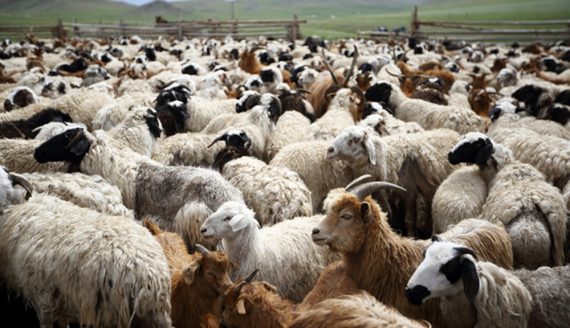
When the Son of Man comes in his glory, and all the angels with him, then he will sit on the throne of his glory. All the nations will be gathered before him, and he will separate people one from another as a shepherd separates the sheep from the goats, and he will put the sheep at his right hand and the goats at the left. (The full readings for today can be found here.)
In the name of the Holy One who makes the world, the Son who saves it, and the Spirit who breathes life into our lives.
Several of y’all know that my family had a ranch out in West Texas. Now, I don’t want you to get the wrong impression. When I say we had a “ranch,” you might think about the Four Sixes, or the King Ranch. And those are wonderful, prosperous spreads, which are nothing at all like our place. You see, out there on the Double Mountain Fork of the Brazos River, we were basically starving to death….and raising some very skinny cows. So, anyway, we didn’t know anything about sheep or goats and didn’t really care.
But one of my uncles was named Cecil and his family raised sheep and goats. Well, I wasn’t really sure of the difference between them. So I went over to Uncle Cecil’s place and saw him sorting his flock into two separate pens.
I asked my uncle, “How do you tell them apart? They look so similar!” Uncle Cecil told me, “Easy. I let the dogs bark. The sheep stick together and follow the group. But the goats will scatter, climb on top of a tractor, chew on a tin can, pull out a pack of Lucky Strikes, and look at you like you owe them money.” And that’s all I know about separating sheep from goats.
We are gathered today on Christ the King Sunday, a celebration which is actually not all that old. It was first recognized in 1925 and instituted by Pope Pius XI. You see, after the First World War, the Church was concerned about the rise of authoritarian governments around the world—particularly communism and fascism. And so today we join with the rest of the Church in standing against authoritarian governments because we Christians recognize that real authority, genuine moral authority, flows from Jesus.
So, here on Christ the King Sunday, we celebrate the God who rules our hearts as we stand on the edge, right on the precipice, of the season of Advent. And we will spend the next season of the church year waiting on Jesus. And we have learned about preparing for Jesus by using our talents and not burying them. And we have learned to prepare for Jesus’ arrival by staying awake and knowing what we’ll need when the bridegroom comes.
So, what sort king is this Jesus? Well, our Gospel lesson today suggests this is a very different kind of king, not what we expected at all, and a very irregular sort of glory. And this morning, we’ll learn about how to recognize Jesus, and how he might recognize us.
We often hear about people who are looking for Jesus in various ways and in diverse places. Some people go off on a long pilgrimage, others fast for several days or pray for endless hours, and some look for Jesus in a gothic cathedral. For heaven’s sake, I’ve even known people who say they saw Jesus in a tortilla.
But in this morning’s Gospel, Jesus tells us where to find him. He tells us to look for him with those who are hungry. Jesus tells us he will be among those who don’t have enough clothes to wear. He tells us he will be with the sick, and with those in prison. Now, these are the very people most of us don’t associate with much. When we see these people, many of us will avert our eyes or try to think about something more pleasant. But Jesus tells us he’s right there.
Now here’s the tricky part. Jesus doesn’t just tell us he’ll be with these troublesome people. He tells us that he is one of them. He tells us that whenever we welcome the stranger, that’s Jesus we’re inviting into our home. Whenever we feed the hungry, that’s Jesus we’re sharing a meal with. And taking care of these unfortunates, the “least of these,” well, that’s nothing less than taking care of Jesus. So, it turns out that loving God and loving our neighbor aren’t really two things at all: they’re the same thing.
And none of this should come as any sort of surprise to us here at St. Mark’s Episcolopolus Church. If you’ll remember, every time there’s a baptism we all promise to “seek and serve Christ in all persons…” That includes those who are “the least of these,” those who are down on their luck. Jesus reminds us that being down on your luck is not a moral failure. Ignoring our brothers and sisters who are down on their luck—now that is a moral failure.
So, what do we do with all this sheep and goat business? What about this judgment that is coming? Well, that is often read as a passage to explain that the good people are going to heaven, and the bad people (the wicked people) will be sent for an eternal punishment in hell.
And I’ve known way too many folks, and way too many preachers, who seemed to delight in the idea of bad people (those other people) being sent to eternal damnation. They treat this breathtakingly beautiful and heartbreaking world, this precious life, as if it were some sort of a pass/fail test. That’s way too simplistic, and it’s just not how I understand God, or God’s plans for us.
I want us to at least consider the possibility that Jesus has something else in mind. You see, I have never met anyone who was all good or completely bad. I never ran across a single soul that was all goat or all sheep. I think every one of us is a mixed pasture. Now I do believe that each of us, at the end of our lives, will stand in the presence of perfect love and absolute mercy. And that love and that mercy will hold a mirror up to our lives so that we can see ourselves in truth.
Now suppose that the separation Jesus is talking about is happening within each of us. Suppose that, in the dazzling light of boundless, unfailing love God will separate the best of me from the parts that just don’t make sense in that land where there is no more weeping. I’m thinking God’s love is a blazing fire that will purify and bless the very best parts of our lives. God’s love and mercy is not a destructive flame, but a cleansing and healing light that reveals and restores all of creation.
All of us are capable of love, and all of us have parts of our lives that are in desperate need of redemption, of transformation. All of us have failed, all of us have betrayed and broken the promises of our baptism. We have lived and loved imperfectly. I know I have.
Suppose that, like a refining fire, God’s love will separate the part of me that knew and served Jesus from the more….well, goaty parts. In the vocabulary of the Church we call that process “sanctification.” I’m wondering if that’s what eternal life might look like. It’s just a thought. Amen.
Suppose that, like a refining fire, God’s love will separate the part of me that knew and served Jesus from the more….well, goaty parts. In the vocabulary of the Church we call that process “sanctification.” I’m wondering if that’s what eternal life might look like. It’s just a thought. Amen.
James R. Dennis, O.P. © 2026


