
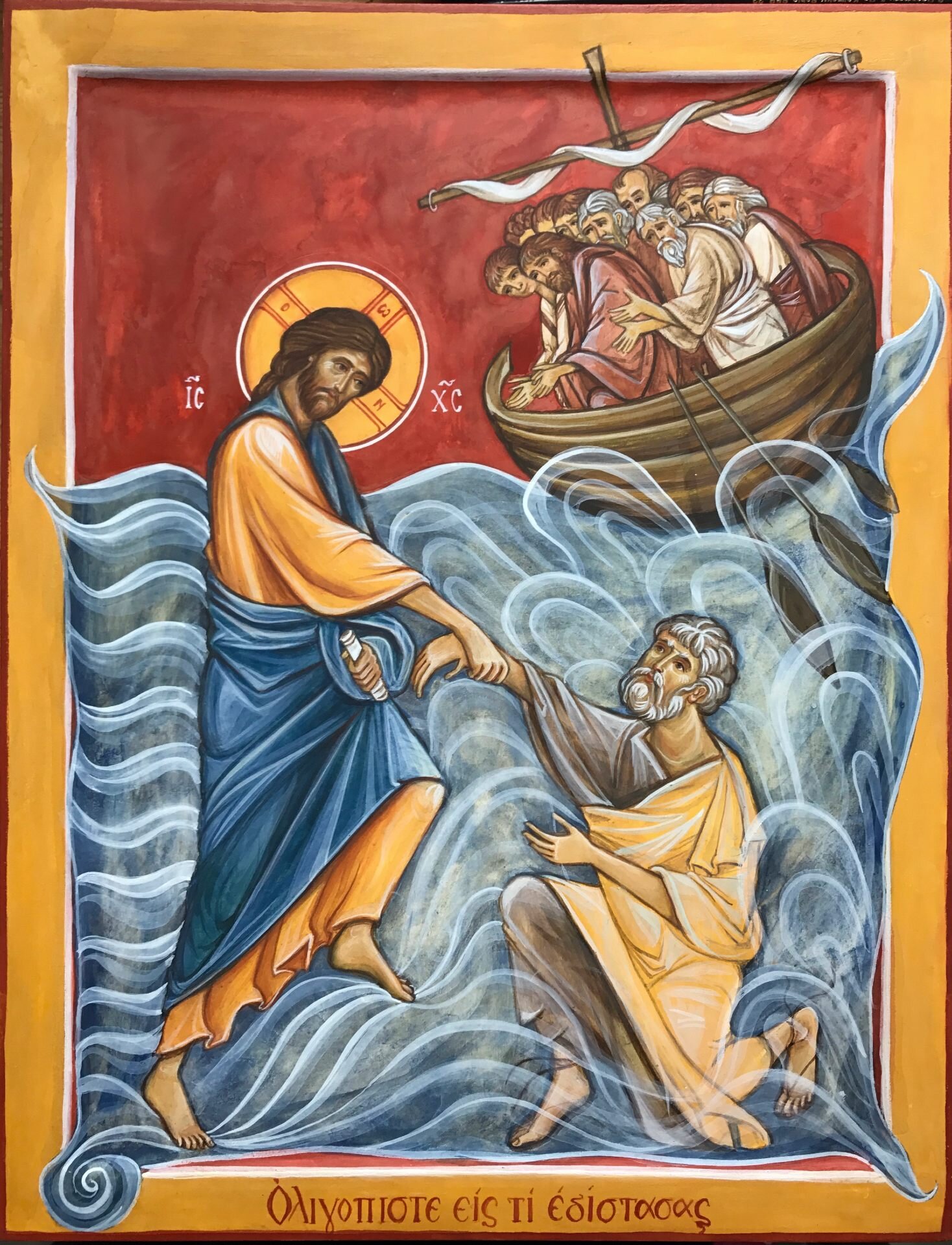
But when he noticed the strong wind, he became frightened, and beginning to sink, he cried out, “Lord, save me!” Matt. 14:30 (The full text of the readings can be found here.)
In the name of the Living God: by whom we are being created, redeemed, and sustained.
As a boy in West Texas, I grew up as the oldest of four sons. Now, that was in the 60s, and back then, we went through a lot of uncertainty, a good deal of ambiguity. But there’s one thing we all knew with absolute mathematical precision; we knew it to a moral certainty. We knew it because every boy in West Texas knew it. We were sure that if a horny toad shot blood into your eyes, we knew that you would go blind.
So one morning, early in the morning, I woke up to find that my brothers had tied me to my bed. Like Gulliver, these Lilliputians had bound me where I lay, and I knew that nothing good could come of this. But my predicament got even worse when my brother Patrick, my no-good brother Patrick, took out a shoebox containing at least a dozen big fat horny toads. With glee in his eyes, he dumped them onto the bed where I was tied down and screaming like a banshee. Now, I’m not saying that my brothers were intentionally trying to blind me, but they were at least wildly indifferent to the possibility that I would end up sightless. So, I understand exactly how Joseph felt when his brothers threw him into a pit and sold him into slavery in Egypt. And I was sorely tempted to preach on that today, but the Church has given us an even better story.
Oh my, what a story. So today, we hear the story of a man named Peter who is willing to leave his relative comfort and security because he hears the call of Jesus.
If you know anything about my spiritual life, you know that I love Peter. He is my favorite biblical blunderer—overenthusiastic, and terribly underprepared. He is full of bravado and bluster and he clumsily rushes in where angels fear to tread. I think he really wants to follow Jesus, but most of the time, he really doesn’t have a clue about what that might look like. You know, now that I think about it, he’s a lot like…me.
It’s important for us to look at this story in context. This passage follows the feeding of the 5,000 in a deserted place, in the wilderness. Now the writers of scripture use two ways to signal a time and place of trouble and anxiety and danger. They talk about the wilderness, and they talk about the sea. And in this Gospel passage, Jesus has just left the wilderness, and the disciples find themselves on a stormy sea. So, you know there’s going to be some trouble.
One of the consistent metaphors used throughout the Old and New Testaments is the image of the sea as representing trouble or difficulty. These waters represent the nothingness before creation, in the Hebrew the tobu wa-bohu. The sea was perceived as the vortex around which danger and chaos and evil spun. So, in today’s Gospel, we find Jesus calling the disciples, not away from the storm, but into it. In fact, Jesus sends the disciples into the boat while he dismisses the crowds and goes to pray. Jesus goes to the mountain, like Moses, to encounter the God of Abraham. Thus, while he retreats to the mountains, he compels the disciples to face the sea of chaos. Literally translated, they are being tormented by the waves. Jesus compels them to confront their own frailty, their own vulnerability.
This story reminds us of another story in Matthew’s Gospel, in the eighth chapter. If you’ll remember that passage, Jesus was sleeping through the storm while the disciples cried, “Save us, Lord, for we are perishing.” And if you’ll recall, that story ends with the disciples wondering what kind of man Jesus is, if even the wind and the water obey him.
So, in today’s reading, it’s worth noting that the disciples have been out in this storm, on the water, for a long time. They’re sent away before evening, and they don’t see Jesus again until early in the morning. So, like many of us, they’ve been struggling to stay afloat for a good while. It’s not really the storm that frightens them, but they are terrified when they see Jesus. I love the nonchalant way the Gospel writer reports, “he came walking toward them on the sea.” Matthew records it as matter-of-factly as if he were saying that Jesus scratched his head or sat down to eat a tomato sandwich.
The disciples, as is so often the case, fail to recognize Jesus. And maybe, just maybe, it’s their fear that keeps them from knowing Jesus, just like our fear sometimes keeps us from seeing Jesus when he’s right beside us.
While the disciples are initially afraid that they are seeing a ghost, Jesus reassures them it’s him. And our translation really doesn’t do justice to Jesus’ words of comfort. In fact, this is a bad translation; it’s a terrible translation. In the original Greek, Jesus’ announcement is more sparse, succinct, and significant. In the Greek, Jesus says “Ego eimi.” That phrase, I Am, is the name of God, the name he gave Moses as he told him to confront Pharoah. And so, Jesus assures them: “I Am.” He takes them back all the way to the God of Abraham and Moses, reminding them of the presence of God even on this storm-rocked sea.
And so, Peter sort of invites himself to join Jesus on the water. He calls Jesus “Lord,” but I’m not sure he understands exactly what he’s saying. Jesus is Lord, Lord over the deep and troubled waters, Lord over the wind and waves, Lord over the storms and all the destructive powers that seek to overwhelm our lives.
This is why I love Peter: he is so eager and yet, not quite ready. And he joins our Lord on the water and for a moment….the laws of nature and gravity are suspended. I suspect that, for just a moment, the angels stopped their singing and all heaven held its breath. And then, Peter began to notice the strong winds around him and he began to sink. And, whatever else you can say about Peter, at least he has the presence of mind to know where to turn in trouble. He turns to Jesus. He cries out, “Lord, save me.”
And when Jesus returns to the boat with Peter the wind dies down and the disciples all acknowledge that Jesus, the Jesus who walks across the storm and calms all our troubled seas, is the Son of God. And I don’t think we should judge St. Peter too harshly, in fact, I don’t think we should judge him at all, because he embodies one of the fundamental principles of the Christian life: we are going to fail. We fall down five times, and through God’s grace, we get up six.
Changing our lives is hard. It was hard for Peter and it’s hard for us. If we want to live for Christ, live whole-hearted lives, it’s going to take some time, and we’re going to make mistakes. Living with courage and hope and taking chances means we’re going to fail sometimes, and we need to be prepared for that. And yet, God—the God of Abraham, Isaac, and Jacob, who constantly reminds us “I Am”— is always stronger than the sum of all our fears and failures.
Following Jesus is no assurance of smooth sailing. Being disciples does not shield us from the hard knocks of life and death. In fact, the biblical witness would tell us something quite to the contrary: we are assured of the storm.
You see, like St. Peter, God wants more from us than lives of safety and stability. God’s dreams for the world are bigger than that. God has called us to be explorers on an adventure: seeking God in unlikely places and pointing out His presence when others cannot see it. God had wonderful dreams for Peter, and has wonderful dreams for us, too. And so, we join him in stepping out of the boat, sinking sometimes, but always proclaiming the presence of God in the storm. Amen.
James R. Dennis, O.P. © 2023

 Domini Canes
Thank you! it is good to be able to read it at leisure, and I enjoyed it just as much. A great message, told with your usual scholarship, personality, and touches of humor.
Rest up, my Brother, you deserve it!
Gill
>
Thank you for these timely and eloquent thoughts, James R. Dennis.