Tag Archives: Salvation

Name This Child


After eight days had passed, it was time to circumcise the child; and he was called Jesus, the name given by the angel before he was conceived in the womb.  Luke 2:  21

Today, the Episcopal Church celebrates the Feast of the Holy Name of Jesus.  Most families view naming our children as an incredibly important decision.  Many ponder the issue for months, and even years.  Often, the name of a child will ring with significance for the family, sometimes borrowing the name of the father or of an important ancestor.  Sometimes, families will examine books filled with baby names and their meanings.  Sometimes, parents name the child after a city, or favorite character in a book or a movie. How then, does one go about naming the incarnate son of God?

Now, throughout the Old Testament, we encounter several stories of God being pretty careful about revealing his name.  In Exodus, God tells Moses:  “‘I am the Lord.’ I appeared to Abraham, Isaac, and Jacob as God Almighty, but by my name ‘The Lord’ I did not make myself known to them.”  Ex. 6:2-3.  Similarly, God tells Moses, “I Am Who I Am.”  Ex. 3: 14. This divine ambiguity becomes so ingrained into the Jewish understanding of the divine that the name of God could not, and still cannot, be spoken by the Jewish people.

Luke’s Gospel reports that Gabriel told Mary to name the child “Jesus” (Yeshua in the Hebrew).  Luke 1:31.  Mathew reports that an angel of the Lord instructed Joseph to name the child Jesus.  Matt. 1:21.  In both stories, God clearly directs Jesus’ parents about his name.  Jesus’ name results, therefore, from both divine and human activity.

In first century Palestine, the name Yeshua (“God saves” or “God is salvation”) was a fairly common name.  It echoed with meaning, invoking the name of one of the heroes of the Exodus, the central narrative of the Jewish people.  But I think there’s something more at work here:  in the very name of his incarnate son, God engages in the process of self-revelation.  The Lord is telling us what He’s like, answering questions the Jewish people had raised for years about the nature and name of God.

Traditionally, devout Jews named their male children as part of the rite of circumcision, which constituted part of the Abrahamic covenant.  We find God’s self-revelation, then, in the midst of the ritual fulfilling the covenant.  And God, through his participation in the naming of this child, reveals Himself and Jesus’ mission to us:  salvation. 

One of my favorite monastics, St. Bernard of Clairvaux, wrote about the name of Jesus.  He said that the Jesus’ very name was light, food and medicine.  Jesus brought light into the darkness of a world dominated by power, dominance, sin and death.  John’s Gospel teaches that Jesus “was the light of all people. The light shines in the darkness, and the darkness did not overcome it.”  Jesus described himself as “the bread of life.”  He brought food that “restores the wearied faculties, strengthens virtue, [and] gives vigor to good and holy habits…”  Bernard of Clairvaux, 15th Sermon on the Canticle of Canticles.  The name of Jesus serves as medicine for souls in torment, and all the illnesses of this world.  We remember how often Jesus was engaged in healing, and how the disciples were able to heal through the invocation of Jesus’ name.

And so today, we celebrate the naming of our Lord, we recognize the name:

     that is above every name,
so that at the name of Jesus
     every knee should bend,
     in heaven and on earth and under the earth,
and every tongue should confess
     that Jesus Christ is Lord,
     to the glory of God the Father.   Phil. 2:9-11.

In the life of Christ, God has revealed Himself as meek, humble and self-denying.  In the name of Jesus, God tells us that He is deeply concerned with our salvation.  In the midst of the muck and stench of the manger, through the joy of the wedding at Cana, in the sorrow of Lazarus’ tomb, and despite the horror of Golgatha, God saves.  That’s got to be Good News.

Shabbat shalom,

James R. Dennis, O.P.

 © 2012 James R. Dennis
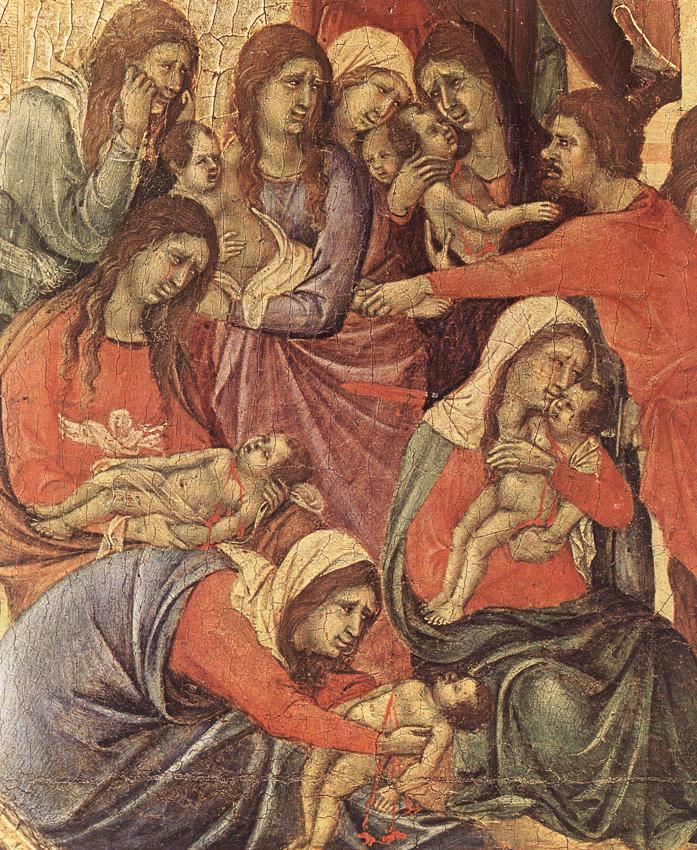
The Holy Innocents

Now after they [the Magi] had left, an angel of the Lord appeared to Joseph in a dream and said, “Get up, take the child and his mother, and flee to Egypt, and remain there until I tell you; for Herod is about to search for the child, to destroy him.” Then Joseph got up, took the child and his mother by night, and went to Egypt, and remained there until the death of Herod. This was to fulfill what had been spoken by the Lord through the prophet, “Out of Egypt I have called my son.”

When Herod saw that he had been tricked by the wise men, he was infuriated, and he sent and killed all the children in and around Bethlehem who were two years old or under, according to the time that he had learned from the wise men. Then was fulfilled what had been spoken through the prophet Jeremiah:  “A voice was heard in Ramah, wailing and loud lamentation, Rachel weeping for her children; she refused to be consoled, because they are no more.”  Matt. 2:11-18.

Today the Church remembers the slaughter of the Holy Innocents. Here, we encounter a ghastly and appalling story, but I think there are several lessons we can take from this narrative.  We should first examine the character of Herod (known to historians as Herod the Great).  Although Herod greatly expanded the Second Temple, he also murdered many rabbis and members of his own family.  He collaborated with the Roman occupation, and he reigned with a demented savagery.

While scholars may question the historical accuracy of this account in Matthew’s gospel, Matthew’s portrayal meshes well with what we know of Herod’s character.  At the root of these frightening events, we find a genuine insight into Herod’s depravity.  Herod fears losing power, and that phobia sparks his maniacal infanticide.  Into this world, the Christ child is born.

The world hasn’t changed much.  From Dachau to Serbia to Darfur, Herod is still afraid, and the slaughter of the innocents continues.  And this remains the world into which Christ enters.  And ultimately, Christ offers himself as a victim of our savage history.

Matthew offers another insight in this story.  The Holy Family protects the Christ child, traveling to Egypt to escape Herod’s rage.  Matthew refers to Hos. 11:1 and Exodus 4:22-23 with a purpose.  He’s telling his audience that Jesus is the new Moses:  just as Moses delivered the chosen people from slavery, Jesus will free them from sin and death.   Moses and the Prophets reveal God’s dedication to mankind’s salvation; in the Christ child, that dedication becomes incarnate.

I’m also fascinated with the impulse of Mary and Joseph:  I think there’s something more at work here than the simple protective impulse of Jesus’ parents.  You see, I think they’re still out there in the world today: Pharoah, Herod, Stalin, Pol Pot and the other slaves to fear and hatred. 

So, I think Matthew asks us, are we willing to shelter Jesus?  What are we willing to do to protect Christ in the world?  Because I think Matthew and the Church are telling us that our Christmas joy never takes place in a historical vacuum, and the world can be a place of deadly and senseless violence.  As my great-aunt once cautioned me, “May the peace of Christ disturb you greatly.”

Pax,

James R. Dennis, O.P.

 © 2011 James R. Dennis


Looking For the Kingdom

Then the king will say to those at his right hand, ‘Come, you that are blessed by my Father, inherit the kingdom prepared for you from the foundation of the world; for I was hungry and you gave me food, I was thirsty and you gave me something to drink, I was a stranger and you welcomed me, I was naked and you gave me clothing, I was sick and you took care of me, I was in prison and you visited me.’  Then the righteous will answer him, ‘Lord, when was it that we saw you hungry and gave you food, or thirsty and gave you something to drink?  And when was it that we saw you a stranger and welcomed you, or naked and gave you clothing?  And when was it that we saw you sick or in prison and visited you?’  And the king will answer them, ‘Truly I tell you, just as you did it to one of the least of these who are members of my family, you did it to me.’  Then he will say to those at his left hand, ‘You that are accursed, depart from me into the eternal fire prepared for the devil and his angels;for I was hungry and you gave me no food, I was thirsty and you gave me nothing to drink, I was a stranger and you did not welcome me, naked and you did not give me clothing, sick and in prison and you did not visit me.’ Then they also will answer, ‘Lord, when was it that we saw you hungry or thirsty or a stranger or naked or sick or in prison, and did not take care of you?’  Then he will answer them, ‘Truly I tell you, just as you did not do it to one of the least of these, you did not do it to me.’  Matt. 25: 34-46.

By now, we Christians should be accustomed to the notion of an invisible reality.  We believe in an unseen God at work in the world, that simple bread and wine are transformed every week into the body and blood of Jesus, and that the Church operates as the mystical body of Christ today.  So, the reading from today’s Lectionary shouldn’t surprise us:  Christ tells us that somehow our works of charity reveal and reflect His presence in the world.

Charity doesn’t mean simply rich people writing checks to poor people, and it’s quite different from what we think of as philanthropy.  It’s Latin root is caritas, meaning loving-kindness.  In Greek the word is agape, and in Hebrew, the word is chesed.  The ancient Christian virtue of charity both glorifies and reflect’s God’s love.  In no small measure, charity is less about what we do and more about who we are.

Let’s return to the notion of this invisible reality about which Jesus is teaching us.  He tells us that our charity (our ability to love our ability to see his love and be his love) to those on the margins of society actually reveals our love for Him.  This is the tricky part:  “Just as you did it to one of the least of these who are members of my family, you did it to me.”  Jesus tells us that through the mystery of the  incarnation, every one of us can still encounter the Living Christ.  Our compassion for the hungry, the stranger,  the sick and the prisoners will allow us to find Jesus.  If we take Scripture seriously, we are all compelled to accept this mystical reality.

This entire discussion takes place within the context of Jesus telling us that our ability to love without flinching provides the standard by which the sheep and the goats will be separated.  Our salvation depends on our charity.  Jesus offers all this as an explanation of what the Kingdom is like. 

I don’t think Jesus is simply talking about heaven, or about some distant time when we’ll find out what it’s like to see the face of God.  Remember, Jesus also told us, “the kingdom of God is among you now.”  Luke 17:21. 

I know:  the world today doesn’t look much like the Kingdom.  That sick lady in the hospital, that homeless smelly old man, and that tattooed gang member in the County Jail:  they just don’t seem to have much in common with the Son of God.  But I believe in the invisible reality that Jesus told us we couldn’t yet see.  And I believe that our charity will  form our souls and will reveal the kingdom among us.

Shabbat Shalom,

James R. Dennis, O.P.

© 2011 James R. Dennis

The Feast of the Holy Cross

Today, on the Feast of the Holy Cross, I thought I’d share a thought from one of our Franciscan brothers.

“God wants useable instruments who will carry the mystery, the weight of glory, and the burden of sin simultaneously, who can bear the darkness and the light, who can hold the paradox of incarnation–flesh and spirit, human and divine, joy and suffering at the same time, just as Jesus did.”

–Fr. Richard Rohr, Things Hidden

Pax,

James R. Dennis, O.P.