Tag Archives: Old Testament

Standing on Holy Ground


Moses was keeping the flock of his father-in-law Jethro, the priest of Midian; he led his flock beyond the wilderness, and came to Horeb, the mountain of God. There the angel of the Lord appeared to him in a flame of fire out of a bush; he looked, and the bush was blazing, yet it was not consumed. Then Moses said, “I must turn aside and look at this great sight, and see why the bush is not burned up.” When the Lord saw that he had turned aside to see, God called to him out of the bush, “Moses, Moses!” And he said, “Here I am.” Then he said, “Come no closer! Remove the sandals from your feet, for the place on which you are standing is holy ground.” He said further, “I am the God of your father, the God of Abraham, the God of Isaac, and the God of Jacob.” And Moses hid his face, for he was afraid to look at God.

Then the Lord said, “I have observed the misery of my people who are in Egypt; I have heard their cry on account of their taskmasters. Indeed, I know their sufferings, and I have come down to deliver them from the Egyptians, and to bring them up out of that land to a good and broad land, a land flowing with milk and honey, to the country of the Canaanites, the Hittites, the Amorites, the Perizzites, the Hivites, and the Jebusites. The cry of the Israelites has now come to me; I have also seen how the Egyptians oppress them. So come, I will send you to Pharaoh to bring my people, the Israelites, out of Egypt.”

But Moses said to God, “Who am I that I should go to Pharaoh, and bring the Israelites out of Egypt?” He said, “I will be with you; and this shall be the sign for you that it is I who sent you: when you have brought the people out of Egypt, you shall worship God on this mountain.”  But Moses said to God, “If I come to the Israelites and say to them, ‘The God of your ancestors has sent me to you,’ and they ask me, ‘What is his name?’ what shall I say to them?” God said to Moses, “I AM WHO I AM.” He said further, “Thus you shall say to the Israelites, ‘I AM has sent me to you.’“ God also said to Moses, “Thus you shall say to the Israelites, ‘The Lord, the God of your ancestors, the God of Abraham, the God of Isaac, and the God of Jacob, has sent me to you’: This is my name forever, and this my title for all generations. Exodus 3:1-15.

I found this reading in the Daily Office for today.  The passage begins with Moses engaged in an everyday sort of task.  He’s tending to his father-in-law’s flock; he’s working.  Moses has not set out on a spiritual journey, he hasn’t gone into the desert to retreat and encounter the Infinite.  Like most of us, God confronts Moses when he’s busy trying to do something else.

We should also note that Moses is pretty much homeless when this remarkable event happens.  Although an Israelite child, he was adopted by the Egyptians and lived among them until he killed an Egyptian overseer.  He runs away from the wrath of Pharoah into the land of Midian.  And as we know from the balance of the story, Moses will spend the bulk of his life wandering.  (It’s a bit ironic that he ends up finding a homeland for his people, but not for himself.)  In fact, Moses offers a revealing glimpse into himself when he says, “I have been an alien living in a foreign land.”  Gen. 2:22.  I think lots of folks feel that way, constantly looking for a home.

As Moses encounters this burning bush, YHWH tells him to remove his sandals because he is standing on holy ground.  The removal of one’s sandals not only signifies that one has arrived at a sacred space, but also (within many cultures) suggests that one has entered a home.  Therefore Moses, the wanderer, finds his home with the Lord.

Two questions from this passage echo into each of our lives, and will shape the course of our faith.  The first is the question Moses asks of the Lord:  “Who am I?”  Moses wants to know his own authority to preach truth to power, and it’s a question most of us have faced at one time or another.  Who am I to be God’s voice in this troubled world?  Who am I to speak out against something that’s wrong?

We should find the second question equally troubling, and equally determinative for us.  Moses asks the Lord (the God of Abraham, the God of Isaac, and the God of our ancestors), “Who are you?”  Moses wants to know exactly what he’s going to tell people about who he met in the burning bush.  He wants to understand the Almighty; he wants to know God’s name.

The answer Moses heard, “I AM WHO I AM,” probably didn’t leave him completely satisfied.  The name “I AM” obviously conjures up so many of Jesus’ “I am” statements (the bread of life, the light of the world, the good shepherd, etc).  In this case, however, we might find particular encouragement in Jesus’ assurance:  “I AM with you always, even to the end of the age.”  Matt. 28:20.

Many of us still hear the reverberations of these two questions, “Who am I?” and “Who is God?” As we begin to answer them, I think we may find the story of Moses even more rich.  Once Moses begins to understand the answers (a rudimentary and incomplete understanding) God immediately sends him on a mission.  In Moses’ case, the mission involves confronting Pharoah and leading the people into Israel as God saves His people.  In our case, that mission may be completely different.  But only through that journey, which will last for the rest of his life, will Moses come to more fully understand who God is and who Moses is.

The journey leads him to a deeper understanding of YHWH, which leads him to a deeper understanding of himself, which leads him further along the journey.  I believe that’s part of the reason why the Exodus became the overarching narrative of the Jewish people, and why it remains so important today.

Shabbat Shalom,

James R. Dennis, O.P.

© 2012 James R. Dennis

A New Song

Sing to the LORD a new song,
for he has done marvelous things.

With his right hand and his holy arm
has he won for himself the victory.

The LORD has made known his victory;
his righteousness has he openly shown in the sight of the nations.

 He remembers his mercy and faithfulness to the house of Israel,
and all the ends of the earth have seen the victory of our God.

Shout with joy to the LORD, all you lands;
lift up your voice, rejoice, and sing.

 Sing to the LORD with the harp,
with the harp and the voice of song.

 With trumpets and the sound of the horn
shout with joy before the King, the LORD.

Let the sea make a noise and all that is in it,
the lands and those who dwell therein.

 Let the rivers clap their hands,
and let the hills ring out with joy before the LORD,
when he comes to judge the earth.

 In righteousness shall he judge the world
and the peoples with equity.  Psalm 98.

The Psalm from today’s Lectionary offers us the perfect message as we near the end of the Easter season.  The Psalmist calls for every person, every nation, and all of creation to rise up in a joyful song of being known and loved by the God of Israel. We need “a new song” because God has done something new, something out of our experience.  Even the rivers will clap their hands as God’s judgment will set creation right.

The Sabbath, the day of rest, offers both Jews and Christians the principle occasion for giving praise to God.  Praise is a funny thing; it is not particularly useful and does not accomplish any particular thing.  Praise, therefore, is not a means to an end.  Rather, praise is the end.  We join together to acknowledge God and give Him thanks for no particular reason other than He is God.  And somehow, in that simple act of gratitude, the Psalmist tells us we will find our joy.

One of the reoccurring ideas in this psalm is the Lord’s “victory”, also sometimes translated as “salvation”.  In the original Hebrew, the word is Y’shua or yeshua.  That word is the basis for the name of the old Testament hero Joshua, and is anglicized as “Jesus.”  Viewed through a Christian lens, this psalm speaks of the victory God has won, offering us a wonderful Easter message.

Walter Brueggeman has observed, “In this literature the community of faith has heard and continues to hear the sovereign speech of God, who meets the community in its depths of need and in its heights of celebration. The Psalms draw our entire life under the rule of God, where everything may be submitted to the God of the gospel.”

In the life of Christ, God sang a love song to all of creation, a song through which all creation was made new.  This psalm invites us to share in that song, replying to God’s song with great gladness.  My prayer for all of us is that we join in that new song, in that love song, with happy voices and glad hearts.

Shabbat Shalom,

James R. Dennis, O.P.

© 2012 James R. Dennis
Not One Letter, Not One Stroke of a Letter

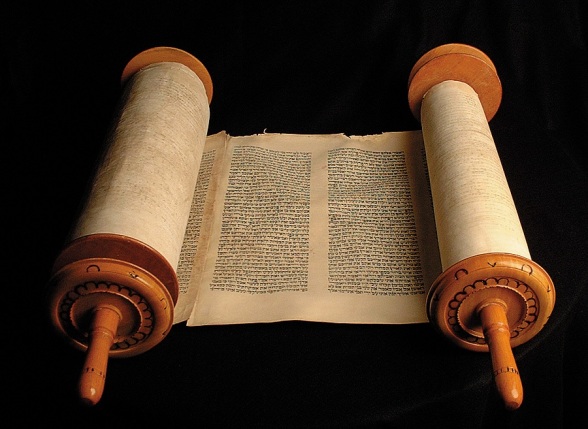
“Do not think that I have come to abolish the law or the prophets; I have come not to abolish but to fulfill. For truly I tell you, until heaven and earth pass away, not one letter, not one stroke of a letter, will pass from the law until all is accomplished.  Therefore, whoever breaks one of the least of these commandments, and teaches others to do the same, will be called least in the kingdom of heaven; but whoever does them and teaches them will be called great in the kingdom of heaven. For I tell you, unless your righteousness exceeds that of the scribes and Pharisees, you will never enter the kingdom of heaven.  Matt. 5:17-20.

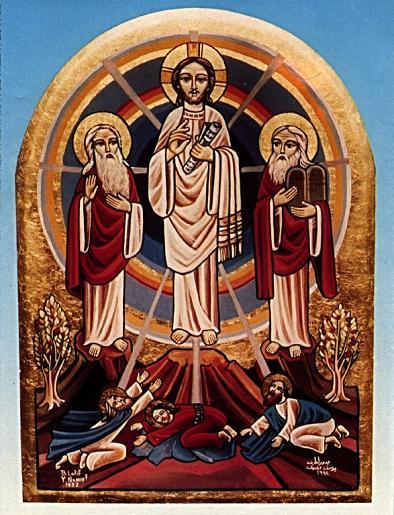
In the Gospel from today’s Daily Office, Jesus emphasizes his continuity with God’s message to His people, a message first announced in the law and the prophets.  That continuity shines forth in the story of the Transfiguration, which St. Matthew records at Matt. 17:1-9 and which the icon above depicts.  As God announces Jesus as his beloved Son, Christ appears flanked by Moses and Elijah.  We might wonder, “Why those two heroes of the Old Testament?”  Moses and Elijah, respectively, represented the Law (given by Moses) and the prophets.  Jesus comes as the full flowering, the conclusion or completion of the law and the prophets.

Rather than encouraging his disciples to abandon Scripture, he asks them to take it seriously. Like many of us today, the Pharisees and scribes had read scripture as calling us into a worthiness competition.  We find the perfect example of that view in the parable of the Pharisee and the tax collector.  (Luke 18:9-14; see here).  Jesus completes the law and the prophets by showing us that God’s love and grace has nothing to do with our worthiness.

A legalistic vision of Scripture works externally, requiring people to confirm to rules and to require such conformity from those around them.  Jesus calls us to internalize the Scripture, allowing it to transform our hearts so that we can live more deeply into it.  Legalism mistakes the packaging for the contents.  Thus, he tells his disciples that must go beyond the righteousness of the scribes and Pharisees.  The impulse to legalism always calls us into a kind of idolatry, in which we substitute performance of a given set of obligations for a relationship with the living God.

Jesus asks us to move forward from the notion of right action to the idea of a right relationship with God. We find an example of what Jesus means in Matthew 23:23.  There, He notes that the Pharisees “tithe mint, dill, and cummin, but have neglected the weightier matters of the law: justice and mercy and faith.”  Jesus doesn’t ask us to reject the Law (the Torah), merely to examine the principles which underlie it.  When our principle objective becomes a relationship with the Almighty that pushes us toward justice and mercy and faith, we will read the Law in the right context.

Jesus brings that Law into its fullness, pointing out how narrowly the people had come to understand God’s purposes.  The problem wasn’t that the scribes and Pharisees overvalued the Law; the problem lay in their underestimation of God’s purposes.  Thus, Jesus taught that the good Samaritan actually lived into loving his neighbor, while a more legalistic or superficial view asked, “And who is my neighbor?” Luke 10:29.  Like many of us today, while the scribes may have known exactly what the words of the law said, they had completely missed what they meant.  They had captured the notion of compliance, but missed the blessing of God’s spirit reshaping their lives.

I pray that we find that blessing today.

James R. Dennis, O.P.

© 2012 James R. Dennis
Standing in Awe of Him

1 May God be merciful to us and bless us,*
show us the light of his countenance and come to us.
2 Let your ways be known upon earth,*
your saving health among all nations.
3 Let the peoples praise you, O God;*
let all the peoples praise you.
4 Let the nations be glad and sing for joy,*
for you judge the peoples with equity
and guide all the nations upon earth.
5 Let the peoples praise you, O God;*
let all the peoples praise you.
6 The earth has brought forth her increase;*
may God, our own God, give us his blessing.
7 May God give us his blessing,*
and may all the ends of the earth stand in awe of him. Ps. 67.

We find Psalm 67 in the Daily Office for this morning.  The idea of a blessing provides the principle theme for this psalm, one of the great songs of the people of God.  In the opening verse, the psalmist prays for the blessing of the light of God’s presence.

We see the movement of asking for a blessing in the idea of God revealing Himself (“show us the light of your countenance”) and asking the Lord to make Himself known.  The psalmist, however, seeks not only that God’s gifts be apparent to the people of Israel, but also throughout the world.  He prays “let all the peoples praise you” to “all the ends of the earth”.  We hear the echo of the book of Genesis, in which God told Abram, “‘I will make of you a great nation, and I will bless you, and make your name great, so that you will be a blessing. I will bless those who bless you, and the one who curses you I will curse; and in you all the families of the earth shall be blessed.’” Gen 12:2-3.

While the psalm celebrates the prior gifts of God (a good harvest), it calls for God’s blessings throughout the world.  It strikes me that the psalmist really prays for an awareness of God’s presence throughout all creation.  The psalm asks for the light of God’s presence.  I’m struck by the idea that we never actually see “light”; rather we see all things because of the light.  The light which flows from God’s presence, therefore, enables us to see the grace of our blessings.  To paraphrase C.S. Lewis, I believe in God’s grace “as I believe that the sun has risen: not only because I see it, but because by it I see everything else.”

When we do become aware of God’s presence in and movement through the world, the psalmist describes our appropriate response:  “may all the ends of the earth stand in awe of him.”  I believe we have been conditioned to avoid experiencing awe.  If you’ve been reading this blog for a while, you know that I’m a big fan of Rabbi Abraham Joshua Heschel.  He said, “The opposite of good is not evil; the opposite of good is indifference.”  Many of us have become indifferent to God’s presence in and blessings of this world.

We are like guests at a banquet, who have stuffed ourselves and gorged upon the feast for so long that we’ve forgotten how to savor the food.  God’s presence surrounds us; only through it do we “live and move and have our being.”  Acts 17:28.  As Rabbi Heschel noted, “The thought of it is too powerful to be ignored and too holy to be absorbed by us.”  So today, my prayer for you is that, full of the certainty of God’s presence, that you be blessed today, and that you be a blessing.

Pax Christi,

James R. Dennis, O.P.

© 2012 James R. Dennis
How Can These Things Be?

From Mount Hor the Israelites set out by the way to the Red Sea, to go around the land of Edom; but the people became impatient on the way. The people spoke against God and against Moses, “Why have you brought us up out of Egypt to die in the wilderness? For there is no food and no water, and we detest this miserable food.” Then the LORD sent poisonous serpents among the people, and they bit the people, so that many Israelites died. The people came to Moses and said, “We have sinned by speaking against the LORD and against you; pray to the LORD to take away the serpents from us.” So Moses prayed for the people. And the LORD said to Moses, “Make a poisonous serpent, and set it on a pole; and everyone who is bitten shall look at it and live.” So Moses made a serpent of bronze, and put it upon a pole; and whenever a serpent bit someone, that person would look at the serpent of bronze and live.  Numbers 21: 4-9.

Jesus said to Nicodemus, “Just as Moses lifted up the serpent in the wilderness, so must the Son of Man be lifted up, that whoever believes in him may have eternal life.
“For God so loved the world that he gave his only Son, so that everyone who believes in him may not perish but may have eternal life.”  John 3: 14-16.

The first passage, from the Book of Numbers, deeply challenges our understanding of Yahweh, and confronts our  imaginations.  It takes place against the backdrop of  the consistent theme within the Exodus narrative:  forty years of wandering in the wilderness, marked by the people’s resistance, God’s punishment, the people’s repentance, and God’s restoration.   As the people near the end of their journey, a campaign of rebellion  arose against both Moses and God.  The text reports that God addressed this issue through an infestation of seraphs (poisonous snakes).

One might reasonably conclude that there were already poisonous snakes among the Hebrew people, spreading this contagion of destructive grumbling.  While we may struggle with the notion that God sent the snakes down upon the Hebrews, I want to suggest that those vipers were merely visible tokens of the toxic rebellion that already enveloped them.  The serpents which would lead to their deaths were already there.  God merely revealed a physical sign of the spiritual reality they already confronted.  It’s as though the Lord were telling them, “This is what your way looks like.”

In this fitting Lenten passage, when the people acknowledge their complicity for their situation, God intervenes to save them.  God instructs Moses, who creates a bronze serpent placed upon a pole.  When those bitten by snakes look upon this image, this icon, God heals them.  Out of this destructive pattern of sin and death, God will raise up a way of healing.  This leads us to the Gospel reading for today.

In the Gospel passage, we encounter the terribly interesting figure of Nicodemus, a Pharisee who secretly followed Jesus.  Immediately prior to this passage, Jesus challenges Nicodemus’ imagination, teaching about the need for a man to be “born again”.  Jesus then reveals his messianic role, drawing on the iconic image of Moses lifting up a serpent in the wilderness.  This statement carries with it the double-meaning of the Christ being raised up as the Messiah and of Jesus raised up on the cross.  As with the earlier passage from Numbers, Jesus describes a spiritual reality that the world cannot yet comprehend.

The cross will become the source of healing this broken world.  Just as with the bronze serpent, that which we perceived as an image of fear and death becomes the source of our new life.  Again, it’s as though God said to the world, “All right.  This horror on Golgotha is the result of the way you want to do business.  But I can still create life where you see nothing but death and shame.”

 Jesus teaches Nicodemus that believing  in the Son “lifted up” provides the way to eternal life.  It’s important to note that the Greek phrase John uses isn’t actually “believes in him” but rather “believes into him”.  In other words, Jesus isn’t describing an intellectual assent to a set of propositions, but rather a radical submission and new way of life.  Jesus offers eternal life, therefore, to those who join in His way of life.  Thus, St. Paul could accurately say “I no longer live, but Christ lives in me.”  Gal. 2:20.

John’s Gospel offers us a deeply rooted theology of the cross.  In fact, for St. John, the cross operates as the fulcrum point upon which all of human history turns.  This passage seems to answer, perhaps a little obliquely, Nicodemus’ question, “How can these things be?”  John 3:9.

Jesus points to a spiritual reality we cannot yet see, that we cannot yet understand.  Our new life, our eternal life, in Christ originates in one mysterious, glorious, incomprehensible notion:  “God so loved the world that he gave his only Son, so that everyone who believes into him may not perish but may have eternal life.”  Salvation arises through God’s love, revealed on the cross.  In the depth of this Lenten season, that’s good news.

Shabbat shalom,

© 2012 James R. Dennis

Moses and the Bronze Serpent © Fr. Lawrence Lew, O.P.

Laughter From the Barren Places

When Abram was ninety-nine years old, the LORD appeared to Abram, and said to him, “I am God Almighty; walk before me, and be blameless. And I will make my covenant between me and you, and will make you exceedingly numerous.” Then Abram fell on his face; and God said to him, “As for me, this is my covenant with you: You shall be the ancestor of a multitude of nations. No longer shall your name be Abram, but your name shall be Abraham; for I have made you the ancestor of a multitude of nations. I will make you exceedingly fruitful; and I will make nations of you, and kings shall come from you. I will establish my covenant between me and you, and your offspring after you throughout their generations, for an everlasting covenant, to be God to you and to your offspring after you.”

God said to Abraham, “As for Sarah your wife, you shall not call her Sarai, but Sarah shall be her name. I will bless her, and moreover I will give you a son by her. I will bless her, and she shall give rise to nations; kings of peoples shall come from her.”  Gen. 17: 1-7, 15-16.

In today’s Lectionary reading, we  continue with the notion of covenant from last week’s Old Testament reading about Noah.  Here, we encounter Abram as an old man.  Twenty-four years earlier, God had instructed Abram to move from his home in Haran. Abram left behind his home and his family; he left behind his past.  Although Abram’s very name meant “father of the multitudes”, deep into their old age he and his wife Sarai had no children.  Despite God’s promises that his descendants would number as many as the stars, Sarai remained barren.

When God re-named him Abraham (“the father of many nations”), it must’ve seemed like a bit of a cruel joke.  And when God re-named his wife Sarah (which means “princess”), that must have made her wince a bit.  And when God told him that  wife would be the mother of nations and kings would spring from her, the whole thing must have seemed….well, just not very likely.

In the very next verse, we learn that Abraham laughed at the whole idea.  Gen. 17:17.  And when Sarah heard the news, she couldn’t help but laugh, too.  Gen. 18:12.  God has a funny sense of humor, and the whole idea struck them as a bit absurd.  And yet, very late in their lives, laughter (which translates as “Yizhak” or “Isaac”) will spring from their marriage.  Their laughter at the absurdity of God’s promise will become laughter of joy.  But, I’m getting ahead of the story…

In those days, at that time, being childless meant a deep and fundamental kind of failure.  (Some folks still perceive infertility that way today, or at least as deeply heartbreaking.) God’s repeated promises seemed to mock the reality of Abram and Sarai’s long struggle with infertility.  So when God Almighty (“El Shaddai”) repeats his promise, Abram falls to the earth, and we can imagine him hoping desperately that somehow the Almighty can bring his dreams to fruition and bless him with an heir.

As happens so often in Scripture, the significance of this event is marked by a re-naming.  We’ve seen it happen to Simon (“Peter), to Jacob (“Israel”), and now to Abram (“Abraham”) and Sarai (“Sarah”).  In each instance, the assignment of a new name implies both a new understanding of mission and a re-making of God’s creation.  It connotes a change so thoroughgoing that the old name simply would no longer suffice.  In this passage, the Lord reveals also himself, using a new name (“El Shaddai”) for the first time.  The name reflects this new covenantal relationship, implying limitless capacity.

This reading offers us several important insights during this Lenten season.  God calls each of us into the covenant He established with Abraham and which was revealed most clearly in the life, death and resurrection of Jesus.  He wants to take the places in our lives which are broken and barren and create new life there.  He wants to turn our laughter of incredulity into laughter of joy.  Just like Abraham, God calls us to walk with Him, so that all our steps are taken with and toward God.  And mostly, He wants us to become living icons of this covenant, to trust in His vision for all of creation and its redemption.  And, I think, God wants us all to laugh, deeply and with great joy.

Shabbat shalom,

James R. Dennis, O.P.

© 2012 James R. Dennis

You Have Asked a Hard Thing

Now when the LORD was about to take Elijah up to heaven by a whirlwind, Elijah and Elisha were on their way from Gilgal. Elijah said to Elisha, “Stay here; for the LORD has sent me as far as Bethel.” But Elisha said, “As the LORD lives, and as you yourself live, I will not leave you.” So they went down to Bethel. The company of prophets who were in Bethel came out to Elisha, and said to him, “Do you know that today the LORD will take your master away from you?” And he said, “Yes, I know; keep silent.”

Elijah said to him, “Elisha, stay here; for the LORD has sent me to Jericho.” But he said, “As the LORD lives, and as you yourself live, I will not leave you.” So they came to Jericho. The company of prophets who were at Jericho drew near to Elisha, and said to him, “Do you know that today the LORD will take your master away from you?” And he answered, “Yes, I know; be silent.”

Then Elijah said to him, “Stay here; for the LORD has sent me to the Jordan.” But he said, “As the LORD lives, and as you yourself live, I will not leave you.” So the two of them went on. Fifty men of the company of prophets also went, and stood at some distance from them, as they both were standing by the Jordan. Then Elijah took his mantle and rolled it up, and struck the water; the water was parted to the one side and to the other, until the two of them crossed on dry ground.

When they had crossed, Elijah said to Elisha, “Tell me what I may do for you, before I am taken from you.” Elisha said, “Please let me inherit a double share of your spirit.” He responded, “You have asked a hard thing; yet, if you see me as I am being taken from you, it will be granted you; if not, it will not.” As they continued walking and talking, a chariot of fire and horses of fire separated the two of them, and Elijah ascended in a whirlwind into heaven. Elisha kept watching and crying out, “Father, father! The chariots of Israel and its horsemen!” But when he could no longer see him, he grasped his own clothes and tore them in two pieces.  2 Kings 2: 1-12.

We are nearing the end of the season of Epiphany, a season when we mark the ways God reveals Himself in the world.  This season affords us a wonderful time to remember Elijah and his student Elisha.  As this passage begins, Elijah is nearing the end of his days.  At the Lord’s instruction, he has already placed his mantle (the symbol of his prophetic spirituality) on Elisha.  1 Kings 19: 19.

Elijah must travel to Bethel, and suggests that Elisha remain behind.  Some scholars have suggested that Elijah is testing Elisha’s loyalty.  I think something different is happening here.   Perhaps Elijah wants to spare Elisha the pain of this moment.  Perhaps he wants to spare himself the heartbreak of that last goodbye.  It’s no secret that Elijah’s death is near;  prophets along the way, at Bethel  and Jericho remind Elisha of this.  Elisha tells these voices to remain silent.   While Elisha remains committed to accompanying his friend and teacher towards his death, the tremendous sense of loss and mystery defy language.  Words simply fail at moments like these.

While on their journey, Elijah parts the river Jordan, revealing himself as the second Moses.  The progress of their journey–from Gilgal to Jericho to the Jordan–reminds us of the people’s journey as they enter into the promised land.

In the central passage of the story, Elijah asks what he can do for his student, his friend, before he dies.  Elisha asks for a “double share” of his spirit.  Under Deuteronomic law, the eldest son would receive a double portion of his father’s estate.  (Deut. 21:15-17).  Elijah responds that he has asked “a hard thing.”  Elijah knows that this spiritual inheritance is God’s to give, and not his own. More than just a student of the great prophet, it’s clear that Elisha considers himself the spiritual child of Elijah.  This meaning becomes clear when Elijah is taken up into the whirlwind and Elisha cries out, “Father!  Father!”

So, it seems to me that this passage, like today’s Gospel reading on the Transfiguration, centers on the notion of translation.  Jesus’ divinity is translated into a language the disciples can understand.  Elijah, the prophet who stood alone, is translated into a life with the Father.  And Elisha is translated into his new role as the spiritual heir of his teacher.  Coincidentally (and I really don’t believe in coincidences), these things all happen in the context of a journey.  I think Holy Scripture is making a very important point:  we cannot  be transfigured into God’s new creation by remaining in the same place.

I hope to see you on the road.

Shabbat Shalom,

James R. Dennis, O.P.

© 2012 James R. Dennis

Who Are You, My Son?

So he went in to his father, and said, “My father”; and he said, “Here I am; who are you, my son?”  Jacob said to his father, “I am Esau your firstborn. I have done as you told me; now sit up and eat of my game, so that you may bless me.”  But Isaac said to his son, “How is it that you have found it so quickly, my son?” He answered, “Because the LORD your God granted me success.”  Then Isaac said to Jacob, “Come near, that I may feel you, my son, to know whether you are really my son Esau or not.” So Jacob went up to his father Isaac, who felt him and said, “The voice is Jacob’s voice, but the hands are the hands of Esau.”  He did not recognize him, because his hands were hairy like his brother Esau’s hands; so he blessed him.  He said, “Are you really my son Esau?” He answered, “I am.”  Then he said, “Bring it to me, that I may eat of my son’s game and bless you.” So he brought it to him, and he ate; and he brought him wine, and he drank.  Then his father Isaac said to him, “Come near and kiss me, my son.”   So he came near and kissed him; and he smelled the smell of his garments, and blessed him . . . .  Gen. 27:18-27.

In the Old Testament reading in today’s Daily Office, we find the story of Isaac blessing Jacob.  I confess that I’ve always loved the story of Jacob, in part because he is one of those “holy rascals” we’ve talked about before.  In part, I’m attracted to the story because my own name is the Anglicized version of the name “Jacob”.  And in part, I’m drawn to this story because it’s the story of a dysfunctional family, fraught with deceit and discord, finding a kind of redemption.

 Jacob offers us an interesting character; he’s nobody’s idea of a saint.  He’s deceptive, self-centered, and covetous.  His very name, meaning the grasper, or the supplanter, implies this.  While not completely wicked, like a lot of us, Jacob has a little larceny in his heart.  Like most of us, God did not choose Jacob because he was so holy; rather, he was holy because God chose him.

Jacob displayed these character traits from the very beginning.  As you’ll remember, Jacob and Esau were twins.  They struggled within their mother’s womb.  At birth, Jacob held on to his brothers foot, grasping at his brother.   Through sharp dealing, he acquires his brother’s birthright from Esau in exchange for a bowl of stew.  That birthright included the right of a double share of the inheritance, but perhaps more importantly determined who would run the family.

We find further evidence of familial dysfunction.  Isaac favors his son Esau; Rebekah favors Jacob.  Knowing that he was just not quite good enough for his father almost certainly shaped some of Jacob’s behavior.    Although Esau had sold his birthright to Jacob, Jacob still needed to deal with Isaac, who controlled the blessing of the father.  In order to obtain this blessing, Jacob deceives his father.  We find Rebekah, Isaac’s wife, participating in this little illusion.

We should remember, however, that Rebekah carries out God’s plan in this regard.  As we recall, the Lord told Rebekah:

“Two nations are in your womb,
and two peoples born of you shall be divided;
the one shall be stronger than the other,
the elder shall serve the younger.”

Gen. 25: 23.  So, while Jacob has deceived his father and taken advantage of his brother, God will somehow redeem this shamefully poor behavior.  Jacob, and not Esau, will become the father of the nation of Israel.  But first, Jacob will run away from his family and his brother’s murderous intent, and only years later will God bring him safely back home to bear the covenant into the next generation.

But I think there’s still more at work in this passage.  Isaac asks, “Who are you, my son?”  While we recognize that Isaac’s sight has grown dim, and Jacob has disguised himself with skins to resemble his brother, reason teaches us that Isaac would still recognize his own son.  In fact, Isaac comes out and says that the voice was Jacob’s rather than Esau’s.  I wonder whether Genesis might be teaching us something else.

We’ve talked before about the contrast between physical blindness and spiritual insight.  I wonder whether, although he could not see physically, Isaac could spiritually see God’s hand in all this.  Perhaps Isaac knew that God was at work in all this artifice, and that God would do what he always did:  make something sacred and holy out of our mess.

Perhaps this story of the younger brother obtaining the birthright may also prefigure something we’ll hear Jesus teach about at great length.  In this story of the younger son receiving his father’s blessing we may see the beginning of the notion that “the first will be last and the last will be first.”  Maybe we’re seeing just the sort of inversion through grace that Jesus would preach about.  Perhaps we’re being inoculated to the notion that God’s justice works differently from ours, and God sees things we cannot yet see.

This story may have something else to teach us.  Jacob lies when Isaac asks him, “Who are you, my son?”  How many of us, when confronted by the Father, have similarly not been able to make an honest account of ourselves?  How many of us, standing naked before the Creator, can honestly answer for who we’ve become and what we’ve done?  And perhaps, like Isaac, our heavenly Father sees through our misrepresentation and self-deception, knowing that he can still work with these imperfect materials.

God’s great peace on you and your house,

James R. Dennis, O.P.

 © 2012 James R. Dennis

A Voice in the Darkness

Now the boy Samuel was ministering to the LORD under Eli. The word of the LORD was rare in those days; visions were not widespread. At that time Eli, whose eyesight had begun to grow dim so that he could not see, was lying down in his room; the lamp of God had not yet gone out, and Samuel was lying down in the temple of the LORD, where the ark of God was. Then the LORD called, “Samuel! Samuel!” and he said, “Here I am!” and ran to Eli, and said, “Here I am, for you called me.” But he said, “I did not call; lie down again.” So he went and lay down. The LORD called again, “Samuel!” Samuel got up and went to Eli, and said, “Here I am, for you called me.” But he said, “I did not call, my son; lie down again.” Now Samuel did not yet know the LORD, and the word of the LORD had not yet been revealed to him. The LORD called Samuel again, a third time. And he got up and went to Eli, and said, “Here I am, for you called me.” Then Eli perceived that the LORD was calling the boy. Therefore Eli said to Samuel, “Go, lie down; and if he calls you, you shall say, `Speak, LORD, for your servant is listening.'” So Samuel went and lay down in his place.Now the LORD came and stood there, calling as before, “Samuel! Samuel!” And Samuel said, “Speak, for your servant is listening.”

As Samuel grew up, the Lord was with him and let none of his words fall to the ground.  And all Israel from Dan to Beer-sheba knew that Samuel was a trustworthy prophet of the Lord. The Lord continued to appear at Shiloh, for the Lord revealed himself to Samuel at Shiloh by the word of the Lord.  1 Sam. 3: 1-10; 19-21.

I have a theory.  My theory is this:  with surprising regularity, things tend to end much as they began.  In many respects, the story of the prophet Samuel seems to validate that notion.

Now, the prophet Samuel began his ministry during the first generation of Israel’s monarchy.  You’ll remember the story that Samuel’s mother (Hannah) was presumed to be barren.  Hannah begged God for a child, promising that if God would give her a son, she would offer the child as a Nazarite (who would not drink wine or strong drink nor shave his head).  Eli, the priest at the holy place of Shilo,  assured Hannah that she would have a son.

Once Hanna weened Samuel, she presented him at Shilo.  In a song remarkably similar to the Magnificat, Hannah sang that God had broken the bows of the mighty, raised the poor up from the dust, and seated the needy with princes.  It’s a striking song, full of political radicalism and foreshadowing Jesus’ promise that the first will be last and the last will be first.

That same notion will run throughout Samuel’s ministry.  Samuel would eventually turn his prophetic vision to Eli the priest.   Eli failed to restrain his sons who abused their power and blasphemed by eating the choice cuts of the sacrificial animals.  1 Sam. 2:12-17.  Similarly, Samuel warned the people of Israel against kings who would abuse their power and take advantage of the vulnerable.  Now, that’s a very old story:  the poor and the powerless suffer under the appetites of the strong.  Samuel would ultimately give voice to God’s conclusion that King Saul’s reign has come to an end. God thus instructed Samuel to anoint David as the King of Israel.

I wonder whether we again live in days “when the word of the Lord is rare.” How do we confront those two twin tremendous mysteries, the silence of God and the voice of God?  Maybe God’s silence arises from our regular failure to ask him for guidance, or our failure to listen when He does speak.  For many of us, like Samuel, we’re not exactly sure when we’re hearing the Lord’s voice, and we certainly know that the news will not always be popular.  As was the case with Samuel, once we’ve identified the voice of the Lord, there’s no guarantee anyone else will be receptive, or even interested.

Despite that, I always smile a bit and find great comfort  when the Lectionary rolls around to this reading. I smile because when I was a child, my parish priest told me that this was a story about what happens to little boys who fall asleep in church.  I find comfort because God calls to Samuel again and again throughout that night.  Regardless of our confusion, God can be remarkably persistent.  He can, in fact, hound us repeatedly while we’re trying to sleep.  God’s word has a remarkable capacity to interrupt and disturb us when we’re trying to do something else. I pray that you’ll listen for that voice, and that I will also.

Shabbat shalom,

James R. Dennis, O.P.

© 2012 James R. Dennis