Tag Archives: Moral Theology

A Great Chasm

Now he is comforted here, and you are in agony. Besides all this, between you and us a great chasm has been fixed…. (The full readings for this morning can be found here.)

In the name of the Living God, who is creating us, redeeming us, and sustaining us.

Well, good morning, everybody. So, in today’s gospel we encounter a man who’s having trouble with the afterlife and is concerned for his family. Whenever I hear this story, I think about a family we knew back in West Texas, the Beauchamp brothers.

Now, they were not nice people. In fact, everybody in the whole county knew the Beauchamp brothers. In business they were crooked, mean and cold-blooded. Well, one day, the older brother, Howard Beauchamp, he up and died. The younger brother, Ronnie, wanted to make sure that Howard got the finest funeral there had ever been in the county. He went down to the funeral home and bought a fine cherrywood coffin with silver hardware. Then he went to go see the minister.

The little church there was not doing so well. In fact, it was kind of falling apart at the seams. The air conditioner was old and tired, and the roof struggled to keep out the rain. Well, Ronnie Beauchamp, he went to the minister, and he offered him the Devil’s own bargain. He said, “Pastor, I will give your church half a million dollars if you will preach my brother’s funeral and tell everyone he was a saint.” Well, this was a real conflict for the preacher, because the church really needed that money, but he couldn’t lie from the pulpit.

So, the day of the funeral came around, and the whole town was there as the minister began to preach the funeral sermon.  He said, “The man you see in this coffin was a vile and debauched individual.  He was a liar, a thief, a bully, a great sinner, and he broke his mama’s heart.  He destroyed the fortunes, careers, and lives of countless people in this county, some of whom are here today. This man did every dirty, rotten thing you can think of.”

“But, the preacher added, … compared to his brother, he was a saint.”

Now, before we go any further, I want to make a couple of things clear. The passage we are reading isn’t a theological guide about how to get to heaven or how to avoid hell. This passage is one of Jesus’ parables—a riddle or a fable. So, I don’t think the rich man went to Hades because he was rich. And I don’t think Lazarus went to heaven because he was poor. But I do want us to start thinking this morning about the various chasms we encounter: chasms that separate us from each other, the gulfs between us and God—the chasms we come upon, and the chasms we help create.

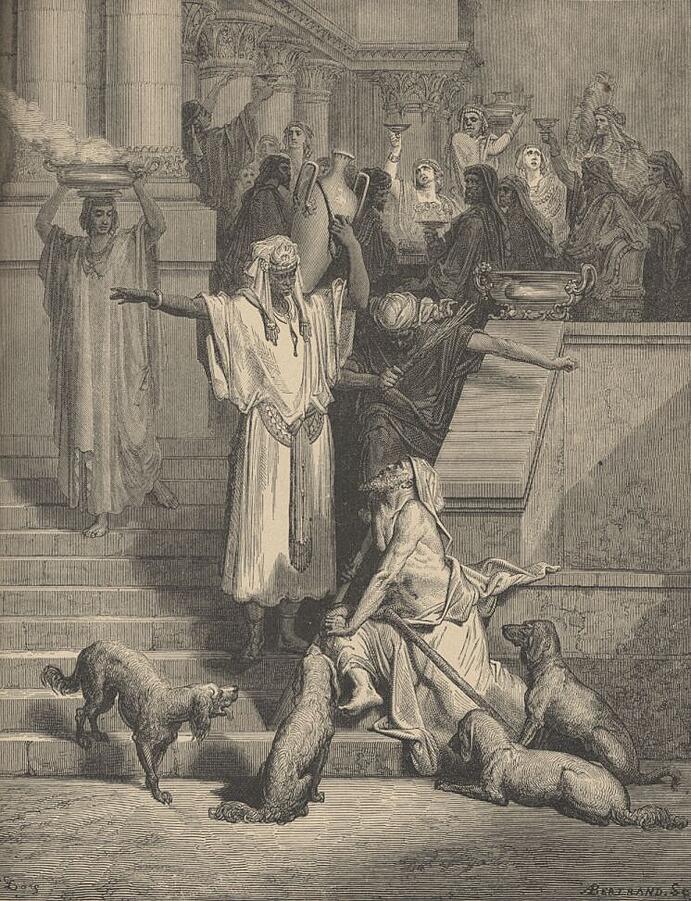
One of the first places we notice a gap, or a distance, is between the circumstances of these two men. We are told that every day, the rich man ate luxurious meals, and he wore fine linen and purple. On the other hand, we can imagine Lazarus in rags, and we’re told he’s covered in sores. He’s also starving, and dreams of eating even the crumbs or scraps from the rich man’s meals.

And although their lives were very different, they did not live far away from each other. In fact, Lazarus lived just outside the rich man’s gate. But we get the feeling the rich man never noticed Lazarus. In fact, I get the impression that the rich man had become quite adept at ignoring Lazarus at the gate, a kind of studied disregard, a well-rehearsed apathy. So, their lives on earth were very far apart; they were separated by a great economic and social chasm.

Then, when the two men die, we have one of those classic reversals of fortune that Luke loves. It’s already happened right from the outset of the story. You see, we know the name of the poor man in the story—his name is Lazarus, which means God’s help. We don’t, however, know the name of the other character; he’s just some rich guy. That’s not how things normally work. We remember the rich and the mighty, and too often the names of the poor and the hopeless are forgotten.

But when their earthly lives are over, the angels carry Lazarus to the bosom of Abraham. In other words, he has a place of peace and comfort and honor among the righteous dead. The rich man, however, finds himself being tormented in Hades. There’s a considerable distance, a chasm, between their circumstances. But even from the fiery pit, the rich man doesn’t seem to recognize his new situation yet. He’s still treating Lazarus like a slave. You see, the biggest lie the devil ever told us is that some lives are worth more than others, that some people are more important than others.

The rich man asks Abraham to send Lazarus with just a bit of water on his finger to ease the rich man’s suffering. Once again, here’s that Lucan reversal of fortune. Abraham tells the rich man: “Child, remember that during your lifetime you received your good things, and Lazarus in like manner evil things; but now he is comforted here, and you are in agony.”

The bigger problem, Abraham explains, is that vast chasm between Lazarus and the rich man. Now, maybe Jesus was trying to tell us that heaven is a long, long way away from hell, but I don’t think so. I think the distance between Lazarus and the rich man is simply the echo and amplification of the separation the rich man created while they were alive. In other words, to borrow an idea from Charles Dickens, they wear the chains they forged in life. Jesus reminds us that there is a deep and profound connection between how we live in this life and how we live in the next life.

So, what are we supposed to do with this passage? What am I supposed to do about the homeless man that I drove by on my way to church this morning? Am I supposed to give him a dollar? Buy him a meal? Pay for him to spend a night in a hotel room? If I do that, will Jesus let me into heaven?

I think the very last thing Jesus wanted to do in his parables was to give us easy answers to these questions. I think we were meant to struggle with this issue, to learn to listen to Moses and the prophets. I also think we have to find a way to close the tremendous gaps between ourselves and our brothers and sisters. We all know about the terrible gap of wealth inequality, and we saw the political distance widen in this country after Charlie Kirk was killed and both parties clawed at each other desperately for a spot on the moral high ground

My friends, as Doctor King warned us, “We must learn to live together as brothers and sisters or perish together as fools.” We know about the chasm between God’s children. I think the biggest chasm I have to struggle with every day is the gap between the man I am and the man I want to be, the distance between the life I’m leading, and the life Jesus wants for me.
I think the first thing is that we notice how deeply, how profoundly, God cares for the poor. This morning, the Psalmist tells us happy are those:

Who give justice to those who are oppressed,
and food to those who hunger.
The Lord sets the prisoners free;
the Lord opens the eyes of the blind;
the Lord lifts up those who are bowed down.

A friend of mine puts it a little differently. He likes to tell me that no one gets into heaven without a letter of recommendation from the poor.

Secondly, I think we have to find a way to bridge the gap between us and the broken-hearted of this world. We must find a way to reach across to those who are hungry, to those who live in hopelessness. And we’ve got to quit asking whether they deserve our help, our charity. Quite frankly, that is none of our business. God will figure that out.

I do believe charity is important, and yes, the rich man fails to tend to, or care about, the needs of Lazarus. But there was a sin that came before that, an earlier fault that made all the others possible. He didn’t even notice Lazarus. He didn’t notice the man at his gate. I don’t want to think about the number of times I’ve turned my glance away from the homeless and the poor. And the failure to notice them robs us of any chance we have to make a difference in their lives, to make a friend. So maybe we should begin by noticing them, and I mean this quite literally, for the love of God, notice them. Maybe if we go out of our way, just a little bit, we might learn to share our resources, and more importantly, to share our hearts. Amen.

James R. Dennis, O.P. © 2025

The Scent of Scandal at Bethany

Mary took a pound of costly perfume made of pure nard, anointed Jesus’ feet, and wiped them with her hair. The house was filled with the fragrance of the perfume. (The full readings for this morning can be found here.)


In the name of the living God who is creating, redeeming, and sustaining us.

Way back a very long time ago, back in the early twelfth century, I was a boy in Odessa, Texas. And I can tell you my very first memory. I was riding in a golf cart with my father, and I couldn’t have been older than three or four years old. And the sun was coming up, and I smelled the scent of freshly cut grass, and I thought I must have gone to heaven.

And I remember going to my grandmother’s house for Thanksgiving, and the house was full of the most wonderful smells: ham, turkey, sweet potatoes, about 5 kinds of pie, and a pot of cowboy coffee on that old stove. Oh, I can still smell those thanksgivings.

Rudyard Kipling once wrote, “Smells are surer than sights or sounds to make your heartstrings crack.” And Hellen Keller once observed, “Smell is a potent wizard that transports you across thousands of miles and all the years you have lived.” Neuropsychologists tell us that smell is one of the most powerful gateways into our memories, in part because those two parts of the brain are very close to each other. Think about your first new car, or favorite book or your first trip to the library as a child, and you will almost automatically be drawn to the way they smelled. I think this is true in part because our sense of smell is so closely tied with the act of breathing—we don’t just detect a scent, we take it into our lungs and our bodies through our breath, which is another way of saying we take it into our spirit.

So, this morning, the Church offers us this wonderful story of a dinner party. It takes place in Bethany, which is bordered by the Mount of Olives, and only about two miles from the city of Jerusalem. And Jesus is on his way to Jerusalem; in fact, it’s his last trip to that city. And nothing very good is going to happen there.

Now, this is sort of an odd dinner party, for a number of reasons. It takes place at the home of Mary and Martha and their brother Lazarus—yes, that Lazarus. And just one chapter before this, Jesus had raised Lazarus from the dead. And even Jesus, knowing all that he knew and was about to do, wept at that tomb. He wept over the death of his friend, and he wept over the grief he shared with his friend’s sisters. And when Jesus told them to roll away the stone, Martha voiced her concern: “Lord, already there is a stench because he has been dead for four days.” She was concerned about the stench of the grave, the odor of death and decay. But Jesus called Lazarus back from the grave and ordered them to unbind him from the strips of cloth in which he was entombed.

So, we have these two sisters at this dinner party, along with Lazarus (who was dead, but is alive) and Jesus (who is alive but will not be for much longer). And then, we have Judas. I’ll circle back around to him in a bit. And they are gathered at the table.

Then, one of the sisters (Mary) does something remarkable. She does something scandalous, something embarrassing, something shocking, something prodigal. (You may remember that story of the prodigal son from last week, another story of a reckless love that doesn’t care about dignity.) She takes a pound of perfume made from pure nard and anoints Jesus’ feet with it and then she wipes them with her hair. Let’s break this down a bit.

Nard was a very expensive perfume with a strong, distinctive aroma that clung to the skin. It is mentioned elsewhere in Scripture, in the Song of Solomon, which is also a sensuous and erotic and sometimes scandalous book of the bible. The value of the oil with which she anoints Jesus’ feet is approximately a year’s wages. So, this is a lavish, sensuous act of devotion. And women of that time, did not loosen their hair, let alone wash a man’s feet with it. But just as her brother Lazarus was unbound from his death shroud, Mary unbinds her hair and begins to wash Jesus’ feet. Washing someone’s feet—well, that was dirty work for the servants or slaves. In fact, women of that time did not touch a man at all unless they were married.

So, all the good, proper ladies over at the First Baptist Church of Jerusalem would have been clutching their pearls at this scene.

And then Judas asks a question, “Why didn’t she do some good with this money? Why not give it to the poor?” Now Judas is the consummate cynic, right? You know what a cynic is—a cynic is someone who knows what everything costs but doesn’t know what anything is worth. The stench of betrayal and stinginess and violence clings to him. And he cannot recognize the worth of this moment as this woman pours out her wealth, pours out her life and her dignity, upon this man Jesus. A love that reckless doesn’t care what love costs.

And Jesus tells Judas, “Leave her alone. She bought it so that she might keep it for the day of my burial.” And I don’t want you to think that Jesus was unconcerned with the plight of the poor. The gospels tell us, rather, that he was profoundly concerned with the poor. But this is a special moment, a moment of lavish, unselfish tenderness, and I’m sure it strengthened Jesus for those horrifying days that lay ahead. Judas, if we take him at his word, was more concerned with a return on the investment. Mary, on the other hand, wasn’t making an investment; she was giving a gift. Love, with no strings attached. Love may not always be the most practical response, but it is always the divine response.

Now, Mary had purchased this perfume for the time of Jesus’ death, but instead chooses to anoint Jesus now. In a profound sense, she chooses life over death. This woman was willing to risk shame and embarrassment and ridicule— all for a reckless love. That kind of love always leads to the cross. Always. And maybe sometimes, every now and then, we might remember that loving God sometimes means a reckless refusal to consider the cost of love, and we might focus on what it’s worth. And maybe we might remember that God, as Isaiah tells us, is about to do a new thing.

Now, in just a few days we will celebrate Maundy Thursday, the day when Jesus washed his disciples’ feet. It’s the very next Chapter of John’s gospel, and again, it’s very intimate and embarrassing. But, when we get there, I want you to remember, it was this woman Mary who showed Jesus how to do that, who showed him what love looks like.

The house was filled with the fragrance of the perfume. Breathe that in, breath in her tender, reckless devotion and breathe in the life of Jesus. And then, exhale love. Amen.

James R. Dennis, O.P. © 2025
Let No One Put Assunder

“It is to such as these that the Kingdom of God belongs.” (The full text of our readings can be found here.)

In the name of the Living God, who is creating, redeeming, and sustaining us. Well, good morning, everyone, good morning.

You know, I grew up out in West Texas. And when I was a young man I engaged in some pretty risky behavior. Now and then I would drink too much. And I liked fast cars, and liked to see how fast they would go. And I would date these girls..well, if you’ve ever been to a rodeo…well, they were barrel racers. And I want to assure you that they are, every single one of them, loco. I mean not average plain old crazy…they were fancy crazy, with glitter and everything, and some of them were mean, too.

So, I know what it means to walk into a room full of trouble. But when you walk into a church full of people you really don’t know all that well, about a third to half of whom have been divorced, including the guy in the pulpit, to preach a sermon on the topic of divorce, well, that’s next-level hazardous; that’s right on the border between silly and imbalanced. But here in the diocese of West Texas when there’s a really foolish, precarious situation, one that really no one with good sense would mess with, I’m the guy they call. Because, as we all know, fools rush in where angels dare not tread.

So, let’s turn to this passage of Scripture, a passage that has been poorly understood, horribly misused, and cruelly interpreted.  Let’s try to look at this story in context, beginning with the historical context.

The first thing we need to understand is that whatever sort of divorce Jesus was talking about, divorce in first-century Palestine had very little to do with the sort of divorce we may have had some experience with. Ancient Israel, like most of the ancient world, was patriarchal, and wives were regarded as the property of their husbands. Thus, while a husband could divorce his wife, the wife had no reciprocal ability to divorce her husband. Marriages were not based on our current notions of romantic love between two persons but on considerations of property, status, and honor between two families. If a husband did divorce his wife, she and the children would  probably end up penniless, begging, or something worse

Now let’s look at this story in the textual context, in the context of a story that Mark is telling us. This discussion takes place when Jesus is answering certain questions he’s asked by the Pharisees, asked to test him or to trap him. In this passage, Jesus isn’t asked about how God feels about divorce, or even how Jesus feels about divorce. Rather, they ask Jesus a question they already know the answer to—they ask him what the law says. Now, the Pharisees were a lot of things, but mostly, they were a group devoted to understanding, preserving, and interpreting the law. So, they didn’t come to Jesus with a genuine question, but rather with a snare.

Now let’s look at this story in the broader Gospel context about Jesus’ relationship with the law. Everything we know tells us that Jesus’ relationship with the law was….well, complicated. When Jesus’ disciples were accused of breaking Jewish law by plucking grain and eating it as they walked along on the Sabbath, Jesus responded that David and his companions ate the consecrated bread that the law reserved for the priests.  When the Pharisees caught a woman in adultery and were going to stone her as the law directed, Jesus told them that the one without sin should throw the first rock. The Pharisees constantly criticized Jesus for healing on the Sabbath, which he did so regularly one might conclude that Jesus was looking for trouble. And I think he was: I think Jesus was looking for what the great John Lewis called “Good Trouble.”

It seems to me that in this morning’s reading, Jesus is doing what he did so often. I think he was forcing us to overcome our legalism and look more deeply at the principles that underlie the law, and to look more deeply within ourselves. Jesus tells us the problem isn’t with our legal situation but with our medical situation—with the hardening of our hearts.  He says Moses only gave you the commandment concerning divorce because of the hardness of your hearts. If you’ve ever walked through a divorce with one of the parties, or with a couple, you know how hard our hearts can get. If you’ve ever watched children go through a custody battle, you know how hard our hearts can become.

Rather than involving himself in a debate about the circumstances in which divorce might be permissible, Jesus (as he so often did) calls us to examine the first principles behind marriage. Part of that first principle Jesus turns to is the story of creation: we were not made to be alone; we were made for life in common, a life in love.

We know of many reasons why a marriage can fail: infidelity; alcohol and substance abuse; workplace stress; financial stress; mental illness; disagreements over parenting styles; religious differences; physical and mental abuse. Like the psalmist says, we’re “just a little lower than the angels.” Very rarely have I encountered a situation where one party was completely to blame and the other party was completely blameless in the failure of the marriage. Divorce can leave behind emotional and spiritual wreckage. And sometimes I have seen circumstances where ending the marriage was the least wrong answer two people had available to them. Because whatever the marriage covenant is, I’m pretty sure God didn’t intend it to be a suicide pact.

I have known way too many people, mostly women, who were berated and shamed by churches and church leaders when their marriage ended in divorce. And I don’t know how Jesus would feel about all the reasons modern marriages break down. But I do know how Jesus felt about our habit of judging each other and I know how he felt about cruelty. I know that, for all of us, hardness of heart is a spiritual issue. Our lives can become so very isolated, so very disintegrated, so very fragmented.

Today’s Scripture isn’t really about the legality of our justifications for divorce. It’s about how we overcome our natural hard-heartedness and learn to live lives that are full of compassion and vulnerability and courage. It’s about learning to live into God’s dreams for the world rather than our failures and disappointments. That’s the only way we’ll discover the real intimacy God intended for us and the real blessing of a life spent in gratitude and the joy of delighting in each other. I’m pretty sure if we start off in that direction we might find the kingdom of God. That’s the kind of life I want, and I hope you want it, too. Amen.

James R. Dennis, O.P. © 2024

You Are the Man!

But the thing that David had done displeased the Lord, and the Lord sent Nathan to David. (The full readings for today can be found here.)

In the name of the Living God, who is creating, redeeming, and sustaining us. Good morning, good morning. Now, some of y’all know that my family came from out in West Texas, and that’s where I grew up. And y’all might find this surprising, but I was not always the saintly person you know today. No, I was not always the shining angelic light you see here on Sunday mornings. My misbehavior wasn’t usually all that serious: maybe I was cruel to my brothers, or acted selfishly, or took something that didn’t belong to me. And every now and then, the fire trucks would have to come to our house, but that’s another story.

So, when I would fall short of my parents’ expectations, my father would pull me aside and look me in the eyes and tell me, “Son, that’s not the cowboy way.” And without fail, I would crater. I would dwindle away and shrink to about 2 inches tall because I knew I had failed to live the way my family had lived for generations. And come to think about it, my father was not unlike one of the Old Testament prophets, not unlike Nathan in today’s story. And when my father had these little chats with me . . . well, I knew I had been prophesied to.

So, our reading today continues the story we began last week. So, maybe we ought to review just a bit. Our story began when David was king over Israel, in the springtime as scripture tells us, “when kings go out to battle.” But David, he didn’t go out to battle, and we’re not told why, but David let others fight his battles for him. David looked down from his roof and saw a beautiful woman bathing herself, and he wanted her. Even knowing she is the wife of one of his commanders, who is off fighting his battles for him, he wanted to have her.

And David took her, and lay with her and she became pregnant. And then, and this is hard to imagine, it gets worse. First, he tried to cover up his affair by bringing Uriah home from the war. When that didn’t work, he arranged to have Uriah killed in battle. And that gets us up to where our reading begins this morning. After arranging for her husband’s death, David brings Bathsheba into his house, marries her, and she gives birth to his child.

I know this is a shocking story and we are all clutching our collective pearls. Within about a month, David has managed to break almost every one of the Ten Commandments. I mean, a political figure, a religious leader, involved in a sexual scandal and then trying to cover it up? Thank heavens we don’t have to deal with that sort of thing anymore.

 So, I want to stop there and do a bit of a theological reflection on this man, this king, David. We all remember the story of David killing the giant Goliath who had been mocking the armies of Israel. The very first words we hear out of David’s mouth in that story are: “What will you do for the man who kills this Philistine?” In other words, what exactly is in it for me? Then we have him engage in an affair with Bathsheba, and engage in all sorts of sordid behavior to try and cover it up, including what amounts to basically murder. Our Jewish brothers and sisters have a complicated theological term for this sort of person. They would tell us that David is acting like a schmuck, and they would be right.

So, our translation this morning tells us that the thing that David had done displeased the Lord. That translation sort of softens the original text;  this is not exactly what the original Hebrew says. In Hebrew, the text reads that the thing David had done was evil in the in eyes of the Lord. And so, the Lord sends the prophet Nathan to speak to David, to tell him that he’s been acting like a schmuck, to tell him “that’s not the cowboy way.”

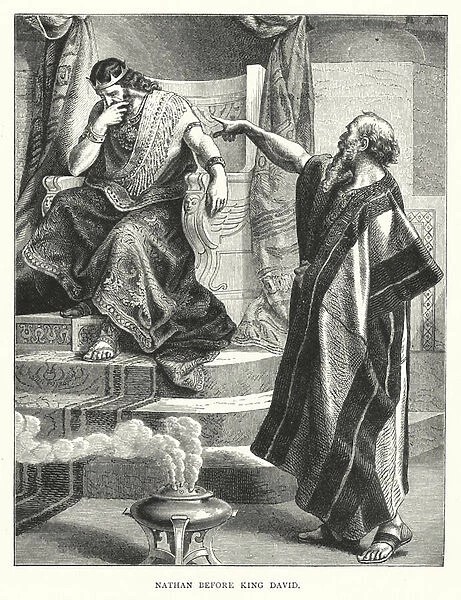
So Nathan goes to David,  and Nathan tells him a little story: he tells him a parable about a poor man and a rich man who stole the poor man’s only lamb. And to his credit, David hasn’t completely lost his sense of right and wrong. David says, “As the Lord lives, the man who has done this deserves to die.”  So, David can see the moral failure in the story; he just can’t manage to see it in the mirror.

This gets me to one of the first observations I want to make about sin. Sin can act like a kind of moral cataract, obscuring our ability to clearly see our own situation and the nature of our actions. Like King David, self-delusion is one of my superpowers. And because of the nature of sin and its ability to blur our vision, from time to time we all need a prophet Nathan to help us see ourselves more clearly.

And Nathan shows David some of the consequences of what he’s done. He says because you’ve taken the life of Uriah and taken his wife, the sword will never leave your house. And God tells him, I will raise up trouble against you from within your own house. God says, you did these things in secret but I will do them openly. And David comes to realize that he has sinned.

So, I think this story teaches us a few other things about the nature of sin. First, we think we can control it, but we can’t. The outcome of sin is unpredictable. Sin operates sort of like the science of forensics. When the bullet enters the body, it enters through a tiny hole, but as it travels through cartilage and bone it flattens and spreads and the exit wound is much larger and jagged.

Secondly, there are two people who haven’t done anything wrong in this story: Uriah and the child of David and Bathsheba’s union. Both of them will die. It would be nice if the only people who suffered because of sin were the guilty, but that’s not the way this world works. Sin has a gravitational pull and draws the innocent into it. Sin is unstable, and collateral damage is just part of its capricious nature.

Third, we hope that the harm done by our wrong will be comparable to the wrong done. Again, that’s magical thinking, an infantile hope. Because of sin’s unstable nature, the consequence of sin can sometimes be vastly disproportionate to the level of wrong done.

And the last observation I’ll make about sin comes from one of my favorite novels, The Great Gatsby. Fitzgerald wrote: “They were careless people, Tom and Daisy – they smashed up things and creatures and then retreated back into their money or their vast carelessness, or whatever it was that kept them together, and let other people clean up the mess they had made.” The point is this: in order to great harm, we don’t actually have to intend some evil plan; great harm and great suffering can result from our simple carelessness.

The more we understand about the nature of sin, the more perilous this world can seem, as though we were walking through a moral minefield, with nowhere safe to step. But there is a place we can go. There is a balm in Gilead, and there is mercy, and it is plentiful. We can trust in the practice of confession and absolution. We can turn to the Nathans in our lives, perhaps our confessors, perhaps our spiritual directors, perhaps a priest or a close friend. We can find all those right here at St. Mark’s Episcolopolus Church. And in a few moments, we can come to this altar, to take a bit of Jesus into our lives, maybe lay down some of our burdens there. And in that sacrament of repentance and forgiveness and renewal, we can start over again. Amen.

James R. Dennis, O.P. © 2024

The First Duty of Love


“I am the good shepherd. I know my own and my own know me, just as the Father knows me and I know the Father.” (The full readings for today can be found here.) In the name of the Living God, who is creating, redeeming, and sustaining us.

Well, good morning, everybody, good morning. You know, I’m not sure…no, I’m not sure at all. I’m not sure that I’m qualified to preach on this Good Shepherd Sunday. You see, my people were cattle people. They weren’t sheep people. And cattle people didn’t always get along with sheep people. By “not always,” I mean they never got along with each other.

And while there are a lot of differences between cattle and sheep, a couple of them come to mind. One of the biggest differences is that you can lead sheep, but you have to drive cattle. Unlike cattle, sheep will learn to follow. They build friendships and will stick up for one another. Like us, they are highly social animals, and when they are under stress or isolation, they become sad, and yes, even depressed. And they are very intelligent creatures; they recognize faces and voices. But like us, they will sometimes stray away from the herd, and need to be watched over.

In Jesus’ time, sheep were a mainstay of survival: they provided milk and cheese, and sometimes meat for the family and for sacrifices. They also provided wool for warm garments. But I think there’s something going on in John’s gospel than a discussion of first-century animal husbandry or livestock. I think this gospel reading is, at its core, about how we love, and how we are loved.

So, I think we should note a couple of things before we go on. And for this, I think we have to go all the way back to the beginning of John’s gospel, back to the very first time we meet this man called Jesus. You may remember that John was baptizing people in the river Jordan when he saw Jesus and shouted out: “Here is the lamb of God who takes away the sins of the world.” Now, lambs had been used as sacrificial animals for a long time by the Jewish people and were particularly associated with the holy feast of Passover.

We hear this same image, this same symbolic language in the last passage of John’s gospel, where the resurrected Jesus and Peter sit by a charcoal fire after breakfast.  And Jesus makes clear to Peter that Peter’s assurance of love carries with it a tender and sometimes difficult office, an obligation to feed his sheep. So, I want to suggest if we find this image being used in the beginning of John’s gospel, at the end of his gospel, and this morning pretty much in the middle of the gospel, we can probably safely assume that John thought this was important.

But as we read this, we might be forgiven if we have a moment of confusion. Is Jesus the lamb or the shepherd? Why is Peter feeding the sheep? Are we the sheep, or is Jesus the lamb? Quite frankly, it seems a bit complicated, and a little bewildering.

I think at least part of the answer lies, perhaps a bit veiled, in Jesus’ statement: “I am the good shepherd.” It’s one of what’s called the “I am” sayings of Jesus: you know, “I am the Bread of Life”, “I am the Light of the World”, “I am the vine,” and “I am the Good Shepherd.” In doing so, Jesus is aligning himself with a very old understanding of who God is. You remember the story from the Book of Exodus, when Moses asks God his name and God replies, “I am who I am.” For John, there is no difference between God and Jesus, the Word, the Logos. And for John, there is no difference between listening to Jesus and listening to God.

Jesus distinguishes his role from that of a hired hand. And at least part of the distinction has to do with how they react when the wolves come. Whether you’re a cattle person or a sheep person, you know about wolves. Lord have mercy, I believe we all know about wolves. You can find them in any walk of life—in business, in politics, and on our television screens. Sometimes those wolves come disguised as ambition or greed, sometimes as addictions, sometimes as failure, and sometimes as desperation.

You might argue that the distinction between the Good Shepherd and the hired hand is about their level of commitment. Perhaps the hired hand acts out of self-interest, while the Good Shepherd isn’t afraid of the wolves and understands his responsibilities. But I think there’s something more there. I think the Good Shepherd doesn’t run away when the wolves come because he acts out of something much more profound. Love, and only love, hangs around when the wolves come. Love, and only love, is willing to stand its ground when the situation gets risky. Only that kind of love is willing to lay down its life for the beloved.

Now, here’s the good news. We are the beloved. And Jesus is telling us that he loves us like that, that God loves us like that. And that kind of love doesn’t even ask what it costs, because it knows what it’s worth.
Later in this same Chapter of John, Jesus tells us “My sheep hear my voice. I know them, and they follow me.” I often wonder how well I’m listening for the voice of Jesus. When I get busy, when I get worried, or when I’m simply careless, it’s hard to hear.

You know, a very famous theologian named Paul Tillich said, “The first duty of love is to listen.” That’s worth repeating: “The first duty of love is to listen.” We have a lot of choices in this world as to which voices we’ll listen to. We can listen to the voices that tell us that our neighbors aren’t like us—voices that tell us that they’re not as smart as we are, or they’re freeloaders, or they’re dangerous. Or we can listen to the voices that tell us this world is full of risk and danger, that we might not have enough, or the voices that tell us that our lives will finally make sense if we just get that new car, that new outfit, that new iPhone, or earn enough to retire. We can listen to those voices that tell us that we’re not quite smart enough, not quite pretty enough, or not quite good enough.  

Or we can listen to the voice of the One who will never run away when the wolves come, the one who offers us forgiveness, the one who came to show us what an abundant life really looks like. We can listen to the One who laid down his life for us, who said he’d never leave us, who says he’s with us always, even to the end of time. That kind of voice, that kind of love, is hard to fathom; in fact, it’s one of life’s deepest mysteries.

We are sometimes told, “You are what you eat.” I think it’s equally true that we are what we listen to. The voices we hear can shape us in powerful ways. Genuine listening is an attitude of the heart, a vulnerability to the holy. If indeed the first duty of love is to listen, the choice we are compelled to make is which voice we are going to listen for. Maybe, just maybe, if we listen in love, we will hear the voice of the One who loves us limitlessly, who loves us fearlessly. Amen.

James R. Dennis, O.P. © 2024

The Border Crisis

Let it be done for you as you wish.” And her daughter was healed instantly Matt. 15:28. The full readings for today can be found here.

In the name of the Living God: by whom we are being created, redeemed and sustained.

          You know, I have met a lot of priests. Many of them are my friends. And to be honest with you, I’m really not sure why. Because they treat me so bad. They really do. When it’s time for the Good Samaritan, or the little baby Jesus in the manger, my phone is silent—as silent as a midnight graveyard. But when the lectionary rolls around to Jesus calling a woman with a sick child a dog, all my friends have a conflict: “Brother James, could you come preach for me this Sunday?”  And all the sudden my phone is ringing like the bells of Notre Dame.

          I want to talk about that, but I want to put this story in a bit of context. You know, I love borders. I have spent most of my life near the border, and spent 25 years living right on the border with Mexico. And one of the things I love the most is the intersection of two cultures, the way culture is porous, even when a border may not be. When you live near a border, you come to realize just how fluid and flexible borders can be.

We see it in our meals: I learned very early on that enchiladas and huevos rancheros and carne asada just made life better. We see it in our families, as blended families soften our hard hearts, and all a sudden that’s not just some immigrant, that’s my grandchild, or my uncle, my tio. And we see it in our language: words and phrases cross cultural boundaries with absolute sovereignty, with no constraints. So, in Mexico, if you need to leave your car to go shopping, you’ll look for el parquing, or for breakfast you might have a cereal called los confleis, and the device you use for with your computer is el maus. And it travels in both directions: Our words corral, ranch, stampede all came from Spanish. We have states called Arizona and Florida, and even the name of your own town, Blanco comes from the Spanish. Borders and the confluence of cultures are fascinating.

My favorite border story comes from Mother Teresa, who was crossing one day into Israel. The border guards there asked her if she was carrying any weapons, and she replied, “Oh yes. I have my rosary and I have my prayer books.”

So, this morning, we find Jesus crossing from Jewish territory into the area of Tyre and Sidon, into Gentile country, into the land of the Canaanites. You remember the Canaanites; they were the people in the Old Testament who continually worshipped idols and were always in fights with the people of Israel. They really didn’t get along with the Jewish people, in fact, Jews would routinely refer to these Gentile pagans as “dogs.” It was a commonly used slur for the Canaanites, but it seems shocking when we hear that slur being used by Jesus. We might ask ourselves, “Was Jesus just having a very bad day?” Maybe we begin to get a sense that something more is going on here when we look at Jesus’ family tree and find three Canaanite women there: Tamar, Rahab, and Ruth. As I said, the border changes things.

We learn just how elastic things are on the border when this woman cries out: “Have mercy on me, Lord, Son of David; my daughter is tormented by a demon.” So, here’s a gentile woman, who calls Jesus “Lord” and the “Son of David.” She may be a pagan, but she’s speaking a pretty solidly Jewish language. In this borderland, this woman doesn’t seem to fit any of the fixed markers of a pagan or a Gentile.

Jesus seems to ignore her, then tells her, “I was sent only to the lost sheep of the house of Israel.” In other words, I’m not here for you; you’re outside my borders. But then, the story begins to shift, and there’s an interesting shift in the plot. This woman, this Canaanite woman, kneels before Jesus and begs, “Lord, help me.” And things begin to change. They enter into a conversation.  It’s worth noting that Matthew says this woman knelt before Jesus.  

Jesus tells her that it wouldn’t be fair to take the children’s food and give it to the dogs. And it’s shocking, and it’s uncomfortable to hear Jesus say that. But maybe we should remember a couple of things here. First, remember from Matthew’s gospel the parable about the workers who showed up early in the morning getting paid the same as those who showed up late in the afternoon? I don’t think Jesus gave a hoot about what’s fair; I think he was fiercely indifferent to our ideas of fairness. I think Jesus knew God’s mercy was lavish, that there was enough of it for everyone. And I think this woman knew it, too. And as for the slur about calling this woman a dog, well, as we observed earlier, Jesus had a little “dog” blood in him, too.

And look at this woman’s response, in the context of how desperate she is for Jesus to help her daughter. She doesn’t get her feelings hurt, she doesn’t lose her nerve or her persistence. She tells Jesus even the dogs eat the crumbs that fall from the table. In other words, there’s enough for everyone to eat—to quote that old hymn, “There’s a wideness in God’s mercy.” In God’s economy, supplies of grace and blessings are not limited. God’s love and mercy cross every border we try to establish, skirt around all our barricades, and break down every wall. Now, here’s the tricky part: none of that was news to Jesus.

So, I want to pause that story and go back to the first part of our gospel today. Jesus is talking about the Jewish dietary laws, which are sometimes called the Purity Codes. And there were lots of these regulations, governing who you couldn’t spend your time with (like tax collectors), who you could and couldn’t touch (like lepers), and what you could eat and what you couldn’t eat. And all these rules operated as a kind of a border, a border between what was holy and the things and people that were not. And Jesus rejects this notion, he challenges this border.

Jesus tells us, it’s not what you put into your mouth, it’s what comes out of it that’s the problem. The problem isn’t what you eat; the problem is the slander and gossip and envy in your heart. So, your borders were all wrong. Holiness has a lot more to do with what’s in your heart than with what you eat. That’s the real border.

So, now we return to this woman, begging for Jesus to help her, to heal her child. And I think Jesus looked into her heart and knew that whatever border separated them, he was going to cross it. He tells her that she has great faith, and here I don’t think faith has anything to do with some intellectual proposition that she’s going to accept. I think it has to do with who she trusts. She is willing to give up her dignity, her pride, and her self-respect because she trusts that Jesus can help her daughter. And Jesus, having looked into her heart, is willing to cross the borders that separate them. He assures her that her prayers have been heard and answered.

So, I think it’s worth asking ourselves, “What are the borders that I have that separate me from God?” A lot of us have created a spiritual ghetto, isolated God and Jesus to an hour on Sunday morning. Jesus, you can have a bit of time while I’m in church, but I don’t want you coming with me to work, or when I’m arguing with my family, and I don’t want you getting into my politics, and I sure don’t want to see you on the golf course.

There’s a fellow named Russell Moore, who used to be a top official with the Southern Baptist Convention and is now the editor of Christianity Today. And he and several other pastors talked about preaching on turning the other cheek and preaching the Sermon on the Mount. And they were accosted by their congregation for preaching on “liberal talking points.” And when these pastors would reply “I’m literally quoting Jesus Christ” their congregations would answer “Yes, but that doesn’t work anymore. That’s weak.” Moore concludes that our church today is in a crisis, a crisis in which the teachings of Jesus Christ are considered subversive. I think that happens because some of us have created a border between Jesus and our politics.

And I think Moore may be right: we are in a crisis. But here’s the good news: if we trust Jesus, if we let him into our lives and take him seriously, he will knock down every false border we’ve created until there’s nothing left standing between us and God. Amen.

James R. Dennis, O.P. © 2023

Seeing with Eyes of Blessing

When Jesus saw the crowds, he went up the mountain . . . .Then he began to speak, and taught them. Matt. 5:1. (The full text for this morning’s readings can be found here.)

In the name of the Living God, who is making all things new. Good morning, good morning. I want to thank Father Holloway for asking me back again and thank you all once more for your generous hospitality.

You know, there’s an idea floating around in Christianity today, and it’s been around for a while. This notion still has a lot of adherents today, and you can hear many of them on television. But this doctrine is well summed up in a story that Oral Roberts used to tell. It goes back to a time in 1947 when Roberts was going through a time of crisis in his life and ministry.

Well, around this time, through a friend who owned a Buick dealership, Roberts was able to acquire a brand-new shiny Buick automobile. According to Roberts, the “new car became a symbol to me of what a man can do if he would believe God.” His first book on this topic was entitled “God’s Formula for Success and Prosperity.” Like I said, that notion is still running around today. And that idea, which suggests that God’s love for us can be measured by our financial well-being, is sometimes called the Prosperity Gospel.

And there’s a theological term for it. We call it poppycock. We call it gibberish; we call it balderdash. If you have any doubts about it, all you need to do is study today’s gospel—because that’s not what Jesus is saying. Not at all.

Now, this story appears very early in Matthew’s gospel. Jesus is baptized, he calls his disciples and then begins teaching and healing and the crowds start following him. And this story describes Jesus’ very first sermon, the first teaching that Matthew records. And Matthew wants to place Jesus in a historical context and a spiritual context. Like Moses, Jesus ascends to the mountain. Matthew wants to point his readers—us—to the notion that Jesus is the new Moses.

Rather than a tablet of laws, however, Jesus offers us a set of descriptions or signposts that point the way to the kingdom of heaven. Rather than a set of rules, he describes the surprising people that God treasures, and along the way shows us what a life with God would look like. They describe a divine reality we already live in, but can’t always see.

When we look at the world, any fool can see that meek don’t look very blessed. They didn’t inherit the earth then, and they’re still not inheriting it. And the merciful, they don’t seem to get much mercy. I’ve known way too many who mourn and they are still looking for their comfort. I’ve seen too many peacemakers laughed at, scorned and called unpatriotic. And those who hunger and thirst for righteousness, well, they’re still hungry and they’re still thirsty.

If we’re really honest as we look at the world today, we’d say something like blessed are the well-to-do, for they can send their kids to good schools. And blessed are the really attractive people in this world, because their road is going to be a lot easier. Or, too often, blessed are those without much of a conscience, because they will find a way to get it done even when it’s built on deception or hurting good people. If we’re honest, we have to admit that the world Jesus describes is not really the world we’ve made for ourselves.

But it can be. In one sense, I think these beatitudes are a daring protest against the world around us. Jesus is announcing: this is not how God meant for us to live. This is not how things have to be. God sees this world very differently than most people do. And if we want to share in this kingdom-vision, we can begin by reexamining our values and the people who are down on their luck. Because in God’s story, in God’s story, we find some very surprising heroes.

These beatitudes teach us that the people that God calls holy, the people that God cherishes, are those who are vulnerable. Not the spiritual whizkids, but the poor in spirit. This world admires those who are strong, follows those who are influential, and marvels at blustery braggarts. But those are not the people that God embraces.  

We can hear echoes of other parts of the gospel here. When Mary finds out she’s pregnant, she announces that God is going to scatter the proud and lift up the lowly. He will send the rich away empty and fill the bellies of the poor. He will pull the mighty from their seats and raise up the meek. Or maybe we hear the echo of Jesus saying that the first will be last and the last will be first. Or maybe we hear the resonance of Jesus telling us that the stone that the builder has rejected has become the cornerstone. All of us have experienced, at one time or another, that sort of rejection. We have all, at some time, been broken.

If we look at the people Jesus is talking about, the people this world rejects and calls losers, we find one common trait. They are vulnerable. The beatitudes teach us that the people God calls holy are broken people. And maybe that’s where we’ll find an insight into God’s mercy: it evades the appearance of perfection and reaches into the broken parts of the world to mend it. And maybe, just maybe, if we drink from the deep well of grace, we’ll learn to be like children, who show their scars like medals they’ve won.

I think that Jesus offered us these beatitudes, these blessings, to show us the world that God sees, to show us a vision that is too often clouded by the cataracts of sin and self-assurance.  The gospel text today begins with the idea that Jesus “saw” the crowds. There’s a world of difference between looking and seeing. I think Jesus turned his penetrating gaze right into the broken hearts and souls of those very ordinary people who were listening to him.

So maybe that’s the challenge of today’s gospel. Maybe we are called to look upon the broken people—the vulnerable people in this world—and see them as a blessing. Maybe this passage calls out to us to bless them, and be blessed by them. I think Jesus’ vision of the kingdom calls us to see the world through the lens of mercy, through the eyes of those with pure hearts, from the perspective of those who’ve experienced a terrible loss.

These blessings are a protest against the world-as-it-is, and a call for us to reshape our lives as a people who have experienced the gift of failure. Jesus teaches us that our full humanity lies along the road of loss and the messiness of want and longing. Our deep hope, as opposed to a superficial optimism, lies in learning to live with compassion.

Sometimes I look at God’s one, holy, catholic, and apostolic church, and I think it is the light of the world. And sometimes, I look at it, and I think it’s the Island of Broken Toys. And on my best days, on my very best days, I can look at it and see that it is both. Amen.

James R. Dennis, O.P. © 2022

Up to the Temple to Pray

“Two men went up to the temple to pray, one a Pharisee and the other a tax collector.”  Luke 18. (The full readings for today can be found here.)

In the name of our Living God, who is creating, redeeming, and sustaining us.  

Well good morning, good morning.

          You know, I love today’s gospel, and every time I think about it and about the spiritual danger of comparing ourselves to others, I remember a story my great grandfather used to tell.  It’s a story about two brothers, who like my great grandfather, came over from Ireland, from the old country. And the Flanagan brothers, well, they weren’t very nice men. In fact, they were terrible men. Although they were filthy rich, they were very stingy. They were terrible drunkards and beat their wives and children. Even the neighborhood dogs were afraid of the Flanagan brothers.

          Well, one day Tommy Flanagan died, and his brother Michael went to the parish priest. And Michael proposed a terrible bargain to the priest. He said, “Father, I know my brother wasn’t a good man, but I want people to think well of him. And I will give a million dollars to the church orphanage if you will tell people he was a saint at his funeral. But you must use those exact words, Father. You must tell them that Tommy was a saint.”

          Well, this caused a terrible crisis of conscience for the parish priest. He knew that the orphanage was deeply in debt and the children of the parish had a terrible need for that money. But he just couldn’t imagine lying about Tommy Flanagan and losing all moral authority with his parish. Well, the day of the funeral came, and the priest rose to the pulpit to give the homily.

          He said, “I knew Tommy Flanagan, I knew him all my life and I knew him well. He was a drunkard and a cruel man. He beat his children and his wife, and never came to Mass. He was stingy, and a bully, and a lout. But,” the priest said, “compared to his brother Michael, Tommy Flanagan was a saint.”

Like I said, I love this gospel because we find at least three aspects of this passage that are classic Luke. The first of these is the way in which Luke uses pairs to tell a story. Not long ago, we heard the story of Lazarus and the rich man, and last week we heard the story of the widow and the unjust judge. Luke begins the story this week: “Two men went up to the temple to pray….” The opening echoes with the resonance of another story from Luke: “A certain man had two sons….” And just like in the story of the prodigal son, when we hear that these two men went up to pray, we suspect there’s going to be some trouble.

Another aspect of this story that is classic Luke is the notion of inclusion. Luke’s gospel is the gospel of radical inclusion. In Jesus’ time, it was clear that there was a circle of holiness and some people were inside that circle and some people were outside of that circle—including women, lepers, those who were sick, especially tax collectors.

Tax collectors were particularly despised because they did not simply collect the amount of tax owed. Because the position was unpaid, they had to collect more than was owed to support themselves. They often used violence and extortion to collect the taxes. And most importantly, they were seen as collaborators, working with the occupying Roman government to suppress the people of Israel. Tax collectors were dreaded, and they were despised. But in Luke’s gospel, everyone is invited into the circle of holiness, and that includes tax collectors. Jesus eats with them; he even calls them his friends.

The third aspect of this story that marks it as squarely fitting into Luke’s gospel is the way it upends our expectations. Luke constantly does that. Jesus constantly does that. This story is sort of like one of those mirrors at the circus where our reflections are distorted. They’re still recognizable, but not at all what we expect. We’ve already talked about one of these, and Jesus upends our expectation that the tax collector would be the villain of the story.

A second expectation that is frustrated is the place where this story occurs—the temple. For most good, devout Jews in first century Palestine, the temple was the holiest place on earth. It served as the fulcrum of the world, the place where heaven and earth intersected. And I suspect if you asked Jesus about how he felt about the temple his feelings would have been richly and profoundly ambivalent. While he knew of its scriptural importance, he also knew of the ways in which the temple system had been compromised and corrupted.

So, the temple was traditionally a place where sacrifice was offered. Yes, it was a place of prayer, but one could pray most anywhere. The temple system was built on sacrifice and a transactional approach to washing away one’s sins or having one’s prayers answered. In Jesus’ story, however, rather than a place of sacrifice, the temple becomes a place of mercy. And rather than a system of merit, mercy seems to rain down upon some shockingly undeserving people.

And then Jesus capsizes our expectations about the Pharisee. He’s a fine specimen of a faithful churchgoer. We get the feeling that he prays often, he fasts regularly, and he gives money to the church. Honestly, that’s a good, solid spiritual regimen. He’d probably fit in well over at St. Elsewhere Episcolopolus Church; he might even fit in well here with us.

I suspect he really was a good guy, a decent sort, and a fine churchman. But he was blind to two critical issues: the source of his blessing; and the purpose of his blessing. He cannot see that the source of his blessing was not his own good character. And he cannot understand that all of his blessings were to be used for God’s purposes. Luke offers us a sharp contrast: the tax collector’s focus is inward (on his own sins and his failure to live a holy life), but the Pharisee is focused on others, and how they live.

We so often attempt to summarize our brothers and sisters in one glance, as this Pharisee does. And therein we find ourselves mired in a spiritual quicksand: the sin of dismissal. It points us to one of the greatest risks to our spiritual lives—comparing ourselves to others. I want us to examine the many ways we might compare ourselves to others: the books we’ve read, what we do for a living, where we went to school, the car we drive, our exercise regime, who we vote for, the neighborhood we grew up in, and where we go to church.

The Pharisee is convinced that he’s in good shape with the Almighty. His claim to righteousness is based upon his own accomplishments while the tax collector realizes his only chance is God’s mercy. Without that, he hasn’t got a prayer. In a classic upheaval of expectations, Jesus says “all who exalt themselves will be humbled, but all who humble themselves will be exalted.” It’s a close parallel to the idea that the first will be last and the last will be first.

          Jesus tells us that the tax collector, rather than the Pharisee, went home justified. In the Greek, that word “justified” carries a lot of connotations, including the connotation of having gone through a judicial proceeding. It means having been acquitted, restored, forgiven, made right, or rebalanced. Here, we find another inversion of what we expect because the Pharisee offers a number of justifications for his life and his goodness. The tax collector offers no defense. He can rely upon nothing other than God’s mercy.

          In one sense, learning to live without self-justification is a terrible burden. It leaves us vulnerable to the judgment of others, and vulnerable to our harshest critic, ourselves. In another sense, it’s terribly liberating because we come to realize that our justification or our salvation depends upon God’s mercy rather than our merit. And one of the things we can let go of, one of the things we must let go of, is keeping score. We don’t need to keep score against our brothers or sisters, or against God, anymore. It’s a hard lesson, my friends.  But this parable teaches us that in the spiritual life if you are keeping score, you have already lost the game. Amen.

James R. Dennis, O.P. © 2022

Go, and Do Likewise


Which of these three, do you think, was a neighbor to the man who fell into the hands of the robbers?” He said, “The one who showed him mercy.” Jesus said to him, “Go and do likewise.” The full readings for this service can be found here.

In the name of our God, the One who creates, redeems and sustains us.

A long time ago, in medieval Europe, they used to have what they called mystery plays. These dramas were often accompanied by a procession or a parade, and would depict scenes or stories from the Bible, particularly from the Gospels. Now, I do something like that in my neighborhood. Anyone who knows me knows that I have two dogs, and they’re not very good dogs at all. In fact, they are terrible dogs. I take them for a long walk at least twice a day, but they are ill-behaved and are committed to that bad behavior. And every now and then, we run across an animal that’s been hit by a car or killed somehow—a squirrel or a cat or a bird.

And my dogs always insist that we stop. They insist that we investigate and consider these incidents very carefully. Now, I’m not sure that they want to bandage up the creature’s wounds, or to carry the poor animal to an innkeeper and pay for its lodging. But I’m always trying to get them to keep walking, to move along, because there’s nothing to see here. I don’t know if that makes me the priest or the Levite in the story, and I’m not sure I like where this analogy is going so let’s get back to the Gospel.

So, Luke begins this fabulous story with a lawyer, a lawyer who wants to test Jesus. And this lawyer asks Jesus, “What must I do to inherit eternal life?” I want us to look at the assumption in this question. The assumption is that eternal life is somehow linked to something we do. And I think Jesus’ response will unsettle that assumption. Initially, Jesus answers with a question, and then he answers with a story. Neither directly answers this lawyer’s question, by which I mean Jesus’ response calls us into a discussion that goes beyond a simple answer. It calls us to walk with our rabbi, rather than simply solving a puzzle.

So, this lawyer asks Jesus to give him the secret to eternal life, and I love Jesus’ response. He asks him two very important questions: what is written in scripture; and what do you read there? In other words, Jesus asks him: (1) what is the text; and (2) how do you interpret it? Sometimes, I hear people say that they just want the plain meaning of scripture without any interpretation. We have a theological term for that idea: we call it “poppycock.” Every reading of Scripture requires our interpretation, requires that we bring our understanding filtered through our lives to the work. Our Bible is less like an encyclopedia and more like a chess partner against whom we struggle and sharpen our wits and moral sensibilities. Or, as Bishop Hibbs used to say, biblical fundamentalism is fundamentally unbiblical. Jesus recognizes that principle in his questions to the lawyer.

The lawyer has an answer at the ready; he knows his scriptures. He tells Jesus, “You shall love the Lord your God with all your heart, and with all your soul, and with all your strength, and with all your mind; and your neighbor as yourself.” The lawyer answers with a passage from Deuteronomy which is sometimes called the Shema, and a passage from Leviticus. Jesus replies, “You have given the right answer; do this, and you will live.” In other words, you already knew the answer. If you want to know what to do, do those things. And anybody would be happy with that answer. Anybody, that is, except a lawyer. So, now he wants to drill down, “But who is my neighbor?”

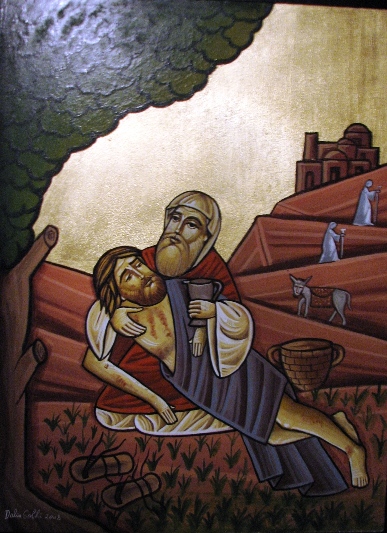
And Jesus answers this question with a story, a story about a man who was traveling from Jerusalem to Jericho. Now, we know that Jericho is the place where God knocks down walls, and Jesus is going to knock a few down himself with this story. We may have lost a bit of the geography here: the story takes place on the long, downhill road between Jerusalem and Jericho, a road also known at the time as the “Bloody Pass” or “The Way of Blood.”  The road meanders and the topography provides the perfect environment for an ambush:  a paradise for bandits and robbers.

So, I don’t think Jesus’ audience would have been surprised at all about the man being beaten, robbed, and left for dead on that road.  Nor would Jesus’ audience have been particularly surprised to hear Jesus tell them that the priest and the Levite both passed the man by, in fact, they walked by “on the other side” of the road.  (The laws of ritual purification at the time might actually have recommended this practice to devout Jews.)  We aren’t surprised by Jesus’ casting the priests and Levites in the role of the villains:  both Jesus and John the Baptist had been doing that for a while.

However, the notion that the Samaritan showed the quality of mercy, the notion of the Samaritan as the hero of the story, would have astonished and befuddled Jesus’ first-century audience.  The Samaritans and the Jews had despised each other for hundreds of years at the time Jesus told this story.  The Samaritans had desecrated the Temple with human bones.  The Jews reciprocated.  According to the Mishna (the first major work of Rabbinic Judaism), “He that eats the bread of the Samaritans is like to one that eats the flesh of swine” (Mishna Shebiith 8:10). So, hearing about a “good Samaritan” would have bewildered Jesus’ audience.  It would be the equivalent of a modern parable about the “good Klansman” or a “good member of the Sinaloa cartel,” or the “good fascist.”

The parable reports that the Samaritan came near to the man and was “moved with pity.” The Greek word here implies being moved to compassion at the deepest part of who we are. Thus, most of us assume the good Samaritan in the parable is like Jesus, or God, who loves inclusively with a kind of promiscuous empathy for everyone. But suppose for a moment that it’s actually God in the ditch, and the question is what are we going to do about it? And while the question the lawyer originally asked was about what we have to do for eternal life, suppose the real issue isn’t so much about what we do as it is about the kind of people we’re going to be. Are we going to be the kind of people who notice the suffering in the world around us and are moved by it, or are we going to walk on the other side of the road? I’m wondering who I didn’t notice? Who did I walk to the other side to avoid? Lord, spit on our eyes so that we can see.

In just a little while, we’re going to come up to this altar, and the priest will put a bit of bread into our mouths. And the Church spent a lot of time, and energy, and struggle, trying to figure out how the bread and wine actually become the body and blood of Jesus. And I have to tell you, I’m not really that interested in that question. But I am profoundly interested in the question of how you and I become the body of Christ in the world, and I think this parable holds a good part of the key.

This world is so polarized today. We want to fight about guns, about abortion, about race, about money, and about who’s got the moral high ground. Like the Jews and the Samaritans, we have been carrying these grudges along for so very long. And it may turn out that we really are in for the fight of our lives. Suppose, just for a moment, that learning to love our neighbors, learning to care for God’s children recklessly, really is the fight for our lives. It’s a great irony: the fight of our lives is learning how to love. As Bishop Monterroso recently observed, there are thousands and thousands of ways for us love our neighbor. There is only one way to love God; and that’s to love our neighbor. Amen.

James R. Dennis, O.P. © 2022

Divine Risk and the Work of Liberation

“What have you to do with me, Jesus, Son of the Most High God?” (The full readings for today can be found here.)

In the name of the name of the Living God, who is creating, redeeming, and sustaining us.

So, it’s a special day today, and I want to begin by telling you a story, or a couple of stories actually. I don’t know if y’all have noticed this, but whenever I mention that I’m going to tell a story, our clergy have one of three different reactions: sometimes they wince a little bit (the way one might wince sitting in the dentist’s chair as the drill approaches), sometimes, they close their eyes and wish they were someplace else, and sometimes they just bow their heads to pray.

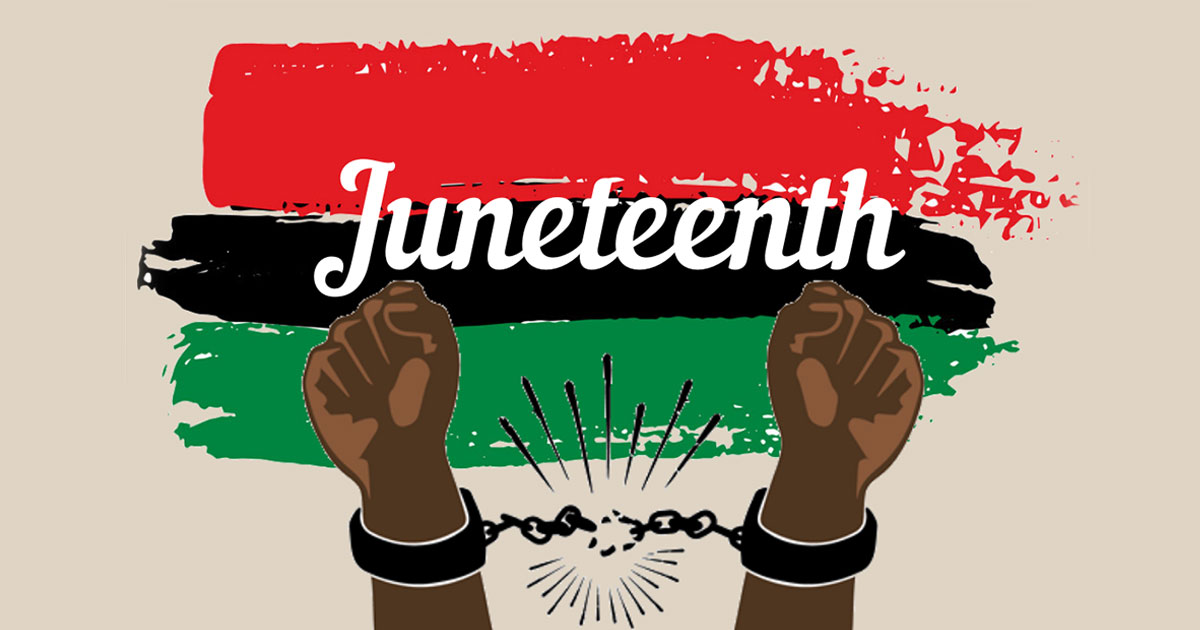
            Today is the nineteenth day of June, in the year of our Lord 2022. And it’s an important day in our history, but the story begins a bit before that. Way back on January 1, 1863, Abraham Lincoln delivered the Emancipation Proclamation. He announced that enslaved people held in the Confederate states were free. Now while that was a fine idea, for many of our enslaved brothers and sisters, it had very little meaning. Pronouncing our fellow countrymen free did not actually change their lives much, especially for those in the southern states. And here lies one of the great contradictions of our nation: we were born out of a yearning for liberty, conceived in language that exalted liberty, and built on the backs of men and women we kept in chains. It was, in short, our country’s original sin. And to proclaim it was over meant very little to the men and women who lived under the yoke of slavery.

            Here in Texas, that situation continued for another two and a half years. On June 19, 1865, just a few miles down the road in Galveston, General Gordon Granger finally arrived at the port of Galveston with Union troops. He delivered General Order No. 3 which provided: “The people of Texas are informed that, in accordance with a proclamation from the Executive of the United States, all slaves are free. This involves an absolute equality of personal rights and rights of property between former masters and slaves, and the connection heretofore existing between them becomes that between employer and hired labor.” Many of our African American brothers and sisters would have to wait still longer for their freedom, wait until the harvest was completed.

          And I want you to imagine all those years following the Emancipation Proclamation. “They tell me that we’re free, but it don’t seem no different to me at all.”  Or maybe, “I have heard rumors of my liberation, but nothing in my life tells me that’s true.” And I have heard those voices in AA meetings, and I have heard those voices as various groups (women, the poor, those subjected to human trafficking, and those suffering from addiction and frightening diseases) struggle for their dignity. And many years ago, that first celebration we call Juneteenth led the people to the Reedy Chapel, which is an AME church in Galveston. Because those people know it was not their enslavers who had liberated them; they knew they had been freed by their God.

          And it’s a very old story, that struggle for human dignity and liberation. Our Scripture records Moses going to Pharaoh and telling him that he must set the captives free. It seems that the divine plan, God’s intention for humanity, is intricately tied up with our freedom. And that brings us to the gospel for today.

          The gospel story has Jesus wandering far from his home, in the country of the Gerasenes. So, if we look at this story, let’s examine where Jesus is, and what he’s doing. He’s in gentile country, he’s in the tombs (which means ritual impurity), and he’s talking with a demon. He’s in an unclean land, in an unclean place, talking with an unclean spirit. This is the last place a good Jewish boy should be.

That region was also the site of a horrifying event in Jewish history, a terrible war crime. According to the historian Josephus, during the late 60s CE, toward the end of the Jewish revolt, the Roman general Vespasian sent soldiers to retake Gerasa. The Romans killed a thousand young men, imprisoned their families, burned the city, and then attacked villages throughout the region. So, many of those buried in Gerasene tombs had been slaughtered by Roman legions.

           As soon as Jesus crosses the Lake of Galilee and steps on shore, he is met by this man who is the victim of demonic possession. The portrait of this man is truly horrifying. He goes about naked and does not live in a home, but rather in the tombs. Luke is telling us that this man is more dead than alive. Mark’s account adds to this man’s torment. He tells us: “He lived among the tombs; and no one could restrain him any more, even with a chain; for he had often been restrained with shackles and chains, but the chains he wrenched apart, and the shackles he broke in pieces; and no one had the strength to subdue him. Night and day among the tombs and on the mountains he was always howling and bruising himself with stones.” Mark 5:3-5.

          So, it is this man, this tortured fragment of a man, who raises one of the most important questions in the Bible: He asks, “What have you to do with me, Jesus, Son of the Most High God?”  It’s a question most of us should ask, and ask regularly. What exactly is the role of Jesus in our lives? For this man, and I hope for many of us, Jesus has come to set us free. I’m wondering how well we know Jesus as liberator. This man, who is never named in the Gospels came to know Jesus as the man who set him free. And just as the Jewish homeland was occupied by Roman legions, this man was occupied by a legion of forces which robbed him of his full humanity.

          When Jesus asks the man to identify the spirits which had taken possession of him, he answers: “Legion,” for many demons had entered him. I don’t know about you, but I have heard the voices of those many demons. You see, the most dangerous message those satanic forces have for us is “This will never change. This will never get better.” I have heard those voices in those who struggle with addiction, and they are legion. We heard those voices as Vladimir Putin invaded Ukraine and we saw thousands of refugees forced to leave their homes. And they are legion. We heard those voices use scripture, our holy book, to justify the chains on the enslaved people in the American South. And they are legion. We hear those voices every time there is another mass shooting, and we are paralyzed because some of us are committed to the notion that that’s just how things are. And those voices are legion. And we have heard the voices of anger and grievance in our political discourse, and they are legion.


            As was the case on that morning in Galveston in 1865, as was the case that morning in the country of the Gerasenes, the divine movement is always a movement of liberation. Let me say that again, the divine movement is always a movement of liberation. We should not confuse this movement as a license to do whatever we want. We know that the movement of liberation is of divine origin when it calls us, not as a charter or privilege for a disordered freedom from all constraint, but rather the liberty to become the people God intended for us to become, the freedom to become fully human. We find the intersection of the divine and the human impulse toward liberation when we hear the call toward becoming more deeply human and restoring our brothers and sisters to the imago dei, the image of God in which they were created.

            Jesus understood this was his mission—to release the captives, to let the oppressed go free. But we profoundly misunderstand our faith if we think that we should sit back and applaud this work of Jesus from a distance. Christianity, my brothers and sisters, is not a spectator sport. I’m always amazed when we give the newly baptized a candle. We should give them seat belts and a crash helmet. Because that work of casting out the demonic forces in the world, that work of setting the captives free and restoring men and women to God’s vision for them—that’s our work now.
            Amen