Tag Archives: Incarnation

My Lord and My God!

But Thomas (who was called the Twin), one of the twelve, was not with them when Jesus came. So the other disciples told him, ‘We have seen the Lord.’ But he said to them, ‘Unless I see the mark of the nails in his hands, and put my finger in the mark of the nails and my hand in his side, I will not believe.’

A week later his disciples were again in the house, and Thomas was with them. Although the doors were shut, Jesus came and stood among them and said, ‘Peace be with you.’ Then he said to Thomas, ‘Put your finger here and see my hands. Reach out your hand and put it in my side. Do not doubt but believe.’ Thomas answered him, ‘My Lord and my God!’  John 20: 24-28.

On December 21, the church celebrates the Feast of St. Thomas, sometimes known as the Doubting Thomas.  This feast day may seem like a bit of an interruption in our Advent preparation, but I hope to convince you that it makes perfect sense.

For the past few weeks, we’ve been discussing the Incarnation.  Of course, the Latin root of that word is carnis, which means meat or flesh. So, the term Incarnation means that God became flesh and bone, that the immortal became mortal, that the spiritual became physical. God, in a sense, consecrated humanity by entering into our history.  

This was  not, however, some metaphysical entry, nor some encounter with an ethereal spirit.  No, Scripture tells us that Christ was born into human history, born among the animals in a stable or a cave or a stall.  This Incarnation was lowly, mean and decidedly real.

Similarly, in this story of St. Thomas, we learn that even the resurrected Christ bears the scars of his entry into human history, of his encounter with human sin.  Thomas doubted the reality of the resurrected Christ, and would not permit himself to believe until he saw the marks of that encounter in Jesus’ flesh.

I don’t think we should judge Thomas too harshly.  Most of us will face serious doubts at one point or another, and maybe face them again and again.  Perhaps because of my Jesuit education, I’m inclined to think a rigorous examination of our faith is healthy.  Otherwise, we consign ourselves to something I believe is perhaps more dangerous, a faith that is five miles wide and a quarter- inch thick.  Many of us have prayed, in some desperate hour, “Lord, I believe; help my unbelief.”  I certainly have, and so feel  a certain spiritual kinship with this good Apostle.

“Then Thomas answered him, ‘My Lord and my God!'” I think the point of this Gospel reading is not so much how Thomas came to the conclusion, but that he ultimately reached the conclusion of the  sovereignty and divinity of the Incarnate Word. 

So, we’ve been talking about what Advent means, in terms of the triumph of hope and promise over desolation and darkness.  Advent calls us to look beyond what John Newman called “the shadows and deceits of this shifting scene of time and sense”.  And as we approach again the entry of Jesus into the world, we hear Christ calling to us, “Do not doubt, but believe.” 

Emmanuel, God is with us.

James R. Dennis, O.P.

 © 2011 James R. Dennis


St. John of the Cross On the Incarnation

Because today is the feast day of St. John of Cross, and we’ve been meditating on the mystery of the Incarnation, I thought we might look at what he had to say on the subject.  In the Eighth Ballad, he wrote:

Then he summoned an archangel;
Saint Gabriel came,
And He sent him to a maiden,
Mary was her name,

Whose consent and acquiescence
Gave the mystery its birth;
It was the Trinity that clothed
With flesh the Living Word.

Though the three had worked the wonder
It was wrought in but this one,
And the incarnated Word
Was left in Mary’s womb.

And He who had a father only
Now possessed a mother,
Though not of man was He conceived
But unlike any other.

And deep within her body
His life of flesh began:
For this reason He is called
The Son of God and Man.

The poem properly focusses on the figure of Mary, by whose acquiescence the mystery of the Incarnation begins.  In many ways, Mary operates as the lynchpin of the season of Advent.  Our Orthodox brothers and sisters call her the Theotokos, or God-Bearer. 

During this season of Advent, we might properly reflect on what it means to be pregnant with God.  I suggest that we consider that, not only as it pertains to the Holy Mother, but also as it pertains to each one of us.  What does it mean for you and I to bring God into the world, a world which is sometimes hostile and often indifferent to Christ?  And while we’re doing so, as with any expectant parent, we might properly wonder just what this event will cost.  How do we carry Jesus into the places where, as with Bethlehem so long ago, there’s just no room for Him?

Part of the mystery of the Incarnation, part of the wonder of belonging to the Body of Christ we call the Church, lies in the recognition that Christ must live within us.  Somehow, through the enigma of God coming to live among us, our very DNA has changed.  St. Paul recognized this, writing:  “I no longer live, but Christ lives in me.”  Gal.  2:20.   Paul reminds us that following Christ does not so much hinge on an intellectual assent to a certain doctrine  as it does on surrendering to Christ’s indwelling within us and allowing Jesus to re-make us.

Our Advent hope lies in recognizing that God’s entry into the world is not an event that took place a couple of thousand years ago, and which made things a bit more bearable.  Rather, the very fabric of time and space have changed.  God has and will re-create all things (including you and me) through this Son of God and Man.

Have a good and holy Advent,

James R. Dennis, O.P. 

© 2011 James R. Dennis
Binding Up the Brokenhearted

The spirit of the Lord GOD is upon me,
           because the LORD has anointed me;
he has sent me to bring good news to the oppressed,
          to bind up the brokenhearted,
to proclaim liberty to the captives,
          and release to the prisoners;
to proclaim the year of the LORD’s favor,
          and the day of vengeance of our God;
          to comfort all who mourn;
to provide for those who mourn in Zion—
          to give them a garland instead of ashes,
the oil of gladness instead of mourning,
          the mantle of praise instead of a faint spirit.  Is. 61: 1-3.

In many respects, this passage from the book of Isaiah provides the perfect Advent reflection.  It gathers up many of the emotions of the people of Israel after the Babylonian exile.   King Nebuchadnezzar and his army had destroyed the Temple, the place where God and man intersected.  Many had been sold into bondage; families were scattered and broken.  The Jews had been humiliated and these were “the worst hard times”.    And Isaiah rose to tell them God remained with them, somehow, in all this mess.

Isaiah refers back to the book of Leviticus, to proclaim the year of jubilee.  (In the year of jubilee, which occurred every fifty years, the prisoners were released, and all debts were forgiven. )  We see this theme running throughout Scripture (both the Old and New Testaments):  God comes to shower his blessings on those whose spirits have been crushed and whose hearts have been broken.  God’s focus doesn’t rest on the superpowers, the wealthy, the priests or the religious elite.  Isaiah thus proclaimed that God was at work; the days of sorrow were over and the days of joy had begun.

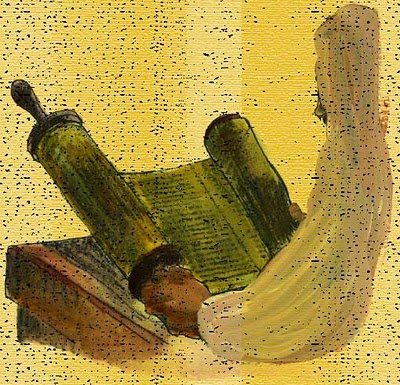
 This passage from Isaiah should sound very familiar to Christian readers.  This is the exact passage Jesus reads from in the synagogue when he returns to his hometown, Nazareth.  When Jesus read from this scroll, he announced:  “Today this scripture has been fulfilled in your hearing.”  Luke 4:20.  I think this reveals two important messages.  First, it tells us a good deal about Jesus’ understanding of his mission.  He came to bind up the brokenhearted, to release the prisoners and set the captives free, and to bring sight to the blind.

 If we take the Incarnation seriously and believe that we really are the body of Christ the second message of this Scripture becomes clear:  if we follow Jesus, this is our mission as well.  Because of the Incarnation, our task is clear:  we are to tend to the brokenhearted, the blind, those who mourn, and those who are enslaved.  Sometimes, those conditions may be literal, and sometimes they may be spiritual.  Either way, that’s the purpose and the proper function of the Body of Christ.

Thus, Advent announces something deeply joyous, a joy that reaches far beyond our understanding.  As Rabbi Heschel once wrote:

There is not enough grandeur in our souls
To be able to unravel in words
The knot of time and eternity.
One should like to sing for all men,
For all generations…
There is a song in the wind
And joy in the trees.

Our joy approaches, and the whole earth quickens as the Word nears.

Shabbat Shalom,

James R. Dennis, O.P.

 © 2011 James R. Dennis
The Last Prophet

Now the time came for Elizabeth to give birth, and she bore a son. Her neighbors and relatives heard that the Lord had shown his great mercy to her, and they rejoiced with her.

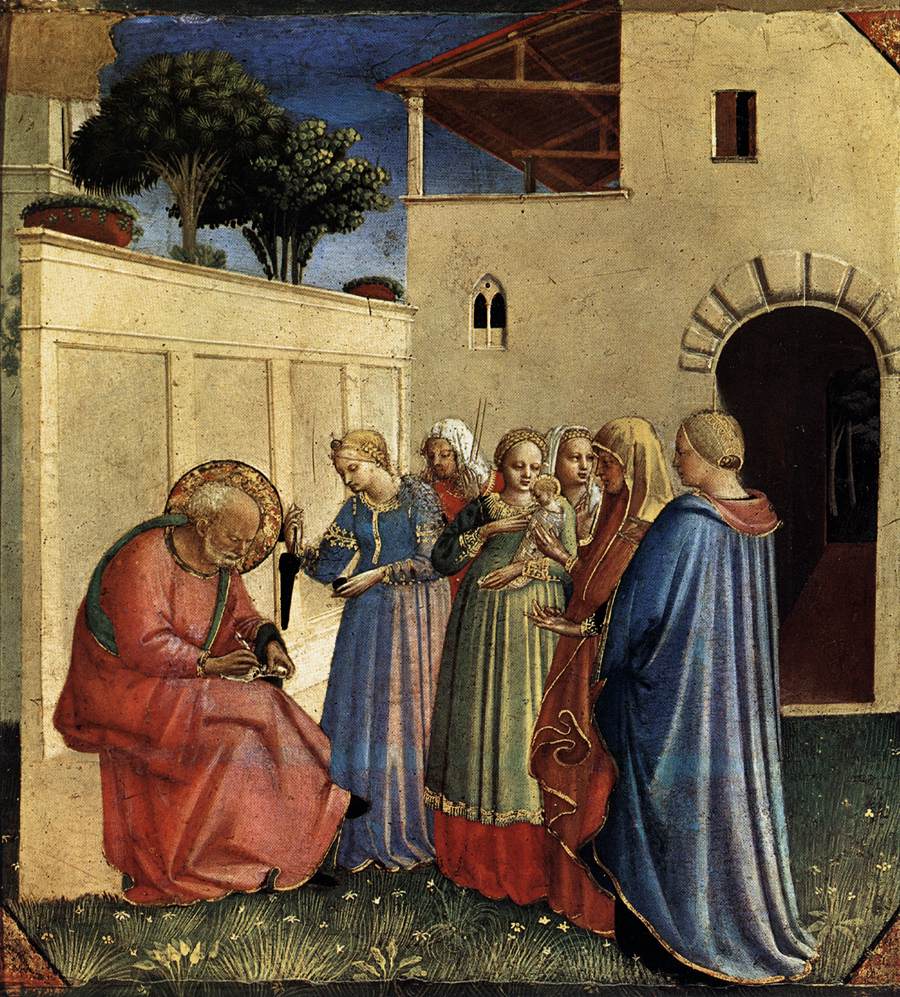
On the eighth day they came to circumcise the child, and they were going to name him Zechariah after his father.  But his mother said, ‘No; he is to be called John.’  They said to her, ‘None of your relatives has this name.’Then they began motioning to his father to find out what name he wanted to give him.He asked for a writing-tablet and wrote, ‘His name is John.’ And all of them were amazed. Immediately his mouth was opened and his tongue freed, and he began to speak, praising God.  Fear came over all their neighbours, and all these things were talked about throughout the entire hill country of Judea.  All who heard them pondered them and said, ‘What then will this child become?’ For, indeed, the hand of the Lord was with him.  Luke 1:57-68.

In today’s Gospel reading in the Daily Office, we find the story of the birth and naming of John the Baptist.  This bit of Scripture provides us with a wonderful Advent reflection on  John, who our Orthodox brothers and sisters call The Forerunner.  It’s a remarkable story.

As you’ll remember, John’s father (Zechariah) was a priest.  The angel Gabriel appeared to Zechariah, explaining that his wife Elizabeth would bear a son named John, a son who would turn the people of Israel’s hearts to the Lord.  When Zechariah expressed his disbelief, he was struck dumb. 

For months, Zechariah remains dumb-struck in this God-imposed silence.  (Sometimes, it seems, even God wants priests to remain silent.)  We shouldn’t judge Zechariah too harshly, though, because nothing that was happening was….well, natural. I sometimes think Zechariah was struck dumb mostly because he continued to cling to his hopelessness, even when his better angels told him there was good cause to trust God and hope for a better world.

Although tradition dictated that the child would bear a family name, Zechariah insistently scribbled on a writing-tablet:  “His name is John.”  Scripture teaches that Zechariah’s speech returned immediately, and he proclaimed that God’s redemption of his people was at hand.

The story provides several important Advent messages.  First, Elizabeth (who was elderly and barren) will produce a child, just as a world which had become stale and ordinary and barren of meaning will produce something completely new.  Zechariah, speechless through his disobedience, recovers all that he has lost by listening to the Lord.  (He recovers his speech at his son’s circumcision, a rite which operated as a sign of the covenantal relationship between the people of Israel and the God who chose them.)   Within the loving covenant God calls us into, life springs up in the desert, and all we’ve lost will be recovered.

The story serves as an extended metaphor for what’s going on in the Incarnation.  God is breaking into this broken, handicapped, barren world.  He is re-defining what is “natural”; in other words, re-making all of creation.  This isn’t just an ocasional miracle in a world that otherwise remains the same.  With apologies to the advertising industry, “This changes everything.”

The birth of John, often referred to as the last of the Old Testament prophets, signals that God is redeeming and reclaiming all of creation.  It teaches that we cannot rely on the old rules or our old expectations anymore.  Thus, during this time of year when the days are shorter and the darkness seems to dominate time itself, we light an Advent candle.  We know things are about to change.

Shabbat shalom,

James R. Dennis, O.P.

© 2011 James R. Dennis

The Feast of the Holy Cross

Today, on the Feast of the Holy Cross, I thought I’d share a thought from one of our Franciscan brothers.

“God wants useable instruments who will carry the mystery, the weight of glory, and the burden of sin simultaneously, who can bear the darkness and the light, who can hold the paradox of incarnation–flesh and spirit, human and divine, joy and suffering at the same time, just as Jesus did.”

–Fr. Richard Rohr, Things Hidden

Pax,

James R. Dennis, O.P.