Tag Archives: Faith

A Great Chasm

Now he is comforted here, and you are in agony. Besides all this, between you and us a great chasm has been fixed…. (The full readings for this morning can be found here.)

In the name of the Living God, who is creating us, redeeming us, and sustaining us.

Well, good morning, everybody. So, in today’s gospel we encounter a man who’s having trouble with the afterlife and is concerned for his family. Whenever I hear this story, I think about a family we knew back in West Texas, the Beauchamp brothers.

Now, they were not nice people. In fact, everybody in the whole county knew the Beauchamp brothers. In business they were crooked, mean and cold-blooded. Well, one day, the older brother, Howard Beauchamp, he up and died. The younger brother, Ronnie, wanted to make sure that Howard got the finest funeral there had ever been in the county. He went down to the funeral home and bought a fine cherrywood coffin with silver hardware. Then he went to go see the minister.

The little church there was not doing so well. In fact, it was kind of falling apart at the seams. The air conditioner was old and tired, and the roof struggled to keep out the rain. Well, Ronnie Beauchamp, he went to the minister, and he offered him the Devil’s own bargain. He said, “Pastor, I will give your church half a million dollars if you will preach my brother’s funeral and tell everyone he was a saint.” Well, this was a real conflict for the preacher, because the church really needed that money, but he couldn’t lie from the pulpit.

So, the day of the funeral came around, and the whole town was there as the minister began to preach the funeral sermon.  He said, “The man you see in this coffin was a vile and debauched individual.  He was a liar, a thief, a bully, a great sinner, and he broke his mama’s heart.  He destroyed the fortunes, careers, and lives of countless people in this county, some of whom are here today. This man did every dirty, rotten thing you can think of.”

“But, the preacher added, … compared to his brother, he was a saint.”

Now, before we go any further, I want to make a couple of things clear. The passage we are reading isn’t a theological guide about how to get to heaven or how to avoid hell. This passage is one of Jesus’ parables—a riddle or a fable. So, I don’t think the rich man went to Hades because he was rich. And I don’t think Lazarus went to heaven because he was poor. But I do want us to start thinking this morning about the various chasms we encounter: chasms that separate us from each other, the gulfs between us and God—the chasms we come upon, and the chasms we help create.

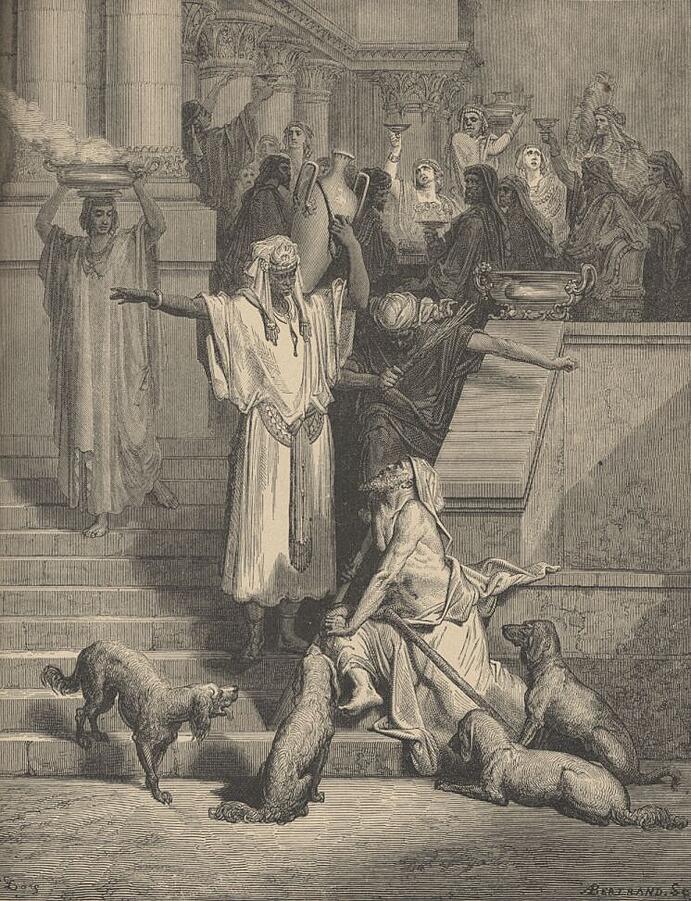
One of the first places we notice a gap, or a distance, is between the circumstances of these two men. We are told that every day, the rich man ate luxurious meals, and he wore fine linen and purple. On the other hand, we can imagine Lazarus in rags, and we’re told he’s covered in sores. He’s also starving, and dreams of eating even the crumbs or scraps from the rich man’s meals.

And although their lives were very different, they did not live far away from each other. In fact, Lazarus lived just outside the rich man’s gate. But we get the feeling the rich man never noticed Lazarus. In fact, I get the impression that the rich man had become quite adept at ignoring Lazarus at the gate, a kind of studied disregard, a well-rehearsed apathy. So, their lives on earth were very far apart; they were separated by a great economic and social chasm.

Then, when the two men die, we have one of those classic reversals of fortune that Luke loves. It’s already happened right from the outset of the story. You see, we know the name of the poor man in the story—his name is Lazarus, which means God’s help. We don’t, however, know the name of the other character; he’s just some rich guy. That’s not how things normally work. We remember the rich and the mighty, and too often the names of the poor and the hopeless are forgotten.

But when their earthly lives are over, the angels carry Lazarus to the bosom of Abraham. In other words, he has a place of peace and comfort and honor among the righteous dead. The rich man, however, finds himself being tormented in Hades. There’s a considerable distance, a chasm, between their circumstances. But even from the fiery pit, the rich man doesn’t seem to recognize his new situation yet. He’s still treating Lazarus like a slave. You see, the biggest lie the devil ever told us is that some lives are worth more than others, that some people are more important than others.

The rich man asks Abraham to send Lazarus with just a bit of water on his finger to ease the rich man’s suffering. Once again, here’s that Lucan reversal of fortune. Abraham tells the rich man: “Child, remember that during your lifetime you received your good things, and Lazarus in like manner evil things; but now he is comforted here, and you are in agony.”

The bigger problem, Abraham explains, is that vast chasm between Lazarus and the rich man. Now, maybe Jesus was trying to tell us that heaven is a long, long way away from hell, but I don’t think so. I think the distance between Lazarus and the rich man is simply the echo and amplification of the separation the rich man created while they were alive. In other words, to borrow an idea from Charles Dickens, they wear the chains they forged in life. Jesus reminds us that there is a deep and profound connection between how we live in this life and how we live in the next life.

So, what are we supposed to do with this passage? What am I supposed to do about the homeless man that I drove by on my way to church this morning? Am I supposed to give him a dollar? Buy him a meal? Pay for him to spend a night in a hotel room? If I do that, will Jesus let me into heaven?

I think the very last thing Jesus wanted to do in his parables was to give us easy answers to these questions. I think we were meant to struggle with this issue, to learn to listen to Moses and the prophets. I also think we have to find a way to close the tremendous gaps between ourselves and our brothers and sisters. We all know about the terrible gap of wealth inequality, and we saw the political distance widen in this country after Charlie Kirk was killed and both parties clawed at each other desperately for a spot on the moral high ground

My friends, as Doctor King warned us, “We must learn to live together as brothers and sisters or perish together as fools.” We know about the chasm between God’s children. I think the biggest chasm I have to struggle with every day is the gap between the man I am and the man I want to be, the distance between the life I’m leading, and the life Jesus wants for me.
I think the first thing is that we notice how deeply, how profoundly, God cares for the poor. This morning, the Psalmist tells us happy are those:

Who give justice to those who are oppressed,
and food to those who hunger.
The Lord sets the prisoners free;
the Lord opens the eyes of the blind;
the Lord lifts up those who are bowed down.

A friend of mine puts it a little differently. He likes to tell me that no one gets into heaven without a letter of recommendation from the poor.

Secondly, I think we have to find a way to bridge the gap between us and the broken-hearted of this world. We must find a way to reach across to those who are hungry, to those who live in hopelessness. And we’ve got to quit asking whether they deserve our help, our charity. Quite frankly, that is none of our business. God will figure that out.

I do believe charity is important, and yes, the rich man fails to tend to, or care about, the needs of Lazarus. But there was a sin that came before that, an earlier fault that made all the others possible. He didn’t even notice Lazarus. He didn’t notice the man at his gate. I don’t want to think about the number of times I’ve turned my glance away from the homeless and the poor. And the failure to notice them robs us of any chance we have to make a difference in their lives, to make a friend. So maybe we should begin by noticing them, and I mean this quite literally, for the love of God, notice them. Maybe if we go out of our way, just a little bit, we might learn to share our resources, and more importantly, to share our hearts. Amen.

James R. Dennis, O.P. © 2025

Things Hoped For

“Now faith is the assurance of things hoped for, the conviction of things not seen.” (The full readings for this morning can be found here.)

In the name of the living God, who is creating, redeeming, and sustaining us. Amen. Well good morning, good morning. I thought this morning we’d talk about faith, about different ways some folks have of understanding faith, and about what the scriptures can teach us about that.

When I think about faith, I am often reminded of my great great grandfather. You see, he had come to America from the Old Country, from Ireland. He settled for a while in the Boston area. And he was a very busy man, but a very devout man. Well, one day he had an appointment with the bishop, and he was running late. And there was no place left to park.

As I said, he was a very devout man. And he looked to the heavens and prayed. He said, “Lord, you know I’m here to see the bishop. You know I can’t be late, Lord, and you know there’s no place for me to park. So, I’ll tell you what I’ll do, if you help me find a parking place, I’ll go to mass every day for a month. He looked and there were still no places. And so he added, “And Lord, I’ll give up the whiskey.”

Well, it was a cloudy day that afternoon in Boston, but all of a sudden, the skies parted, and a bright beam of sunshine opened up to reveal a single parking spot right in front of the cathedral. And my ancestor looked up to heaven and said, “Never mind, Lord. I found one m’self.”

So, I want to suggest something to you, at least a starting premise for us to work from. I want to suggest that faith is much more about who we trust, or where we place our trust, than about what we believe. I’ll say that again: I wonder whether faith isn’t much more about who we trust, or where we place our trust, than about the ideas we have decided to accept.

Let’s look at a couple of examples that might help with that distinction. We all remember the story of Noah and the flood. The earliest claims of having found the Ark in which Noah sought shelter from the flood date back to around 700 BC. Since then, hundreds of people have claimed that they found the ark. Recently, one group is using ground penetrating radar at the Durupinar formation in Turkey and claim to have found the remains of a preserved vessel. But does that have anything to do with faith? If we could scientifically prove this was the ark, and found trace DNA from Noah, would our lives in faith be better?

If we could absolutely prove the story of Noah and the flood, we might have a very fine argument or some fascinating dinner conversation—we might even have some certainty.  But certainty is not an environment in which faith thrives. Because faith, the scripture teaches us, is the conviction of things not seen. Our discovery of the ark might prove something we could all see with our eyes, but faith looks beyond the visible, the provable, to what can only be seen with the heart.

Let’s examine question, the very old question of which religion offers us the surest path to salvation. So, we have been fighting about our beliefs for a long time: about whether you could have pictures of Jesus in the church, about calculating the date of Easter, and about how Jesus really really gets into the communion host. In the 1960s, one group of the Amish community separated from the main body of the Amish over the question of whether one could wear buttons, or whether one could only be true to their religion by fastening their clothes with hooks and eyes.

We can believe all sorts of things: our beliefs are the conclusions we are led to by our rational minds, the conclusions of our thinking. We can believe that our safety lies in our military might—nuclear submarines that can wipe our enemies off the map. Or you might belief in an afterlife in which all the meals are composed of chocolate cake and crème brûlée, where the streets are made of peanut brittle. Or maybe you believe the government is listening to our every thought through a complex system of internet connections, cell phones, and vaccinations.  I don’t really care whether you think  UFOs come down each summer to swim with the Loch Ness Monster and discuss how we faked the moon landing. You might believe that our salvation only lies in eating unleavened bread while listening to the Star-Spangled Banner and staring at an isosceles triangle.

I am not especially concerned with what you believe: Beliefs change; they are constructs of our mind. So, I’m not especially concerned with that. But I am profoundly concerned with your faith, with the place where your trust abides, and how that trust shapes the way you live your life.

That kind of faith reshapes the world and makes it ready for God’s word to vibrate through creation. This is a music that can only be heard with the heart, a music that assures us that God knows of our deepest hopes. Abraham heard that music of faith, and followed God when God told him to leave behind his home and everything he’d ever known. Abraham trusted God when God told him he would have children, even though both he and his wife were too old. And even when God asked him to give up his only son, Abraham trusted God and knew that somehow it would all work out right.

So, I’ll tell you a secret. I think that kind of trust, that deep faith or “assurance of things hoped for,” usually comes only after you’ve had your heart broken a time or two and learned where you can find shelter—who you can depend on, what you can trust. That kind of trust will necessarily influence our actions, influence how we walk through the world. In our modern world, faith (or trust) is so very hard to come by. We have become so jaded, so suspicious of each other and our institutions.

Back in the earliest days of the Church, those first Christians knew about sorrow, and suffering, and broken hearts. And it took them about 300 years to articulate who they could turn to, who they could trust. And they gathered together to work out their ideas down at a place called Nicaea. We still say their prayer, and we’ll recite it in just a moment.

They said they trusted God, “the maker of heaven and earth, of all that is, seen and unseen.” Do you hear that prayer echo in the reading from Hebrews: “the worlds were prepared by the word of God, so that what is seen was made from things that are not visible.” They trusted in Jesus, Mary’s boy, who promised he would be with them until the end of time. They had faith because Jesus told them it pleased his Father to give them the kingdom. The had faith in the Spirit which had moved across the waters, the Spirit which came upon them in baptism, and the Spirit which had inspired their Scriptures. And they trusted the Church, although they knew that from time to time a particular instance of the church might let them down.  But that’s not where their faith abided; no, they trusted in the whole church, which is the mystical body of Christ.

The great J.M. Barrie, who wrote Peter Pan, said, “All the world is made of faith, and trust, and pixie dust.” That sounds just about right. I know I have great hopes for us. That hope is invisible, but I am assured of it. “Lord, I believe. Help my unbelief.” Amen.

James R. Dennis, O.P. © 2025

The First Duty of Love


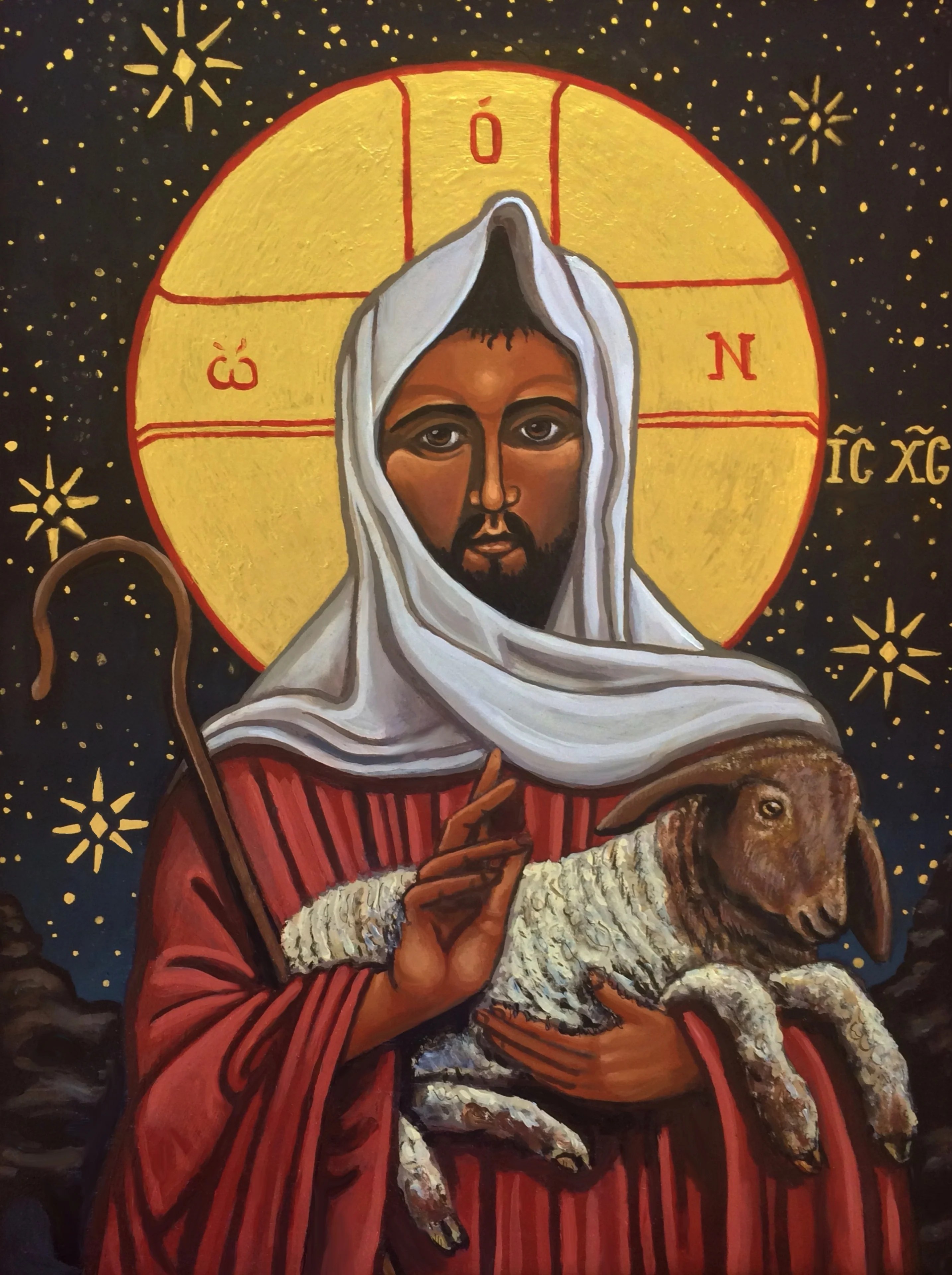
“I am the good shepherd. I know my own and my own know me, just as the Father knows me and I know the Father.” (The full readings for today can be found here.) In the name of the Living God, who is creating, redeeming, and sustaining us.

Well, good morning, everybody, good morning. You know, I’m not sure…no, I’m not sure at all. I’m not sure that I’m qualified to preach on this Good Shepherd Sunday. You see, my people were cattle people. They weren’t sheep people. And cattle people didn’t always get along with sheep people. By “not always,” I mean they never got along with each other.

And while there are a lot of differences between cattle and sheep, a couple of them come to mind. One of the biggest differences is that you can lead sheep, but you have to drive cattle. Unlike cattle, sheep will learn to follow. They build friendships and will stick up for one another. Like us, they are highly social animals, and when they are under stress or isolation, they become sad, and yes, even depressed. And they are very intelligent creatures; they recognize faces and voices. But like us, they will sometimes stray away from the herd, and need to be watched over.

In Jesus’ time, sheep were a mainstay of survival: they provided milk and cheese, and sometimes meat for the family and for sacrifices. They also provided wool for warm garments. But I think there’s something going on in John’s gospel than a discussion of first-century animal husbandry or livestock. I think this gospel reading is, at its core, about how we love, and how we are loved.

So, I think we should note a couple of things before we go on. And for this, I think we have to go all the way back to the beginning of John’s gospel, back to the very first time we meet this man called Jesus. You may remember that John was baptizing people in the river Jordan when he saw Jesus and shouted out: “Here is the lamb of God who takes away the sins of the world.” Now, lambs had been used as sacrificial animals for a long time by the Jewish people and were particularly associated with the holy feast of Passover.

We hear this same image, this same symbolic language in the last passage of John’s gospel, where the resurrected Jesus and Peter sit by a charcoal fire after breakfast.  And Jesus makes clear to Peter that Peter’s assurance of love carries with it a tender and sometimes difficult office, an obligation to feed his sheep. So, I want to suggest if we find this image being used in the beginning of John’s gospel, at the end of his gospel, and this morning pretty much in the middle of the gospel, we can probably safely assume that John thought this was important.

But as we read this, we might be forgiven if we have a moment of confusion. Is Jesus the lamb or the shepherd? Why is Peter feeding the sheep? Are we the sheep, or is Jesus the lamb? Quite frankly, it seems a bit complicated, and a little bewildering.

I think at least part of the answer lies, perhaps a bit veiled, in Jesus’ statement: “I am the good shepherd.” It’s one of what’s called the “I am” sayings of Jesus: you know, “I am the Bread of Life”, “I am the Light of the World”, “I am the vine,” and “I am the Good Shepherd.” In doing so, Jesus is aligning himself with a very old understanding of who God is. You remember the story from the Book of Exodus, when Moses asks God his name and God replies, “I am who I am.” For John, there is no difference between God and Jesus, the Word, the Logos. And for John, there is no difference between listening to Jesus and listening to God.

Jesus distinguishes his role from that of a hired hand. And at least part of the distinction has to do with how they react when the wolves come. Whether you’re a cattle person or a sheep person, you know about wolves. Lord have mercy, I believe we all know about wolves. You can find them in any walk of life—in business, in politics, and on our television screens. Sometimes those wolves come disguised as ambition or greed, sometimes as addictions, sometimes as failure, and sometimes as desperation.

You might argue that the distinction between the Good Shepherd and the hired hand is about their level of commitment. Perhaps the hired hand acts out of self-interest, while the Good Shepherd isn’t afraid of the wolves and understands his responsibilities. But I think there’s something more there. I think the Good Shepherd doesn’t run away when the wolves come because he acts out of something much more profound. Love, and only love, hangs around when the wolves come. Love, and only love, is willing to stand its ground when the situation gets risky. Only that kind of love is willing to lay down its life for the beloved.

Now, here’s the good news. We are the beloved. And Jesus is telling us that he loves us like that, that God loves us like that. And that kind of love doesn’t even ask what it costs, because it knows what it’s worth.
Later in this same Chapter of John, Jesus tells us “My sheep hear my voice. I know them, and they follow me.” I often wonder how well I’m listening for the voice of Jesus. When I get busy, when I get worried, or when I’m simply careless, it’s hard to hear.

You know, a very famous theologian named Paul Tillich said, “The first duty of love is to listen.” That’s worth repeating: “The first duty of love is to listen.” We have a lot of choices in this world as to which voices we’ll listen to. We can listen to the voices that tell us that our neighbors aren’t like us—voices that tell us that they’re not as smart as we are, or they’re freeloaders, or they’re dangerous. Or we can listen to the voices that tell us this world is full of risk and danger, that we might not have enough, or the voices that tell us that our lives will finally make sense if we just get that new car, that new outfit, that new iPhone, or earn enough to retire. We can listen to those voices that tell us that we’re not quite smart enough, not quite pretty enough, or not quite good enough.  

Or we can listen to the voice of the One who will never run away when the wolves come, the one who offers us forgiveness, the one who came to show us what an abundant life really looks like. We can listen to the One who laid down his life for us, who said he’d never leave us, who says he’s with us always, even to the end of time. That kind of voice, that kind of love, is hard to fathom; in fact, it’s one of life’s deepest mysteries.

We are sometimes told, “You are what you eat.” I think it’s equally true that we are what we listen to. The voices we hear can shape us in powerful ways. Genuine listening is an attitude of the heart, a vulnerability to the holy. If indeed the first duty of love is to listen, the choice we are compelled to make is which voice we are going to listen for. Maybe, just maybe, if we listen in love, we will hear the voice of the One who loves us limitlessly, who loves us fearlessly. Amen.

James R. Dennis, O.P. © 2024

The Wind Ceased

LJA130270

The full readings for today can be found here.

And they cried out in fear. But immediately Jesus spoke to them and said, “Take heart, it is I; do not be afraid.”

In the name of the Living God: Father, Son and Holy Spirit.

You know, every now and then, the stars align, the gears click into place, the dice roll reveals our hopes to be well founded and the Lectionary gives us just exactly what we need. So today, we hear the story of a man named Peter who is willing to leave relative comfort and security because he hears the call of Jesus. As Einstein used to say, “Coincidence is God’s way of remaining anonymous.”

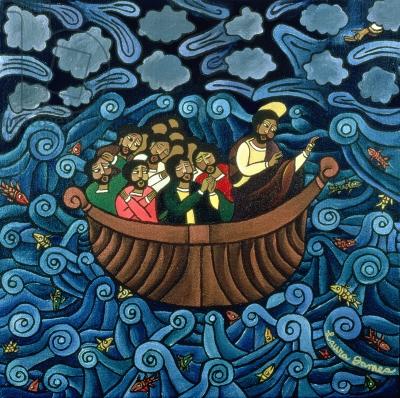
So, we know that one of the consistent metaphors used throughout the Old and New Testaments is the image of the sea as representing trouble or difficulty. These waters represent the nothingness before creation: in the Hebrew, the tohu wa-bohu. The sea was perceived as the vortex around which danger and chaos and evil spun. So, in today’s Gospel, we find Jesus calling the disciples, not away from the storm, but into it. In fact, Jesus sends the disciples into the boat while he dismisses the crowds and goes to pray. Jesus goes to the mountain, like Moses, to encounter the God of Abraham. Thus, while he retreats to the mountains, he compels the disciples to face the sea of chaos. Literally translated, they are being tormented by the waves. Jesus compels them to confront their own frailty, their own vulnerability.

This story reminds us of another story in Matthews Gospel, in the eighth chapter. If you’ll remember that passage, Jesus was sleeping through the storm while the disciples cried, “Save us, Lord, for we are perishing.” And if you’ll recall, that story ends with the disciples wondering what kind of man Jesus is, if even the wind and the water obey him.
So, in today’s reading, it’s worth noting that the disciples have been out in this storm, on the water, for a long time. They’re sent away before evening and they don’t see Jesus again until early in the morning. So, like many of us, they’ve been struggling to stay afloat for a good while. And I love the nonchalant way the Gospel writer reports, “he came walking toward them on the sea.” Mathew records it as matter-of-factly as if he were saying that Jesus then ate a ham sandwich. The disciples, as is so often the case, fail to recognize Jesus. And maybe, just maybe, it’s their fear that keeps them from knowing Jesus, just like our fear sometimes keeps us from seeing Jesus when he’s right beside us.
While the disciples are initially afraid that they are seeing a ghost, Jesus reassures them it’s him. And our translation really doesn’t do Jesus’ words of comfort justice. In the original Greek, Jesus’ announcement is more sparse, succinct, and significant: he tells them “I Am.” He harkens back all the way to the God of Abraham and Moses, reminding them of the presence of God even on this storm-rocked sea.

And then, we have this wonderful story of Peter. Now, if you’ve heard me preach before at all, you know I love Peter. Peter is full of confidence and bravado and a genuinely good heart which is regularly undone by his clumsy efforts to accomplish his tasks. Peter usually opens his mouth only to change feet, but he rushes in where angels fear to tread. He is full of well-intentioned, but impetuous folly.

And so, he sort of invites himself to join Jesus on the water. This is why I love Peter: he is so eager and yet, not quite ready. And he joins our Lord on the water and for a moment….the laws of nature and gravity are suspended. I suspect that, for just a moment, the angels stopped their singing and all heaven held its breath. And then, he began to notice the strong winds around him and he began to sink. And, whatever else you can say about Peter, at least he has the presence of mind to know where to turn in trouble. He turns to Jesus. He cries out, “Lord, save me.”

And when Jesus returns to the boat with Peter the wind dies down and the disciples all acknowledge that Jesus, the Jesus who walks across the storm and calms all our troubled seas, is the Son of God. And I don’t think we should judge St. Peter too harshly, in fact I don’t think we should judge him at all, because he embodies one of the fundamental principles of the Christian life: we are going to screw up. We fall down five times, we get up six.

Changing our lives is hard. It was hard for Peter and it’s hard for us. If we want to live for Christ, live whole-hearted lives, it’s going to take some time, and we’re going to make mistakes. In the religious life, that’s why we have a novitiate. Living with courage and hope and taking chances means we’re going to fail sometimes and we need to be prepared for that. And yet, God is always stronger than the sum of all our fears and failures.

Following Jesus is no assurance of smooth sailing. Following St. Dominic does not shield us from the hard knocks of life and death. In fact, the biblical witness would tell us something quite to the contrary: we are assured of the storm. You know, we clothe our new brothers and sisters with cowls and scapulars. I’m not sure we wouldn’t do better to give them life jackets and crash helmets.

I’m reminded of a poem by a fellow named Andrew King. He wrote:


Consider the wild wave, its wet tension,
tissues of torn foam in its curled fist;
contradiction of calm, enemy of evenness,
it says to the stormed soul: fear my strength.

Consider the flinty wind, its walled power,
shreds of white clouds in its biting teeth;
uncaring and unkind to brittle weakness,
it says to the scoured soul: fear my strength.

Consider the fragile flesh, its limitations,
gravity’s slave and tattered by time;
weak against wave and wind’s toughness,
it says to the struggling soul: I’ve little strength.

Consider Christ who walks through storm toward us,
who reaches out, compassion in his hands,
counters fearing with God’s loving faithfulness.
Who says to the yearning soul: here is strength.

You see, like St. Peter, God wants more from us than lives of safety and stability. God’s dreams for the world are bigger than that. God has called us to be explorers on an adventure: seeking God in unlikely places, and pointing out his presence when others cannot see it. And so it is with our brother Peter, who will make his life vows this evening. Like Joseph in the Old Testament reading today, he has come, seeking his brothers and his sisters.We have seen in him the love of God, reflected in his love and commitment to this Order and the path of St. Dominic. We have watched him grow in marvelous ways. God has wonderful dreams for our brother, and we do, too. And so, we join him in stepping out of the boat, sinking sometimes, but always proclaiming the presence of God in the storm. Amen.

James R. Dennis, O.P. © 2017

And Now You’re Here

My travel schedule remains quite busy, so today’s post will be short.  Today is the feast day of St. Thérèse of Lisieux, a Carmelite nun who lived a short life from 1873 to 1897.

I ran across this in Celtic Daily Prayer, from The Song of Simeon:

And now You’re here–
the light is shining where
the darkness used to be–
and all the world
is a different place…

…and every single day a fresh beginning.

As St. Thérèse once said,  “May you not forget the infinite possibilities that are born of faith.”

James R. Dennis, O.P.

© 2012 James R. Dennis

My Lord and My God!

But Thomas (who was called the Twin), one of the twelve, was not with them when Jesus came. So the other disciples told him, ‘We have seen the Lord.’ But he said to them, ‘Unless I see the mark of the nails in his hands, and put my finger in the mark of the nails and my hand in his side, I will not believe.’

A week later his disciples were again in the house, and Thomas was with them. Although the doors were shut, Jesus came and stood among them and said, ‘Peace be with you.’ Then he said to Thomas, ‘Put your finger here and see my hands. Reach out your hand and put it in my side. Do not doubt but believe.’ Thomas answered him, ‘My Lord and my God!’  John 20: 24-28.

On December 21, the church celebrates the Feast of St. Thomas, sometimes known as the Doubting Thomas.  This feast day may seem like a bit of an interruption in our Advent preparation, but I hope to convince you that it makes perfect sense.

For the past few weeks, we’ve been discussing the Incarnation.  Of course, the Latin root of that word is carnis, which means meat or flesh. So, the term Incarnation means that God became flesh and bone, that the immortal became mortal, that the spiritual became physical. God, in a sense, consecrated humanity by entering into our history.  

This was  not, however, some metaphysical entry, nor some encounter with an ethereal spirit.  No, Scripture tells us that Christ was born into human history, born among the animals in a stable or a cave or a stall.  This Incarnation was lowly, mean and decidedly real.

Similarly, in this story of St. Thomas, we learn that even the resurrected Christ bears the scars of his entry into human history, of his encounter with human sin.  Thomas doubted the reality of the resurrected Christ, and would not permit himself to believe until he saw the marks of that encounter in Jesus’ flesh.

I don’t think we should judge Thomas too harshly.  Most of us will face serious doubts at one point or another, and maybe face them again and again.  Perhaps because of my Jesuit education, I’m inclined to think a rigorous examination of our faith is healthy.  Otherwise, we consign ourselves to something I believe is perhaps more dangerous, a faith that is five miles wide and a quarter- inch thick.  Many of us have prayed, in some desperate hour, “Lord, I believe; help my unbelief.”  I certainly have, and so feel  a certain spiritual kinship with this good Apostle.

“Then Thomas answered him, ‘My Lord and my God!'” I think the point of this Gospel reading is not so much how Thomas came to the conclusion, but that he ultimately reached the conclusion of the  sovereignty and divinity of the Incarnate Word. 

So, we’ve been talking about what Advent means, in terms of the triumph of hope and promise over desolation and darkness.  Advent calls us to look beyond what John Newman called “the shadows and deceits of this shifting scene of time and sense”.  And as we approach again the entry of Jesus into the world, we hear Christ calling to us, “Do not doubt, but believe.” 

Emmanuel, God is with us.

James R. Dennis, O.P.

 © 2011 James R. Dennis