Tag Archives: Dominican

You Have Asked a Hard Thing

Now when the LORD was about to take Elijah up to heaven by a whirlwind, Elijah and Elisha were on their way from Gilgal. Elijah said to Elisha, “Stay here; for the LORD has sent me as far as Bethel.” But Elisha said, “As the LORD lives, and as you yourself live, I will not leave you.” So they went down to Bethel. The company of prophets who were in Bethel came out to Elisha, and said to him, “Do you know that today the LORD will take your master away from you?” And he said, “Yes, I know; keep silent.”

Elijah said to him, “Elisha, stay here; for the LORD has sent me to Jericho.” But he said, “As the LORD lives, and as you yourself live, I will not leave you.” So they came to Jericho. The company of prophets who were at Jericho drew near to Elisha, and said to him, “Do you know that today the LORD will take your master away from you?” And he answered, “Yes, I know; be silent.”

Then Elijah said to him, “Stay here; for the LORD has sent me to the Jordan.” But he said, “As the LORD lives, and as you yourself live, I will not leave you.” So the two of them went on. Fifty men of the company of prophets also went, and stood at some distance from them, as they both were standing by the Jordan. Then Elijah took his mantle and rolled it up, and struck the water; the water was parted to the one side and to the other, until the two of them crossed on dry ground.

When they had crossed, Elijah said to Elisha, “Tell me what I may do for you, before I am taken from you.” Elisha said, “Please let me inherit a double share of your spirit.” He responded, “You have asked a hard thing; yet, if you see me as I am being taken from you, it will be granted you; if not, it will not.” As they continued walking and talking, a chariot of fire and horses of fire separated the two of them, and Elijah ascended in a whirlwind into heaven. Elisha kept watching and crying out, “Father, father! The chariots of Israel and its horsemen!” But when he could no longer see him, he grasped his own clothes and tore them in two pieces.  2 Kings 2: 1-12.

We are nearing the end of the season of Epiphany, a season when we mark the ways God reveals Himself in the world.  This season affords us a wonderful time to remember Elijah and his student Elisha.  As this passage begins, Elijah is nearing the end of his days.  At the Lord’s instruction, he has already placed his mantle (the symbol of his prophetic spirituality) on Elisha.  1 Kings 19: 19.

Elijah must travel to Bethel, and suggests that Elisha remain behind.  Some scholars have suggested that Elijah is testing Elisha’s loyalty.  I think something different is happening here.   Perhaps Elijah wants to spare Elisha the pain of this moment.  Perhaps he wants to spare himself the heartbreak of that last goodbye.  It’s no secret that Elijah’s death is near;  prophets along the way, at Bethel  and Jericho remind Elisha of this.  Elisha tells these voices to remain silent.   While Elisha remains committed to accompanying his friend and teacher towards his death, the tremendous sense of loss and mystery defy language.  Words simply fail at moments like these.

While on their journey, Elijah parts the river Jordan, revealing himself as the second Moses.  The progress of their journey–from Gilgal to Jericho to the Jordan–reminds us of the people’s journey as they enter into the promised land.

In the central passage of the story, Elijah asks what he can do for his student, his friend, before he dies.  Elisha asks for a “double share” of his spirit.  Under Deuteronomic law, the eldest son would receive a double portion of his father’s estate.  (Deut. 21:15-17).  Elijah responds that he has asked “a hard thing.”  Elijah knows that this spiritual inheritance is God’s to give, and not his own. More than just a student of the great prophet, it’s clear that Elisha considers himself the spiritual child of Elijah.  This meaning becomes clear when Elijah is taken up into the whirlwind and Elisha cries out, “Father!  Father!”

So, it seems to me that this passage, like today’s Gospel reading on the Transfiguration, centers on the notion of translation.  Jesus’ divinity is translated into a language the disciples can understand.  Elijah, the prophet who stood alone, is translated into a life with the Father.  And Elisha is translated into his new role as the spiritual heir of his teacher.  Coincidentally (and I really don’t believe in coincidences), these things all happen in the context of a journey.  I think Holy Scripture is making a very important point:  we cannot  be transfigured into God’s new creation by remaining in the same place.

I hope to see you on the road.

Shabbat Shalom,

James R. Dennis, O.P.

© 2012 James R. Dennis

St. Brigid’s Day

Today is the feast day of St. Brigid of Kildare.  The people of Ireland love her dearly, as do the people who love the people of Ireland (folks like me).  The legends about Brigid far outweigh the facts known about her.   She was born around 450.  Her parents may have been baptized by  St. Patrick.

We know she founded a Christian community at Kildare, primarily for women.  She had a profound influence on the Church in Ireland.    She may have been consecrated as a bishop.  (Thus, she is often depicted with a bishop’s crozier.)  When others protested that he improperly bestowed this Holy Order on a woman, Bishop Mel reportedly replied “No power have I in this matter.”  He suggested that God alone had chosen Brigid for that Holy Office.

Brigid understood that the physical needs of the poor intersected with their spiritual needs. We remember Brigid for her profound hospitality, her unflinching generosity, and her extraordinary compassion.   I pray that her spirit will grow within the Church today, which so desperately needs it.

I found this prayer for today within the wonderful Celtic Book of Daily prayer.  I hope you find as much life and joy and light in it as I do.

I would welcome the poor
and honor them
I would welcome the sick
in the presence of angels
and ask God to bless and
embrace us all.

Seeing a stranger approach,
I would put food in the eating place,
drink in the drinking place,
music in the listening place,
and look with joy for the blessing of God,
who often comes to my home
in the blessing of a stranger.

God bless you and those you love,

James R. Dennis, O.P.

© 2012 James R. Dennis

I Know Who You Are

Jesus and his disciples went to Capernaum; and when the sabbath came, he entered the synagogue and taught. They were astounded at his teaching, for he taught them as one having authority, and not as the scribes. Just then there was in their synagogue a man with an unclean spirit, and he cried out, “What have you to do with us, Jesus of Nazareth? Have you come to destroy us? I know who you are, the Holy One of God.” But Jesus rebuked him, saying, “Be silent, and come out of him!” And the unclean spirit, convulsing him and crying with a loud voice, came out of him. They were all amazed, and they kept on asking one another, “What is this? A new teaching– with authority! He commands even the unclean spirits, and they obey him.” At once his fame began to spread throughout the surrounding region of Galilee.  Mark 1:21-28.

In today’s Gospel reading, Mark reports that Jesus taught in the synagogue in Capernaum.  Somehow, Jesus’ teaching wasn’t like the normal commentary  to which the people had become accustomed.  His words carried a power which they have not heard before, and they would soon discover the breadth of his authority.  Jesus had a command of scripture which the people had not encountered before, but we also get the sense that it’s more than that.  We have the impression that they encountered something in Jesus himself they hadn’t previously seen: a certain gravitas, a new mastery and might.

Suddenly, a man “with an unclean spirit” accosted Jesus.  Interestingly, this unholy spirit spoke to Jesus in the plural. (The spirit asked “What have you to do with us?” and “Have you come to destroy us?”) Perhaps this daemon refered to both itself and the possessed man.  Or perhaps evil is always multifaceted, or duplicitous by its very nature.  The spirit then announced, “I know who you are, the Holy One of God.” 

Further evidencing his authority, Jesus expels the spirit from the man, freeing him from a terrible torment and bondage.  I suspect most of us have known someone in the grip of such an evil spirit, one which confines their souls and robs them of joy.  We may have concluded, as Einstein famously remarked, “It’s easier to denature plutonium than to denature the evil spirit of man.”  Those in the grip of such an evil spirit have no power within themselves to help themselves.

In a few short sentences, Mark has revealed several facets of Jesus: teacher; healer; liberator; and compassionate pastor.  This revelation fits perfectly within our Epiphany theme.  Through the act of freeing this man from the shackles of sin, Jesus restores God’s creation.

I don’t think Mark tells this story so much to describe an exorcism as to reveal the reach of Jesus’ authority, which includes the scriptures, the world of the flesh and the world of the spirit.  In this passage, Mark thus reveals Jesus as Lord of all created things. 

Ironically, Mark places some of the most important questions about and observations of Jesus within the mouth of this evil spirit.  The unclean spirit asks, “What have you to do with us?”  I am certain that I do not ask myself that question often enough.  What does Jesus have to do with me, with this day, with this place and with this hour?  In what way is Jesus relevant to this very moment of my life, and what am I going to do about that? 

The unholy spirit also announces, “I know who you are,  the Holy One of God.”  I’m wondering how well we know who Jesus is, and do we recognize his authority?  Do we recognize Jesus when we encounter him, and do we know his power?  Are we willing to let him rid us of those spirits that would destroy us? Will we listen when he tells our demons to be silent and to depart?  I pray we will.

 Shabbat shalom,

Br. James

© 2012 James R. Dennis

On the Road to Damascus

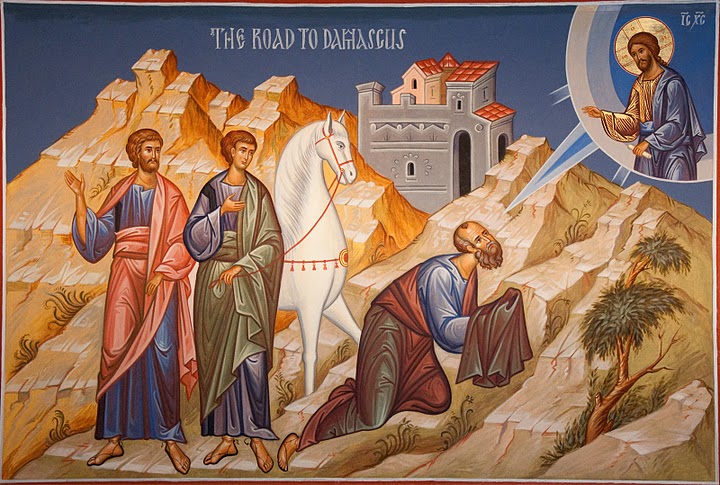
Meanwhile Saul, still breathing threats and murder against the disciples of the Lord, went to the high priest and asked him for letters to the synagogues at Damascus, so that if he found any who belonged to the Way, men or women, he might bring them bound to Jerusalem. Now as he was going along and approaching Damascus, suddenly a light from heaven flashed around him. He fell to the ground and heard a voice saying to him, ‘Saul, Saul, why do you persecute me?’ He asked, ‘Who are you, Lord?’ The reply came, ‘I am Jesus, whom you are persecuting. But get up and enter the city, and you will be told what you are to do.’ The men who were travelling with him stood speechless because they heard the voice but saw no one. Saul got up from the ground, and though his eyes were open, he could see nothing; so they led him by the hand and brought him into Damascus. For three days he was without sight, and neither ate nor drank.

Now there was a disciple in Damascus named Ananias. The Lord said to him in a vision, ‘Ananias.’ He answered, ‘Here I am, Lord.’ The Lord said to him, ‘Get up and go to the street called Straight, and at the house of Judas look for a man of Tarsus named Saul. At this moment he is praying, and he has seen in a vision a man named Ananias come in and lay his hands on him so that he might regain his sight.’ But Ananias answered, ‘Lord, I have heard from many about this man, how much evil he has done to your saints in Jerusalem; and here he has authority from the chief priests to bind all who invoke your name.’ But the Lord said to him, ‘Go, for he is an instrument whom I have chosen to bring my name before Gentiles and kings and before the people of Israel; I myself will show him how much he must suffer for the sake of my name.’ So Ananias went and entered the house. He laid his hands on Saul and said, ‘Brother Saul, the Lord Jesus, who appeared to you on your way here, has sent me so that you may regain your sight and be filled with the Holy Spirit.’ And immediately something like scales fell from his eyes, and his sight was restored. Then he got up and was baptized, and after taking some food, he regained his strength. Acts 9:1-19.

God has a really funny way of doing business. He choses a murderer with a speech impediment to lead His people out of Egypt, an ethically challenged chiseler to bear the name of the nation of Israel, and a murderous philanderer to unite the kingdom of His people. In today’s reading, Luke reports that despite the resurrection, Saul continued to breathe threats and murder against those who followed the Way. Let’s be clear about this: Saul was engaged in genocide against those who followed Christ.

And so, had the Lord asked me about his selection of Saul, like Ananias I would have asked Him, “Are you really sure this is the guy?” You see, not much in Saul’s life suggested that he would be the person most responsible for spreading the message of Jesus throughout the Empire. God, however, had something remarkable in mind. God knew something we really struggle against: people can change.

While en route to Damascus to continue in his campaign of annihilation, Saul (or Paul, in the Greek form of the name) encounters the risen Lord. Again, the reading meshes well into our Epiphany theme, as Scripture records that he was surrounded by a light from heaven.

This passage further reinforces our understanding of the Church as the body of Christ. Saul, of course, was persecuting the early Church. Jesus didn’t ask, “Why are you messing with my church?” Rather, Jesus asks Saul, “Why are you persecuting me?” Already, in the book of Acts, the Church is identified therefore with the body of Christ.

After his post-resurrection encounter with Jesus, Paul loses his sight for three days. This story fits very well within an idea we’ve already encountered, the distinction between physical observation and spiritual insight. And Paul must lose his physical powers of insight before he can gain a genuine spiritual vision. God was reshaping Paul’s understanding of the Lord and his entire world-vision. It’s as though this transformation, this conversion, required a complete reboot of his system. Paul must have gone through a terrible loneliness during this time. As Bonhoeffer once observed, we are never more isolated than we are in becoming a Christian, but the alienation occurs for the sake of a new community.

For most of us, our conversion experience will not look like this. Although I’ve run across them now and then, most folks will not find their conversion so complete or so dramatic. I’ve found that my conversion takes place in small increments, daily, through several small decisions to follow Jesus’ example, through self-denial and participation in the sacramental life with which the Church has blessed us, and mostly through God’s redeeming grace.

And yet, God chose Saul–this monster, this antagonist and enemy of the early Church. God saw within him “an instrument to bring my name before gentiles and kings and before the people of Israel.” It’s worth noting that Saul’s conversion required more of him than simply changing his mind about things. Saul’s conversion, like ours, carried along with it a call and a vocation. Rather than simply offering a new way of looking at things, his conversion required an apostolic commitment as Saul would be sent out to serve in the world. Ours does too.

So today, as we celebrate the Feast of St. Paul’s conversion, I hope this story serves as a reminder of the need for charity towards our enemies, and perhaps even charity towards ourselves. God may yet have in mind a way to use them (and us) for his redeeming work. As children of the Creator, we may all someday become new creatures, a great blessing and a great gift to the Church. Saul did.

May the peace of Christ disturb you profoundly,

Br. James

© 2012 James R. Dennis

Remembering Peter

Then Peter began to speak to them: ‘I truly understand that God shows no partiality, but in every nation anyone who fears him and does what is right is acceptable to him. You know the message he sent to the people of Israel, preaching peace by Jesus Christ he is Lord of all. That message spread throughout Judea, beginning in Galilee after the baptism that John announced: how God anointed Jesus of Nazareth with the Holy Spirit and with power; how he went about doing good and healing all who were oppressed by the devil, for God was with him. We are witnesses to all that he did both in Judea and in Jerusalem. They put him to death by hanging him on a tree; but God raised him on the third day and allowed him to appear, not to all the people but to us who were chosen by God as witnesses, and who ate and drank with him after he rose from the dead. He commanded us to preach to the people and to testify that he is the one ordained by God as judge of the living and the dead. All the prophets testify about him that everyone who believes in him receives forgiveness of sins through his name.’  Acts 10: 34-44.

Today, the Episcopal Church marks the confession of St. Peter the Apostle.  I have always found Peter one of the most approachable saints within the Church and a great source of hope.  Scripture records that he was quick to speak, even when he was deeply confused. Like me, Peter generally opened his mouth only to change feet.   But in today’s reading from the Book of Acts, Peter gets it right:  deeply and  thoroughly right.

This passage takes place as Peter visits the home of Cornelius, a Roman centurion living in Caesarea.  Scripture doesn’t reveal much about Cornelius, although we learn that he prayed regularly, and practiced charity.  Cornelius, however, was also a Gentile, and no good Jew would have anything to do with him.  Peter traveled to his home as a result of a vision in which he heard God’s voice telling him:  “What God has made clean, you must not call profane.”

Now, the disciples had already accepted that Jesus held the hope of salvation.  The question remained, however: whose salvation? Peter began his sermon with a remarkable notion:  in God’s economy, all of the distinctions we’ve drawn are erased.  While we strive to create barriers to and enclosures around the well of sanctification, Peter preached God (through Christ) had knocked them down.

We may be initially tempted to read this passage as talking about our relations with our brothers and sisters.  Clearly, no people enjoy a special claim to salvation, God’s love, or the redemptive work of Christ.  I think a fair reading, however, would also permit an interpretation that looks to our relentless drive to keep Jesus contained in a single corner of our lives.  We allow Jesus into our hearts from nine o’clock to eleven thirty on Sunday mornings, and maybe one evening a week, but will permit no trespassing beyond those boundaries.  We have created a sort of spiritual ghetto, excluding God from all but a narrow section of our lives.

Peter’s confession, his sermon, announces God’s radical, promiscuous hospitality:  all are welcome; Jesus is Lord over all; and his forgiveness is available to all.  Despite our best efforts, God’s love will overcome all our attempts to contain it.

During this season of Epiphany, we are drawn into images of light breaking into the darkness.  The star that came to rest over Bethlehem, the heavens torn open at Jesus’ baptism, and the transfiguration of Jesus:  all of these icons center on the astonishing entry of the “light of the world.”  I love physics and the study of light. If you’ve studied light much, you’ve noticed that when you’ve turned on a light switch, the light bathes every surface in a room.  Some of those surfaces, however, reflect light better than others.

I think that’s the case with our spiritual lives as well.  The light of Christ, having entered into the world has spread throughout all creation.  In some folks, that light is reflected back again, piercing and holding back the darkness.  Peter seems, despite his lesser angels, to have learned to reflect the light of Christ, and we properly remember him and his vision today.

Pax Christi,

James R. Dennis, O.P.

© 2012 James R. Dennis
A Voice in the Darkness

Now the boy Samuel was ministering to the LORD under Eli. The word of the LORD was rare in those days; visions were not widespread. At that time Eli, whose eyesight had begun to grow dim so that he could not see, was lying down in his room; the lamp of God had not yet gone out, and Samuel was lying down in the temple of the LORD, where the ark of God was. Then the LORD called, “Samuel! Samuel!” and he said, “Here I am!” and ran to Eli, and said, “Here I am, for you called me.” But he said, “I did not call; lie down again.” So he went and lay down. The LORD called again, “Samuel!” Samuel got up and went to Eli, and said, “Here I am, for you called me.” But he said, “I did not call, my son; lie down again.” Now Samuel did not yet know the LORD, and the word of the LORD had not yet been revealed to him. The LORD called Samuel again, a third time. And he got up and went to Eli, and said, “Here I am, for you called me.” Then Eli perceived that the LORD was calling the boy. Therefore Eli said to Samuel, “Go, lie down; and if he calls you, you shall say, `Speak, LORD, for your servant is listening.'” So Samuel went and lay down in his place.Now the LORD came and stood there, calling as before, “Samuel! Samuel!” And Samuel said, “Speak, for your servant is listening.”

As Samuel grew up, the Lord was with him and let none of his words fall to the ground.  And all Israel from Dan to Beer-sheba knew that Samuel was a trustworthy prophet of the Lord. The Lord continued to appear at Shiloh, for the Lord revealed himself to Samuel at Shiloh by the word of the Lord.  1 Sam. 3: 1-10; 19-21.

I have a theory.  My theory is this:  with surprising regularity, things tend to end much as they began.  In many respects, the story of the prophet Samuel seems to validate that notion.

Now, the prophet Samuel began his ministry during the first generation of Israel’s monarchy.  You’ll remember the story that Samuel’s mother (Hannah) was presumed to be barren.  Hannah begged God for a child, promising that if God would give her a son, she would offer the child as a Nazarite (who would not drink wine or strong drink nor shave his head).  Eli, the priest at the holy place of Shilo,  assured Hannah that she would have a son.

Once Hanna weened Samuel, she presented him at Shilo.  In a song remarkably similar to the Magnificat, Hannah sang that God had broken the bows of the mighty, raised the poor up from the dust, and seated the needy with princes.  It’s a striking song, full of political radicalism and foreshadowing Jesus’ promise that the first will be last and the last will be first.

That same notion will run throughout Samuel’s ministry.  Samuel would eventually turn his prophetic vision to Eli the priest.   Eli failed to restrain his sons who abused their power and blasphemed by eating the choice cuts of the sacrificial animals.  1 Sam. 2:12-17.  Similarly, Samuel warned the people of Israel against kings who would abuse their power and take advantage of the vulnerable.  Now, that’s a very old story:  the poor and the powerless suffer under the appetites of the strong.  Samuel would ultimately give voice to God’s conclusion that King Saul’s reign has come to an end. God thus instructed Samuel to anoint David as the King of Israel.

I wonder whether we again live in days “when the word of the Lord is rare.” How do we confront those two twin tremendous mysteries, the silence of God and the voice of God?  Maybe God’s silence arises from our regular failure to ask him for guidance, or our failure to listen when He does speak.  For many of us, like Samuel, we’re not exactly sure when we’re hearing the Lord’s voice, and we certainly know that the news will not always be popular.  As was the case with Samuel, once we’ve identified the voice of the Lord, there’s no guarantee anyone else will be receptive, or even interested.

Despite that, I always smile a bit and find great comfort  when the Lectionary rolls around to this reading. I smile because when I was a child, my parish priest told me that this was a story about what happens to little boys who fall asleep in church.  I find comfort because God calls to Samuel again and again throughout that night.  Regardless of our confusion, God can be remarkably persistent.  He can, in fact, hound us repeatedly while we’re trying to sleep.  God’s word has a remarkable capacity to interrupt and disturb us when we’re trying to do something else. I pray that you’ll listen for that voice, and that I will also.

Shabbat shalom,

James R. Dennis, O.P.

© 2012 James R. Dennis

The Beloved

John the baptizer appeared in the wilderness, proclaiming a baptism of repentance for the forgiveness of sins. And people from the whole Judean countryside and all the people of Jerusalem were going out to him, and were baptized by him in the river Jordan, confessing their sins. Now John was clothed with camel’s hair, with a leather belt around his waist, and he ate locusts and wild honey. He proclaimed, “The one who is more powerful than I is coming after me; I am not worthy to stoop down and untie the thong of his sandals. I have baptized you with water; but he will baptize you with the Holy Spirit.”

In those days Jesus came from Nazareth of Galilee and was baptized by John in the Jordan. And just as he was coming up out of the water, he saw the heavens torn apart and the Spirit descending like a dove on him. And a voice came from heaven, “You are my Son, the Beloved; with you I am well pleased.” Mark 1:4-11.

The Lectionary offers us this reading from Mark’s Gospel on this first Sunday of the season of Epiphany.  The Greek word epiphaino translates roughly as the appearance or manifestation of the light.  This Gospel reading fits perfectly within that idea, and you’ll remember that we previously discussed  Jesus had describing himself as the “light of the world.”

I’ve always been fascinated with the issue of Jesus’ understanding of himself:  what did the incarnate Lord understand about his role, and when did he begin to understand it?  The story of Jesus’ baptism offers us some remarkable insight into these questions.

The story begins with a character we’ve become familiar with, John the Baptist.  Now, at the time, the practice of ritual purification was fairly common.  John seems to have been doing something different, though, in this rite of baptism. More than just a ceremonial cleansing, John appears to have called  his followers to a spiritual act of  initiation.   Rather than a regular ritual purification, John seems to be engaged in something unique, radical and challenging at the time. 

John’s baptism would have challenged the institutional church of the day, offering baptism for the forgiveness of sins.  John lacked any institutional authority and forgiving sins lay within the exclusive jurisdiction of the Temple priests.  Like most of the prophets, John presents himself as a fanatic, an outsider and a critic of the status quo.  So, when Jesus endorses John’s ministry, his baptism itself challenged the authority of the Temple. 

Jesus shared in listening to John’s prophetic call. He waded into the same waters as the rest of John’s followers. He approaches John just as everyone else came to John. Thus, Jesus shared those waters with all humanity. And then, something astonishing happened….

Earlier, we talked about the collision of heaven and earth in Jesus’ nativity.  We discussed the notion that the Incarnation changed the very fabric of space and time.  We see those ideas reinforced in this remarkable story of the Epiphany, as God begins to reveal Himself, to “enlighten” the world a bit.

 As Jesus comes forth from the water, Mark reports that the heavens were “torn open.”  That terribly interesting phrase, “torn open”, suggests this was no peaceful, gentle encounter.  Mark uses that same word, “torn”, to describe the separation of the Temple curtain after Jesus “breathed his last” on Golgotha.  As the veil separating heaven and earth rips apart, the Spirit emerges.

These remarkable events unfold as Jesus (whose very name means “God saves”)  emerges from the water.  The story reverberates with the memory of the Jewish people emerging the Red Sea, their principle narrative of salvation.  And then, from the heavens, God claims Jesus as His son, the Beloved.

I’d encourage you to engage in an exercise.  I’d like you to think back to your own baptism.  And I’d like you to imagine that same voice announcing that you are God’s child, and His beloved.  I believe it’s important that we become acclimated to that idea.  It may offer the first step in going beyond celebrating an Epiphany to living out the Epiphany and spreading the light of Christ into the dark places of the world.  My friend, Father Mike Marsh noted recently ( here)  that God calls each of us to “become Epiphany”.  Our vocation and our challenge lies in manifesting God’s love, helping His people hear that voice as the heavens are torn apart.

Shabbat shalom,

James R. Dennis, O.P.

  © 2012 James R. Dennis

The Holy Innocents

Now after they [the Magi] had left, an angel of the Lord appeared to Joseph in a dream and said, “Get up, take the child and his mother, and flee to Egypt, and remain there until I tell you; for Herod is about to search for the child, to destroy him.” Then Joseph got up, took the child and his mother by night, and went to Egypt, and remained there until the death of Herod. This was to fulfill what had been spoken by the Lord through the prophet, “Out of Egypt I have called my son.”

When Herod saw that he had been tricked by the wise men, he was infuriated, and he sent and killed all the children in and around Bethlehem who were two years old or under, according to the time that he had learned from the wise men. Then was fulfilled what had been spoken through the prophet Jeremiah:  “A voice was heard in Ramah, wailing and loud lamentation, Rachel weeping for her children; she refused to be consoled, because they are no more.”  Matt. 2:11-18.

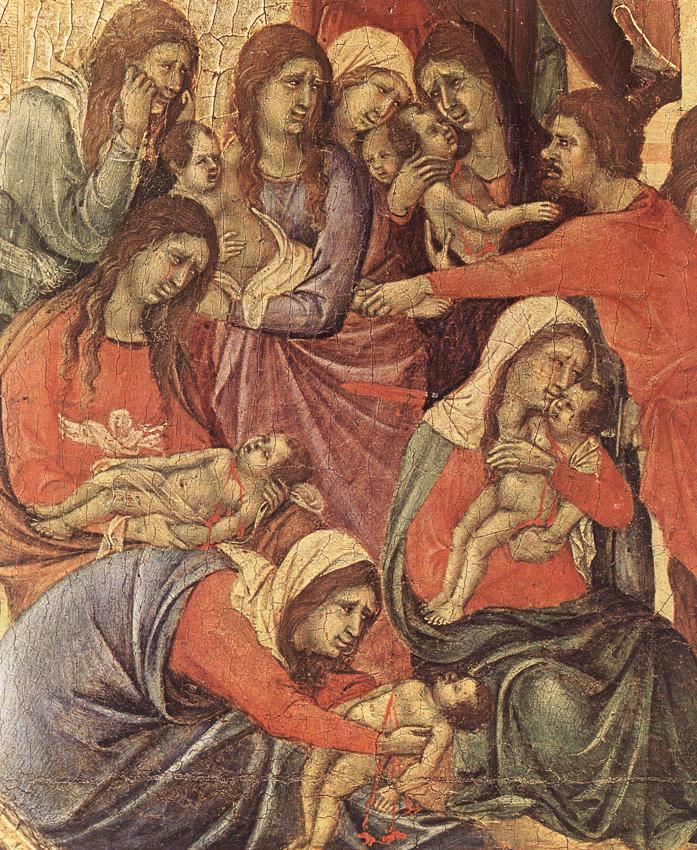
Today the Church remembers the slaughter of the Holy Innocents. Here, we encounter a ghastly and appalling story, but I think there are several lessons we can take from this narrative.  We should first examine the character of Herod (known to historians as Herod the Great).  Although Herod greatly expanded the Second Temple, he also murdered many rabbis and members of his own family.  He collaborated with the Roman occupation, and he reigned with a demented savagery.

While scholars may question the historical accuracy of this account in Matthew’s gospel, Matthew’s portrayal meshes well with what we know of Herod’s character.  At the root of these frightening events, we find a genuine insight into Herod’s depravity.  Herod fears losing power, and that phobia sparks his maniacal infanticide.  Into this world, the Christ child is born.

The world hasn’t changed much.  From Dachau to Serbia to Darfur, Herod is still afraid, and the slaughter of the innocents continues.  And this remains the world into which Christ enters.  And ultimately, Christ offers himself as a victim of our savage history.

Matthew offers another insight in this story.  The Holy Family protects the Christ child, traveling to Egypt to escape Herod’s rage.  Matthew refers to Hos. 11:1 and Exodus 4:22-23 with a purpose.  He’s telling his audience that Jesus is the new Moses:  just as Moses delivered the chosen people from slavery, Jesus will free them from sin and death.   Moses and the Prophets reveal God’s dedication to mankind’s salvation; in the Christ child, that dedication becomes incarnate.

I’m also fascinated with the impulse of Mary and Joseph:  I think there’s something more at work here than the simple protective impulse of Jesus’ parents.  You see, I think they’re still out there in the world today: Pharoah, Herod, Stalin, Pol Pot and the other slaves to fear and hatred. 

So, I think Matthew asks us, are we willing to shelter Jesus?  What are we willing to do to protect Christ in the world?  Because I think Matthew and the Church are telling us that our Christmas joy never takes place in a historical vacuum, and the world can be a place of deadly and senseless violence.  As my great-aunt once cautioned me, “May the peace of Christ disturb you greatly.”

Pax,

James R. Dennis, O.P.

 © 2011 James R. Dennis


St. John of the Cross On the Incarnation

Because today is the feast day of St. John of Cross, and we’ve been meditating on the mystery of the Incarnation, I thought we might look at what he had to say on the subject.  In the Eighth Ballad, he wrote:

Then he summoned an archangel;
Saint Gabriel came,
And He sent him to a maiden,
Mary was her name,

Whose consent and acquiescence
Gave the mystery its birth;
It was the Trinity that clothed
With flesh the Living Word.

Though the three had worked the wonder
It was wrought in but this one,
And the incarnated Word
Was left in Mary’s womb.

And He who had a father only
Now possessed a mother,
Though not of man was He conceived
But unlike any other.

And deep within her body
His life of flesh began:
For this reason He is called
The Son of God and Man.

The poem properly focusses on the figure of Mary, by whose acquiescence the mystery of the Incarnation begins.  In many ways, Mary operates as the lynchpin of the season of Advent.  Our Orthodox brothers and sisters call her the Theotokos, or God-Bearer. 

During this season of Advent, we might properly reflect on what it means to be pregnant with God.  I suggest that we consider that, not only as it pertains to the Holy Mother, but also as it pertains to each one of us.  What does it mean for you and I to bring God into the world, a world which is sometimes hostile and often indifferent to Christ?  And while we’re doing so, as with any expectant parent, we might properly wonder just what this event will cost.  How do we carry Jesus into the places where, as with Bethlehem so long ago, there’s just no room for Him?

Part of the mystery of the Incarnation, part of the wonder of belonging to the Body of Christ we call the Church, lies in the recognition that Christ must live within us.  Somehow, through the enigma of God coming to live among us, our very DNA has changed.  St. Paul recognized this, writing:  “I no longer live, but Christ lives in me.”  Gal.  2:20.   Paul reminds us that following Christ does not so much hinge on an intellectual assent to a certain doctrine  as it does on surrendering to Christ’s indwelling within us and allowing Jesus to re-make us.

Our Advent hope lies in recognizing that God’s entry into the world is not an event that took place a couple of thousand years ago, and which made things a bit more bearable.  Rather, the very fabric of time and space have changed.  God has and will re-create all things (including you and me) through this Son of God and Man.

Have a good and holy Advent,

James R. Dennis, O.P. 

© 2011 James R. Dennis

Taking Nothing

Then Jesus called the twelve together and gave them power and authority over all demons and to cure diseases, and he sent them out to proclaim the kingdom of God and to heal. He said to them, “Take nothing for your journey, no staff, nor bag, nor bread, nor money — not even an extra tunic. Whatever house you enter, stay there, and leave from there. Wherever they do not welcome you, as you are leaving that town shake the dust off your feet as a testimony against them.” They departed and went through the villages, bringing the good news and curing diseases everywhere. Luke 9: 1-6.

If we’re willing to listen, I believe this passage of Scripture can teach us a good deal about how we should approach Advent.  For most of us, accustomed to succeeding through diligent preparation, Jesus’ suggestion that the disciples “take nothing” seems a little odd. We wonder why Jesus did not want the disciples to bring along a few supplies, a little extra cash or some snacks.

First, I think the answer lies in understanding the context.  In this passage, for the first time, Jesus inaugurates the notion of what it means to be an apostle.  (That word comes to us from the Greek apóstolos, which translates as “one who is sent out”.)  Thus, following Christ will require that they leave their rabbi behind and take their own journey.  It will require the same of us. No longer would the disciples simply stand around and watch Jesus’ miracles and ministry. Jesus taught them, as he teaches us, that the Christian life was not a spectator sport.

So, why would Jesus send his disciples, his friends, out without any tools, equipment or provisions?  I don’t think Jesus wanted the disciples to be unprepared.  I think rather that Jesus was telling them, “None of that stuff is what you need.  In fact, it will only get in your way.”  The disciples needed to trust that God would give them everything they needed to do the work he wanted them to do.  When they learned to use God’s resources, rather than their own, they were capable of far more than they imagined.

That’s not a bad notion for us to carry forward into our journey through the season of Advent.  We will need to leave a lot of stuff behind.  Mostly, we’ll need to leave behind the illusion of self-reliance that we’ve come to accept.  We need to learn to trust God and trust that God will give us the tools for His work.  We may also need to leave behind our notion of who we are, and what we’re capable of doing.  The real question we should ask during Advent inquires where God is sending us, and what He can accomplish through our lives.

Have a good and holy Advent,

James R. Dennis, O.P.

© 2011 James R. Dennis