Tag Archives: Dominican Order

A Great Chasm

Now he is comforted here, and you are in agony. Besides all this, between you and us a great chasm has been fixed…. (The full readings for this morning can be found here.)

In the name of the Living God, who is creating us, redeeming us, and sustaining us.

Well, good morning, everybody. So, in today’s gospel we encounter a man who’s having trouble with the afterlife and is concerned for his family. Whenever I hear this story, I think about a family we knew back in West Texas, the Beauchamp brothers.

Now, they were not nice people. In fact, everybody in the whole county knew the Beauchamp brothers. In business they were crooked, mean and cold-blooded. Well, one day, the older brother, Howard Beauchamp, he up and died. The younger brother, Ronnie, wanted to make sure that Howard got the finest funeral there had ever been in the county. He went down to the funeral home and bought a fine cherrywood coffin with silver hardware. Then he went to go see the minister.

The little church there was not doing so well. In fact, it was kind of falling apart at the seams. The air conditioner was old and tired, and the roof struggled to keep out the rain. Well, Ronnie Beauchamp, he went to the minister, and he offered him the Devil’s own bargain. He said, “Pastor, I will give your church half a million dollars if you will preach my brother’s funeral and tell everyone he was a saint.” Well, this was a real conflict for the preacher, because the church really needed that money, but he couldn’t lie from the pulpit.

So, the day of the funeral came around, and the whole town was there as the minister began to preach the funeral sermon.  He said, “The man you see in this coffin was a vile and debauched individual.  He was a liar, a thief, a bully, a great sinner, and he broke his mama’s heart.  He destroyed the fortunes, careers, and lives of countless people in this county, some of whom are here today. This man did every dirty, rotten thing you can think of.”

“But, the preacher added, … compared to his brother, he was a saint.”

Now, before we go any further, I want to make a couple of things clear. The passage we are reading isn’t a theological guide about how to get to heaven or how to avoid hell. This passage is one of Jesus’ parables—a riddle or a fable. So, I don’t think the rich man went to Hades because he was rich. And I don’t think Lazarus went to heaven because he was poor. But I do want us to start thinking this morning about the various chasms we encounter: chasms that separate us from each other, the gulfs between us and God—the chasms we come upon, and the chasms we help create.

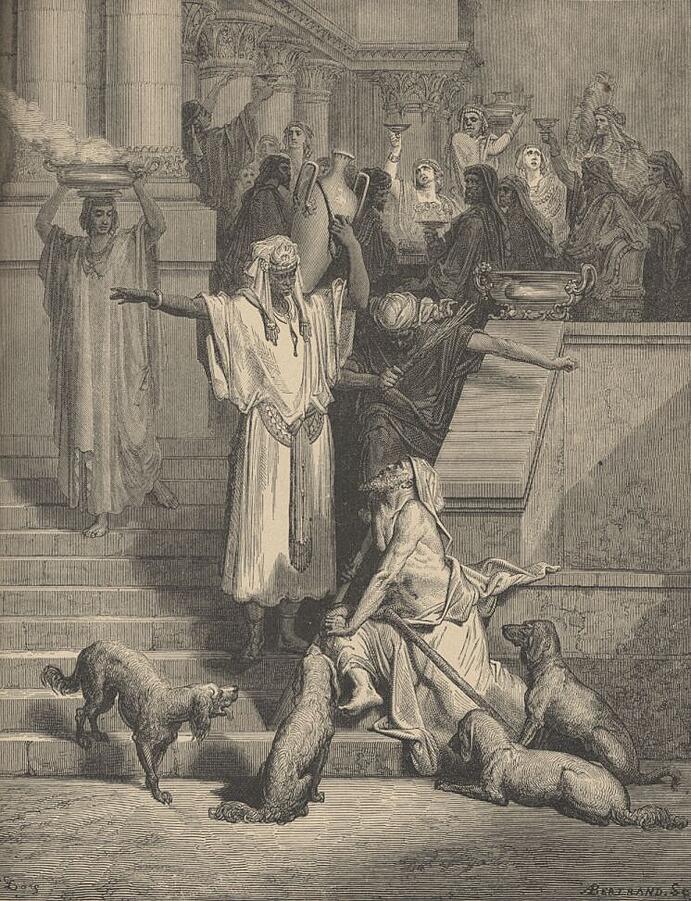
One of the first places we notice a gap, or a distance, is between the circumstances of these two men. We are told that every day, the rich man ate luxurious meals, and he wore fine linen and purple. On the other hand, we can imagine Lazarus in rags, and we’re told he’s covered in sores. He’s also starving, and dreams of eating even the crumbs or scraps from the rich man’s meals.

And although their lives were very different, they did not live far away from each other. In fact, Lazarus lived just outside the rich man’s gate. But we get the feeling the rich man never noticed Lazarus. In fact, I get the impression that the rich man had become quite adept at ignoring Lazarus at the gate, a kind of studied disregard, a well-rehearsed apathy. So, their lives on earth were very far apart; they were separated by a great economic and social chasm.

Then, when the two men die, we have one of those classic reversals of fortune that Luke loves. It’s already happened right from the outset of the story. You see, we know the name of the poor man in the story—his name is Lazarus, which means God’s help. We don’t, however, know the name of the other character; he’s just some rich guy. That’s not how things normally work. We remember the rich and the mighty, and too often the names of the poor and the hopeless are forgotten.

But when their earthly lives are over, the angels carry Lazarus to the bosom of Abraham. In other words, he has a place of peace and comfort and honor among the righteous dead. The rich man, however, finds himself being tormented in Hades. There’s a considerable distance, a chasm, between their circumstances. But even from the fiery pit, the rich man doesn’t seem to recognize his new situation yet. He’s still treating Lazarus like a slave. You see, the biggest lie the devil ever told us is that some lives are worth more than others, that some people are more important than others.

The rich man asks Abraham to send Lazarus with just a bit of water on his finger to ease the rich man’s suffering. Once again, here’s that Lucan reversal of fortune. Abraham tells the rich man: “Child, remember that during your lifetime you received your good things, and Lazarus in like manner evil things; but now he is comforted here, and you are in agony.”

The bigger problem, Abraham explains, is that vast chasm between Lazarus and the rich man. Now, maybe Jesus was trying to tell us that heaven is a long, long way away from hell, but I don’t think so. I think the distance between Lazarus and the rich man is simply the echo and amplification of the separation the rich man created while they were alive. In other words, to borrow an idea from Charles Dickens, they wear the chains they forged in life. Jesus reminds us that there is a deep and profound connection between how we live in this life and how we live in the next life.

So, what are we supposed to do with this passage? What am I supposed to do about the homeless man that I drove by on my way to church this morning? Am I supposed to give him a dollar? Buy him a meal? Pay for him to spend a night in a hotel room? If I do that, will Jesus let me into heaven?

I think the very last thing Jesus wanted to do in his parables was to give us easy answers to these questions. I think we were meant to struggle with this issue, to learn to listen to Moses and the prophets. I also think we have to find a way to close the tremendous gaps between ourselves and our brothers and sisters. We all know about the terrible gap of wealth inequality, and we saw the political distance widen in this country after Charlie Kirk was killed and both parties clawed at each other desperately for a spot on the moral high ground

My friends, as Doctor King warned us, “We must learn to live together as brothers and sisters or perish together as fools.” We know about the chasm between God’s children. I think the biggest chasm I have to struggle with every day is the gap between the man I am and the man I want to be, the distance between the life I’m leading, and the life Jesus wants for me.
I think the first thing is that we notice how deeply, how profoundly, God cares for the poor. This morning, the Psalmist tells us happy are those:

Who give justice to those who are oppressed,
and food to those who hunger.
The Lord sets the prisoners free;
the Lord opens the eyes of the blind;
the Lord lifts up those who are bowed down.

A friend of mine puts it a little differently. He likes to tell me that no one gets into heaven without a letter of recommendation from the poor.

Secondly, I think we have to find a way to bridge the gap between us and the broken-hearted of this world. We must find a way to reach across to those who are hungry, to those who live in hopelessness. And we’ve got to quit asking whether they deserve our help, our charity. Quite frankly, that is none of our business. God will figure that out.

I do believe charity is important, and yes, the rich man fails to tend to, or care about, the needs of Lazarus. But there was a sin that came before that, an earlier fault that made all the others possible. He didn’t even notice Lazarus. He didn’t notice the man at his gate. I don’t want to think about the number of times I’ve turned my glance away from the homeless and the poor. And the failure to notice them robs us of any chance we have to make a difference in their lives, to make a friend. So maybe we should begin by noticing them, and I mean this quite literally, for the love of God, notice them. Maybe if we go out of our way, just a little bit, we might learn to share our resources, and more importantly, to share our hearts. Amen.

James R. Dennis, O.P. © 2025

Things Hoped For

“Now faith is the assurance of things hoped for, the conviction of things not seen.” (The full readings for this morning can be found here.)

In the name of the living God, who is creating, redeeming, and sustaining us. Amen. Well good morning, good morning. I thought this morning we’d talk about faith, about different ways some folks have of understanding faith, and about what the scriptures can teach us about that.

When I think about faith, I am often reminded of my great great grandfather. You see, he had come to America from the Old Country, from Ireland. He settled for a while in the Boston area. And he was a very busy man, but a very devout man. Well, one day he had an appointment with the bishop, and he was running late. And there was no place left to park.

As I said, he was a very devout man. And he looked to the heavens and prayed. He said, “Lord, you know I’m here to see the bishop. You know I can’t be late, Lord, and you know there’s no place for me to park. So, I’ll tell you what I’ll do, if you help me find a parking place, I’ll go to mass every day for a month. He looked and there were still no places. And so he added, “And Lord, I’ll give up the whiskey.”

Well, it was a cloudy day that afternoon in Boston, but all of a sudden, the skies parted, and a bright beam of sunshine opened up to reveal a single parking spot right in front of the cathedral. And my ancestor looked up to heaven and said, “Never mind, Lord. I found one m’self.”

So, I want to suggest something to you, at least a starting premise for us to work from. I want to suggest that faith is much more about who we trust, or where we place our trust, than about what we believe. I’ll say that again: I wonder whether faith isn’t much more about who we trust, or where we place our trust, than about the ideas we have decided to accept.

Let’s look at a couple of examples that might help with that distinction. We all remember the story of Noah and the flood. The earliest claims of having found the Ark in which Noah sought shelter from the flood date back to around 700 BC. Since then, hundreds of people have claimed that they found the ark. Recently, one group is using ground penetrating radar at the Durupinar formation in Turkey and claim to have found the remains of a preserved vessel. But does that have anything to do with faith? If we could scientifically prove this was the ark, and found trace DNA from Noah, would our lives in faith be better?

If we could absolutely prove the story of Noah and the flood, we might have a very fine argument or some fascinating dinner conversation—we might even have some certainty.  But certainty is not an environment in which faith thrives. Because faith, the scripture teaches us, is the conviction of things not seen. Our discovery of the ark might prove something we could all see with our eyes, but faith looks beyond the visible, the provable, to what can only be seen with the heart.

Let’s examine question, the very old question of which religion offers us the surest path to salvation. So, we have been fighting about our beliefs for a long time: about whether you could have pictures of Jesus in the church, about calculating the date of Easter, and about how Jesus really really gets into the communion host. In the 1960s, one group of the Amish community separated from the main body of the Amish over the question of whether one could wear buttons, or whether one could only be true to their religion by fastening their clothes with hooks and eyes.

We can believe all sorts of things: our beliefs are the conclusions we are led to by our rational minds, the conclusions of our thinking. We can believe that our safety lies in our military might—nuclear submarines that can wipe our enemies off the map. Or you might belief in an afterlife in which all the meals are composed of chocolate cake and crème brûlée, where the streets are made of peanut brittle. Or maybe you believe the government is listening to our every thought through a complex system of internet connections, cell phones, and vaccinations.  I don’t really care whether you think  UFOs come down each summer to swim with the Loch Ness Monster and discuss how we faked the moon landing. You might believe that our salvation only lies in eating unleavened bread while listening to the Star-Spangled Banner and staring at an isosceles triangle.

I am not especially concerned with what you believe: Beliefs change; they are constructs of our mind. So, I’m not especially concerned with that. But I am profoundly concerned with your faith, with the place where your trust abides, and how that trust shapes the way you live your life.

That kind of faith reshapes the world and makes it ready for God’s word to vibrate through creation. This is a music that can only be heard with the heart, a music that assures us that God knows of our deepest hopes. Abraham heard that music of faith, and followed God when God told him to leave behind his home and everything he’d ever known. Abraham trusted God when God told him he would have children, even though both he and his wife were too old. And even when God asked him to give up his only son, Abraham trusted God and knew that somehow it would all work out right.

So, I’ll tell you a secret. I think that kind of trust, that deep faith or “assurance of things hoped for,” usually comes only after you’ve had your heart broken a time or two and learned where you can find shelter—who you can depend on, what you can trust. That kind of trust will necessarily influence our actions, influence how we walk through the world. In our modern world, faith (or trust) is so very hard to come by. We have become so jaded, so suspicious of each other and our institutions.

Back in the earliest days of the Church, those first Christians knew about sorrow, and suffering, and broken hearts. And it took them about 300 years to articulate who they could turn to, who they could trust. And they gathered together to work out their ideas down at a place called Nicaea. We still say their prayer, and we’ll recite it in just a moment.

They said they trusted God, “the maker of heaven and earth, of all that is, seen and unseen.” Do you hear that prayer echo in the reading from Hebrews: “the worlds were prepared by the word of God, so that what is seen was made from things that are not visible.” They trusted in Jesus, Mary’s boy, who promised he would be with them until the end of time. They had faith because Jesus told them it pleased his Father to give them the kingdom. The had faith in the Spirit which had moved across the waters, the Spirit which came upon them in baptism, and the Spirit which had inspired their Scriptures. And they trusted the Church, although they knew that from time to time a particular instance of the church might let them down.  But that’s not where their faith abided; no, they trusted in the whole church, which is the mystical body of Christ.

The great J.M. Barrie, who wrote Peter Pan, said, “All the world is made of faith, and trust, and pixie dust.” That sounds just about right. I know I have great hopes for us. That hope is invisible, but I am assured of it. “Lord, I believe. Help my unbelief.” Amen.

James R. Dennis, O.P. © 2025

You Are the Man!

But the thing that David had done displeased the Lord, and the Lord sent Nathan to David. (The full readings for today can be found here.)
In the name of the Living God, who is creating, redeeming, and sustaining us. Good morning, good morning. Now, some of y’all know that my family came from out in West Texas, and that’s where I grew up. And y’all might find this surprising, but I was not always the saintly person you know today. No, I was not always the shining angelic light you see here on Sunday mornings. My misbehavior wasn’t usually all that serious: maybe I was cruel to my brothers, or acted selfishly, or took something that didn’t belong to me. And every now and then, the fire trucks would have to come to our house, but that’s another story.

So, when I would fall short of my parents’ expectations, my father would pull me aside and look me in the eyes and tell me, “Son, that’s not the cowboy way.” And without fail, I would crater. I would dwindle away and shrink to about 2 inches tall because I knew I had failed to live the way my family had lived for generations. And come to think about it, my father was not unlike one of the Old Testament prophets, not unlike Nathan in today’s story. And when my father had these little chats with me . . . well, I knew I had been prophesied to.

So, our reading today continues the story we began last week. So, maybe we ought to review just a bit. Our story began when David was king over Israel, in the springtime as scripture tells us, “when kings go out to battle.” But David, he didn’t go out to battle, and we’re not told why, but David let others fight his battles for him. David looked down from his roof and saw a beautiful woman bathing herself, and he wanted her. Even knowing she is the wife of one of his commanders, who is off fighting his battles for him, he wanted to have her.

And David took her, and lay with her and she became pregnant. And then, and this is hard to imagine, it gets worse. First, he tried to cover up his affair by bringing Uriah home from the war. When that didn’t work, he arranged to have Uriah killed in battle. And that gets us up to where our reading begins this morning. After arranging for her husband’s death, David brings Bathsheba into his house, marries her, and she gives birth to his child.

I know this is a shocking story and we are all clutching our collective pearls. Within about a month, David has managed to break almost every one of the Ten Commandments. I mean, a political figure, a religious leader, involved in a sexual scandal and then trying to cover it up? Thank heavens we don’t have to deal with that sort of thing anymore.

 So, I want to stop there and do a bit of a theological reflection on this man, this king, David. We all remember the story of David killing the giant Goliath who had been mocking the armies of Israel. The very first words we hear out of David’s mouth in that story are: “What will you do for the man who kills this Philistine?” In other words, what exactly is in it for me? Then we have him engage in an affair with Bathsheba, and engage in all sorts of sordid behavior to try and cover it up, including what amounts to basically murder. Our Jewish brothers and sisters have a complicated theological term for this sort of person. They would tell us that David is acting like a schmuck, and they would be right.

So, our translation this morning tells us that the thing that David had done displeased the Lord. That translation sort of softens the original text;  this is not exactly what the original Hebrew says. In Hebrew, the text reads that the thing David had done was evil in the in eyes of the Lord. And so, the Lord sends the prophet Nathan to speak to David, to tell him that he’s been acting like a schmuck, to tell him “that’s not the cowboy way.”

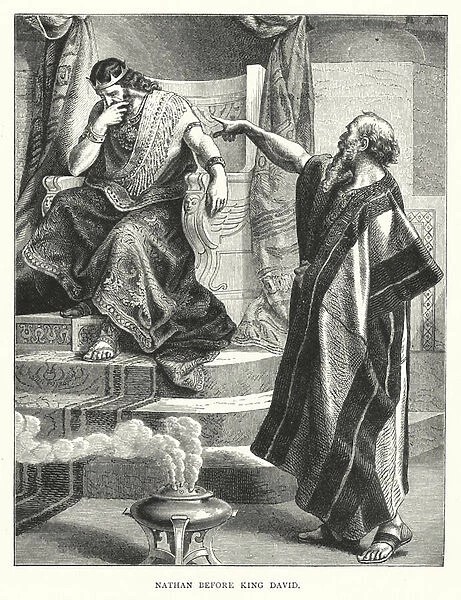
So Nathan goes to David,  and Nathan tells him a little story: he tells him a parable about a poor man and a rich man who stole the poor man’s only lamb. And to his credit, David hasn’t completely lost his sense of right and wrong. David says, “As the Lord lives, the man who has done this deserves to die.”  So, David can see the moral failure in the story; he just can’t manage to see it in the mirror.

This gets me to one of the first observations I want to make about sin. Sin can act like a kind of moral cataract, obscuring our ability to clearly see our own situation and the nature of our actions. Like King David, self-delusion is one of my superpowers. And because of the nature of sin and its ability to blur our vision, from time to time we all need a prophet Nathan to help us see ourselves more clearly.

And Nathan shows David some of the consequences of what he’s done. He says because you’ve taken the life of Uriah and taken his wife, the sword will never leave your house. And God tells him, I will raise up trouble against you from within your own house. God says, you did these things in secret but I will do them openly. And David comes to realize that he has sinned.

So, I think this story teaches us a few other things about the nature of sin. First, we think we can control it, but we can’t. The outcome of sin is unpredictable. Sin operates sort of like the science of forensics. When the bullet enters the body, it enters through a tiny hole, but as it travels through cartilage and bone it flattens and spreads and the exit wound is much larger and jagged.

Secondly, there are two people who haven’t done anything wrong in this story: Uriah and the child of David and Bathsheba’s union. Both of them will die. It would be nice if the only people who suffered because of sin were the guilty, but that’s not the way this world works. Sin has a gravitational pull and draws the innocent into it. Sin is unstable, and collateral damage is just part of its capricious nature.

Third, we hope that the harm done by our wrong will be comparable to the wrong done. Again, that’s magical thinking, an infantile hope. Because of sin’s unstable nature, the consequence of sin can sometimes be vastly disproportionate to the level of wrong done.

And the last observation I’ll make about sin comes from one of my favorite novels, The Great Gatsby. Fitzgerald wrote: “They were careless people, Tom and Daisy – they smashed up things and creatures and then retreated back into their money or their vast carelessness, or whatever it was that kept them together, and let other people clean up the mess they had made.” The point is this: in order to great harm, we don’t actually have to intend some evil plan; great harm and great suffering can result from our simple carelessness.

The more we understand about the nature of sin, the more perilous this world can seem, as though we were walking through a moral minefield, with nowhere safe to step. But there is a place we can go. There is a balm in Gilead, and there is mercy, and it is plentiful. We can trust in the practice of confession and absolution. We can turn to the Nathans in our lives, perhaps our confessors, perhaps our spiritual directors, perhaps a priest or a close friend. We can find all those right here at St. Mark’s Episcolopolus Church. And in a few moments, we can come to this altar, to take a bit of Jesus into our lives, maybe lay down some of our burdens there. And in that sacrament of repentance and forgiveness and renewal, we can start over again. Amen.

James R. Dennis, O.P. © 2024

The Unjust Judge

In that city there was a widow who kept coming to him and saying, `Grant me justice against my opponent.’ Luke 18. (The full readings for this morning can be found here.)

In the name of the Living God, who is creating, redeeming, and sustaining us.  Well, good morning, good morning. It’s good to be with you again here at St. Michael’s. And many thanks to Brynn and all of you for your generous hospitality.

So, this morning in the lectionary, the Church offers us this story which is sometimes called the parable of the unjust judge. And this passage of the Gospel reminds me of one of my favorite stories about the religious life. Several years ago, there was a young woman who became a nun. And she made her vows and entered the convent. Now the rules of this particular Order required that she be cloistered and keep silence, although every ten years the sisters were allowed to say two words. So, for the first ten years, she was assigned to make the beds. And she changed the sheets, and washed them,  and made every bed throughout the monastery. And at the end of that ten years, she went to the Mother Superior and said, “Bed hard.” Well, the next ten years, she was assigned to the kitchen. And she peeled the potatoes and cooked the oatmeal and cleaned every pot in that monastery. And at the end of that ten years, she went to the Mother Superior and told her, “Kitchen hot.”

After ten long years she was next assigned to clean the bathrooms. And she washed every sink and bathtub and scrubbed every toilet they had. And at the end of that ten years, she went to the Mother Superior and said, “I quit.” And the elder nun looked at her and said, “Good. You haven’t done anything but nag me since you got here.” Contrary to that story, and today’s gospel, I don’t think prayer has much to do with nagging God.

And we may be a little confused by this parable, or by many of them. The Hebrew word for parable is mashal, which carries with it connotations of a story, or an allegory, or a riddle. And many of these parables may leave us scratching our heads, including the one this morning, but that’s their function. They’re kind of like a picture frame that is intentionally hung so that it’s not level, so that we’ll have to really think about and puzzle over what’s portrayed. These parables are meant to make us think, to examine, and to turn an idea over in our minds until we come to a deeper understanding of it. And the broader question that I think Luke wants us to look at is how do we think prayer operates, and what does faithful living look like in a fallen world?

So, let’s take a deeper look at this parable and see what it offers us. Jesus begins his story: “In a certain city there was a judge who neither feared God nor had respect for people.” Oh, I’ve been to that city. And I’m pretty sure that I know that judge. I was a lawyer for a very long time, and on more than one occasion, I ran across that judge who did not fear God nor respect people. And without revealing too much about this judge, I can tell you that the county seat is Beaumont. Now, I should have known there was going to be a problem because in French the name Beaumont means “beautiful mountain.”  Have y’all ever been to Jefferson County? Well, it’s not beautiful, and there’s no mountain.

Seriously, if you’ve ever met someone like that—someone who doesn’t fear God and doesn’t respect people—you know how truly frightening a person that is. And I don’t think for a moment, Jesus is trying to tell us that God is like that. The God we worship loved and respected humanity, embraced all sorts of people, prayed regularly, and his blood watered the hill we call Golgotha. I want to circle back to the contrast between God and this unjust judge in just a moment, but first let’s look at one of the other characters in the story.

When we examine the widow in this parable, we remember the biblical direction about taking care of widows because in that world they were fragile and vulnerable. And yet this widow doesn’t seem vulnerable at all. She constantly goes to the unjust judge asking for justice against her opponent. Some translators tell us the better translation is “give me revenge.” And we might re-think our notion of her as fragile when we realize that the judge is actually being worn out by this woman.

So, is Jesus actually telling us that the real secret to a rich prayer life is becoming a bother to God, pestering the Almighty until He just gives in? Somehow, I don’t think that’s the point, especially since Jesus is on the receiving end of so many of our prayers. Now, there are some folks, and a few preachers, who will tell you that if you close your eyes real hard, and give money to the church, and believe just right, God will give you anything you ask for—as if the Almighty were some sort of a cross between a celestial ATM and a divine Santa Claus. We have a name for that sort of theology. We call it “heresy.”

I think Jesus is talking to us about two things. First, he’s telling us not to lose heart. And it’s so easy in this world to lose heart. There are unjust judges everywhere. Our political discourse has been reduced to the snarkiest common denominator. And in our prayer life, help never seems to come as quickly as we’d like, if it comes at all. And if we view prayer as a transaction, we might lose heart all the more quickly.  I don’t think our prayer life is like a Vegas slot machine, where if we just keeping putting in enough tokens, we’ll hit the jackpot.

            I do think, however, it’s like another bible story, one we didn’t hear today but I’ll bet you know it. I think our prayer life is a lot like the story of Jacob. And you’ll remember that Jacob was trying to come back home, knowing that his brother Esau was furious with him and he’s worried that his brother is coming to kill him. And that night a man comes to Jacob and wrestles with him. And the scripture is unclear about whether Jacob is wrestling with a man, or an angel, or with God himself. The two of them wrestle all night.  And although in the struggle Jacob’s hip is thrown out of joint, he tells his opponent, “I will not let you go unless you bless me.”

Our prayer life is like holding onto God, struggling with God all night, even when we are injured in the struggle. It is a stubborn insistence on a blessing, oftentimes a blessing we do not yet understand. As Saint Paul says, we train ourselves to be persistent whether the time is favorable or unfavorable. We will wrestle all night, holding on for that blessing. We will lift up our eyes to the hills, knowing that our help can only come from the Lord. And if we remain obstinate, if we stubbornly cling to God even when our strength is failing, the Son of Man will return to find that we are a faithful people. Amen.

James R. Dennis, O.P. © 2022

How Can These Things Be?

The full readings for this Sunday can be found here.

“The wind blows where it chooses, and you hear the sound of it, but you do not know where it comes from or where it goes. So it is with everyone who is born of the Spirit.”

In the name of the Living God: Father, Son and Holy Spirit.

          Back in 1975, my parents packed me up and loaded me onto an airplane bound for Lacombe, Louisiana. There, I would attend a minor seminary, which was a kind of a prep school for young men who wanted to become priests.  In addition to the regular courses, we would study Latin and theology. And we went to Mass every day.

          While I was there, I became close with three young men: Steve Delacroix, who taught me the benefits of being a rogue; Gerard Lascaux, who taught me how to play poker; and Jariet Randall, a young African-American man who taught me a great deal about courage.

          Well, every now and then, the four of us would sneak off from the seminary into the Louisiana night and go through the woods into the town of Lacombe. There was an old swimming pool there where the girls from town would go, and we would meet them for what my friend Gerard Lascaux called “general mischief.”

          So this one night, we snuck out of the dorm and went walking towards town, and it was way past dark-thirty. And I observed that if the priests caught us sneaking out, we would be in real trouble. And my friend Steve Delacroix said, “Oh no, chère.  They won’t be upset, cause we’re doing this for their benefit.” Well, I looked at him and said, “Delacroix, how do you figure we are doing this for their benefit?”

          Well, Steve, he looked at me and said, “You see, we’re living such holy lives here at the seminary that if we didn’t sneak out every now and then, we wouldn’t have no sins to confess, and the priests wouldn’t have nothing to forgive.”

          Well, it turns out that my friend Delacroix had misjudged the priests’ attitude about our late night adventures, and they weren’t nearly as grateful as we thought they might be.

          So, in today’s Gospel, we hear about another fellow who has been sneaking around at night, albeit for reasons somewhat more noble than were mine and my friends’.

          We meet this man Nicodemus, a leader of the Jewish people, who Jesus calls “the teacher of Israel.” He comes to Jesus as one of the stewards of the religious traditions of his people. Now the Evangelist John is a very fine poet, and when he says Nicodemus came to Jesus by night, we need to recognize that John’s not just talking about events that took place after sunset. John means that Nicodemus was walking in a spiritual darkness. And he comes to Jesus at night, in secret.

          Now Nicodemus was a Pharisee, and he had inherited a rich, long tradition and had devoted his life to it. And yet, he was drawn to this man Jesus, drawn to the signs he has seen, drawn to the miracles, and drawn to the clear presence of God in Jesus’ life.

          And then, their conversation takes a very strange turn. Jesus tells Nicodemus that he must be born from above if he wants to see the kingdom. Now this is a moment that transcends Nicodemus’ initial curiosity. This is not just a minor adjustment in Nicodemus’ ideas about God. This is a completely new way of being, which will require Nicodemus to let go of most everything he thinks he understands.

          And understandably, Nicodemus is confused. He doesn’t get it; he takes Jesus literally. He wonders how an old man is supposed to be born again, to go back to the womb. And Jesus’ response doesn’t necessarily clear that confusion up. He tells Nicodemus that what is born of flesh is flesh and what is born of spirit is spirit. In essence, Jesus tells him, you’ve got to be born all over again; you’ve got to start from the very beginning.

          Jesus tells him that Spirit goes where it will; we don’t know where it comes from and we don’t know where it’s going. A life in the spirit of God, a life like that of Jesus, isn’t neat or calculable or predictable. The Spirit is holy and wild and unrestrained. Jesus is telling Nicodemus that God will not remain in the box that we try to keep God in.

          And Nicodemus doesn’t understand. He is confused. He reveals his amazement when he says, “How can these things be?” There is a certain terror in his confusion. Because like every birth, being born in the spirit will involve a certain amount of pain as well as some chaos. But there is a certain grace in that bewilderment.

          God will not stay inside the box of our comprehension. As a friend noted, “God, as I understand Him, is not well understood.” Or, to paraphrase the great physicist Werner Heisenberg, Not only is God stranger than we think, God is stranger than we have the capacity to think.

          We all like our mountaintop experiences. We love those moments when we think we can grasp God, or the movement of God in our lives. But those aren’t the moments where growth happens. Spiritual growth arises more often from moments when we say, “I don’t understand this at all” or “What is this happening here?” or “How can these things be?” If we want to follow Jesus, really follow Jesus, we need to become comfortable with being uncomfortable.

          We might call these moments of “holy confusion.” In times like these, God draws us closer. God calls us to change. God calls us into something completely new. In such moments, we feel like the rest of our lives don’t make sense anymore. We feel like new people; we feel reborn.

          One of my favorite theologians is a rabbi named Abraham Joshua Heschel, who prayed that God would give him the gift of wonder. He once said “Our goal should be to live life in radical amazement. . . . to get up in the morning and look at the world in a way that takes nothing for granted. Everything is phenomenal; everything is incredible; never treat life casually. To be spiritual is to be amazed.” As Heschel knew, we are far closer to God when we are asking questions than when we are convinced of our answers.

          But we know a few more things about Nicodemus. We know that at the trial of Jesus, he was the only person who stood up for Christ. Nicodemus, who had initially come to Jesus in secret, spoke up for him in public. And we know that when Jesus was crucified, it was Nicodemus (along with Joseph of Aramethea) who took the body to be buried and anointed it. Somehow, the encounter with this man Jesus changed Nicodemus.

          And we want to know more, we want to know what happened to him. But I think that John’s Gospel intentionally leaves that story unfinished. Our story, too, is unfinished. But God wants to make something new of us; God draws us into a holy vortex where God is making all things new again.

          For Nicodemus, like many of us, faith had become a beautiful heirloom rather than a living fountain from which we drink and are refreshed. You see, I don’t think we need a little more God in our lives. I think we need to be born from above, into the life of God. Every now and then, if we’re really lucky, God will shake us to our core.

          And in this holy season of Lent, it’s my prayer that we all walk through a bit of that night, a bit of holy confusion. As we approach the nightfall of Holy Week, it is my prayer that we find ourselves wondering at the meaning of the Cross and Golgotha, awestruck by the mystery of God.

          If we do, we may find that we, too, have been reborn and we are a new creation. Let it be, Lord. Amen.

James R. Dennis, O.P. © 2017


Teach Us to Pray

a

The full readings for today can be found here:
He was praying in a certain place, and after he had finished, one of his disciples said to him, ‘Lord, teach us to pray….”

In the name of the Living God: Father, Son and Holy Spirit.

Good morning, good morning. It’s good to be back with you at St. Paul’s.

You know, there’s an old family legend among my kinfolk about my great-grandfather, an Irishman who lived in Boston. One day, he had an appointment with the Bishop, and he was frantically running late. Well, he couldn’t find a parking spot, and so he lifted his eyes to heaven and spoke: “Lord, you know I need to speak with the good bishop. If you will find me a parking space, I promise that I will go to Mass every day for the rest of the year.”

Well, miraculously, the clouds parted on this dreary day, and bathed in a beam of glowing sunlight a parking space opened up right in front of the cathedral and my great-grandfather looked up to the heavens and said, “Never mind, Lord. I found it myself.”

So, today’s Gospel reading centers around prayer, and prayer for many of us is a bewildering thing. Sometimes, our prayer tumbles out so easily, as the need pours out of us and into God. Sometimes we stutter and stammer, lost in a wilderness of inarticulate mumbles. And sometimes, our prayers are nothing more than groans and silence. Sometimes, I think my best prayers are the simplest: I tell God “Help!” Or I simply say “Thank you.” And sometimes, there just aren’t any words for what I want to say. I just want to be, to abide in presence of the God who said I Am.

I know a lot more about what prayer is not than what it is. I don’t think God is some sort of sacramental concierge or holy genie who will give us three wishes. I don’t think prayer has much to do with making all our dreams come true, at least not in the way many people understand it. I suspect there’s not a one of you who’s not had a prayer go unheeded, and worried that it might have gone unheard.

And yet, the Gospel tells us, “Ask, and it will be given you; search, and you will find; knock, and the door will be opened for you. For everyone who asks receives, and everyone who searches finds, and for everyone who knocks, the door will be opened.” What are we to make of this?

Well, I think we get a hint of that in the way Jesus teaches the disciples to pray. I think this whole reading is teaching us something about the idea of the Kingdom of God. It’s worth noting that when the disciples ask Jesus how they should pray, the first thing he tells them to pray for is the Kingdom of God. Now, maybe that’s just something he thought they needed because they were an oppressed people suffering under Roman occupation who were living a subsistence existence.

I mean, for people like that, the Kingdom of God looks pretty good.  But what about people like us? One of the bishops in the Anglican Communion, a bishop from Africa, once observed: “In America, you don’t need God. You have air conditioning.” And it’s true. In this country, we idolize those who stand on their own two feet, who pull themselves up by their own bootstraps.  We idolize the “self-made man.” And I use that word deliberately. We idolize them. We have made an idol of them.

I don’t like to go to God asking for things. It makes me feel like a beggar. And then, sometimes I think, that’s exactly why I need to pray. You see, everything I have comes from God, and I need the humility of prayer to recognize that. Because I was born on third base, and mostly I strut around like I just hit a triple. I am prone to the delusion of my adequacy, my self-reliance. I need prayer to teach me about my dependency on God for all good things. I need prayer to teach me that I am a beggar.

I don’t think there’s anything wrong with praying for the things we want or need, and I don’t think there’s anything too silly to take to God in prayer. I think all of our prayers, no matter how trivial or crude, involve what Evelyn Underhill called a “brush with Pentecost.” We who are fallen, we refugees from Paradise, have a chance to speak, anytime we want, with the Holy Trinity and to call Them into our lives. And it helps me to realize that while Jesus taught us to ask God for our daily bread, He also taught that He is the bread of life. And I think that whatever I pray for, in the final analysis, I end up with Jesus.

Many of us turn to God only when our lives seem out of control, when we are confronted by the violence of this world in places like Orlando, or Dallas, or Baton Rouge, or Munich, or Istanbul, or Kabul. Because then, everything seems out of control, at least beyond our control. So, maybe we do have a hint of what it felt like in first century Palestine, when the whole world seemed to have gone crazy.

Jesus told his disciples several things about prayer. The first of these is the story of the “friend at midnight” who comes knocking very late to borrow three loaves of bread. There are few things more troublesome than having a friend or being a friend. It doesn’t always happen when it’s convenient, and our friends rarely need us only when it’s convenient. I think Jesus is also telling us, and this is very good news, that it’s never too late to ask for God’s help. Prayer is an awkward thing. It is not always polite, nor can we put our prayers into some manageable cabinet or corner of our lives. Jesus counsels that we should turn to God when our hearts ache and we are in need.

Jesus then suggests we look at our relationship with God as we would look at a parent and a child. When our children ask for something, we don’t give them snakes or scorpions. Jesus reminds us, “If you then, who are evil, know how to give good gifts to your children, how much more will the heavenly Father give the Holy Spirit to those who ask him!” It is the Holy Spirit that compels us to pray for the coming of the Kingdom, for a time of justice and mercy and for a time of peace. And once we have prayed for it, we can join with the Spirit in working for it in a world where these things are needed desperately. Even when God does not bring us the things we ask for, God comes and brings along the Trinity, and that is enough.

You see, I don’t think that when the disciples asked Jesus to teach them to pray that they were asking for a set of specific words to say, or an incantation to be sure that God was listening. And I don’t think that’s what Jesus really gave them. I think they were wanting to know how to get their hearts in the right place, so that they could have the kind of profound relationship Jesus had with the Father. I think they wanted to know how to imitate their rabbi, so that their whole lives would become extended acts of prayer.

There’s a wonderful story about Michael Ramsey, the former Archbishop of Canterbury and one of the giants of the Anglican Church. Someone once asked Ramsey how long he prayed each day. Ramsey answered, “About five minutes. But it usually takes me about an hour to get there.” We have to be willing to take the time to allow our relationship with the living God to develop, to take the time to allow the noise of the world to die down. Only then, can we listen for the voice of the One God to emerge and to become the first voice we listen to in a world where it’s so rarely heard. Only then, can we join in bringing about the Kingdom which is to come. Only then, can our whole lives become a kind of prayer, a living icon of Christ in the world. Lord, teach us to pray.

Amen.

James R. Dennis, O.P.
© 2016

You Can’t Go Home Again

aThe full readings for today can be found here.


In the synagogue at Nazareth, Jesus read from the book of the prophet Isaiah, and began to say, “Today this scripture has been fulfilled in your hearing.” All spoke well of him and were amazed at the gracious words that came from his mouth. They said, “Is not this Joseph’s son?” He said to them, “Doubtless you will quote to me this proverb, ‘Doctor, cure yourself!’ And you will say, ‘Do here also in your hometown the things that we have heard you did at Capernaum.'” And he said, “Truly I tell you, no prophet is accepted in the prophet’s hometown. But the truth is, there were many widows in Israel in the time of Elijah, when the heaven was shut up three years and six months, and there was a severe famine over all the land; yet Elijah was sent to none of them except to a widow at Zarephath in Sidon. There were also many lepers in Israel in the time of the prophet Elisha, and none of them was cleansed except Naaman the Syrian.” When they heard this, all in the synagogue were filled with rage. They got up, drove him out of the town, and led him to the brow of the hill on which their town was built, so that they might hurl him off the cliff. But he passed through the midst of them and went on his way. Luke 4:21-30.

When they heard this, all in the synagogue were filled with rage. They got up, drove him out of the town, and led him to the brow of the hill on which their town was built, so that they might hurl him off the cliff. But he passed through the midst of them and went on his way.

 In the name of the Living God: Father, Son and Holy Spirit.

          Good morning, good morning. It’s a pleasure to be with you today, and I want to thank you for your warm hospitality these past few weeks. I’m going to tell you all something and some of you may find this a bit shocking. Think of it as my confession. Those of you who know me well may not find this surprising at all, but I’m not sure I have been saved. I’m not sure that accurately describes the situation at all.

          I’m going to tell y’all a story about me, back when I was just a wee little boy back in Odessa, Texas. My family raised me as an Irish Catholic and I attended kindergarten and first grade at a Catholic school. But when I was in the second grade, my folks decided I should go to the public school and I began attending Burnett Elementary School.

          And it was during the first week when I was there on the playground, at recess, when I was surrounded by a ring of my classmates.  And I’m pretty sure they were Baptists because I think most everyone in Odessa was. And my new friends began to interrogate me and asked, “Have you accepted Jesus Christ as your personal savior?” And I honestly don’t know where this answer came from because I was not a thoughtful child. There were a lot of words used to describe me in my childhood, but “thoughtful” is not one of them. But I looked at them and said, “Kind of. I don’t think he came just to save me. I think he came to save the whole world.” But I’ll circle back to that idea of salvation here in a bit.

          Speaking of hometowns, in today’s gospel we find Jesus back in his hometown, Nazareth. Now, Nazareth wasn’t a particularly important place, and it was largely known as a poor region, a place populated by rabble rousers and troublemakers. So when folks there heard about the good things Jesus was doing in other cities, I’m sure they were full of expectations and curiosity, a little pride, and perhaps a little envy.

And Jesus stood up there in the synagogue and he reads from the scroll of the prophet Isaiah:

‘The Spirit of the Lord is upon me,
because he has anointed me
to bring good news to the poor.
He has sent me to proclaim release to the captives
and recovery of sight to the blind,
to let the oppressed go free,
to proclaim the year of the Lord’s favor.’

          And then, he tells them, “Today this has happened, and you’ve been here to hear it.” It’s a startling announcement: it’s shocking. And in the most clear expression we can find in the Gospels, Jesus makes the claim: “I’m him. I’m the Messiah you’ve all been waiting for.” And while the people are initially impressed, it doesn’t take long until they’re asking themselves, “Isn’t this Joseph’s son?”

          They’re suggesting: Wait a minute. We know this man, and there’s nothing particularly special about him, or perhaps they are alluding to his dubious parentage. I’ve got a feeling that Jesus knew this town, these people and their narrowness. Jesus had probably heard the whispers about his mother and her “virgin birth.” And these people were confident they knew all about Jesus. Of course, we know that familiarity breeds contempt. And that’s not unusual: we all get accustomed to thinking about people in a certain way. Neuropsychiatrists tell us that human thoughts and ideas travel along well-worn pathways in our brains. These people pretty sure they’ve got Jesus all figured out, and they also know what the Messiah should look like and this upstart . . . well, this isn’t him at all.

          And Jesus knows they want him to do the same stuff in his hometown that he did in Capernaum. You know, all that miracle stuff. As C.S. Lewis once observed, one of our great human weaknesses is to tell God “Encore! Do that again!” Because we want God to be predictable; we want a God we can do business with.

          But Jesus, he’s going to thwart their expectations. In essence, He tells them, “I didn’t come just for you people.” This is not what we’d call an “effective marketing strategy.” Jesus reminds them about Elijah, who was also rejected by His own people, and brought deliverance from sickness and hunger and death to a Gentile woman. He reminds them about Elisha, who cured the Gentile Naaman although there were plenty of lepers in Israel. This is a bitter pill to swallow; this is hard medicine for the hometown crowd, and the crowd has what modern doctors would call an “adverse reaction” to this medicine.

          Luke tells us they were filled with rage, and they ran him outside town and were going to throw him off a cliff, when Jesus somehow just slips away. And that seems a little strange, because it’s hard to get away from an angry mob. But maybe Luke is telling us that when we are full of self-assurance and when we’re filled with rage, it’s very hard to find Jesus.  Rage and fear and self-assurance act like God cataracts: we just can’t see God when we feel that way.

          Jesus is always upending the expectations of those who think they’ve got God figured out: they’ve got a God they understand, a God they can do business with. He does it again and again. It’s one of his character traits, and I think He got that from his Father. The minute we think we’ve got God all figured out, He up and does something we just didn’t see coming. And for those disappointments which prove to be our salvation, we should give thanks every day.

          So, I want to circle back to that concern I shared with you early on. I don’t think I can honestly say that I have been saved. I don’t think my salvation is my rear-view mirror. But I do think I’m being saved. My salvation began over two thousand years ago when God’s son was born into the stench and muck of a cow barn and walked and lived among us until he walked up that hill called Golgotha, the place of the skulls. I am being saved daily, working out my salvation with fear and trembling, through prayer, encounters with the Scriptures, the Sacraments, and the love of Christ’s body, the Church. And I believe I will be saved at the last day through God’s love and mercy: through the mercy of a God who, despite my best efforts, simply will not stay in any of the boxes I try to fit Him into. This, I believe, and this, I give thanks for. Amen.

James R. Dennis, O.P.
© 2016


Advent Study, Part I

My friends,

I’m leading an advent study for several weeks. If you’re interested, there are both audio files and PowerPoint slides associated with the class.

You’ll find the link below:

http://christianformation-dwtx.org/middle-content-block-middle/mary-the-mother-of-god-overview/mary-mother-of-god/

Wishing you all a good and holy Advent as we await the coming of the Christ child. God’s peace,

Br. Jamesa

What Do You Want Me To Do For You?

blind_bartimaeus_arminian_225h

This homily was preached at Chapter, the annual gathering of Anglican Dominicans, on Friday, August 14, 2015.

The text for this sermon can be found here:

In the name of the Living God: Father, Son and Holy Spirit.

Good morning, my brothers and sisters, good morning.  As the Psalmist says, how good it is when the brothers and sisters live together in unity. Well, close enough. And we come together this morning and find ourselves compelled to confront this text, this story of a blind man named Bartimaeus, a blind beggar. And I want us to try and view this story, and perhaps the readings today, in the light of our own vocations as Dominicans, our vocation as followers of St. Dominic and Jesus.

Jesus finds Bartimaeus  in Jericho, a city where walls come down, a city that resonates with the deliverance of Israel and the promises of God.  And all we know about Bartimaeus at the outset of the story is that he is blind, and he is a beggar. He is, as the Psalmist writes, “like an owl among the ruins.” But to be blind in those days didn’t just mean to be handicapped. Blindness was much more than an impediment. Blindness was a mark of being unclean, of being impure. Blindness meant that you would be ostracized from both God and his people.  So, blindness carried with it a spiritual separation as well as a physical impairment.

And Mark often uses blindness to connote a spiritual impairment, an inability to see what’s going on around you. He contrasts those who are physically blind with those who are blind to the reality of Jesus. And that’s a theme carried forward in this Gospel reading today.

It is much the same notion that we find in one of the Church’s favorite hymns, which tells the story of John Newton, a slave trader who awakened to his participation in the industry of sin and bondage. Newton wrote, “I once was lost, but now I’m found; I was blind, but now I see.”

Hold that thought for a moment, while we meander back through the readings for today and look at the story of St. Paul in Acts. Paul tells us that in his former life he was “zealous for God, just as all of you are today. I persecuted this Way up to the point of death by binding both men and women and putting them in prison….”  He tells us that on the way to Damascus to engage in further persecutions of the early Church, he was confronted by a great light and the voice of Christ accused him of persecuting Jesus.  And Paul was struck blind and could not see until Ananias spoke the word to him, because Paul had a special mission to see the Righteous One and bear witness. The confrontation with the light of Christ required Paul to set aside all that he thought he knew about God, joining those who trod the Way. So Paul, like John Newton, who had acted as an instrument of cruelty, bondage and spiritual blindness himself, found his way out of his own darkness only through the light of Christ.

So, let’s get back to the story of Bartimaeus the beggar sitting by the road. When he hears that Jesus is there, he begins to shout, “Jesus, Son of David, have mercy on me.” In his opening address, Bartimaeus recognizes Jesus as God’s Messiah. In some ways, Bartimaeus reminds me a bit of my spiritual director, a retired Bishop. He often says of his own ministry, “I’m  just a beggar myself, trying to show the other beggars where they keep the bread.” We don’t know how, but somehow Bartimaeus knew where the bread of life was.

If Jesus came to the world as part of God’s self-revelation, if he was God’s way of telling us “This is what I am like” then what do we make of the humble life He lived. This is a notion sometimes referred to as The Poverty of God. Bartimaeus could see the divine life in Jesus. But I think we should ask whether we can see the divine in the life of Bartimaeus. Because, as St. John Chrysostrom said, “If you cannot find God in the beggar on the street, you will never find him in the chalice.”

And Jesus asks him a really important question. He asks Bartimaeus “What do you want me to do for you?” Jesus was able to minister to this blind beggar because of two important factors: he cared, and he took the time to find out what the problem was. Too often, I think our fumbling efforts to fulfill the Christian life look like the missionary who shows up at a burning house with a stack of bibles, or the evangelist who goes to a land of famine with a handful of crucifixes. That’s all pretty, and interesting, but it’s not exactly what they need.

As Dominicans we are called to meet the needs of God’s world and God’s children, proclaiming and preaching the good news of God’s love. This world can be a very dark place. There are 60 million refugees in the world today, displaced by war and human hatred. In America alone, 5 million people suffer from Alzheimers. Worldwide, 3.5 million children die from hunger each year.  We daily confront the horror of war, of genocide, of one natural disaster after another. Joseph Stalin once famously said that one death was a tragedy, but a million deaths were a statistic. We live in a world where pain and misery have been reduced to a statistic.

And this world groans, not only in pain, but also in exhaustion. Many people, many good people, suffer from compassion fatigue. They just don’t feel up to the challenge of another crisis, another story of misery in a very long collection of such stories. And yet, there is this blind beggar on the road. Lord, let us see him.

I want to suggest to you that on that day in Jericho, it was Bartimaeus who heard the same call we have heard: to proclaim and preach the rightful place of Jesus in the world and in God’s kingdom. Lord, let us listen to his message. Lord, let us hear and heed the call, as Dominicans, to testify to the light in a world that wanders in darkness. Amen.

© 2015 James R. Dennis

Oh My Son Absalom

absalom

The readings for this morning can be found here:

“O my son Absalom, my son, my son Absalom! Would I had died instead of you, O Absalom, my son, my son!”

In the name of the Living God, Father, Son, and Holy Spirit.

          It was 49 years ago, almost to the day, back in my hometown of Odessa. It was my birthday, and my parents had given me a Gilbert chemistry set. (To this day, I still don’t know what they were thinking about.) And in that chemistry set was the formula for a certain explosive. But the chemicals were in little tiny plastic vials, and I knew I couldn’t do much with that. So I strolled down to the drugstore with my birthday money and I bought a pound of each of the ingredients of this compound.

          Then I walked into our kitchen and asked my mother if I could borrow one of her pots. When she asked what for, I answered: “a science experiment.” She beamed with pride as she handed me a copper-bottomed Revere ware pot. The effort to further my education was working. And I mixed the three chemicals together, and made a long fuse, and placed the pot underneath my tree house and sought shelter behind our home.

          Later that afternoon, after the fire trucks left, my father asked me, “Son, I just want to know what was on your mind?” And I tried to keep from crying as I told him that I didn’t know that it would work. Now, my father was a man with a great capacity for wrath. And he visibly shook as he tried to control himself and gave me a bit of advice, advice that he would repeat several times during my life. He said, “James, the process of elimination is no way to live your life.”

          Now, I was not in open revolt against my father…not yet. That would come years later, during the years my parents would refer to as “the intifada.” But I’m sure my father understood how David felt when his son took up arms against him.

          You know, sometimes, I hear people say that what’s wrong with this country, or this time, or this world is that we need to return to old-fashioned biblical family values. And I wonder whether they’re thinking about King David, and about his family, or exactly what they have on their minds.

But before we get to the text for this morning, it’s worth thinking about the back-story concerning King David. David was a young man when God called him out to succeed Saul, the first king of Israel. He was a shepherd, a good looking boy. He was a poet and a musician, and a fierce warrior who killed a giant named Goliath. He was the pride of the land and a just king who united the people of Israel. And when things were good, they were very good until….until they weren’t good anymore.

          You may recall that later on David committed adultery with a woman named Bathsheba, and then a whole bunch of trouble began. Bathsheba’s husband was a man named Uriah, one of David’s soldiers. And when Bathsheba got pregnant, you’ll remember that David sent Uriah into battle to be sure that he’d be killed so David could take Bathsheba for his wife.

I think one of the things we learn from this story is that sin works a little like the science of forensics, particularly bullet wounds. As the bullet enters the body, the wound is often small and sometimes almost imperceptible. But as it travels through our lives, it tears through bone and tissue and flattens, and the exit wound is often much, much larger. Sin works like that: we cannot imagine the consequences for ourselves or for those we love. It was like that with David.

          So God sent his prophet Nathan to have a chat with David. And Nathan told him the consequences of what he’d done. Nathan said, “the sword shall never depart from your house, for you have despised me, and have taken the wife of Uriah the Hittite to be your wife. Thus says the Lord: I will raise up trouble against you from within your own house….”

          Now that doesn’t end the family troubles for David. Not by a long shot. You see, his oldest son was a boy named Amnon.  Amnon raped his half-sister, a girl named Tamar. Her brother, Absalom, was David’s favorite son. But when David did nothing to punish Amnon, Absalom took matters into his own hands. He apparently believed in that old proverb that revenge is a dish best served cold, and he brooded and waited two years before setting a trap and having his servants kill Amnon at a feast.

          And after a few years in exile, and a few more years of a cold silence, Absalom lead a revolt against his father, against the King, against God’s chosen servant. So, as far as family values go, neither Paris Hilton, the Kennedys, the Jackson family, nor the Kardashians had anything on King David. Or, as Elvis Costello said, “There’s no such thing as an original sin.”

          The text this morning begins as David’s armies are prepared to smash the armies of his son, Absalom. And we hear tenderness in David’s voice as he asks his generals to deal gently with the man, Absalom. Now, notice that at this point, David calls him “the man” rather than “my son.” I suspect David felt a little conflict between his competing roles as king and father. I suspect that some of us here may have felt that conflict between our roles as father and salesman, or mother and doctor, or mother and priest. My friend Rabbi David Wolpe has observed that many times during this story of David and his son, we find not so much a lack of love as a refusal to love. Often David seems frozen, monstrous in his distance from his sons and daughters. He has riven an icy separation between himself and his children.

          And as the battle progresses, we find Absalom in a wooded area, in a forest, riding on a mule. And his head gets caught in the trees, and the text tells us that he was left hanging between heaven and earth. Hanging between heaven and earth. And every time I read that passage, I think of another son (this time, an obedient son) who also hung between heaven and earth. That son, our Lord Jesus, hung there not because of his rebellion, but because of ours.

          And then, despite David’s plea to the contrary, his soldiers surround Absalom and kill him. And when David hears of his son’s death, a death he had no small part in, he cries, “Oh my son, Absalom. Would that I could have died in your place.” Now, David had a complicated relationship with his favorite son. He sort of vacillated between spoiling him rotten and raking him over the coals. And the Bible tells us that Absalom was a beautiful boy, that he was “without blemish.” If we read scripture carefully, we’ll note that great beauty is almost always a bellwether of great trouble.

          You see, in one sense, I think we’re all Absalom. We’re all ungrateful children, all rebellious children. And in another sense, we’re all David. We’re all paralyzed by the consequences of our sins, watching them uncoil like snakes before us. We’re all frozen and withholding forgiveness, all demanding retribution rather than rushing toward reconciliation. This isn’t just the story of David and Absalom: this is our story.

          And David cries that if could have suffered these consequences instead of his son, he would gladly have done so. And there’s something deeply heartbreaking about that moment, when David should be celebrating his victory as king but is instead forced to confront his failure as a father, and as a man. I suspect every parent has felt that heartache. But David is telling us that he would have done this boy’s dying for him. But we know that even David, even a King, can’t do that.

          Only the living God can do that, dying for us, his son dying in our place so that we would live and have abundant life. It is that God who shows us a way out of rebellion, who rushes toward us in reconciliation. It is that God who calls us to “be kind to one another, tenderhearted, forgiving one another.” It is that God who calls to us, “Come to me.” It is that God who promises us that if we eat the bread of life, we will live forever. It is that God who invites us to this table. So take, and eat. Amen.

James R. Dennis, O.P.

© 2015 James R. Dennis