
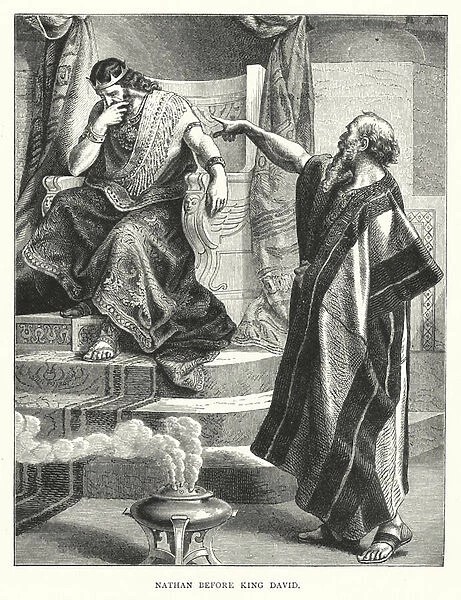
But the thing that David had done displeased the Lord, and the Lord sent Nathan to David. (The full readings for today can be found here.)
In the name of the Living God, who is creating, redeeming, and sustaining us. Good morning, good morning. Now, some of y’all know that my family came from out in West Texas, and that’s where I grew up. And y’all might find this surprising, but I was not always the saintly person you know today. No, I was not always the shining angelic light you see here on Sunday mornings. My misbehavior wasn’t usually all that serious: maybe I was cruel to my brothers, or acted selfishly, or took something that didn’t belong to me. And every now and then, the fire trucks would have to come to our house, but that’s another story.
So, when I would fall short of my parents’ expectations, my father would pull me aside and look me in the eyes and tell me, “Son, that’s not the cowboy way.” And without fail, I would crater. I would dwindle away and shrink to about 2 inches tall because I knew I had failed to live the way my family had lived for generations. And come to think about it, my father was not unlike one of the Old Testament prophets, not unlike Nathan in today’s story. And when my father had these little chats with me . . . well, I knew I had been prophesied to.
So, our reading today continues the story we began last week. So, maybe we ought to review just a bit. Our story began when David was king over Israel, in the springtime as scripture tells us, “when kings go out to battle.” But David, he didn’t go out to battle, and we’re not told why, but David let others fight his battles for him. David looked down from his roof and saw a beautiful woman bathing herself, and he wanted her. Even knowing she is the wife of one of his commanders, who is off fighting his battles for him, he wanted to have her.
And David took her, and lay with her and she became pregnant. And then, and this is hard to imagine, it gets worse. First, he tried to cover up his affair by bringing Uriah home from the war. When that didn’t work, he arranged to have Uriah killed in battle. And that gets us up to where our reading begins this morning. After arranging for her husband’s death, David brings Bathsheba into his house, marries her, and she gives birth to his child.
I know this is a shocking story and we are all clutching our collective pearls. Within about a month, David has managed to break almost every one of the Ten Commandments. I mean, a political figure, a religious leader, involved in a sexual scandal and then trying to cover it up? Thank heavens we don’t have to deal with that sort of thing anymore.
So, I want to stop there and do a bit of a theological reflection on this man, this king, David. We all remember the story of David killing the giant Goliath who had been mocking the armies of Israel. The very first words we hear out of David’s mouth in that story are: “What will you do for the man who kills this Philistine?” In other words, what exactly is in it for me? Then we have him engage in an affair with Bathsheba, and engage in all sorts of sordid behavior to try and cover it up, including what amounts to basically murder. Our Jewish brothers and sisters have a complicated theological term for this sort of person. They would tell us that David is acting like a schmuck, and they would be right.
So, our translation this morning tells us that the thing that David had done displeased the Lord. That translation sort of softens the original text; this is not exactly what the original Hebrew says. In Hebrew, the text reads that the thing David had done was evil in the in eyes of the Lord. And so, the Lord sends the prophet Nathan to speak to David, to tell him that he’s been acting like a schmuck, to tell him “that’s not the cowboy way.”
So Nathan goes to David, and Nathan tells him a little story: he tells him a parable about a poor man and a rich man who stole the poor man’s only lamb. And to his credit, David hasn’t completely lost his sense of right and wrong. David says, “As the Lord lives, the man who has done this deserves to die.” So, David can see the moral failure in the story; he just can’t manage to see it in the mirror.
This gets me to one of the first observations I want to make about sin. Sin can act like a kind of moral cataract, obscuring our ability to clearly see our own situation and the nature of our actions. Like King David, self-delusion is one of my superpowers. And because of the nature of sin and its ability to blur our vision, from time to time we all need a prophet Nathan to help us see ourselves more clearly.
And Nathan shows David some of the consequences of what he’s done. He says because you’ve taken the life of Uriah and taken his wife, the sword will never leave your house. And God tells him, I will raise up trouble against you from within your own house. God says, you did these things in secret but I will do them openly. And David comes to realize that he has sinned.
So, I think this story teaches us a few other things about the nature of sin. First, we think we can control it, but we can’t. The outcome of sin is unpredictable. Sin operates sort of like the science of forensics. When the bullet enters the body, it enters through a tiny hole, but as it travels through cartilage and bone it flattens and spreads and the exit wound is much larger and jagged.
Secondly, there are two people who haven’t done anything wrong in this story: Uriah and the child of David and Bathsheba’s union. Both of them will die. It would be nice if the only people who suffered because of sin were the guilty, but that’s not the way this world works. Sin has a gravitational pull and draws the innocent into it. Sin is unstable, and collateral damage is just part of its capricious nature.
Third, we hope that the harm done by our wrong will be comparable to the wrong done. Again, that’s magical thinking, an infantile hope. Because of sin’s unstable nature, the consequence of sin can sometimes be vastly disproportionate to the level of wrong done.
And the last observation I’ll make about sin comes from one of my favorite novels, The Great Gatsby. Fitzgerald wrote: “They were careless people, Tom and Daisy – they smashed up things and creatures and then retreated back into their money or their vast carelessness, or whatever it was that kept them together, and let other people clean up the mess they had made.” The point is this: in order to great harm, we don’t actually have to intend some evil plan; great harm and great suffering can result from our simple carelessness.
The more we understand about the nature of sin, the more perilous this world can seem, as though we were walking through a moral minefield, with nowhere safe to step. But there is a place we can go. There is a balm in Gilead, and there is mercy, and it is plentiful. We can trust in the practice of confession and absolution. We can turn to the Nathans in our lives, perhaps our confessors, perhaps our spiritual directors, perhaps a priest or a close friend. We can find all those right here at St. Mark’s Episcolopolus Church. And in a few moments, we can come to this altar, to take a bit of Jesus into our lives, maybe lay down some of our burdens there. And in that sacrament of repentance and forgiveness and renewal, we can start over again. Amen.
James R. Dennis, O.P. © 2024


 Domini Canes