
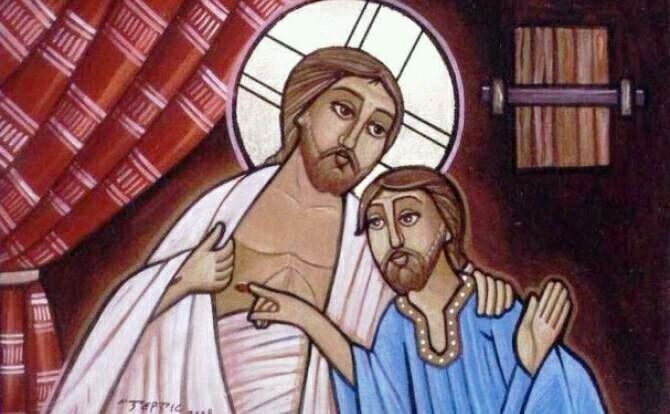
Then he said to Thomas, “Put your finger here and see my hands. Reach out your hand and put it in my side. Do not doubt but believe.” The full readings for this morning can be found here.) In the name of the living God, who is creating, redeeming, and sustaining us.
Well, good morning, everybody, good morning. As I was spending time with the readings for this week, and wondering what we might talk about this morning, I began to think about our wounds, our scars. Our scars are powerful reminders. They recall our history and tell others a bit of our story. They spark our memory, and we rarely forget the event that gave rise to our scars, whether it was a fall from a bunk bed, a bad bicycle accident, or that time your brother shot you (maybe accidentally) with his slingshot. Our scars shape our lives and remind us of our history.
So, a long time ago, I was a kid back in West Texas. I couldn’t have been any more than 6 or 7 years old, so you know it was back before the earth cooled and the dinosaurs died out. Anyway, I was with my father, and we were shopping for something. And I noticed the man behind the sales counter. His face was dreadfully scarred, and he must have been burned terribly. After we walked away, I looked up at my father and asked, “Dad, what happened to that man’s face?”
My father looked at me and said, “James, that man doesn’t have a thing in the world to be ashamed of. That man’s face is scarred because he found something worth fighting for. The man you need to feel sorry for is the man who doesn’t have any scars at all, because he never found anything worth fighting for.” But we’ll come back to that later.
So, when our gospel story for this morning opens, it’s the evening of Easter—the evening of the resurrection, the evening after the stone was rolled away and the tomb was discovered to be empty. And we find the disciples hiding behind locked doors. They are hiding because they’re terrified, they’re afraid of the same people who accused Jesus. But I think there’s another reason they’re hiding behind locked doors. I think they’re still trying to work through the shock and pain and trauma of their rabbi’s torture and death. And I think they’re desperately trying to understand the disappearance of Jesus’ body and the strange stories the women told them. And so, they lock the doors; they lock themselves in and lock themselves up.
I wonder how often we lock ourselves up, because we’re afraid, because we’re confused, because we’re grieving or struggling with trauma. There’s no end to the ways we get locked in—anger, resentment, disappointment, busyness, or the many ways we try to avoid that which hurts or requires us to change. It is our natural reaction, which doesn’t mean that it’s the reaction which gives us life or peace. So often, we lock the doors to keep the monsters out, only to find we’ve cornered ourselves in a place of dread and misery.
And then, once they’ve got all the doors locked and all the trouble shut out, who shows up but that Jesus guy? You know, he’s done that to me. I’m sitting there, raging about something, all locked up in anger or disappointment, and he walks in. Anyway, in the Gospel story, Jesus arrives and he offers them the same thing he offers us. He says, “Peace be with you.” Now, peace (or in the Hebrew “shalom”) meant more than just a ceasefire or a break in the battle. It meant wholeness, a mending of that which is broken, healing and restoration. And which of us couldn’t use a little of that?
So, Jesus says, “Peace be with you”, peace be upon you. Peace be upon you and all the broken parts of your life. Peace be upon your rage. Peace be with your stubborn refusal of forgiveness. Peace be with your shame. Peace be with us in our poverty of spirit. Peace be with you, James, John and Peter. Peace be with you Raymond and Sheryl and Ben. Peace be with you Martha, and Gillian, and Blanca and Mike.
He then breathes on them, which is to say he gives them his Spirit and empowers them to forgive sins. But there’s just one problem. Thomas wasn’t there with the others. Now, you can say what you will about Thomas, but he’s not sitting there with the other disciples cowering behind locked doors. And you may remember, just a couple of weeks ago, when Jesus said it was time to go back to Jerusalem, all the other disciples are worried that Jesus would be killed there. But Thomas, out of loyalty mixed with courage says, “Let us also go, that we may die with him.” So, there’s a lot more to Thomas than just his doubts.
As our story goes along, one week later, the disciples are still stuck in the house but this time Thomas is with them. Although they had told Thomas about Jesus’ earlier visit, Thomas didn’t believe them. This time, when Jesus appears, he invites Thomas to feel his wounds. In the great mystery of the Incarnation, Jesus became human and traveled with us through human history. As John said, “The Word became flesh and lived among us.” Well, the flesh of the resurrected Jesus still bears the scars and wounds of his entry into our history.
And then Thomas says something remarkable. I mean, it’s truly astonishing, and probably qualifies Thomas as our first Christian theologian. He says, “My Lord and my God!”
You see, as Thomas explores the physical evidence of Jesus’ torture with his hand, he recognizes the mystery of the Incarnation. Thomas isn’t just saying that God raised Jesus from the dead—he’s saying that Jesus is God. And it will take the Christian Church another three hundred years to catch up with Thomas in the Nicene Creed which we’ll say together in just a bit.
Like many of us, Jesus’ time on this earth left him with wounds, left him with scars. But if you’ll think back to my earlier story about my father, Jesus’ scars teach us something. You see, as Jesus entered into human history, as he walked this world with us, he found something worth fighting for. What he found was you and me. Jesus thought we are worth fighting for, in fact worth dying for. And you’d best be believin’ me, that’s some good news. Amen.
James R. Dennis, O.P. © 2025

 Domini Canes